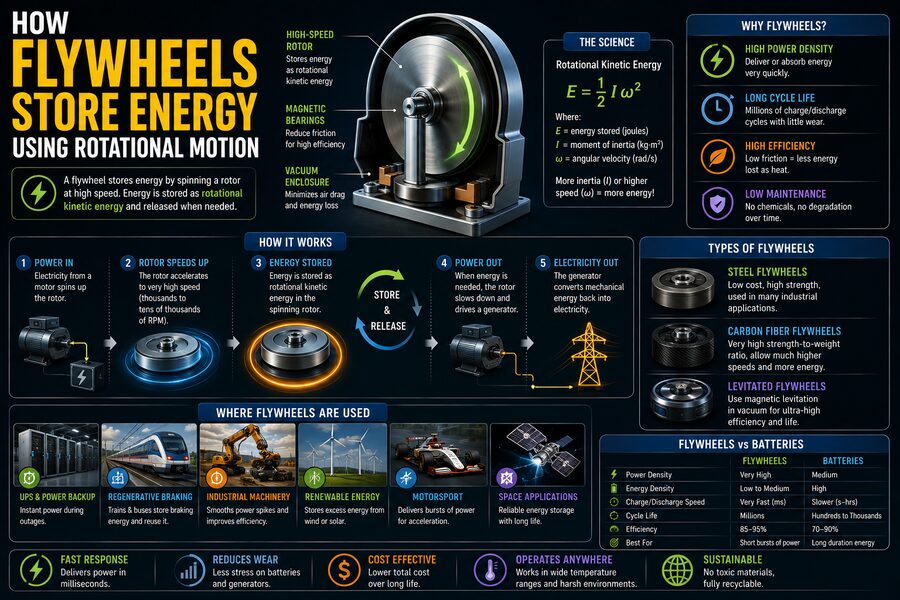

Most energy-storage technologies are easy to picture. A battery stores energy chemically. A reservoir stores gravitational potential energy by holding water at a height. A compressed-air system stores energy by pressurizing gas.
A flywheel, however, stores energy in a very different way: by making a heavy rotor spin extremely fast. 🔄⚡
Instead of storing electricity directly, a flywheel converts electrical energy into rotational kinetic energy. When energy is needed later, the spinning rotor drives a generator and converts that mechanical energy back into electricity.
This makes flywheels useful for applications that require:
- Very fast charging
- Very fast discharging
- High power output
- Frequent cycling
- Short-duration energy storage
- Grid stabilization
- Backup power
The underlying physics is elegant: the faster and more efficiently something can spin, the more energy it can store.
🌀 What Is a Flywheel?
A flywheel is essentially a rotating mass designed to store kinetic energy.
A simple example is a heavy wheel attached to a shaft.
When a motor spins the wheel, energy is transferred into the rotor.
If the motor stops providing power, the flywheel keeps rotating because of its inertia.
That continued rotation represents stored energy.
Later, the spinning flywheel can transfer energy back through the shaft.
This principle has been used for centuries in mechanical machinery.
Traditional flywheels helped smooth the motion of steam engines, presses, and combustion engines.
Modern flywheel energy-storage systems take the same principle much further by using advanced materials, magnetic bearings, vacuum chambers, power electronics, and high-speed electric machines. ⚙️
🔋 How a Flywheel Stores Energy
The energy stored in a rotating flywheel is given by:
E = ½Iω²
where:
E= rotational kinetic energyI= moment of inertiaω= angular velocity
This equation reveals two important ways to store more energy.
You can increase the flywheel’s moment of inertia, which generally means changing its mass or how that mass is distributed.
Or you can increase its rotational speed.
The second option is especially powerful because angular velocity is squared.
If the rotational speed doubles, the stored rotational energy can increase by a factor of four, assuming the moment of inertia stays the same. 🚀
That is one reason modern flywheels are designed to spin at extremely high speeds.
🧠 What Is Moment of Inertia?
Moment of inertia is rotational motion’s equivalent of mass in straight-line motion.
An object with a large moment of inertia resists changes in rotational speed.
Where the mass is located matters.
Mass positioned farther from the axis contributes more strongly to the moment of inertia.
Imagine two wheels with the same total mass.
One has most of its material near the center.
The other concentrates more mass toward the rim.
The second wheel generally has a greater moment of inertia.
That means it can store more rotational energy at the same angular speed.
Traditional flywheels often took advantage of this by using heavy rims.
Modern high-speed flywheels, however, must balance energy storage against material stress.
⚡ Charging a Flywheel
Charging a flywheel means making it spin faster.
An electric motor is connected to the flywheel’s shaft or rotor.
When electricity is available, the motor converts electrical energy into mechanical rotation.
The sequence is:
Electricity → Motor → Faster rotation → Stored kinetic energy
As more energy enters the system, the flywheel’s rotational speed increases.
If a renewable energy source such as a solar array produces a brief surplus, that electricity can be used to accelerate the rotor.
No chemical reaction is required.
The storage process is purely mechanical and electromagnetic. 🔄
🔌 Discharging a Flywheel
When energy is needed, the process reverses.
The spinning rotor drives the same electrical machine as a generator, or a separate generator depending on the design.
The sequence becomes:
Stored rotation → Generator → Electricity
As the flywheel supplies energy, it slows down.
The rotor is not usually allowed to stop completely.
Instead, the control system operates it between a maximum and minimum safe rotational speed.
The usable energy is the difference between the energy stored at those two speeds.
🚀 Why Flywheels Can Deliver Power So Quickly
One of the greatest strengths of flywheel storage is power response.
A chemical battery may require electrochemical reactions to move energy.
A flywheel already has a large amount of mechanical energy available in a spinning rotor.
Power electronics can rapidly change the electrical machine from motor operation to generator operation.
As a result, flywheel systems can respond in fractions of a second.
That makes them valuable for situations where electrical power suddenly drops or demand changes rapidly.
For example, a flywheel can inject power almost immediately after detecting a grid disturbance.
⏱️ Power and Energy Are Not the Same Thing
Flywheels are often excellent at delivering high power, but that does not necessarily mean they store enormous amounts of energy.
This distinction is important.
Power measures how quickly energy is delivered.
Energy measures how much total work can be delivered.
A flywheel might provide several megawatts for a short period.
A large battery could potentially provide less peak power but continue supplying energy much longer.
Flywheels are therefore especially attractive for applications requiring seconds or minutes of intense power rather than many hours of energy storage.
🧲 Why Bearings Matter
A spinning rotor normally loses energy through friction at its bearings.
If a flywheel used ordinary high-friction bearings, it would gradually slow even if no electricity were being drawn from it.
Modern systems reduce this problem through advanced bearing designs.
Some use magnetic bearings.
Instead of allowing the rotor to rest entirely on conventional mechanical contact points, magnetic forces help support it.
Reducing physical contact reduces friction and wear.
This allows the rotor to keep spinning efficiently for longer periods. 🧲
🌌 Why Flywheels Often Spin in a Vacuum
Even if bearing friction is reduced, a rapidly spinning rotor can lose large amounts of energy by pushing through air.
Air resistance creates drag.
At extremely high rotational speeds, that drag can become substantial.
Many modern flywheel systems therefore place the rotor inside a vacuum enclosure.
Removing most of the air dramatically reduces aerodynamic resistance.
This improves efficiency and allows the rotor to maintain high speed with lower standby losses.
A vacuum chamber therefore plays a critical role in high-performance flywheel storage.
🧱 What Are Flywheels Made Of?
Traditional flywheels were commonly made from steel or cast iron.
Modern high-speed flywheels may use advanced steel alloys or composite materials, including carbon-fiber-based structures.
The choice of material is extremely important.
A fast-spinning rotor experiences enormous internal stresses.
The material must withstand the outward forces created by rotation.
Composite materials can be attractive because of their high strength-to-weight ratio.
They can sometimes tolerate much higher rim speeds than conventional metals.
💥 Why Rotational Stress Becomes a Design Limit
As the flywheel spins faster, every part of the rotor experiences forces trying to pull it outward.
These internal stresses increase dramatically with speed.
If the rotor exceeds its material limits, it could fail catastrophically.
That is why engineers cannot simply keep increasing RPM indefinitely.
The maximum operating speed depends on:
- Material strength
- Rotor geometry
- Manufacturing quality
- Temperature
- Safety margins
Modern flywheel systems are designed with substantial containment and monitoring because a high-speed rotor stores significant mechanical energy.
🛡️ Containment Is a Critical Safety Feature
A high-speed flywheel is typically surrounded by a strong protective enclosure.
If part of the rotor were ever to fail, the containment system is intended to limit the release of debris and energy.
Engineers may use:
- Thick structural housings
- Composite containment
- Steel barriers
- Underground installation
- Remote equipment rooms
Rotor imbalance is also monitored carefully.
Even a small asymmetry can produce substantial vibration when a rotor is spinning at thousands or tens of thousands of revolutions per minute.
Safety therefore depends on both structural strength and precise control.
⚖️ Balancing a Flywheel
A perfectly balanced rotor rotates smoothly around its axis.
If one side is slightly heavier, the rotor generates periodic forces.
At low speed, the vibration may be small.
At very high speed, it can become severe.
High-performance flywheels therefore require extremely precise manufacturing and balancing.
Sensors can monitor vibration during operation.
If abnormal behavior appears, control systems may reduce speed or shut the system down.
This is similar to balancing a car wheel—but at far higher rotational speeds and energy levels.
🔄 Flywheels Can Cycle Many Times
One of the greatest advantages of flywheel energy storage is cycle life.
A battery slowly degrades as chemical reactions repeatedly occur.
A flywheel stores energy mechanically.
As long as bearings, vacuum systems, electronics, and rotor components remain healthy, it can tolerate an enormous number of charge-discharge cycles.
Some flywheel systems are designed for hundreds of thousands or even millions of cycles.
This makes them attractive when power must be charged and discharged repeatedly throughout the day.
🔋 Flywheels vs. Batteries
Flywheels and batteries both store energy, but their characteristics differ.
Flywheels typically excel at:
- High power
- Rapid response
- Frequent cycling
- Long cycle life
- Short-duration storage
Batteries often excel at:
- Higher energy density
- Longer-duration storage
- Lower self-discharge
- Compact energy storage
The technologies are therefore not always competitors.
They can complement one another.
A flywheel may handle rapid fluctuations while a battery supplies longer-duration energy.
📉 What Is Self-Discharge?
A flywheel does not retain energy forever.
Even with magnetic bearings and a vacuum chamber, some losses remain.
Energy can be lost through:
- Bearing losses
- Motor-generator losses
- Power electronics
- Magnetic losses
- Vacuum-system loads
As a result, the rotor gradually slows.
This is sometimes described as self-discharge.
For long-term energy storage over days or weeks, flywheels are generally less suitable than technologies with lower standby losses.
Their strength lies in frequent, short-duration cycling.
⚡ Flywheels for Grid Frequency Regulation
Power grids need generation and consumption to remain balanced continuously.
If demand suddenly exceeds generation, grid frequency can begin to fall.
If generation becomes excessive, frequency can rise.
Flywheels are very useful for frequency regulation because they can rapidly absorb or release power.
If grid frequency rises slightly, flywheels can consume electricity and accelerate.
If frequency falls, they can generate electricity and slow down.
Because this response can happen extremely quickly, flywheels can help stabilize the grid. 🌐
🌬️ Supporting Renewable Energy
Wind and solar generation can change rapidly.
A cloud passing over a solar farm may reduce output.
Wind speed can fluctuate from minute to minute.
Flywheels can help smooth these short-term variations.
When renewable output suddenly rises:
Excess electricity → Flywheel accelerates
When output suddenly falls:
Flywheel slows → Electricity returned to grid
Flywheels are not usually intended to store an entire night’s worth of solar energy.
Instead, they can help bridge short fluctuations and improve power quality.
🏢 Flywheels in Data Centers
Data centers require extremely reliable electricity.
Even a brief power interruption can disrupt servers.
Uninterruptible power supplies, or UPS systems, are therefore essential.
Some UPS designs use flywheels.
During normal operation, the flywheel remains spinning.
If utility power suddenly fails, the flywheel immediately begins supplying electricity.
This can bridge the short interval until backup generators start.
Because generators often need several seconds to reach operating speed, a flywheel can provide valuable ride-through power during that transition. 💻⚡
🏥 Critical Facilities Can Use Flywheel Backup
The same concept can apply to facilities such as:
- Hospitals
- Telecommunications centers
- Industrial plants
- Transportation systems
Sensitive equipment may not tolerate even a fraction of a second without stable electricity.
A flywheel can act as a fast buffer between the grid and backup generation.
Its rapid response is often more important than storing energy for a very long period.
🚆 Regenerative Braking and Transportation
Flywheels can also capture energy from braking.
When a vehicle slows down, kinetic energy normally becomes heat in the brakes.
A regenerative system can redirect some of that energy into storage.
With a flywheel:
Vehicle slows → Energy spins flywheel faster
Later:
Flywheel slows → Energy helps accelerate vehicle
This concept has been explored or used in buses, rail systems, racing vehicles, and industrial transportation applications. 🚆
🏎️ Flywheels in Motorsport
Motorsport has experimented with mechanical and electromechanical flywheel energy-recovery systems.
During braking, energy that would otherwise be lost as heat can accelerate a flywheel.
During acceleration, that energy can be returned.
The advantage is extremely fast charging and discharging.
However, packaging, weight, gyroscopic effects, safety, and system complexity must all be managed carefully.
🌀 What Are Gyroscopic Effects?
A rapidly spinning rotor resists changes in its rotational axis.
This is called a gyroscopic effect.
If a high-speed flywheel is installed in a moving vehicle, turning or tilting the vehicle can create additional forces.
Engineers can reduce these effects through orientation or by using two flywheels rotating in opposite directions.
Counter-rotating rotors can cancel much of the net angular momentum.
This is less important in stationary grid installations but can matter greatly in mobile systems.
🏭 Industrial Machines Have Used Flywheels for Generations
Long before modern electrical storage systems, factories used flywheels to smooth mechanical power.
Imagine a press that requires a huge burst of energy during one brief part of its cycle.
Instead of building a motor large enough to supply peak power continuously, a smaller motor can gradually accelerate a flywheel.
Then, when the press needs energy:
Flywheel slows → releases a burst of mechanical power
Afterward, the motor accelerates it again.
This principle remains useful in industrial machinery.
🔨 Mechanical Energy Buffering
A flywheel essentially works as a buffer between uneven energy supply and uneven energy demand.
Suppose a machine’s power requirement looks like:
Low → Low → Very High → Low → Low
Instead of sizing the entire electrical system for the brief peak, the flywheel can accumulate energy during low-demand periods and release it during the peak.
This can reduce power fluctuations and electrical infrastructure requirements.
🧮 A Simple Energy Example
Imagine a flywheel with a moment of inertia of:
100 kg·m²
spinning at an angular velocity of:
200 radians per second
Its rotational kinetic energy is:
E = ½Iω²
So:
E = ½ × 100 × 200²
E = 2,000,000 joules
That equals:
2 megajoules
If the angular speed were doubled to 400 radians per second:
E = ½ × 100 × 400²
E = 8,000,000 joules
The speed doubled, but the stored energy quadrupled.
This illustrates why high-speed rotors are so attractive. 📈
⏳ Why Usable Energy Depends on Speed Range
A flywheel normally operates between maximum and minimum speeds.
Suppose its maximum speed corresponds to:
10 MJ
of stored rotational energy.
At minimum operating speed, it may still contain:
4 MJ
of energy.
The usable amount is:
10 MJ − 4 MJ = 6 MJ
Engineers therefore design control systems around the usable speed range rather than assuming the rotor will discharge all the way to zero RPM.
🎛️ Power Electronics Connect the Flywheel to the Grid
A flywheel’s motor-generator does not necessarily produce electricity in exactly the voltage and frequency required by the grid.
Power-electronic converters manage the interface.
They can control:
- Charging rate
- Discharging rate
- Voltage
- Current
- Grid synchronization
- Reactive power in some designs
This allows the flywheel to respond almost instantly to control commands.
Modern flywheel storage is therefore a combination of mechanical engineering and power electronics.
🤖 Control Systems Continuously Monitor the Rotor
A modern flywheel system may continuously monitor:
- Rotational speed
- Bearing position
- Vacuum level
- Temperature
- Vibration
- Motor current
- Converter status
The control computer can adjust magnetic bearings or charging power in real time.
If abnormal conditions develop, the system can reduce speed or initiate a controlled shutdown.
This monitoring is essential because of the extremely high mechanical energy stored in the rotor.
📦 Energy Density Is a Challenge
One limitation of flywheels is energy density.
Storing large amounts of energy may require substantial rotor mass, very high rotational speed, or both.
Batteries can often store more energy in a smaller space.
That is why flywheels are rarely the default technology for powering an electric car for hundreds of kilometers or storing residential solar energy overnight.
They are more competitive when the required storage duration is short and power demands are intense.
♻️ Flywheels Can Have Environmental Advantages
Because flywheels do not depend on electrochemical charge storage, they can avoid some issues associated with battery materials.
They can potentially offer:
- Very long service life
- High recyclability of structural materials
- Minimal capacity degradation from cycling
- Reduced need for battery replacement
However, flywheel systems still require energy-intensive manufacturing, power electronics, structural materials, and maintenance.
Their environmental impact depends on the complete system and application.
🌡️ Temperature Can Be Less Limiting Than for Some Batteries
Battery performance can vary strongly with temperature.
Very cold or hot conditions may reduce battery efficiency, power capability, or lifespan.
Flywheel systems can sometimes tolerate wider environmental ranges because the primary storage mechanism is mechanical.
However, their bearings, power electronics, lubricants where present, cooling systems, and materials still require temperature control.
They are not completely temperature-independent.
🧲 Magnetic Bearings Can Reduce Maintenance
Mechanical bearings experience physical contact and eventually wear.
Magnetic bearings can suspend or partially support the rotor without continuous direct contact.
Sensors detect rotor position.
Electromagnets make tiny adjustments to keep the shaft centered.
This reduces wear and enables very high rotational speeds.
Some designs combine passive magnetic forces with actively controlled magnetic bearings.
⚠️ Why Vacuum Failure Matters
If air enters the vacuum chamber unexpectedly, aerodynamic drag increases.
The rotor may begin losing energy much faster.
Heating can also increase.
The system therefore monitors vacuum pressure continuously.
A vacuum failure may trigger a controlled shutdown or reduced-speed operation.
This illustrates how auxiliary systems can be just as important as the spinning rotor itself.
🏗️ Flywheel Farms Can Store Grid Power
Instead of using one enormous flywheel, grid-scale systems can combine many units.
Imagine dozens or hundreds of flywheel modules operating together.
Each contains:
- Rotor
- Bearings
- Motor-generator
- Vacuum enclosure
- Power electronics
The modules can be controlled collectively.
When the grid needs power, many flywheels discharge simultaneously.
When excess electricity is available, they recharge.
Modularity can simplify maintenance because one unit can be taken offline while others remain operating.
⚡ Why Flywheels Are Excellent for Power Quality
Industrial facilities often need extremely stable electrical power.
Voltage dips, frequency deviations, and brief interruptions can damage sensitive processes.
Flywheels can react rapidly enough to smooth these disturbances.
They are therefore useful for power-quality applications, where the challenge is not necessarily storing a large amount of energy but keeping electricity stable from moment to moment.
🔄 Charge-Discharge Efficiency
Modern flywheel systems can achieve high round-trip efficiency, although actual performance varies with design and operating conditions.
Losses occur during:
Electrical input → motor → rotor
and again during:
Rotor → generator → electrical output
There are also standby losses while the rotor remains spinning.
For applications with frequent cycling, these losses can be relatively small compared with the amount of energy repeatedly transferred.
For long storage periods, standby losses become more important.
🆚 Flywheels vs. Pumped Hydro
Pumped hydro stores energy by moving water uphill.
It can store enormous amounts of energy for many hours.
Flywheels store much less total energy but respond much faster and can be installed in far smaller facilities.
A rough comparison is:
Pumped hydro: huge energy capacity, long duration
Flywheel: rapid response, high power, short duration
Different storage technologies serve different parts of the grid.
🆚 Flywheels vs. Supercapacitors
Supercapacitors are another fast-response storage technology.
They store electrical energy electrostatically rather than mechanically.
Both supercapacitors and flywheels can:
- Charge quickly
- Discharge quickly
- Survive many cycles
Flywheels may be attractive at certain power and duration ranges, while supercapacitors may be more compact in other applications.
The best technology depends on cost, lifetime, power, energy, size, and operating environment.
🧠 Why Flywheels Are an Elegant Engineering Solution
A flywheel turns one of the simplest physical observations into a sophisticated energy-storage technology:
A spinning object contains kinetic energy.
Engineers improve this basic idea by:
- Increasing rotor speed
- Using stronger materials
- Reducing friction
- Removing air drag
- Adding magnetic bearings
- Using precise power electronics
- Monitoring vibration and safety
The result is a machine capable of absorbing and releasing large amounts of power with remarkable speed.
🌍 Where Flywheel Storage Fits in the Future Energy System
As electrical grids incorporate more renewable generation, electric vehicles, data centers, and rapidly changing loads, fast-response energy storage becomes increasingly valuable.
Flywheels may play important roles in:
- Grid frequency regulation
- Renewable smoothing
- Industrial power quality
- UPS systems
- Rail energy recovery
- Microgrids
- Critical infrastructure
They are unlikely to replace every other storage technology.
Instead, they occupy a useful niche where speed, durability, and cycling capability matter more than very long storage duration.
✅ The Bottom Line
A flywheel stores energy by accelerating a rotor and keeping it spinning.
The stored energy is rotational kinetic energy, described by:
E = ½Iω²
The heavier and faster the rotor spins—within safe engineering limits—the more energy it can store.
When electricity is available:
Motor → Flywheel accelerates → Energy stored
When electricity is needed:
Flywheel slows → Generator → Electricity produced ⚡
Modern systems make this process efficient by using low-friction bearings, vacuum chambers, high-strength rotors, advanced power electronics, and precise control systems.
Their greatest strengths are rapid response, very high power, and exceptionally long cycle life.
Their main limitations include self-discharge, containment requirements, and relatively short storage duration compared with technologies such as batteries or pumped hydro.
Flywheels demonstrate that energy storage does not always require chemistry.
Sometimes the solution is purely mechanical:
Take a carefully engineered mass, spin it extremely fast, and let inertia become the battery. 🔄⚙️
That simple physical principle allows flywheel systems to stabilize electrical grids, protect data centers, recover braking energy, and deliver enormous bursts of power exactly when they are needed.