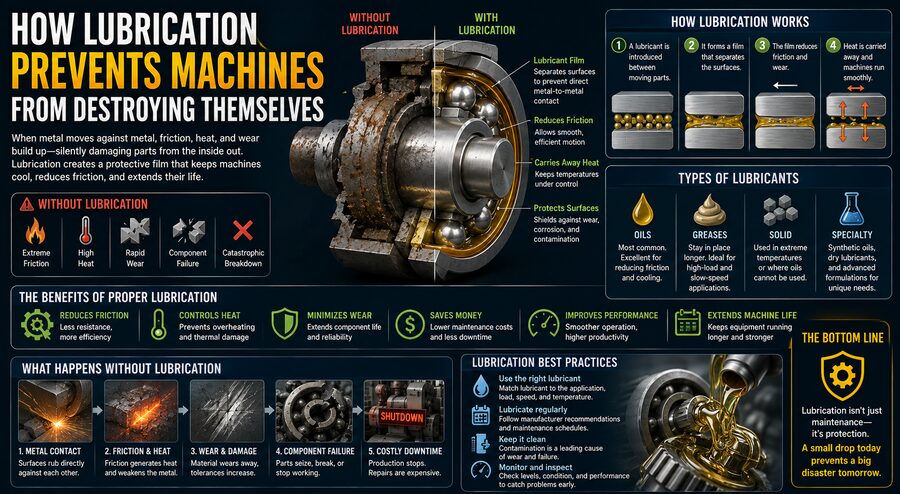

Machines often contain metal surfaces moving against one another at high speed and under enormous loads. Bearings rotate thousands of times per minute. Gears press against neighboring teeth. Pistons slide repeatedly inside engine cylinders. Shafts turn inside bushings, chains articulate around sprockets, and hydraulic components move through extremely small clearances. 🏭🔩
If all of these surfaces rubbed together directly without protection, many machines would damage themselves surprisingly quickly.
The technology that prevents this is lubrication.
Lubrication places a carefully selected substance—usually oil, grease, or another specialized lubricant—between moving surfaces. This lubricant reduces direct contact, lowers friction, removes heat, limits wear, protects against corrosion, and sometimes carries contaminants away from sensitive components.
The basic principle is:
Moving surfaces + no lubrication ➡️ friction + heat + wear ➡️ rapid failure
while:
Moving surfaces + correct lubrication ➡️ protective film ➡️ lower friction + controlled temperature + longer life
Lubrication may appear simple, but it is one of the most important technologies in mechanical engineering. Without it, engines, turbines, gearboxes, pumps, compressors, industrial machinery, and even small household appliances would experience dramatically shorter operating lives. ⚙️🛢️
🔥 What Happens When Two Metal Surfaces Touch?
A machined metal surface may look perfectly smooth to the human eye.
Under a microscope, however, it contains countless tiny peaks and valleys.
These microscopic high points are called asperities.
When two unlubricated metal surfaces slide against each other, the asperities come into direct contact.
At high pressure, some of these microscopic points can:
- Deform
- Break
- Weld together temporarily
- Tear apart
- Generate metal particles
This creates friction and wear.
The surfaces may gradually become rougher, increasing friction even further.
In severe cases, the metal surfaces can seize together completely.
Lubrication works largely by preventing these microscopic contact points from carrying the full load.
🛢️ The Lubricant Creates a Protective Film
An ideal lubricant forms a thin film between moving surfaces.
Instead of:
Metal ➡️ metal
the interface becomes:
Metal ➡️ lubricant film ➡️ metal
The surfaces are physically separated by the fluid.
Now the machine does not need to overcome as much solid-on-solid friction.
Instead, the lubricant’s internal layers slide past one another.
This process is generally much less damaging.
The effectiveness of the film depends on factors such as:
- Lubricant viscosity
- Surface speed
- Temperature
- Load
- Surface finish
- Component geometry
Selecting the correct lubricant therefore requires more than simply adding “some oil.”
📏 What Is Viscosity?
One of the most important lubricant properties is viscosity.
Viscosity describes a fluid’s resistance to flow.
A low-viscosity liquid flows relatively easily.
A high-viscosity liquid is thicker and resists motion more strongly.
For example:
Low viscosity: thin oil
High viscosity: thicker oil
The lubricant must have enough viscosity to maintain a protective film under load.
But excessive viscosity also creates problems.
A lubricant that is too thick may:
- Increase energy loss
- Generate extra heat
- Flow poorly during cold starts
- Reduce machine efficiency
A lubricant that is too thin may fail to keep surfaces separated.
The goal is therefore:
Thick enough to protect ➡️ thin enough to circulate efficiently
🌡️ Temperature Changes Lubricant Behavior
Lubricant viscosity is strongly affected by temperature.
As many oils become hotter:
Temperature increases ➡️ viscosity decreases
The lubricant becomes thinner.
This matters because machine components often operate much hotter than the surrounding air.
An oil that provides excellent protection at room temperature might become too thin inside a hot gearbox or engine.
Conversely, a lubricant that performs well when hot may become extremely thick during a cold startup.
Lubricants are therefore formulated to maintain suitable viscosity across the expected temperature range. 🌡️
🌀 Hydrodynamic Lubrication
One of the most effective lubrication regimes is hydrodynamic lubrication.
In this condition, moving surfaces are completely separated by a pressurized film of lubricant.
Consider a rotating shaft inside a plain bearing.
As the shaft rotates, it drags oil into a narrowing gap between itself and the bearing surface.
This creates pressure inside the fluid film.
The pressure can become high enough to support the shaft’s load without significant direct metal-to-metal contact.
Conceptually:
Shaft rotation ➡️ oil pulled into wedge-shaped gap ➡️ fluid pressure develops ➡️ surfaces separate
When hydrodynamic lubrication is fully established, wear can become extremely low.
This principle is used in many journal bearings found in:
- Engines
- Turbines
- Pumps
- Compressors
- Industrial machinery
⚙️ Elastohydrodynamic Lubrication
Some machine components experience extremely concentrated contact pressures.
Examples include:
- Rolling-element bearings
- Gear teeth
- Cam followers
In these situations, the lubricant film can still separate the surfaces even though the contact area is very small.
The pressure becomes so high that it slightly deforms the contacting surfaces and changes the lubricant’s viscosity.
This regime is called elastohydrodynamic lubrication, often abbreviated as EHL.
It is especially important in ball bearings, roller bearings, and heavily loaded gears.
Without a proper EHL film, these components can suffer rapid surface fatigue and pitting.
⚠️ Boundary Lubrication
Full fluid-film separation is not always possible.
At low speed, high load, or during startup and shutdown, the lubricant film may become too thin to completely separate the surfaces.
This condition is called boundary lubrication.
Some microscopic asperities may still touch.
Lubricants therefore contain chemical additives that react with or attach to metal surfaces, creating extremely thin protective layers.
These films reduce damage when fluid-film lubrication is insufficient.
Boundary lubrication is especially important during:
- Engine startup
- Slow-moving machinery
- Heavy loading
- Stop-start operation
A large amount of machine wear can occur during these transitional conditions.
🔄 Mixed Lubrication
Between full fluid-film lubrication and boundary lubrication is a regime called mixed lubrication.
In mixed lubrication:
Part of the load is supported by the lubricant film
while:
Part is carried through microscopic surface contact
This condition is common in real machines.
Engineers design lubricants, bearings, surface finishes, and operating conditions to minimize damaging contact and keep the system as close as practical to full-film lubrication.
🧊 Lubrication Also Removes Heat
Friction produces heat.
Even with good lubrication, some energy is still lost as the lubricant moves and shears between surfaces.
Lubrication systems therefore often perform a second important job:
cooling.
In an engine, oil circulates through hot components, absorbs heat, and carries it away.
The oil may then pass through:
- Oil pan
- Cooler
- Heat exchanger
- External reservoir
The cooled oil returns to the machine.
In large turbines and compressors, lubrication systems can move substantial quantities of oil specifically to control bearing temperature.
Lubrication is therefore often part of the machine’s thermal-management system. 🌡️🛢️
🧹 Lubricants Carry Contaminants Away
Machine wear, combustion, dust, and environmental exposure can introduce contaminants.
These may include:
- Metal particles
- Dirt
- Carbon
- Water
- Chemical degradation products
Circulating oil can carry these contaminants away from critical surfaces.
Filters then remove many of the particles before the oil returns to the machine.
The cycle becomes:
Lubricant enters bearing ➡️ collects heat and contaminants ➡️ travels to filter/cooler ➡️ returns cleaned
This continuous cleaning action helps prevent abrasive particles from repeatedly passing through sensitive components.
🪨 Contamination Can Turn Oil Into Abrasive Paste
Clean oil is protective.
Dirty oil can become destructive.
Hard particles suspended in lubricant may pass between loaded surfaces and scratch them.
This is known as abrasive wear.
Imagine placing fine sand between two polished metal surfaces and rubbing them together.
The lubricant may still be present, but contamination can overwhelm its protective benefit.
For this reason, industrial lubrication systems often include:
- Fine filters
- Magnetic particle collectors
- Breathers
- Seals
- Water-removal systems
Keeping lubricant clean is often just as important as selecting the correct lubricant.
💧 Water Is a Serious Lubrication Contaminant
Water can enter machinery through:
- Condensation
- Leaking seals
- Washdown operations
- Humid air
- Cooling-system leaks
Water contamination can cause:
- Rust
- Reduced lubricant film strength
- Additive degradation
- Bearing damage
- Sludge formation
In some high-speed bearings, even relatively small quantities of water can significantly shorten service life.
Industrial maintenance teams therefore monitor oil for moisture and may use vacuum dehydration or other treatment systems when necessary.
🧪 Lubricants Contain Chemical Additives
Modern lubricants are not simply refined oil.
They are carefully engineered chemical systems.
Common additives include:
🛡️ Anti-Wear Additives
Form protective films on metal surfaces.
⚡ Extreme-Pressure Additives
Protect heavily loaded gear contacts.
🧹 Detergents and Dispersants
Help keep contaminants suspended and reduce deposits.
🌡️ Antioxidants
Slow chemical degradation caused by heat and oxygen.
🧲 Corrosion Inhibitors
Protect metal surfaces against rust and chemical attack.
🫧 Anti-Foam Additives
Reduce excessive air bubbles.
📉 Viscosity-Index Improvers
Help viscosity remain more stable as temperature changes.
The additive package depends on the machine and operating environment.
🧈 Why Some Machines Use Grease Instead of Oil
Not every machine uses liquid oil.
Many bearings use grease.
Grease is essentially a lubricating oil held within a thickener structure.
It behaves more like a semi-solid than a free-flowing liquid.
Grease offers several advantages:
- Stays in place
- Requires simpler sealing
- Can provide long service intervals
- Helps block contaminants
It is commonly used in:
- Electric motor bearings
- Wheel bearings
- Hinges
- Construction equipment
- Sealed industrial bearings
However, grease does not circulate easily and removes heat less effectively than flowing oil.
It is therefore not ideal for every application.
⚠️ More Grease Is Not Always Better
A common maintenance mistake is over-lubrication.
Packing too much grease into a high-speed bearing can cause the rotating components to churn excessively through the grease.
This creates resistance and heat.
The result may be:
Too much grease ➡️ churning ➡️ temperature rise ➡️ lubricant damage ➡️ bearing failure
Electric motors are especially vulnerable to this problem.
Correct lubrication means applying the correct amount at the correct interval—not simply adding as much as possible.
⚙️ Gearboxes Depend Heavily on Lubrication
Gear teeth transmit large forces through relatively small contact areas.
Without lubrication, tooth surfaces can experience:
- Scuffing
- Pitting
- Welding
- Rapid wear
Gear oil forms protective films between the teeth and carries heat away.
Heavy industrial gearboxes often use specialized extreme-pressure lubricants.
As one gear tooth engages another:
Lubricant film ➡️ separates surfaces ➡️ reduces sliding friction ➡️ protects contact area
Poor lubrication can destroy expensive gearsets even when the gears themselves were designed correctly.
🚗 Engines Would Fail Rapidly Without Oil
Internal-combustion engines contain many moving surfaces operating under harsh conditions.
Engine oil lubricates:
- Crankshaft bearings
- Camshafts
- Pistons
- Cylinder walls
- Connecting rods
- Valve mechanisms
- Turbocharger bearings
The oil must work across an enormous temperature range.
It may be relatively cold during startup and extremely hot near pistons or turbochargers.
Engine oil also collects combustion byproducts and transports them toward the filter.
Without adequate oil pressure, major bearing surfaces can lose their protective film.
Severe engine damage can then occur within a very short period. 🚗🔥
🏭 Centralized Lubrication Systems
Large industrial machines may contain dozens or hundreds of lubrication points.
Lubricating each point manually would be inefficient and unreliable.
A centralized lubrication system distributes lubricant automatically.
A typical system may contain:
Reservoir ➡️ pump ➡️ distribution lines ➡️ metering devices ➡️ bearings
These systems deliver small, measured quantities of oil or grease at regular intervals.
Benefits include:
- Consistent lubrication
- Reduced maintenance labor
- Less risk of missed lubrication points
- Better equipment availability
Automatic lubrication is widely used in mining equipment, factories, wind turbines, and heavy machinery.
📉 Lubrication Reduces Energy Consumption
Friction converts useful mechanical energy into unwanted heat.
Reducing friction therefore improves efficiency.
Consider a large industrial motor driving a heavily loaded gearbox.
If poor lubrication increases friction losses by only a few percent, the extra electricity consumed over thousands of operating hours can become significant.
Correct lubrication can therefore reduce:
⚡ Energy use
🌡️ Operating temperature
🔧 Wear
💰 Maintenance cost
Small improvements become economically important when applied across hundreds of machines.
🛑 Lubricant Starvation
A machine can fail even when the correct lubricant exists nearby if not enough reaches the contact zone.
This is called lubricant starvation.
Possible causes include:
- Blocked oil passages
- Low reservoir level
- Pump failure
- Incorrect grease distribution
- Excessive speed
- Poor bearing design
When lubricant supply falls below what the moving surfaces require, the film collapses.
Metal-to-metal contact increases rapidly.
Temperature may rise, causing the remaining lubricant to thin further.
This can create a destructive feedback loop:
Less lubricant ➡️ more friction ➡️ more heat ➡️ thinner lubricant ➡️ even more contact
🔥 What Is Seizure?
One of the most severe lubrication failures is seizure.
When surfaces experience extreme friction and heat, microscopic areas can weld together.
As motion continues, these welded points tear.
More welding follows.
Eventually, the surfaces can lock together.
A seized bearing may prevent a shaft from turning.
A seized piston can stop an engine.
A seized gearbox can halt an entire production line.
Lubrication is therefore not merely about improving efficiency—it can prevent catastrophic mechanical failure.
🧱 Lubrication Protects Against Surface Fatigue
Rolling bearings and gears experience repeated cyclic stress.
Over millions of load cycles, tiny cracks can form beneath or near the surface.
Eventually, pieces of material can break away.
This process creates pitting or spalling.
A proper lubricant film helps distribute contact pressure and reduces damaging surface interactions.
Contaminated or insufficient lubrication significantly increases the risk of surface fatigue.
Bearing manufacturers therefore often calculate expected life based partly on lubrication quality.
🔬 Oil Analysis Reveals Machine Health
Industrial maintenance teams can analyze used lubricant to learn what is happening inside a machine.
An oil sample may reveal:
- Iron particles
- Copper particles
- Water
- Fuel contamination
- Oxidation
- Viscosity change
- Additive depletion
For example:
Increasing iron content ➡️ possible steel wear
Copper particles ➡️ possible bearing or bushing wear
High water content ➡️ possible seal or cooling-system problem
Oil analysis therefore functions somewhat like a blood test for machinery. 🧪⚙️
It can reveal developing problems before the machine fails.
📊 Condition-Based Lubrication
Traditional maintenance might replace oil at a fixed interval:
Change every 5,000 operating hours
Modern systems increasingly use condition-based maintenance.
Sensors and laboratory analysis determine whether the lubricant actually needs replacement.
Engineers may monitor:
- Viscosity
- Water content
- Particle count
- Acid number
- Temperature
- Dielectric properties
This can prevent both:
Changing healthy oil too early
and
Leaving degraded oil in service too long
The result is better reliability and reduced waste.
🧯 Lubricants Can Degrade Chemically
Lubricants do not last forever.
Heat and oxygen cause oxidation.
Oxidized oil may become thicker and form:
- Sludge
- Varnish
- Acids
- Deposits
High temperatures accelerate this degradation.
This is one reason overheating can cause long-term damage even if a machine does not fail immediately.
Once the oil deteriorates, its ability to protect surfaces decreases.
Maintaining correct temperature therefore extends both component life and lubricant life.
🌀 Air and Foam Can Reduce Lubrication Effectiveness
Air may enter circulating oil through leaks, turbulence, or poor reservoir design.
Entrained air can compress and interfere with lubricant-film formation.
Excessive foam can also cause:
- Poor pump performance
- Inconsistent oil supply
- Oxidation
- Reduced cooling
Lubrication systems are therefore designed to allow air bubbles to separate before the oil is recirculated.
Anti-foam additives may also be used.
🧲 Seals Keep Lubricant In and Contaminants Out
A lubrication system depends heavily on seals.
A seal serves two major purposes:
Keep lubricant inside
and
keep dirt and water outside
A damaged seal can therefore create two problems at once.
The machine loses oil while contamination enters.
This is common in:
- Gearboxes
- Wheel hubs
- Pumps
- Mining equipment
- Agricultural machinery
Regular seal inspection is an important part of lubrication management.
❄️ Extreme Environments Need Special Lubricants
Machines can operate in:
- Freezing climates
- Steel mills
- Underwater equipment
- Vacuum systems
- Food-processing plants
- Chemical factories
Ordinary lubricants may not survive these environments.
Engineers can select specialized formulations such as:
- Low-temperature synthetic oils
- High-temperature greases
- Food-grade lubricants
- Fire-resistant hydraulic fluids
- Chemically resistant synthetic lubricants
Some applications also use solid lubricants such as graphite or molybdenum disulfide when liquids are unsuitable.
🚀 Spacecraft Need Lubrication Too
Lubrication becomes especially challenging in space.
Conventional oils may evaporate or behave differently in vacuum.
Extreme temperature swings can also alter lubricant properties.
Space mechanisms may therefore use specialized greases, solid lubricants, coatings, or carefully selected synthetic fluids.
Even a satellite’s tiny moving components must control friction if they are expected to operate reliably for years. 🛰️
🧠 Lubrication Engineering Is a Science
The study of friction, wear, and lubrication is called tribology.
Tribology combines:
- Mechanical engineering
- Materials science
- Chemistry
- Surface physics
Tribologists investigate how surfaces interact at microscopic scales.
They help design:
- Better oils
- Lower-friction coatings
- Longer-lasting bearings
- More efficient gears
- Improved surface finishes
Because friction and wear occur in nearly every moving machine, tribology has enormous economic importance.
🔧 The Correct Lubrication Strategy
A good lubrication program asks several questions:
What lubricant does the machine require?
What viscosity is appropriate?
How much should be applied?
How often?
Where should it be applied?
How clean must it remain?
When should it be replaced?
The objective is sometimes summarized as delivering:
The right lubricant ➡️ in the right amount ➡️ to the right place ➡️ at the right time ➡️ in the right condition
Getting any one of these wrong can reduce equipment life.
🏁 Conclusion
Lubrication prevents machines from destroying themselves by controlling the destructive interaction between moving surfaces. ⚙️🛢️
Without lubrication, microscopic surface peaks collide directly.
Friction increases.
Heat rises.
Metal particles break away.
Surfaces become rougher.
Bearings, gears, pistons, and shafts can eventually seize, crack, or wear beyond repair.
A correctly selected lubricant changes this process by forming a protective film between the surfaces.
It also removes heat, carries contaminants away, protects against corrosion, and uses chemical additives to defend surfaces during difficult operating conditions.
Different situations require different lubrication regimes:
Hydrodynamic lubrication completely separates surfaces with a fluid film.
Elastohydrodynamic lubrication protects heavily loaded rolling and gear contacts.
Boundary lubrication uses protective chemical films when direct surface contact cannot be completely avoided.
The overall result is dramatic:
Less friction ➡️ less heat ➡️ less wear ➡️ lower energy consumption ➡️ longer machine life. 📉⚡
That is why lubrication is not simply routine maintenance.
It is a fundamental part of machine design.
From a tiny electric-motor bearing to a massive turbine, a thin film of carefully engineered lubricant can be the difference between decades of reliable operation and catastrophic failure.
In mechanical systems, some of the most important protection is only a few micrometers thick. 🔩🛡️✨