
A production line is running normally when a maintenance technician hears a faint change in the sound of a motor-driven pump. The pump still delivers flow. No alarm has stopped the machine, and the next scheduled overhaul is months away. Yet that small change may be the earliest visible sign of a bearing problem.
For decades, many plants handled this uncertainty with either fixed maintenance intervals or a simple rule: run equipment until it fails. Both approaches can work in the right context, but both can also waste useful component life or allow a minor defect to become an expensive outage.
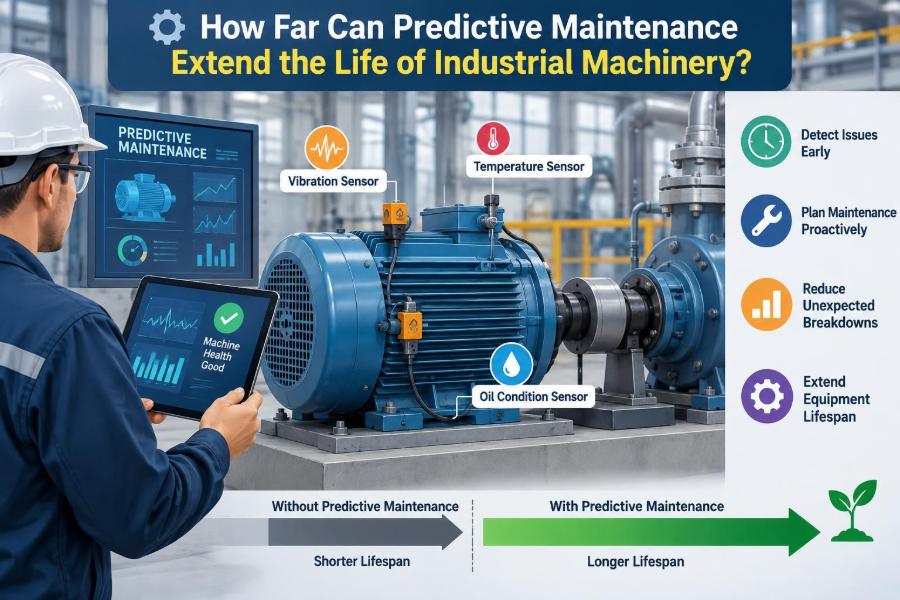
Predictive maintenance offers a third path. It uses condition data—such as vibration, temperature, oil condition, electrical behavior, or process performance—to estimate whether machinery is degrading and when intervention is justified.
The promise is appealing: fewer surprise failures and longer service from valuable assets. But predictive maintenance does not make machinery immortal. Its real value comes from making better decisions about inspection, repair, operation, and replacement.
🔍 What Predictive Maintenance Actually Means
Predictive maintenance, often shortened to PdM, is maintenance triggered by evidence of developing equipment deterioration rather than by the calendar alone. The goal is to detect a fault early enough to plan work before it causes functional failure.
It is sometimes confused with any maintenance software or automated sensor system. In practice, it is a decision process: measure condition, identify meaningful change, assess risk, and choose the right response.
A useful distinction is that PdM predicts the condition of an asset or component, not the future with perfect certainty. A vibration trend may show a bearing is deteriorating; it cannot always specify the exact hour at which it will fail.
🏭 Why Machinery Life Is More Than an Age Number
Machine life is not a single clock. A gearbox that runs at clean, stable load in a controlled environment may serve far longer than an identical gearbox exposed to dust, shock loads, poor alignment, and contaminated lubricant.
Industrial machinery has several relevant “lives”: the usable life of a bearing, the fatigue life of a shaft, the corrosion life of a casing, and the economic life of the complete machine. Predictive maintenance can influence some of these strongly and others only indirectly.
For example, detecting lubricant contamination can prevent accelerated wear. It cannot restore metal already lost from an abrasive wear process. That difference matters when setting realistic expectations.
🧭 The Three Main Maintenance Strategies
Most real maintenance programs combine reactive, preventive, and predictive methods. The right mix depends on safety consequences, redundancy, repair time, failure behavior, and monitoring cost.
| Strategy | Trigger for action | Useful when | Main limitation |
|---|---|---|---|
| Reactive maintenance | Equipment fails | Failure has low consequence and repair is simple | Can cause collateral damage and unplanned downtime |
| Preventive maintenance | Time, cycles, or operating hours | Wear-out behavior is understood and tasks are effective | May replace good parts too early |
| Predictive maintenance | Observed condition or degradation trend | Faults can be detected before failure | Needs reliable data and competent interpretation |
Predictive maintenance does not automatically replace scheduled tasks. Filters, statutory inspections, safety checks, and certain consumables may still need fixed intervals even in a highly monitored plant.
📉 How Failures Usually Develop
Many mechanical failures do not appear without warning. A rolling-element bearing can progress from subtle surface damage to detectable vibration, increased heat, noise, and finally loss of function. A crack can grow from an initiation point until the remaining material can no longer carry the load.
The interval between first detectable evidence and functional failure is often called the P-F interval: the time between potential failure and functional failure. Its length varies widely by component, operating conditions, and monitoring method.
A long P-F interval gives planners time to order parts and schedule a repair. A short interval demands more frequent monitoring or a different protective strategy.
📈 Extending Life by Catching Causes, Not Just Symptoms
The greatest life extension often comes after a fault is detected. Replacing a failed bearing without correcting shaft misalignment, inadequate lubrication, excessive belt tension, or electrical damage simply restarts the same failure cycle.
PdM helps teams investigate causes while evidence is available. A recurring high vibration level at a particular speed, for instance, may point toward imbalance or misalignment rather than a defective bearing alone.
Condition monitoring identifies where to look; root-cause analysis determines what must change. Together, they turn repair work from repeated restoration into reliability improvement.
📳 Vibration Analysis for Rotating Equipment
Vibration analysis is one of the most established predictive tools for motors, pumps, fans, compressors, gearboxes, and other rotating machines. Sensors measure motion, while analysts examine overall levels, frequency content, phase relationships, and changes over time.
Different mechanical issues often leave different frequency patterns. Imbalance tends to produce a strong response at running speed, while misalignment, looseness, gear defects, and bearing damage can create other recognizable features.
Interpretation is not automatic. The same vibration value can have different meaning on a lightly built fan structure than on a rigid pump base. Operating speed, load, sensor location, and machine design all matter.
🌡️ Temperature Monitoring and Thermal Clues
Excess heat can signal friction, poor lubrication, blocked cooling, electrical resistance, or an overloaded component. Temperature is easy to understand, but it is usually a relatively late or nonspecific indicator when used alone.
Infrared inspection can reveal hot motor connections, uneven bearing temperatures, insulation problems, and heat loss patterns without touching live or moving equipment. Fixed temperature sensors are useful where temperature trends are closely linked to failure risk.
A hotter bearing is not automatically failing. Ambient conditions, load, lubricant type, and measurement method can change readings. A meaningful diagnosis compares like with like and looks for an unusual trend.
🛢️ Oil Analysis as a View Inside the Machine
Lubricant can carry evidence from inside a gearbox, hydraulic system, or engine. Oil analysis may evaluate viscosity, contamination, moisture, acidity, additive condition, and wear particles.
Particle characteristics can help distinguish normal rubbing wear from more serious modes such as cutting, fatigue, or corrosion. Water in oil can reduce lubricating performance and accelerate corrosion, while excessive particle contamination can create a damaging wear loop.
Sampling discipline is essential. A sample taken from a stagnant drain point may say little about circulating oil. Consistent sample locations, clean bottles, clear labels, and comparable operating states make trends far more useful.
⚡ Electrical Signature Monitoring
Electrical measurements can reveal conditions that mechanical sensors may miss or detect later. Motor current, voltage balance, power quality, insulation condition, and current signatures can provide clues about rotor issues, load changes, or electrical supply problems.
Motor current signature analysis examines patterns in electrical current to identify certain motor and driven-load abnormalities. It can be valuable where mounting vibration sensors is difficult, although it does not replace direct mechanical inspection.
Mechanical and electrical faults often interact. A pump operating far from its preferred flow range may create hydraulic loads that appear in both power consumption and vibration behavior.
👂 Ultrasound and the Value of High-Frequency Sound
Ultrasound monitoring detects high-frequency sound beyond normal human hearing. It is commonly used to find compressed-air leaks, assess bearing lubrication, identify steam-trap issues, and detect some electrical discharges.
A technician can use ultrasound to hear a developing bearing condition before it becomes obvious in audible noise. During manual lubrication, ultrasound can also help avoid both under-lubrication and over-lubrication.
This technique is especially helpful when machinery is noisy, because the instrument filters and translates a selected ultrasonic band. Still, readings should be trended and interpreted in the context of the machine.
🧠 From Raw Data to a Maintenance Decision
A sensor produces data, not a maintenance recommendation. A useful PdM workflow converts readings into context: which asset produced the signal, under what load, compared with what baseline, and with what consequence if the fault progresses?
Alarm limits are often needed, but a fixed threshold is not enough. A steady value slightly above a generic limit may be less urgent than a sharp rise that remains below it. Trend rate and repeatability can be more informative than a single reading.
The best decision includes operational reality. A noncritical standby pump may be monitored until a planned outage, while a similar defect on a single-point-of-failure production asset may require immediate planning.
🤖 Where Machine Learning Helps—and Where It Does Not
Machine-learning tools can sort large volumes of sensor data, identify unusual patterns, and help prioritize assets for review. They are most useful when data are well labeled, measurements are consistent, and operating states are understood.
They are not a substitute for engineering judgment. A model can mistake a legitimate production change for a fault if it has not seen that operating condition before. Sparse failure history also makes it difficult to train reliable failure-prediction models.
A practical approach is to use analytics for detection and prioritization, then combine it with machine knowledge, inspection, and failure-mode reasoning before authorizing work.
🧩 Failure Modes Determine What Can Be Predicted
Not every failure provides a detectable warning. Sudden impact damage, manufacturing defects, operator error, and some electronic failures can occur too quickly for conventional PdM to prevent.
Before selecting a technology, teams should ask: What failure mode matters? What physical change occurs before failure? Can it be measured? Is there enough warning time to act?
This logic prevents “sensor-first” projects in which data are collected without a clear decision they can support. It also reveals where redundancy, guarding, design changes, or scheduled replacement are better controls.
🪛 Alignment, Balance, and Installation Quality
Many early failures begin at installation or after maintenance. Soft foot, incorrect shaft alignment, poor base condition, improper belt tension, pipe strain, and unbalanced rotating parts can impose loads that components were not designed to carry.
Predictive monitoring can expose these conditions, but precision installation prevents them in the first place. Laser alignment and careful base preparation may deliver more value than adding sophisticated monitoring to a repeatedly misaligned drive train.
After a repair, baseline measurements are valuable. They document the machine’s condition when it is known to be correctly installed and give future trends a trustworthy reference.
💧 Lubrication Is a Major Life Lever
Lubrication failures are rarely just about choosing the wrong oil or grease. Contamination, incorrect quantity, incompatible products, missed intervals, damaged breathers, and poor storage practices can all shorten component life.
Predictive maintenance makes lubrication more precise by showing whether a lubricant remains suitable in service and whether a component is responding abnormally. It should be paired with clean transfer equipment, sealed storage, filtration, and documented procedures.
Adding grease because a bearing is warm can be harmful if overgreasing is the source of heat. Condition information must guide the action rather than merely trigger more lubricant.
🏗️ Operating Conditions Can Consume Life Faster
Design ratings assume particular loads, speeds, temperatures, and environments. Operating far outside those conditions can consume fatigue life quickly, even when the machine appears to run adequately.
A centrifugal pump that frequently operates at very low flow, for example, can experience recirculation and hydraulic instability. A motor that starts too often may accumulate thermal stress. A conveyor subject to shock loading may fatigue shafts and structures.
PdM trends can reveal the consequence of poor operating practice, but operating data are often needed to explain the cause. Joining condition data with load, speed, flow, and temperature data creates a more complete picture.
🗺️ Criticality Tells You Where to Start
Monitoring every asset to the same depth is rarely efficient. A criticality assessment ranks equipment by safety, environmental, production, quality, repair-time, and cost consequences of failure.
A low-cost, easily replaced fan may justify basic inspections and a spare on the shelf. A large compressor without redundancy may justify permanently installed sensors, detailed oil analysis, and a carefully planned response procedure.
Criticality should not be based only on purchase price. A modest component can be critical if its failure stops a process or creates a serious safety hazard.
🧰 Selecting Sensors That Match the Asset
The best sensor is the one that detects a relevant failure mode early enough and reliably enough to change a decision. More sensors do not necessarily produce more useful maintenance.
- Use vibration monitoring where rotating mechanical faults are significant and sensor mounting is practical.
- Use oil analysis for lubricated systems where internal wear and contamination are concerns.
- Use ultrasound for leaks, lubrication routes, and early high-frequency friction signals.
- Use process data when changes in flow, pressure, efficiency, or energy use expose equipment deterioration.
Sensor placement deserves engineering attention. A loosely mounted accelerometer, a temperature probe in a poorly chosen location, or a pressure transmitter with a blocked impulse path can create misleading data.
🕒 Monitoring Frequency Must Fit the Warning Window
Monthly route-based readings may be sufficient for a slowly degrading, low-consequence asset. They may miss a rapidly developing defect in a high-speed critical machine.
Continuous monitoring is not always superior. It adds hardware, networking, cybersecurity, data handling, and alarm-management requirements. The extra information is worthwhile when it provides timely warning that periodic routes cannot provide.
The practical question is simple: can the chosen inspection interval reliably detect a developing fault while enough time remains to plan and complete the response?
🚨 Alarm Fatigue Can Undermine a Good Program
If a system generates frequent nuisance alarms, people eventually ignore it. This is alarm fatigue, and it can turn useful monitoring into background noise.
Common causes include generic thresholds, poorly defined operating states, sensor faults, and alerts sent without clear ownership. Every alert should lead to a defined review path, not an endless stream of notifications.
Alarm settings need periodic refinement. A maintenance team should record whether an alert was confirmed, dismissed, or linked to a known operating change, then use that feedback to improve rules.
🧑🔧 People and Procedures Still Matter
Predictive maintenance succeeds through people who can collect consistent readings, recognize abnormal behavior, verify findings, plan repairs, and document outcomes. Technology supports this work; it does not eliminate it.
Operators are often the first source of condition information. Changes in noise, smell, leakage, cycling behavior, product quality, or required adjustment can provide useful clues before a formal route detects a trend.
A clear handoff matters. Analysts, operators, planners, and maintenance craftspeople need shared definitions of urgency, evidence requirements, and completion feedback.
📋 Turning Findings Into Planned Work
A condition report has limited value if it does not become executable work. The report should identify the asset, observed condition, suspected failure mode, evidence, urgency, recommended verification, and likely repair scope.
Planning then checks spares, tools, labor skills, permits, isolation requirements, and production windows. This is where PdM often delivers substantial value: the work can be completed deliberately instead of under breakdown pressure.
After repair, the team should confirm whether the expected condition improved. If vibration remains high after a bearing replacement, the original diagnosis may have been incomplete or the underlying cause may still exist.
💰 Measuring Value Without Inventing Certainty
It is tempting to claim that every detected defect represents a fully avoided catastrophic failure. That is rarely knowable. A more credible evaluation compares the quality of decisions and outcomes over time.
Useful measures can include planned-versus-unplanned maintenance work, repeat failures, emergency spare usage, condition findings verified during repair, downtime associated with monitored assets, and time from detection to corrective action.
Cost analysis should include the program’s full burden: sensors, routes, laboratory analysis, software, training, engineering review, and follow-up work. The goal is better lifecycle value, not a dashboard with the most data.
📏 Remaining Useful Life Has Wide Uncertainty
Remaining useful life is an estimate of how long an item can continue performing its required function. It is attractive for planning, but it is intrinsically uncertain because degradation rates can change with load, lubrication, temperature, and random events.
For many assets, it is safer to use condition categories and action windows than a precise predicted failure date. “Plan replacement at the next suitable shutdown unless the trend accelerates” is often more defensible than “this bearing has exactly 47 days left.”
Uncertainty should be communicated, not hidden. Decision-makers need to understand both the evidence and the consequences of waiting.
⚠️ Common Ways Predictive Maintenance Fails
PdM programs usually struggle because of process weaknesses rather than a lack of advanced technology. Collecting measurements without baselines, ignoring alerts, or closing work orders without feedback breaks the learning loop.
- Buying sensors before identifying critical failure modes and maintenance decisions.
- Comparing readings taken at different speeds, loads, or locations as though they were identical.
- Replacing components without correcting alignment, contamination, overload, or other causes.
- Treating software output as proof rather than a prompt for engineering verification.
- Monitoring assets that have no practical response plan while neglecting critical equipment.
A modest, disciplined program focused on a few important asset classes is often more durable than a broad rollout with unclear ownership.
🛡️ Safety and Cybersecurity Are Part of the Design
Condition monitoring must not create new hazards. Installing sensors near rotating equipment, collecting data near energized panels, and opening systems for samples require suitable procedures, isolation practices, and trained personnel.
Connected devices also introduce cybersecurity considerations. Asset owners should understand how sensors communicate, who can access data, how devices are updated, and what happens if a connection is lost.
Monitoring should support—not bypass—existing process safety and machine-protection systems. A predictive alert is not a substitute for properly designed shutdown protection where immediate hazards exist.
🪜 A Practical Starting Path
Organizations do not need to digitize every maintenance task at once. Start with machinery that is consequential, reasonably understood, and likely to provide a detectable warning before failure.
- Build an accurate asset list and identify critical systems.
- Review common failure modes and their observable symptoms.
- Choose a small number of monitoring methods tied to specific decisions.
- Collect baseline readings under documented operating conditions.
- Create routes, alarm ownership, work-order triggers, and verification steps.
- Review results after repairs and expand only where the process is working.
This staged approach develops internal skill and exposes data-quality problems before they spread across the site.
🔄 Combining Predictive Maintenance With Lifecycle Planning
Condition data can improve long-term capital decisions as well as daily maintenance. Repeated failures, declining efficiency, escalating repair scope, and unavailable spares may show that an asset is approaching the end of its economic life even if it can still run.
Conversely, a well-monitored machine in stable condition may not need replacement simply because it has reached a conventional age. This can prevent premature capital spending while maintaining an evidence-based risk view.
The decision is broader than technical condition. Energy performance, safety requirements, production needs, maintainability, and technology obsolescence also shape whether to refurbish, redesign, or replace.
🎯 How Far Can Life Really Be Extended?
Predictive maintenance can extend useful machinery life substantially when premature deterioration is driven by controllable factors such as misalignment, contamination, inadequate lubrication, overheating, or harmful operating conditions. It can also reduce collateral damage by allowing a defect to be corrected before it spreads.
Its effect is smaller when the limiting factor is unavoidable material fatigue, severe corrosion, obsolete controls, a fundamentally unsuitable design, or a failure mode with little warning. In those cases, PdM improves preparedness and risk management more than it extends physical life.
The core principle is straightforward: monitor meaningful condition changes, interpret them in operating context, and act on the underlying cause before damage becomes irreversible.
Predictive maintenance extends machinery life not by defeating wear, but by preventing avoidable wear from becoming avoidable failure. Used with sound installation, lubrication, operation, planning, and engineering judgment, it helps industrial equipment deliver more reliable service for as long as its design and condition reasonably allow. ⚙️📈🛠️