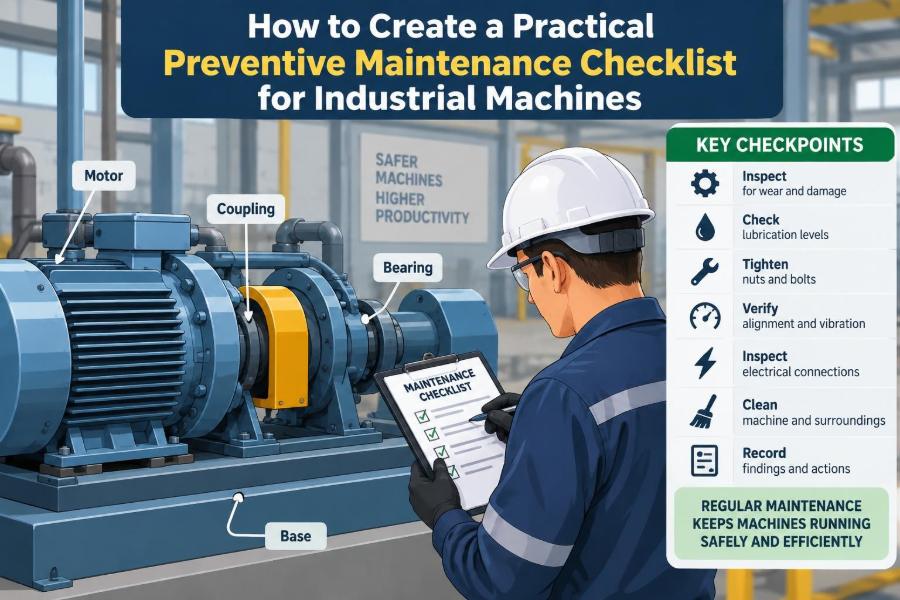

A production line is running normally—until a bearing begins to overheat, a coupling loosens, or a dirty sensor sends the wrong signal. The eventual stoppage may look sudden, but the warning signs often appeared during ordinary operation.
Preventive maintenance turns those small, observable changes into planned work. A good checklist gives technicians a consistent way to inspect, clean, lubricate, adjust, and document equipment before a developing fault becomes a disruptive failure.
The difficult part is not making a long list. It is deciding what each machine actually needs, who can safely do it, how often it should happen, and what an abnormal result should trigger.
This guide shows how to build a practical checklist that supports reliable industrial machines without burying the maintenance team in low-value tasks.
🔧 Start With the Purpose of Preventive Maintenance
Preventive maintenance, often shortened to PM, is scheduled work intended to reduce the likelihood or consequence of equipment failure. It includes routine inspections and housekeeping, but may also include replacement of wear items, calibration, lubrication, and functional testing.
Its purpose is not to make every component last forever. It is to find and control failure modes: the specific ways a machine can lose its required function. A pump may fail by leaking, losing flow, cavitating, or tripping its motor; each failure mode needs a different check.
🏭 Define What “Reliable” Means for the Machine
Before writing tasks, state what the machine must do. This is its required function: move a load, maintain pressure, form a part, cool a process, or convey material at a stated operating condition.
Also identify the consequences when it cannot do that job. A minor fan in a noncritical enclosure can tolerate a different maintenance strategy than a compressor that stops an entire process or a guard interlock that protects people.
🗺️ Set the Boundaries of Each Asset
A checklist becomes confusing when its scope is vague. Identify the asset and its boundaries: for example, a conveyor may include the drive motor, gearbox, belt, pulleys, guards, emergency stops, sensors, and local control panel.
Assign a unique asset name or identification number. Then distinguish shared equipment from dedicated components. A common lubrication system or plant air supply may require its own checklist rather than appearing, incompletely, on every machine list.
📚 Gather the Right Starting Information
Manufacturer manuals are useful starting points because they specify lubrication points, approved lubricants, adjustment limits, torque values, inspection intervals, and safety requirements. They should not be copied blindly into a plant checklist.
Collect information from operators and technicians too. They know where material accumulates, which access panels are awkward, what noises precede a fault, and which parts repeatedly need attention. Maintenance history often reveals more relevant local detail than a generic schedule.
⚠️ Identify Failure Modes Before Listing Tasks
A useful question is: “How could this component stop doing its job?” For a chain drive, possible answers include inadequate lubrication, excessive slack, sprocket wear, misalignment, damaged guards, and contamination.
For each credible failure mode, select a task that can detect, prevent, or limit it. If a task cannot be linked to a likely failure mode or a clear requirement, it may be paperwork rather than maintenance.
🎯 Rank Work by Criticality
Criticality is a practical ranking of the consequences of failure. Consider safety, environmental impact, product quality, regulatory requirements, repair time, availability of spares, and production loss.
High-criticality assets deserve more deliberate planning, condition monitoring, and clear response limits. Lower-criticality equipment may be managed with simple operator checks and corrective repair when a fault appears. The right level is based on consequence, not on how expensive the machine looks.
🧩 Break the Machine Into Maintainable Systems
Large machines are easier to inspect when divided into systems. A CNC machine, for example, can be considered as mechanical motion, spindle, lubrication, coolant, hydraulic, pneumatic, electrical, guarding, and control systems.
This structure prevents blind spots. It also makes task ownership clearer: a mechanical technician may inspect drive components, while an appropriately qualified electrical worker tests cabinet connections and safety circuits.
👀 Use Operator Checks for Early Warning
Operators are usually closest to the machine and can notice changes between formal maintenance visits. Their checks should be quick, safe, and based on things they can observe without opening guarded areas or bypassing controls.
- Unusual noise, vibration, smell, or heat
- Leaks, loose fasteners, damaged guards, or material buildup
- Abnormal cycle time, product quality, or display alarms
- Oil level, pressure indication, or coolant condition where safely visible
Operator checks are not a substitute for skilled maintenance. They are a reporting layer that helps defects get found earlier.
🧤 Build Safety Into Every Task
A checklist must never imply that a task can be performed while exposed to unexpected motion, electrical energy, pressure, heat, or stored energy. Write the required safety condition directly into the task or its referenced procedure.
Lockout/tagout, isolation, verification of zero energy, depressurization, blocking of suspended loads, and suitable personal protective equipment depend on the equipment and site rules. Only trained, authorized personnel should perform tasks requiring those controls.
🧼 Include Cleaning Where Contamination Causes Failure
Cleaning is maintenance when dirt interferes with cooling, sensing, lubrication, motion, insulation, or product quality. A clogged radiator raises temperature; metal fines can damage hydraulic components; dust on an optical sensor can create false signals.
Specify the method and limit. “Clean machine” is vague. “Remove debris from fan guard and cooling fins using the approved method; do not direct compressed air toward bearings or electrical enclosures” gives a technician useful direction.
🛢️ Make Lubrication Tasks Precise
Lubrication is a common source of avoidable problems because both too little and too much lubricant can be harmful. Wrong oil viscosity, incompatible grease, contamination, and overgreasing a bearing can raise temperature and shorten component life.
Each lubrication item should identify the point, lubricant type, quantity or method, interval, and cleanliness requirement. A color code or lubrication map can help, but the written record must remain unambiguous.
📏 Turn Inspection Into Measurable Observation
“Inspect belt” does not tell the technician what to look for or what decision to make. Better wording might be: “Inspect belt for cracking, frayed edges, glazing, and contamination; check tension by the approved method; replace or adjust if outside the manufacturer’s specified condition.”
Measurements are especially useful when a gradual trend matters. Record belt tension, oil level, temperature, vibration reading, pressure, clearance, or thickness only when the measurement can be taken repeatably and used to guide action.
🌡️ Add Condition Monitoring Where It Fits
Condition-based maintenance uses evidence of deterioration rather than a calendar alone. Common techniques include vibration analysis, infrared thermography, oil analysis, ultrasonic inspection, and motor electrical testing.
These methods are valuable for suitable failure modes, but they require competent collection and interpretation. A vibration route with inconsistent sensor placement can produce misleading trends. Use condition monitoring to complement routine PM, not as a decorative line item.
📆 Choose Intervals From Risk and Evidence
Start with manufacturer guidance, operating hours, duty cycle, environment, known failure history, and the consequence of missing a developing defect. A machine running continuously in a dirty, hot area usually needs a different interval from an identical machine used intermittently in a clean room.
Intervals should be reviewed after enough operating experience. If a task repeatedly finds nothing and the failure mode is not time-related, lengthening the interval may be sensible. If defects are found too late, shorten it or improve the detection method.
⏱️ Separate Calendar, Runtime, and Event Triggers
Not every task belongs on a monthly schedule. Some are triggered by operating hours, production cycles, seasonal conditions, prolonged storage, a process upset, or a repair that disturbed alignment.
| Trigger | Suitable example | Why it works |
|---|---|---|
| Calendar time | Inspect emergency-stop condition | Safety function needs periodic confirmation |
| Runtime | Change oil where specified by hours | Wear and heat exposure accumulate in use |
| Condition | Replace filter at differential-pressure limit | Restriction varies with contamination load |
| Event | Check alignment after motor replacement | Work may have altered the machine setup |
📝 Write Tasks That Produce Consistent Results
A practical task has a clear action, location, acceptance criterion, and response. The technician should not have to guess which coupling, which limit, or what to do with an abnormal finding.
A useful format is: action + method + acceptable condition + escalation. For example: “Check gearbox oil level at sight glass with unit stopped as required; level must be within marked range; report leaks or level below range and create corrective work.”
🔢 Use a Logical Task Sequence
Arrange tasks in the order they can be performed safely and efficiently. Begin with a walk-around and operating observations, then isolate energy if needed, complete internal inspection and service, restore the machine, and perform a controlled functional check.
A scattered checklist increases travel, missed points, and the chance of restoring the machine with a guard or fastener overlooked. The sequence should match the physical route around the equipment.
🧰 Specify Tools, Materials, and Access Needs
A task is not truly planned if the technician arrives without the required grease, filter, meter, lifting aid, access key, or replacement seals. Include special tools and consumables on the checklist or linked job plan.
Also identify access constraints. A check that requires a platform, a production shutdown, or cleaning before entry cannot be treated as a quick daily inspection.
👥 Match Tasks to Competence and Ownership
Assign each task to the person or role best able to perform it safely and reliably. Operators may check visible conditions; mechanical technicians may service bearings and drives; electricians may inspect energized equipment only under established procedures and qualifications.
Ownership includes who reviews failed checks and who creates follow-up work. “Maintenance” is too broad when an urgent defect needs a clear decision-maker.
🖥️ Choose Paper or Digital Delivery Carefully
Paper checklists can work well in simple environments, especially when access to devices is limited. Digital systems can improve asset history, scheduling, routing, photographs, automatic meter triggers, and reporting.
The format does not fix a weak task. Whether on paper or in a computerized maintenance management system, the checklist must remain readable at the point of work and easy to complete with honest findings.
📸 Capture Useful Completion Data
A tick mark alone proves little. Record completion date, worker, meter reading where relevant, measurements, abnormalities, parts used, and any follow-up work request number.
Photographs can be valuable for corrosion, leaks, belt condition, damaged guards, or recurring contamination—provided the system manages them sensibly. The goal is a useful maintenance history, not an excessive administrative burden.
🚩 Define What Happens When a Check Fails
A checklist should state how abnormal conditions are classified. Some findings require immediate shutdown or escalation because of a safety risk. Others allow monitored operation until a planned repair window, provided the risk is assessed under site procedures.
Do not leave technicians to decide informally whether a cracked guard, hot bearing, oil leak, or failed interlock is “probably fine.” Clear escalation paths prevent discovered defects from disappearing into completed PM records.
🔄 Connect PM to Corrective Work
Preventive work discovers defects; corrective work removes them. These are connected but not identical. A PM should not become an uncontrolled collection of repairs that extends downtime and hides the original findings.
Create corrective work orders for defects that need planning, parts, engineering review, or additional labor. Urgent repairs should follow the organization’s emergency process, with the final repair documented against the asset history.
🧪 Pilot the Checklist on the Actual Machine
Before widespread release, ask an experienced technician to execute the checklist at the machine. Time it, check access, test whether the instructions are understandable, and identify steps that conflict with production or safety controls.
A pilot frequently exposes hidden assumptions: an inspection point may be inaccessible, the stated lubricant may not be stocked, or an “easy” measurement may vary too much between users. Revise the job plan before calling it standard.
📈 Review Results for Patterns, Not Just Compliance
A high completion rate is useful only if work was performed well and findings led to action. Review recurring defects, overdue PMs, repeated emergency repairs, contamination sources, and measurements that are drifting toward limits.
Patterns can reveal a design issue rather than a maintenance lapse. Repeated loose terminals, for instance, may point to vibration, inadequate strain relief, incorrect hardware, or a poor installation method.
🧠 Avoid the “More PM Is Better” Trap
Excessive intrusive maintenance can introduce faults through contamination, misassembly, damaged threads, incorrect settings, or forgotten fasteners. Opening a healthy component without a failure mode that benefits from intervention is not automatically safer.
Use the least intrusive effective task. Visual inspection, condition monitoring, and functional testing may be preferable to routine disassembly when they provide adequate warning.
❌ Watch for Common Checklist Failures
- Vague language: “Check unit” produces inconsistent work.
- Copied intervals: generic schedules ignore actual duty and environment.
- Missing criteria: a reading is recorded but no limit or response exists.
- Ignored findings: defects are noted without corrective follow-up.
- Unsafe assumptions: tasks omit isolation or access controls.
- Checklist overload: long forms encourage rushed, automatic ticking.
Each failure reduces trust in the PM program. A shorter checklist with meaningful tasks is usually more valuable than a long one that nobody can execute carefully.
🧱 Example: Turning a Conveyor Check Into a Usable Plan
Consider a hypothetical belt conveyor moving packaged goods. A weak checklist might say: “Inspect conveyor weekly.” That instruction does not identify the likely failures or the required observations.
A stronger weekly route could include visible belt damage and tracking, buildup on rollers, guard condition, abnormal noise during operation, drive-chain condition, gearbox leaks, sensor cleanliness, and emergency-stop accessibility. Tasks requiring adjustment, lubrication, or internal access would specify isolation and the relevant procedure.
If repeated belt tracking problems appear, do not simply add more checks. Investigate loading alignment, pulley condition, frame squareness, roller condition, and operating practices. The checklist should help expose the cause, not normalize the symptom.
🧾 Create a Simple Checklist Template
For each task, use fields that force clear planning:
- Asset and system or component
- Task description and safe-work reference
- Trigger and frequency
- Tools, lubricant, spare part, or instrument required
- Acceptance criterion or normal condition
- Recorded reading or observation
- Required response for an abnormal result
- Responsible role and completion record
This structure is detailed enough for accountability while remaining adaptable to a paper form or digital work order.
🔍 Keep Improving the Checklist
A maintenance checklist is a controlled working document, not a permanent artifact. Update it after equipment modifications, significant failures, revised operating conditions, better diagnostic methods, or recurring defects.
Changes should be reviewed rather than made casually. Removing a task because it “never finds anything” may be sensible, but only after confirming that the risk is controlled by another method or that the original failure assumption was wrong.
🤝 Make the Checklist Part of Daily Reliability
The best checklist supports communication between operations, maintenance, engineering, and supervision. Operators report early symptoms, technicians inspect and repair, planners prepare work, and engineers address recurring or design-related problems.
It should also fit real production constraints. A technically perfect monthly task that cannot obtain downtime will become overdue; a carefully designed task aligned with planned windows is more likely to protect the machine.
✅ The Core Principle: Make Every Task Defensible
Every item on a preventive maintenance checklist should answer four questions: what can fail, why does it matter, how will this task detect or prevent it, and what happens if the result is abnormal?
When those answers are clear, the checklist becomes more than a compliance form. It becomes a practical reliability tool: focused enough to be used, specific enough to be trusted, and flexible enough to improve as the machine and operating environment change.
A practical preventive maintenance checklist is built around real failure modes, safe execution, clear acceptance criteria, and disciplined follow-up—not around the number of boxes checked. ⚙️🛠️📋