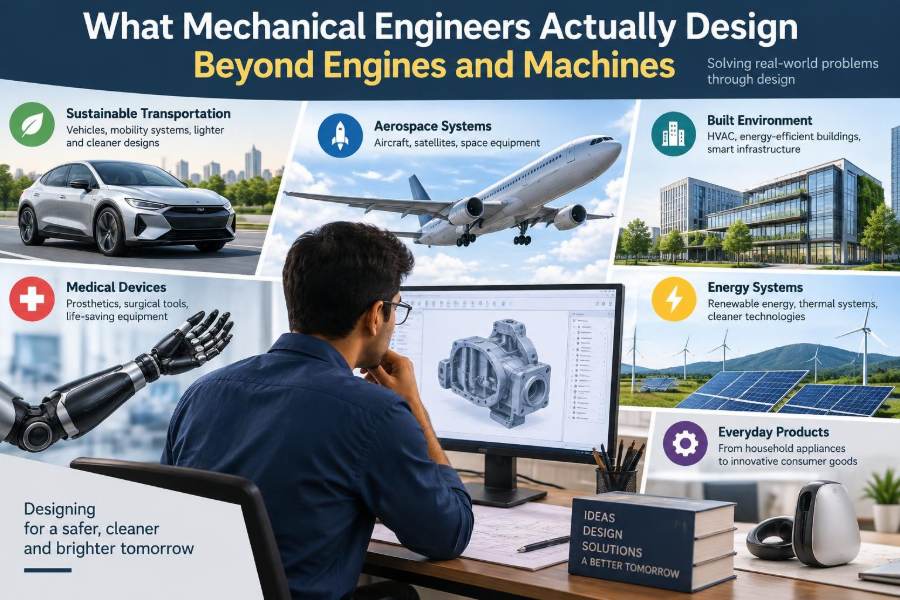

A commuter steps onto a train platform, adjusts the height of an office chair, opens a carton of food, and walks past a hospital scanner. None of these moments feels especially mechanical. Yet each depends on decisions about forces, motion, heat, materials, manufacturing, safety, and human use.
That is why the popular image of mechanical engineering as “people who design engines” is too narrow. Engines remain a valuable part of the field, but they are only one way mechanical engineers turn physical principles into useful systems.
The profession reaches into nearly every place where energy moves, materials carry loads, fluids flow, heat must be controlled, or a product has to be made reliably at scale. The object may be a wind turbine blade, a surgical instrument, a warehouse robot, or a safer bottle cap.
Understanding this broader role helps students see more career paths and helps working professionals collaborate more effectively with mechanical teams. The common thread is not a particular machine; it is the disciplined design of physical systems under real constraints.
🧭 Mechanical Engineering Is a Way of Solving Physical Problems
Mechanical engineering applies mechanics, thermodynamics, materials science, and manufacturing knowledge to create devices and systems that work in the physical world. A mechanical engineer asks practical questions: What loads will this part experience? Where will heat go? Can it be produced repeatedly? What happens after years of use?
The answer is rarely just a sketch. It is a set of connected choices about geometry, material, tolerances, controls, assembly, cost, maintenance, and safety. This systems mindset explains why mechanical engineers contribute far beyond traditional machinery.
🔩 Products Are More Than Their Moving Parts
Many everyday products contain few obvious mechanisms, but still require intensive mechanical design. A laptop enclosure must protect delicate electronics while allowing heat to escape. A reusable water bottle needs a cap that seals, survives repeated opening, feels comfortable, and can be manufactured economically.
Mechanical engineers define shapes, joints, fasteners, stiffness, surface finishes, and assembly methods. Even when electronics provide the “intelligence,” the physical product determines whether users can carry it, clean it, drop it, repair it, and trust it.
📐 Structural Design Keeps Things in Shape
Structural work is about ensuring that a component carries expected loads without excessive bending, cracking, buckling, or permanent deformation. The component might be a bicycle frame, a solar-panel support, a drone arm, a medical-bed rail, or an industrial enclosure.
Engineers examine both the size and direction of forces. A shelf that easily holds a steady box may fail when a load is dropped onto it, while a thin column may buckle long before its material reaches its nominal strength.
Strength is not the same as stiffness. A part can avoid breaking yet bend enough to misalign gears, leak at a seal, or feel poor in the user’s hands.
🧱 Materials Selection Balances Competing Needs
Choosing a material is not simply selecting the strongest option. Engineers compare stiffness, toughness, density, corrosion resistance, temperature capability, electrical behavior, cost, availability, recyclability, and compatibility with manufacturing processes.
Aluminum may reduce mass, steel may offer economical strength, a polymer may simplify molding, and a composite may provide excellent stiffness-to-weight performance. Each choice introduces trade-offs. For example, a light material may be harder to join or more vulnerable to wear.
Real material behavior also depends on processing. Heat treatment, fiber direction, surface finish, and molding conditions can substantially change performance.
🌡️ Thermal Management Moves Heat Safely
Thermal design appears anywhere a system produces, absorbs, stores, or transfers heat. A battery pack, data-center rack, refrigerator, electric vehicle, coffee machine, and medical device all need temperature control for performance, comfort, reliability, or safety.
Mechanical engineers use conduction through solids, convection to moving air or liquid, and radiation between surfaces to predict heat flow. They design heat sinks, cooling passages, insulation, fans, heat exchangers, and thermal interfaces.
A solution must fit the application. More cooling is not always better: fans consume energy, add noise, collect dust, and can create new failure points. The aim is a stable operating temperature under realistic conditions.
💨 Fluid Systems Guide Air and Liquids
Fluid mechanics governs more than aircraft wings and pumps. It affects ventilation ducts, water filters, spray nozzles, irrigation systems, inhalers, fuel lines, dialysis equipment, and industrial piping.
Designers manage pressure drop, flow rate, leakage, turbulence, cavitation, and contamination. Cavitation occurs when local pressure falls enough for vapor bubbles to form and then collapse; in pumps, it can reduce performance and damage surfaces.
A small change in pipe diameter, bend radius, or valve layout can alter energy use and delivered flow. This is why fluid-system design considers the complete path, not just one component.
🔋 Energy Systems Include Much More Than Motors
Mechanical engineers work across energy conversion and storage: wind turbines, solar mounting systems, heat pumps, industrial boilers, thermal storage, hydrogen equipment, and battery thermal hardware. Their work often connects energy sources to practical infrastructure.
A heat pump, for example, uses a refrigeration cycle to move heat rather than generate it directly from fuel. Its compressor, heat exchangers, piping, fan system, structure, and controls all require mechanical engineering decisions.
Energy design involves efficiency, but also durability, maintainability, noise, installation conditions, and safe operation across changing weather and demand.
🏭 Manufacturing Design Determines Whether an Idea Can Exist
A technically elegant part is not a successful design if it cannot be manufactured consistently. Mechanical engineers select and design for processes such as machining, casting, molding, sheet-metal forming, welding, additive manufacturing, and assembly.
Manufacturing constraints shape geometry. Deep narrow pockets may be difficult to machine; abrupt wall-thickness changes can cause molding defects; inaccessible welds complicate fabrication and inspection. Designing with these realities early prevents expensive redesign later.
Design for manufacturability means making choices that achieve required function with a realistic process, yield, inspection method, and production rate.
📏 Tolerances Make Interchangeable Products Possible
No production process makes two parts with exactly identical dimensions. A tolerance specifies the permitted variation around a target dimension. It is what allows a shaft to fit a bearing, a door to close without rubbing, and parts made on different days to assemble together.
Loose tolerances can lead to rattles, leaks, misalignment, or poor appearance. Extremely tight tolerances can sharply increase cost and inspection effort. Engineers therefore assign precision where function demands it, rather than treating every dimension as equally critical.
| Design concern | Typical mechanical question | Possible consequence if missed |
|---|---|---|
| Fit | Will these parts assemble with clearance or interference? | Jamming, looseness, or assembly failure |
| Surface finish | Does this sealing or sliding surface need to be smoother? | Leaks, friction, or accelerated wear |
| Stack-up | How do multiple small variations combine? | Final assembly does not align |
🧩 Mechanisms Transform Motion and Force
Mechanisms are arrangements of parts that transmit or transform motion. They include hinges, linkages, gears, cams, springs, latches, sliders, and clutches. Their purpose may be simple, such as holding a cabinet door open at a useful angle.
In other cases, a mechanism delivers a carefully controlled movement, such as the folding arm of a monitor stand or the dose-setting action in a medical injector. The engineer must consider force, friction, wear, user effort, unintended pinch points, and manufacturing variation.
A mechanism succeeds when it behaves predictably over its intended life, not merely when a prototype moves once on a workbench.
🤖 Robotics Needs a Strong Physical Foundation
Robotics combines software, sensing, electronics, and mechanical engineering. The mechanical team may design the chassis, joints, transmission, end effector, protective housing, cable routing, and structures that hold sensors in accurate positions.
A robot arm’s control algorithm cannot fully compensate for a flexible structure, excessive gear backlash, or a gripper that damages the object it is meant to handle. Backlash is unwanted lost motion between interacting components, often noticeable when direction changes.
Good robotic design treats mechanical stiffness, mass distribution, actuator selection, sensing, and control response as connected choices.
🩺 Medical Devices Turn Requirements Into Safe Hardware
Mechanical engineers help develop wheelchairs, rehabilitation equipment, surgical tools, imaging-device structures, pumps, prosthetic components, and laboratory instruments. These products demand careful attention to ergonomics, cleanability, reliability, and the consequences of failure.
Medical development also operates within formal quality and regulatory processes that vary by jurisdiction and device type. Engineers must document requirements, design decisions, testing, changes, and risk controls rather than relying on informal confidence.
Mechanical suitability alone is not enough. A material that performs well structurally may be inappropriate if it cannot be cleaned, sterilized, or used safely in its intended environment.
🧍 Human Factors Shape Whether Products Work for People
Human factors, also called ergonomics, examines how people physically interact with a product. Grip diameter, reach distance, lifting force, visibility, posture, vibration, and control placement can affect comfort, accuracy, fatigue, and injury risk.
Consider a cordless drill. Its handle angle, trigger travel, center of mass, surface texture, and battery placement influence how controllable it feels. A product that is strong on paper may still be frustrating or unsafe if it ignores the user’s body and behavior.
Design teams should test with representative users where possible, including people with different hand sizes, experience levels, and physical abilities.
🛡️ Safety Is Designed In, Not Added On
Mechanical safety design starts by identifying hazards: crushing, cutting, entanglement, hot surfaces, stored energy, falling loads, pressure release, and unexpected startup. Engineers then reduce risk through inherent design choices before relying on warnings or user training.
For example, a guarded moving part, rounded edge, pressure-relief path, or fail-safe brake can remove or reduce a hazard at its source. Labels remain useful, but they are weaker controls because they depend on people noticing and following them.
- Eliminate the hazard where practical.
- Reduce exposure through guards, spacing, interlocks, or limited force.
- Provide clear instructions and warnings for remaining risks.
🔍 Reliability Means Designing for the Real Lifetime
Reliability is the likelihood that a product performs its intended function for a specified period under stated conditions. It is influenced by fatigue, corrosion, wear, contamination, manufacturing variation, misuse, and the way parts interact.
Fatigue deserves special attention: repeated loads can initiate cracks even when each individual load is well below a material’s one-time breaking strength. A folding chair, vibrating bracket, or rotating shaft may therefore need a different analysis than a static support.
Engineers define realistic duty cycles, identify likely failure modes, and test the conditions most likely to reveal weaknesses.
🧪 Testing Answers Questions Models Cannot Fully Settle
Calculations and simulations are essential, but physical tests reveal effects that models may simplify or miss. Friction changes, assembly variation, material defects, user behavior, and environmental exposure can all shift real performance.
Testing may include load cycling, vibration, pressure, temperature exposure, drop tests, ingress checks, or repeated-use trials. A good test has a clear purpose: verify a requirement, compare concepts, investigate a failure, or establish operating limits.
Passing a test does not prove universal safety or durability. It shows performance under the test’s defined conditions, which must resemble the product’s intended use closely enough to be meaningful.
💻 Simulation Helps Engineers Explore Before Building
Computer-aided engineering allows teams to estimate structural stress, airflow, heat transfer, vibration, and motion before committing to hardware. Finite element analysis divides a structure into many small elements to approximate how it deforms and carries load.
Simulation is powerful for comparing options, locating high-stress regions, and reducing unnecessary prototypes. Yet its output is only as credible as its inputs and assumptions: load cases, material data, contact conditions, constraints, and mesh quality all matter.
A colorful stress plot is not evidence by itself. Engineers need to ask whether the model represents the actual part and whether a targeted test can validate the conclusion.
🔄 Design Is an Iterative Decision Process
Mechanical engineering is often portrayed as a straight line from idea to finished drawing. In practice, it is an iteration between requirements, concepts, calculations, prototypes, feedback, and revisions.
A prototype may show that a part is difficult to assemble; a supplier may identify a manufacturing limitation; a user trial may reveal an uncomfortable handle. These are not necessarily failures of the process. They are information that improves the next decision.
Early prototypes can be deliberately rough when the goal is to learn about size, movement, or user interaction. Later prototypes must represent materials, tolerances, and performance more faithfully.
🗂️ Requirements Keep Design Choices Grounded
A requirement states what the product must do, often with a measurable condition and acceptance method. “Easy to carry” is a useful aspiration, but it becomes engineering-ready only when translated into criteria such as dimensions, mass limits, carry positions, or user-test outcomes.
Clear requirements prevent teams from optimizing the wrong feature. They also make trade-offs visible when goals conflict, such as minimizing mass while controlling vibration or maximizing airflow while limiting noise.
Requirements should be reviewed as evidence develops. Changing one is sometimes appropriate, but the reason and downstream effects should be understood rather than quietly absorbed into the design.
💰 Cost Is an Engineering Constraint, Not an Afterthought
Cost includes more than the price of raw material. Tooling, labor, scrap, inspection, packaging, shipping, warranty exposure, service time, and supply-chain risk can all influence a viable design.
A part with a low material cost may be expensive if it requires several precise machining operations. Conversely, a component that costs more individually may lower total system cost by simplifying assembly or reducing failures.
Good cost engineering protects function. The goal is not indiscriminate cheapness; it is to spend resources where they produce the most useful performance, safety, and durability.
♻️ Sustainability Begins With Design Decisions
Mechanical choices influence a product’s environmental footprint across material extraction, manufacturing, transport, use, maintenance, and end-of-life handling. Mass reduction can lower material use and transport demand, but not if it makes repair impossible or sharply shortens service life.
Engineers may consider energy efficiency, recycled content, fewer material types, replaceable wear parts, disassembly, and longer-lasting components. The best choice depends on the product’s use pattern and available recovery systems.
Sustainable design is a trade-off exercise, not a single-material rule. A durable, repairable product can sometimes be preferable to one optimized only for minimum initial mass.
🔧 Maintenance Is Part of the Product Experience
Many systems must be inspected, cleaned, lubricated, calibrated, or repaired. Mechanical engineers decide whether service points are accessible, whether parts can be replaced without dismantling the entire system, and whether mistakes during maintenance are likely.
A filter that is difficult to reach may be neglected. A fastener that requires an uncommon tool can slow field repairs. A connector that can be reassembled incorrectly can create a quality or safety problem.
Design for serviceability benefits customers, technicians, and organizations responsible for uptime. It can also reduce waste by extending useful life.
📦 Packaging and Logistics Need Mechanical Thinking
Packaging is a mechanical system that protects a product from shock, vibration, compression, moisture, and handling while fitting storage and transport constraints. Engineers assess how a product is supported, restrained, stacked, and unpacked.
Designing only for the pristine product can overlook shipping damage or frustrating installation. A heavy item may need defined lifting points; fragile components may need internal supports that limit movement; packaging may need to prevent incorrect orientation.
The same thinking applies to warehouse systems, pallets, material-handling fixtures, and reusable transit containers.
🏙️ Buildings and Cities Depend on Mechanical Systems
Mechanical engineers contribute to heating, ventilation, air conditioning, plumbing-related equipment, fire-protection hardware, elevators and escalators, building automation interfaces, and district-energy systems. These systems shape indoor air quality, thermal comfort, energy demand, and building resilience.
In a large building, equipment selection is only the start. Duct and pipe routes need space, vibration must be isolated, maintenance access must be preserved, and system behavior must be coordinated with architecture and structural design.
The most visible building features may be architectural, but much of its daily comfort depends on hidden mechanical infrastructure.
🌊 Infrastructure Uses Mechanical Equipment Everywhere
Water-treatment plants use pumps, mixers, screens, valves, blowers, and chemical-dosing equipment. Transit systems use braking hardware, door mechanisms, ventilation, suspension components, and maintenance machinery. Ports, farms, mines, and construction sites depend on specialized equipment designed for demanding conditions.
Infrastructure work often prioritizes robustness and maintainability because a failed component can disrupt essential services. The design environment may include dirt, corrosion, weather, vibration, variable operators, and limited access to replacement parts.
These applications show that mechanical engineering is often less about a single product and more about dependable operation within a larger network.
🧠 Working Across Disciplines Is Core to the Job
Mechanical engineers routinely work with electrical, software, manufacturing, industrial design, quality, procurement, and service teams. A connected appliance, for instance, needs mechanical packaging, electronic protection, software-controlled behavior, a manufacturable assembly, and understandable user interactions.
Collaboration does not mean every engineer must master every specialty. It means communicating interfaces clearly: mounting patterns, heat limits, cable paths, mass budgets, load cases, tolerances, and test responsibilities.
Projects commonly stumble at these interfaces. A technically sound subsystem can still fail the product if its assumptions conflict with those of another team.
⚠️ Common Misconceptions Limit Better Design
One misconception is that mechanical work ends when a CAD model looks complete. In reality, drawings must be checked against manufacturing, assembly, test, safety, and service conditions. Another is that adding material always makes a design safer; it can increase mass, cost, thermal resistance, or stress elsewhere.
A third mistake is treating a prototype as final proof. Prototypes often use different materials and processes from production parts, so their results need careful interpretation.
- Do not confuse a successful demonstration with verified lifetime performance.
- Do not optimize a part without checking system-level consequences.
- Do not wait until late development to involve manufacturing and service perspectives.
🎓 Skills That Transfer Across Mechanical Careers
The tools may change, but several skills travel across industries: translating needs into requirements, visualizing forces and motion, choosing materials, reading drawings, using data carefully, planning tests, and explaining trade-offs.
Students benefit from building physical intuition alongside software skill. Take apart ordinary products, observe how they are assembled, estimate load paths, and ask why a designer chose a rib, gasket, spring, or particular wall thickness.
Working professionals benefit from maintaining this curiosity. New analysis tools and manufacturing methods matter, but sound engineering judgment still comes from connecting models to real hardware.
🛠️ A Simple Example: Designing a Public Bike Rack
Imagine a team designing a bike rack for a station. The task is not merely bending steel into a recognizable shape. The rack must support different bicycle geometries, resist theft methods, avoid damaging frames, withstand weather, anchor securely, allow pedestrians to pass, and be practical to install.
A mechanical engineer may compare tube sizes, weld locations, coatings, anchor forces, corrosion risks, and manufacturing methods. User behavior matters too: can riders lock both the frame and wheel easily, and can they park without handlebar conflicts?
This hypothetical example captures the wider profession: mechanical design joins physical analysis with human context and lifecycle reality.
🌟 The Core Principle: Design for Function in the Real World
Beyond engines and obvious machines, mechanical engineers design the physical conditions that let products and systems perform: stable structures, controlled motion, safe temperatures, useful flows, reliable joints, manufacturable parts, and maintainable equipment.
The field is broad because the real world is broad. Every application introduces competing requirements, uncertain conditions, and people who will use, build, repair, or depend on the result.
The strongest mechanical solutions do not chase a single ideal property. They balance performance with safety, cost, production capability, reliability, usability, and environmental consequences.
Mechanical engineers do far more than design machines: they make physical ideas dependable enough to become part of everyday life. ⚙️ 🧩 🌍