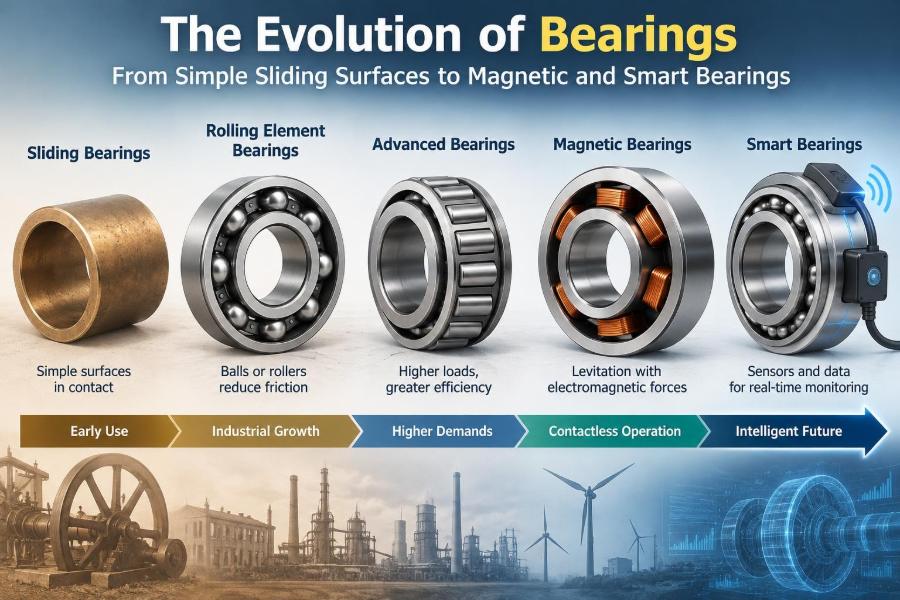

A bicycle wheel that coasts smoothly, a ceiling fan that starts without a groan, and a jet engine rotating at extreme speed all depend on the same deceptively modest component: the bearing. When it works well, it is nearly invisible. When it fails, friction, heat, vibration, noise, and downtime quickly become impossible to ignore.
Bearings do not create motion; they make controlled motion practical. They support loads, keep moving parts aligned, and reduce resistance between surfaces that must rotate, slide, or oscillate relative to one another.
The story of bearing development is also a story of changing engineering priorities. Early machines needed a durable surface that could survive rubbing. Modern systems may demand micron-level positioning, contamination resistance, remote condition monitoring, or operation without conventional lubrication.
Following that progression makes it easier to choose bearings intelligently rather than treating them as interchangeable catalog parts.
🧭 What a Bearing Actually Does
A bearing is an element that constrains relative motion between components while allowing a desired direction of movement. A shaft in a motor, for example, needs to rotate freely but should not drift sideways, sag under load, or rub the housing.
Most bearings perform three jobs at once: they carry load, guide motion, and manage friction. Their design determines which loads they handle best, how fast they can move, what environment they tolerate, and how accurately they hold position.
🪵 The Earliest Sliding Surfaces
The oldest practical bearings were plain sliding interfaces: a wooden sled moving over logs, an axle turning in a wooden block, or a lubricated stone support beneath a rotating object. The principle was simple: replace uncontrolled rubbing with a deliberately shaped contact surface.
These arrangements did not eliminate friction. They made it predictable enough for people to move loads and build rotating machines. Material choice, surface finish, and access to oil or grease were already central concerns.
🛷 Rollers Before Precision Machinery
Placing cylindrical rollers beneath a heavy load reduces sliding by allowing rolling motion. The idea is familiar from moving furniture across pipes, but it also foreshadowed roller bearings used in industrial equipment.
Early rolling arrangements were difficult to retain and align. Rollers could skew, escape, or create uneven loading. A useful bearing therefore needed more than rolling elements; it needed races, guidance, and a way to distribute load reliably.
🔥 Why Sliding Friction Creates Trouble
In a plain bearing, two surfaces move across one another. Microscopic surface peaks, called asperities, interact even when the parts appear smooth. Their contact converts mechanical energy into heat and can remove material through wear.
Higher load or speed can intensify this problem. Excess heat may thin a lubricant, distort parts, or damage a soft bearing lining. The engineering goal is not always to achieve the lowest possible friction, but to maintain stable, manageable friction throughout operating conditions.
🧴 Lubrication Changed the Game
Lubrication separates or partly separates moving surfaces with a film of oil, grease, water, air, or another fluid. This film reduces direct contact and carries heat away from the loaded zone.
Three lubrication regimes are especially useful to understand:
- Boundary lubrication: surface contact remains significant; lubricant chemistry and anti-wear additives matter greatly.
- Mixed lubrication: a fluid film carries part of the load, while some asperity contact remains.
- Full-film lubrication: a continuous fluid film separates the surfaces, greatly reducing solid-to-solid contact.
Real machines may move through these regimes during startup, shutdown, temperature changes, or load variation.
🌊 Hydrodynamic Plain Bearings
A hydrodynamic journal bearing uses shaft rotation to draw lubricant into a converging wedge-shaped gap. Pressure develops in the oil film and supports the shaft without routine metal-to-metal contact during stable operation.
This principle suits large turbines, compressors, marine propulsion equipment, and engine crankshafts. Such bearings can carry substantial loads quietly, but they depend on correct clearance, oil viscosity, speed, and supply conditions.
🧱 Materials Made Plain Bearings Practical
Plain bearings are often made from materials selected to protect the shaft and tolerate imperfect conditions. Bronze, babbitt-type white metals, sintered metals, polymers, and composite liners each offer different combinations of embeddability, strength, low friction, and chemical resistance.
A softer lining can trap small contaminants rather than scoring a more expensive shaft. That benefit has limits: excessive dirt, misalignment, or lubricant loss can overwhelm even a forgiving material.
⚪ The Rise of Ball Bearings
Ball bearings place spherical rolling elements between inner and outer rings, called races. Because balls roll rather than slide through most of their path, they generally offer low starting and running torque.
The geometry also makes them compact and versatile. Deep-groove ball bearings are common in electric motors, pumps, wheels, appliances, and small machines because they can carry radial load and a moderate amount of axial, or thrust, load.
🧰 Precision Manufacturing Enabled Rolling Bearings
Rolling bearings became dependable only when manufacturers could produce hard, accurately shaped races and rolling elements with closely controlled dimensions. Small errors in roundness, surface finish, or heat treatment can concentrate stress and shorten service life.
Modern bearing performance relies on a system of precision: material cleanliness, hardened surfaces, controlled internal clearance, cage design, lubrication, sealing, and proper mounting. A ball bearing is not merely a ring filled with balls.
🧮 Understanding Radial and Axial Loads
A radial load acts perpendicular to a shaft centerline, as the weight of a pulley acts on its shaft. An axial load acts along the shaft centerline, as a propeller thrusts against its support or a helical gear generates end force.
Many bearing failures begin with a mismatch between load direction and bearing type. A bearing selected only by its radial load rating may be unsuitable if thermal expansion, belt tension, gear forces, or assembly preload create substantial axial loading.
📌 The Main Rolling-Bearing Families
| Type | Typical strength | Common limitation | Typical applications |
|---|---|---|---|
| Deep-groove ball | Low friction; radial and moderate axial load | Less suitable for very heavy loads | Motors, pumps, fans |
| Angular-contact ball | Combined radial and axial loading; stiffness | Mounting orientation and preload matter | Machine-tool spindles, pumps |
| Cylindrical roller | High radial load capacity | Limited axial capacity in many designs | Gearboxes, large motors |
| Tapered roller | High combined loads | Requires careful adjustment | Wheel hubs, transmissions |
| Spherical roller | Heavy loads and misalignment tolerance | Higher friction than many ball bearings | Conveyors, mining equipment |
These categories overlap in practice, but the table highlights why “a bearing is a bearing” is a costly assumption.
📐 Contact Geometry Controls Performance
Balls contact races over very small, highly stressed regions. Rollers spread load over a longer contact zone, which usually gives them greater radial load capacity for a comparable size.
That does not make roller bearings universally better. Ball bearings can operate at high speeds with low torque, while rollers may generate more internal friction. Designers balance contact stress, speed, stiffness, available space, and required life.
🧲 Cages Keep Rolling Elements Orderly
The cage, also called a retainer, separates balls or rollers and guides their movement. Without it, rolling elements may rub one another, bunch together, and create excess heat or erratic motion.
Cage materials include steel, brass, and engineered polymers. The right choice depends on speed, temperature, lubrication, chemical exposure, and acceleration. A cage is small, but its failure can rapidly damage an otherwise sound bearing.
🎯 Internal Clearance and Preload
Internal clearance is the small amount of relative movement available between rings before mounting and operation. It changes when interference fits, temperature differences, and loads alter the geometry.
Preload intentionally removes clearance by applying a controlled internal load. It improves stiffness and positioning accuracy in applications such as precision spindles, but excessive preload creates heat and reduces fatigue life. The target is controlled rigidity, not maximum tightness.
🌡️ Heat and Thermal Expansion
A rotating shaft often becomes hotter than its housing. Because metal expands with temperature, the shaft can grow more than the outer ring, reducing bearing clearance and potentially creating harmful preload.
Many assemblies therefore use a locating bearing to control axial position and a floating bearing to allow thermal growth. This arrangement is common in long shafts and machinery with meaningful temperature gradients.
🧼 Seals, Shields, and Contamination Control
Lubricant cannot protect a bearing effectively if abrasive particles or water continually enter the contact zone. Contamination dents raceways, degrades lubricant, and accelerates wear.
Shields offer non-contact protection with low drag, while contact seals generally provide stronger exclusion at the cost of added friction and heat. The correct choice depends on environment: a clean high-speed motor and a muddy agricultural wheel face different threats.
💧 Grease Versus Oil Lubrication
Grease is oil held in a thickener. It is convenient, stays near the bearing, and suits many sealed-for-life or periodically lubricated applications. However, too much grease can churn, raising temperature and wasting energy.
Oil carries heat away more effectively and supports circulation, filtration, and condition monitoring. It is common in gearboxes and high-speed systems, but requires reservoirs, seals, and a reliable delivery method. Neither lubricant is automatically superior.
🧪 Common Bearing Failure Mechanisms
Fatigue damage often appears as pitting or flaking on raceways after repeated contact stress. Other mechanisms include corrosion, false brinelling from vibration at rest, electrical erosion, cage damage, and wear caused by inadequate lubrication.
“Bearing failure” is frequently the final symptom rather than the original cause. Misalignment, a bent shaft, contamination, improper fit, incorrect lubricant, excessive belt tension, or an electrical grounding problem may have started the chain of damage.
📳 Vibration as an Early Warning
A damaged rolling surface produces characteristic vibration as rolling elements pass over defects. Monitoring vibration can reveal changes before the bearing seizes or causes collateral damage.
Interpretation requires care. Imbalance, looseness, gear mesh, cavitation, and structural resonance can also create vibration. Condition monitoring works best when technicians compare trends, operating conditions, and multiple signals rather than reacting to one reading alone.
🔊 Sound, Temperature, and Lubricant Clues
A new rumble, whine, or periodic clicking may indicate a developing issue, especially when it changes with speed or load. Rising temperature can signal excessive preload, lubricant problems, or a damaged bearing, but it can also reflect normal changes in process duty.
Oil analysis can reveal contamination, wear particles, moisture, and lubricant degradation in circulating systems. These tools do not replace inspection; they help prioritize it and reduce unplanned shutdowns.
🔧 Installation Is Part of the Design
A high-quality bearing can be ruined during installation. Force should be applied only to the ring being fitted: press the inner ring when mounting it on a shaft, and press the outer ring when fitting it into a housing.
Driving installation force through rolling elements can dent raceways. Other common errors include striking rings with inappropriate tools, mixing up matched bearing sets, neglecting cleanliness, and setting tapered-roller adjustment by guesswork rather than procedure.
🛠️ Fits, Alignment, and Shaft Quality
Interference fits prevent a loaded ring from creeping on its seat, but too much interference can reduce internal clearance or overstress a thin ring. Loose fits can permit fretting, a damaging oscillatory wear process that creates reddish debris.
Shaft shoulders, housing bores, fillet radii, surface finish, and runout all matter. Misalignment causes uneven contact and edge loading, so engineers may use self-aligning designs when structural deflection or mounting accuracy cannot be controlled tightly.
🌬️ Air Bearings for Ultra-Clean Motion
Air bearings use a thin pressurized gas film to support motion with extremely low friction and no oil contamination. They are used in selected precision measuring systems, semiconductor-related equipment, and high-speed spindles.
The advantages come with demanding requirements. Air supply quality, stiffness, load capacity, and vulnerability to sudden contact must all be considered. They are specialized solutions, not a direct replacement for ordinary rolling bearings.
🧲 Magnetic Bearings Remove Mechanical Contact
Active magnetic bearings use electromagnets, sensors, and control electronics to levitate a rotating shaft. With no physical contact during normal operation, they avoid conventional rolling contact and can operate at very high speeds in sealed or vacuum environments.
Because magnetic levitation is inherently unstable without control, the system continuously measures position and adjusts electromagnetic force. Auxiliary touchdown bearings are commonly included to protect the machine during startup, shutdown, or a control-system fault.
⚡ Where Magnetic Bearings Make Sense
Magnetic bearings are useful in applications where oil contamination is unacceptable, where extremely high shaft speed is required, or where monitoring and controllability justify system complexity. Certain compressors, vacuum systems, and specialized energy equipment fit this profile.
They require power electronics, sensors, robust controls, and a plan for loss of power. Their value comes from solving a specific system problem, not from being technologically newer than rolling or fluid-film alternatives.
🧠 Smart Bearings and Embedded Sensing
A smart bearing combines bearing hardware with sensing or connected monitoring. Depending on the design, it may track temperature, vibration, speed, load-related signals, lubrication condition, or electrical behavior.
The bearing itself does not become infallible. Instead, it becomes a source of operational data that can support maintenance planning. The most useful systems establish a normal baseline, flag meaningful deviations, and connect alerts to an inspection decision.
📡 The Limits of Predictive Maintenance
Predictive maintenance can reduce unnecessary replacement and help avoid surprise failures, but data quality matters. A sensor placed poorly, a changing operating duty, or an alarm threshold copied from another machine can create false alarms or missed warnings.
Successful programs combine sensor data with machine history, operator observations, lubrication records, and an understanding of failure modes. A dashboard is not a maintenance strategy unless people know what action each condition should trigger.
♻️ Efficiency, Reliability, and Life-Cycle Thinking
A bearing decision affects more than purchase price. Friction influences energy use, seal selection affects contamination risk, lubrication affects maintenance labor, and bearing life affects production availability.
Life-cycle thinking asks practical questions: Can the bearing be mounted correctly? Can it be relubricated without introducing dirt? Is a standard replacement available? Will a higher-efficiency design repay its added cost under actual operating hours and loads?
🧭 Choosing the Right Bearing System
Selection starts with the motion and load case, then expands to the environment and maintenance reality. Useful questions include:
- What radial, axial, shock, and moment loads will occur?
- What speed, duty cycle, temperature range, and required stiffness apply?
- Will contamination, moisture, corrosive chemicals, current leakage, or vacuum be present?
- How will lubrication, sealing, mounting, inspection, and replacement be handled?
The best choice is often the simplest bearing that meets these conditions with reasonable margin and can be supported throughout its service life.
🚫 Mistakes That Shorten Bearing Life
Several habits repeatedly create avoidable problems:
- Choosing by outside diameter alone rather than by load and duty.
- Over-greasing in the belief that more lubricant always protects better.
- Ignoring housing distortion or shaft misalignment.
- Reusing contaminated lubricant or handling bearings with dirty tools.
- Replacing a failed bearing without investigating why it failed.
A replacement bearing may run briefly under the same harmful conditions, then fail in the same way. Root-cause analysis is usually less expensive than repeated replacement.
🔭 What the Evolution Teaches Engineers
Bearings evolved from shaped sliding surfaces to rolling elements, fluid films, gas films, magnetically levitated rotors, and sensor-equipped assemblies. Each development addressed a different limitation: friction, wear, speed, load, contamination, precision, or uncertainty about condition.
The central lesson is not that newer technology always wins. A robust plain bearing may be ideal for a heavily loaded turbine; a sealed ball bearing may be right for a fan; an active magnetic bearing may be justified in a high-speed, oil-free system. Good bearing engineering matches the support method to the machine, its environment, and the consequences of failure.
From a lubricated wooden axle to a sensor-guided magnetic rotor, bearings show how careful control of contact and motion enables almost every kind of machine. Choosing, installing, and monitoring them thoughtfully turns a small component into lasting reliability. ⚙️🔩📈