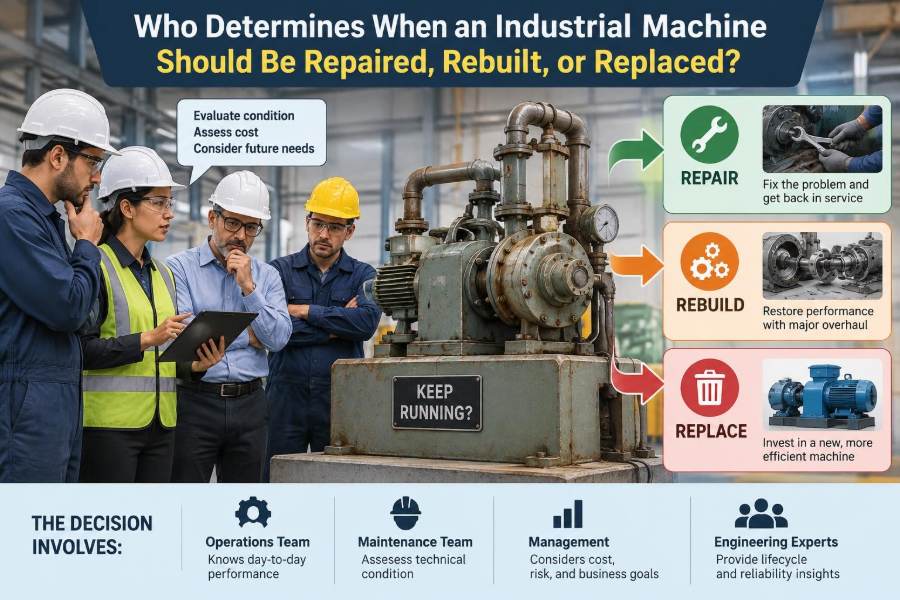

A production line stops halfway through a shift. A pump begins to vibrate more than usual. A gearbox needs its third major repair in two years. The question arrives quickly: should the machine be fixed again, rebuilt properly, or removed from service for good?
That decision is rarely made by one person looking at one fault report. It combines technical evidence, safety obligations, production needs, available money, and an honest view of how much useful life the equipment still has.
For maintenance teams, the wrong choice can be costly in different ways. Repairing a machine that is near the end of its life can create repeated downtime. Replacing a machine too early can tie up capital that could have solved a more urgent reliability problem.
The useful question is not simply, “Can it be repaired?” Almost any machine can be repaired in some form. The better question is: which option delivers safe, reliable, and economically sensible service for the required duty?
🏭 The decision is a business and engineering judgment
Repair, rebuild, and replacement are distinct asset-management decisions. They should be based on evidence, but evidence must be interpreted in the context of the plant’s goals.
A maintenance manager may focus on reliability and spare-parts availability. A production manager may focus on output and shutdown windows. Finance may examine cash flow and long-term cost. Engineering assesses whether the machine can still meet its design duty safely.
No single viewpoint is sufficient. A sound decision brings these perspectives together rather than allowing the lowest immediate repair quotation to decide the outcome.
👥 Who usually has authority to decide?
Authority varies by organization, machine criticality, and spending limits. Routine repair decisions may sit with a maintenance supervisor, while major rebuilds and replacements often require approvals from plant management, engineering, procurement, and finance.
For safety-critical equipment, the decision may also require review by a competent engineer, inspection authority, insurer, regulator, or the equipment manufacturer. Local laws, industry codes, and the site’s management-of-change process can set additional requirements.
The person who signs the purchase order is not necessarily the person who determines the technical answer. Good organizations separate technical recommendation from financial authorization, while ensuring both are informed by the same facts.
🧭 Start by defining the machine’s required duty
A machine cannot be judged only by its age or appearance. It must be compared with what the operation actually needs it to do.
Required duty may include flow, pressure, torque, speed, accuracy, temperature range, cycle time, cleanliness, product quality, and expected operating hours. A ten-year-old machine that reliably meets these requirements can be more valuable than a newer machine that cannot.
Operating conditions matter too. A pump handling clean water faces a different life profile from an otherwise similar pump exposed to abrasive slurry, corrosive chemicals, or frequent dry running.
🔍 Gather facts before choosing a remedy
A decision should begin with a clear failure description, not an assumption. “The compressor is failing” is too broad. Is it overheating, consuming oil, surging, leaking, losing capacity, or tripping on vibration?
Useful evidence can include operator observations, work orders, downtime records, inspection findings, alarm histories, oil analysis, vibration data, electrical test results, dimensional checks, and process trends. The quality of the decision cannot exceed the quality of the information behind it.
Where evidence is incomplete, the team should state its uncertainty. A short diagnostic investigation may be cheaper than committing to a major repair based on a mistaken failure diagnosis.
🩺 Condition monitoring reveals what cannot be seen
Condition monitoring measures indicators of developing damage while equipment is operating or during planned inspections. It helps teams move beyond guesses based on age.
Common methods include vibration analysis for rotating machinery, infrared thermography for abnormal heat, ultrasonic monitoring for leaks or bearing defects, lubricant analysis for wear debris, and motor-current analysis for some electrical and mechanical faults.
These tools do not automatically prescribe replacement. They indicate condition and trends. A rising vibration level, for example, may result from misalignment that is readily repairable, or from damage that points to a deeper rebuild decision.
📈 Failure history changes the economic picture
One failure does not always mean a machine is worn out. A failed seal may be an isolated event caused by improper installation, a process upset, or a temporary lubrication problem.
Repeated failures of the same subsystem deserve closer attention. They can indicate an unresolved root cause, such as shaft runout, poor foundation stiffness, contamination, overload, inadequate cooling, or a design mismatch.
Maintenance records should distinguish between random failures and recurring patterns. Otherwise, a site can spend years replacing the same components without correcting the condition that destroys them.
🌳 Root cause comes before repair scope
Root-cause analysis asks why an event happened, rather than only what part broke. The depth of analysis should match the consequence of failure and the cost of recurrence.
Consider a hypothetical conveyor drive that repeatedly shears couplings. Replacing each coupling is a repair, but it may not solve the problem. Misalignment, an oversized motor, sudden load impacts, binding rollers, or an incorrectly set torque limiter could be responsible.
A repair plan that ignores root cause often creates a false sense of progress. The machine returns to service, but the next failure has already been prepared by the unchanged operating condition.
🛠️ What counts as a repair?
A repair restores a specific failed or degraded element so that the machine can return to acceptable service. Examples include replacing bearings, seals, belts, contactors, hoses, worn wear plates, or a damaged motor.
Repair is usually appropriate when the fault is localized, the main structure remains sound, replacement parts are available, and the rest of the machine has adequate remaining life. It is commonly the fastest and least capital-intensive option.
However, “least expensive now” is not the same as “least expensive over the next several years.” A low-cost repair can be a poor choice when it only postpones a predictable and disruptive outage.
🔧 What a rebuild really involves
A rebuild is more extensive than a repair. It restores, renews, or upgrades major assemblies to return the machine close to a defined condition or performance level.
A typical rebuild may include complete disassembly, cleaning, non-destructive examination where appropriate, dimensional measurement, replacement of wear parts, machining or reconditioning of major components, alignment, balancing, controls modernization, and documented testing.
The word “rebuilt” can mean different things to different suppliers. The scope should therefore be written precisely: which components are renewed, which are inspected only, what tolerances apply, what tests will be performed, and what warranty or acceptance criteria are offered.
🏗️ Replacement is more than buying a new machine
Replacement means retiring the existing asset and installing another machine, whether new, remanufactured, or transferred from elsewhere in the organization. It can solve obsolescence, capacity limits, safety deficiencies, and chronic unreliability.
But a replacement project includes more than equipment price. It may require foundations, piping, wiring, controls integration, guarding, operator training, spare parts, commissioning, and changes to upstream or downstream processes.
A new machine can introduce new risks as well. Its controls may be unfamiliar, its performance assumptions may not match actual process conditions, and installation errors can prevent it from delivering its expected benefits.
⚖️ Compare the options on the same basis
Teams make clearer choices when repair, rebuild, and replacement are compared against common criteria rather than discussed as competing preferences.
| Decision factor | Repair often suits | Rebuild often suits | Replacement often suits |
|---|---|---|---|
| Fault condition | Localized and understood | Widespread wear, sound basic design | Structural, design, or obsolescence issues |
| Remaining life | Substantial life remains | Life can be restored predictably | Life is uncertain or inadequate |
| Production need | Short return-to-service needed | Planned outage is available | Higher capacity or capability is required |
| Supportability | Parts and skills readily available | Key components can be renewed | Parts, software, or expertise are disappearing |
| Risk profile | Consequences are manageable | Risks can be engineered out | Existing risks cannot be acceptably controlled |
The table is a guide, not a rule. A critical machine with a seemingly localized fault may still justify replacement if its failure consequences are severe and its support is uncertain.
💰 Look beyond the repair invoice
Decision-makers should consider the full cost of each option over an appropriate planning period. This is often called life-cycle cost or total cost of ownership.
Relevant costs may include labor, materials, contractor support, lost production, energy consumption, quality losses, emergency freight, inventory carrying cost, planned shutdown time, disposal, and the future maintenance burden.
Estimating these costs involves uncertainty. It is better to use transparent assumptions and test a few plausible scenarios than to present an overly precise forecast that hides weak inputs.
⏱️ Downtime has different meanings in different plants
For a standby pump with a healthy parallel unit, a repair may be scheduled conveniently. For a single-point-of-failure machine in a continuous process, even a short stoppage can affect production, product quality, delivery commitments, or safe process control.
Downtime cost is not always direct lost sales. It can include startup waste, cleanup, overtime, delayed maintenance elsewhere, and the loss of a planned shutdown window.
This is why maintenance and production teams must jointly define the practical cost of outage. Neither group can calculate it accurately in isolation.
🛡️ Safety can override an attractive cost case
Equipment with damaged pressure boundaries, compromised guarding, unreliable emergency functions, unstable structures, or serious electrical hazards requires careful evaluation. A cheap repair is not acceptable if it cannot restore safe operation.
Safety decisions should follow applicable requirements, documented risk assessment, and competent technical judgment. If the site lacks the necessary expertise, external engineering or manufacturer support may be needed.
It is also worth separating a machine’s inherent design limitations from deterioration. A rebuild may restore worn components, but it cannot automatically make an outdated or fundamentally unsafe design acceptable.
📜 Compliance and inspection requirements matter
Pressure equipment, lifting equipment, electrical systems, emissions-control devices, and certain process machines may be subject to specific inspection, certification, or modification requirements. The exact obligations depend on jurisdiction and application.
A repair that changes material, capacity, controls, protective devices, or operating limits can trigger a more formal review than like-for-like maintenance. Documentation protects both the organization and the people who work around the equipment.
When uncertainty exists, treat compliance as a design question to be checked early, not paperwork to be completed after the machine is already rebuilt.
📦 Obsolete parts can decide the issue
A mechanically sound machine can become difficult to keep in service when critical drives, sensors, circuit boards, software, or proprietary components are no longer supported. Salvaged parts may keep it running temporarily, but they create supply and quality uncertainty.
Obsolescence does not always demand full replacement. A controls retrofit, motor upgrade, or reverse-engineered mechanical component may extend useful life if the base machine remains robust.
The key question is whether the organization can reasonably support the asset for its intended future role. A machine dependent on one unknown used part is not truly reliable.
⚡ Energy and process performance deserve a place
Newer equipment may use less energy, deliver more consistent output, or provide better control. These benefits can matter, especially for machines that run many hours or strongly influence product quality.
Still, claimed improvements should be checked against actual duty. A highly efficient pump will not perform efficiently if it is selected far from its normal operating point. A faster packaging machine may not increase line output if another station remains the bottleneck.
Replacement is strongest when it solves a verified performance gap, not when modern features are assumed to create value automatically.
🎯 Machine criticality sets the decision threshold
Criticality describes the consequence of a machine’s failure. It commonly considers safety, environment, production, quality, repair time, redundancy, and customer impact.
A low-criticality workshop fan may be repaired when convenient. A compressor feeding instrument air, a boiler feed pump, or a primary material-handling drive may require more conservative decisions because failure affects much more than the unit itself.
Criticality should influence inspection frequency, spare-parts strategy, contingency planning, and how much uncertainty the organization is willing to accept after repair.
🔩 Assess the condition of the base structure
Machines are not collections of replaceable parts only. Frames, casings, shafts, pressure-containing bodies, foundations, and bedplates determine whether a meaningful rebuild is possible.
Cracks, corrosion loss, distorted housings, worn fits, repeated weld repairs, and foundation movement can indicate that component replacement alone will not restore dependable service. In some cases, specialist repair is possible; in others, replacement is the more defensible path.
Measurements matter. A rebuild decision should not rest solely on visual impressions when alignment, clearances, concentricity, or wall thickness determine serviceability.
🧪 Test the repaired or rebuilt machine
Work is not complete when the last bolt is tightened. The machine should be tested against agreed acceptance criteria before routine production depends on it.
Depending on the asset, this may include leak testing, electrical checks, no-load running, load testing, vibration baseline measurement, alignment verification, functional safety checks, performance testing, and operator trials.
A documented baseline is valuable after return to service. It provides a reference for future condition monitoring and helps distinguish new deterioration from normal operating behavior.
📝 Define acceptance criteria before work begins
Ambiguous expectations are a frequent source of disputes and disappointment. Before a major repair or rebuild, the owner and service provider should define what “successful” means.
- Required operating duty and allowable operating range
- Components to be replaced, restored, or inspected
- Applicable drawings, tolerances, and material requirements
- Testing methods and pass/fail criteria
- Documentation, parts traceability, and warranty terms
- Responsibilities for installation, commissioning, and follow-up support
Clear criteria also help prevent scope creep. If inspection reveals additional damage, the team can evaluate the new work openly instead of treating it as an assumption hidden inside the original estimate.
🤝 Operators provide evidence engineers may miss
Operators often notice changes before instruments show a clear alarm: a different sound, slower response, unusual smell, increased adjustment, or changes in product behavior. Their observations should be captured in a usable form.
At the same time, anecdotal reports need verification. A machine that “always runs hot” may have a normal operating temperature, a faulty sensor, or a genuine cooling problem. The best approach respects operator experience and checks it with measurements.
Involving operators in decisions also improves startup after a repair or replacement. They understand practical access, cleaning demands, changeover issues, and process behaviors that drawings may not show.
🏭 Maintenance, engineering, and finance have different roles
Maintenance typically owns day-to-day condition knowledge and repair execution. Reliability or asset engineers analyze failure mechanisms, risk, and long-term performance. Production defines operational consequences. Finance evaluates affordability and investment governance.
Conflict is not automatically a problem. It becomes useful when it exposes assumptions: whether a repair will truly last, whether output is genuinely constrained, or whether a replacement’s benefits justify its installed cost.
A cross-functional review should end with a documented recommendation, assumptions, risk controls, and a named decision authority. That creates accountability without pretending that uncertainty has disappeared.
🧮 Use simple decision tools without hiding judgment
A decision matrix can help teams compare options consistently. Criteria such as safety, reliability, cost, lead time, energy, supportability, and process capability can be weighted according to plant priorities.
Such tools are useful because they make trade-offs visible. They are not substitutes for engineering judgment. A scoring sheet cannot make an unsafe option acceptable merely because it scores well on cost and delivery.
For larger investments, organizations may also compare cash flows over time. The model should show its assumptions clearly, especially expected operating life, downtime exposure, maintenance cost, and energy use.
🚧 Beware the sunk-cost trap
The sunk-cost trap occurs when past spending is used to justify more spending, even though that earlier money cannot be recovered. “We have already repaired it so much” can lead either to unnecessary replacement or to continuing repairs for the wrong reason.
The relevant question is forward-looking: what will each option cost and deliver from this point onward? Past history still matters because it reveals reliability patterns, but it should not become an emotional reason to continue or abandon an asset.
Likewise, a recent expensive overhaul deserves a technical review if replacement is proposed soon afterward. The aim is not to defend the past decision; it is to understand why expected life was not achieved.
🔄 Plan repairable assets for their whole life
The best time to think about rebuildability is often before the machine is purchased. Equipment selection should consider access for maintenance, standardization of bearings and motors, availability of drawings, diagnostic capability, and supplier support.
Maintaining accurate asset records makes later decisions stronger. Useful records include original specifications, modifications, inspection reports, repair scopes, failure history, operating hours, and current spare-parts status.
This creates an asset life plan rather than a series of emergencies. The organization can schedule major overhauls, budget replacements, and hold strategic spares before a crisis forces a rushed decision.
🚨 Emergency repairs require a second decision later
During a breakdown, restoring service safely may be the immediate priority. A temporary repair can be justified when it is controlled, documented, and followed by a defined permanent-action review.
The danger is allowing temporary arrangements to become permanent through habit. Bypassed alarms, improvised supports, borrowed components, and repeated patches can gradually normalize unacceptable risk.
After emergency work, review what failed, what was changed, what operating restrictions apply, and when the machine must receive its final repair, rebuild, or replacement solution.
📅 Timing the work can be as valuable as selecting it
A technically correct rebuild can still be a poor operational choice if it is scheduled during peak demand without adequate contingency. Conversely, a planned shutdown may be the ideal opportunity to complete work that would be too disruptive at another time.
Lead times matter. Replacement often requires design, procurement, fabrication, delivery, installation, and commissioning. If failure is likely before that sequence can finish, an interim repair or spare-machine strategy may be necessary.
Good planning turns a forced outage into a controlled intervention. It also gives teams time to inspect related systems that could shorten the life of the renewed equipment.
🧰 Common mistakes that distort the choice
Several patterns repeatedly lead to weak decisions:
- Choosing only by the lowest initial quotation
- Replacing parts without finding the failure mechanism
- Using machine age as the sole indicator of condition
- Assuming new equipment will solve process problems automatically
- Ignoring installation, controls, training, and commissioning costs
- Accepting vague rebuild scopes and undefined performance tests
- Failing to involve operators, safety personnel, or process engineers
Each mistake narrows the question too far. The decision concerns a working system, not merely a damaged component or a purchase transaction.
📌 A practical sequence for making the call
A disciplined sequence can prevent rushed, opinion-driven decisions:
- Make the equipment safe and stabilize the immediate situation.
- Define the required duty, operating constraints, and criticality.
- Diagnose the fault and identify likely root causes.
- Inspect the machine’s overall condition and supportability.
- Develop repair, rebuild, and replacement scopes that are genuinely comparable.
- Evaluate safety, compliance, downtime, cost, risk, and future capability.
- Obtain appropriate technical and financial approvals.
- Execute, test, document, and monitor the chosen solution.
This sequence can be scaled. A small noncritical pump does not need the same analysis as a major process compressor, but the underlying logic remains useful.
🌟 The core principle: choose the best future service
The central decision is not about loyalty to old machinery or enthusiasm for new equipment. It is about selecting the option that provides the required future service at an acceptable level of safety, risk, and cost.
Repair is sensible when a known, localized defect can be corrected and the asset retains useful life. Rebuild is sensible when the machine’s foundation is sound but major systems need planned renewal. Replacement is sensible when condition, capability, safety, supportability, or economics make continued ownership difficult to justify.
The people who determine the outcome should combine evidence from the shop floor with engineering analysis and organizational priorities. Their most valuable contribution is not simply approving a choice; it is making the reasoning visible enough to be challenged, improved, and trusted.
Industrial machines should be repaired, rebuilt, or replaced according to their future ability to perform safely and reliably—not according to age, habit, or the cheapest immediate quote. ⚙️🛠️📈