
A production machine starts showing its age in familiar ways: an actuator leaks, a gearbox runs hot, quality drifts, and maintenance calls become more frequent. The first reaction is often simple: replace it.
But replacement is not always the lowest-risk or lowest-cost choice. A well-built machine may still have a sound frame, useful process capability, and years of service left—if its worn systems can be restored or improved intelligently.
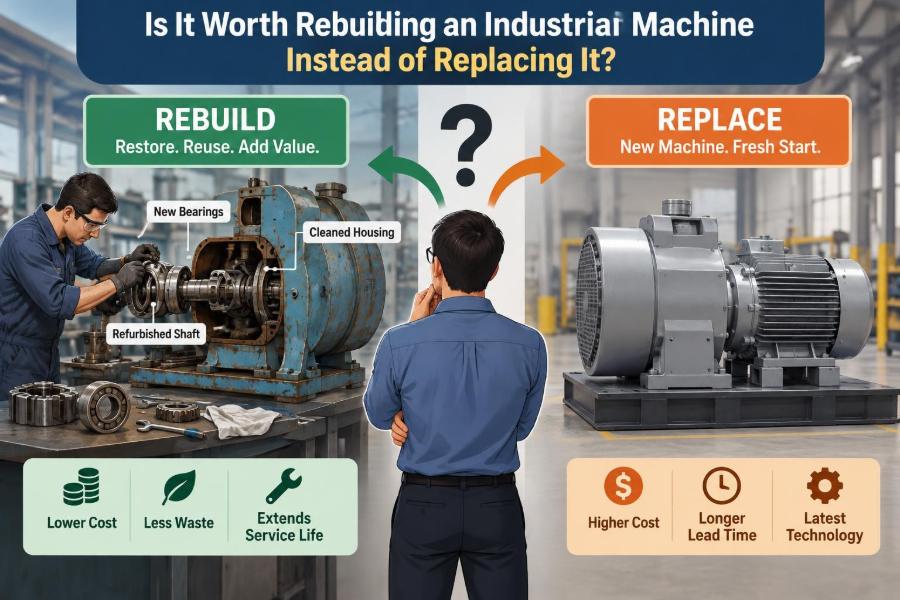
Rebuilding, remanufacturing, retrofitting, and replacing are different decisions with different technical and business consequences. Choosing well requires more than comparing purchase prices.
The real question is whether the machine can return to reliable, safe, capable operation at a cost, timeline, and risk level that makes sense for the operation.
🔍 Start With the Decision, Not the Breakdown
A failure creates urgency, and urgency can distort judgment. A failed spindle or obsolete drive may be the immediate problem, but it does not automatically mean the entire machine is finished.
Frame the choice as a lifecycle decision: should the organization repair one fault, rebuild major systems, modernize controls, purchase a new machine, or change the process altogether? Each option solves a different problem.
A rebuild is worthwhile only when it addresses the causes of poor performance, not merely the most visible symptom.
🏭 What “Rebuilding” Actually Means
In industrial practice, rebuilding usually means disassembling a machine far enough to inspect, repair, replace, or recondition its major mechanical elements. This can include bearings, shafts, gears, ways, seals, hydraulic components, wiring, guarding, and alignment features.
The scope varies widely. One project may restore a press gearbox and lubrication system; another may strip a CNC machine to its base, regrind guideways, replace ballscrews, and install new electrical controls.
A rebuild is not automatically a return to original condition. It can also be an opportunity to correct known design weaknesses.
🧩 Rebuild, Retrofit, Repair, and Remanufacture
These terms are often used loosely, but separating them prevents confusion during planning and vendor discussions.
| Approach | Main purpose | Typical scope |
|---|---|---|
| Repair | Restore a failed function | Replace or fix the faulty component |
| Rebuild | Restore mechanical condition | Major disassembly, inspection, renewal, alignment |
| Retrofit | Upgrade capability or controls | New drives, PLC, sensors, safety systems, software |
| Remanufacture | Return equipment to a defined specification | Comprehensive restoration, testing, and documentation |
Many successful projects combine rebuilding and retrofitting. Mechanical restoration without reliable controls may leave a machine limited; new controls on worn mechanical foundations can create a different set of problems.
📉 Recognize the Cost of Keeping a Weak Machine
The visible repair invoice is rarely the full cost. A machine with recurring failures also consumes maintenance labor, spare parts, setup time, lost production, scrap, expedited shipping, and supervisory attention.
Some losses are difficult to see because they appear as routine workarounds. Operators may slow the machine, inspect parts more often, or avoid certain product variants. Those actions can hide declining capability while reducing throughput.
Before deciding, document downtime events, defect patterns, repair history, and production constraints. The record often reveals whether the issue is isolated or systemic.
💰 Compare Total Cost of Ownership
The purchase price of a new machine is only one part of replacement cost. Installation, foundations, utilities, tooling, operator training, commissioning, integration, and production interruption can be substantial.
Likewise, a rebuild quote is not its total cost. The project may uncover hidden damage, require temporary production arrangements, or need upgrades to meet current safety expectations.
A useful comparison considers the expected cost of owning and operating each option over a common planning period. Include reasonably foreseeable maintenance, energy use, staffing effects, consumables, downtime exposure, and end-of-life value.
⏱️ Downtime Can Decide the Case
A new machine can take significant time to specify, procure, ship, install, and qualify. A rebuild may be faster when parts and specialist capacity are available, especially if work can occur during a planned shutdown.
However, rebuilding is not always the quicker route. Deep disassembly can expose cracked castings, unavailable components, severe corrosion, or undocumented prior modifications. Those discoveries can extend the schedule.
Ask for a schedule that identifies critical-path items: long-lead motors, control hardware, custom gears, machining capacity, site access, and acceptance testing. A date without dependencies is not a dependable plan.
🧱 The Base Structure Must Be Worth Saving
Machine frames, beds, columns, housings, and foundations are the starting point for rebuild viability. Their stiffness and geometric stability determine whether renewed components can perform as intended.
Cast iron structures can remain valuable for decades when they are free from serious cracking, distortion, corrosion damage, or fatigue-related defects. Their mass and damping may even be difficult to replicate economically.
Inspection should look beyond surface appearance. Dimensional checks, non-destructive examination where appropriate, and evaluation of loaded areas help determine whether the structure can support the required accuracy and forces.
📐 Accuracy Is a Functional Requirement
A machine does not need laboratory-level precision to be useful. It needs enough positional accuracy, repeatability, alignment, and stability for its actual process.
For example, a packaging line may tolerate more mechanical variation than a grinding machine. A press may continue producing parts while gradually losing parallelism, yet that drift can affect tooling life and part quality.
Define acceptance criteria before committing to a rebuild. Measure the machine against the tolerances that matter: runout, backlash, straightness, flatness, squareness, cycle repeatability, force consistency, or product dimensions.
⚙️ Wear Patterns Tell a Story
Wear is evidence, not just damage. Uneven guideway wear can indicate poor lubrication, misalignment, overloading, contamination, or a process that repeatedly operates in one location.
Bearings damaged by electrical discharge may point to variable-frequency-drive grounding issues. Repeated seal failures may signal shaft runout, pressure spikes, wrong materials, or heat rather than simply “bad seals.”
If the underlying mechanism is not identified, a rebuild can recreate the same failure pattern with new parts.
🛢️ Lubrication and Contamination Matter More Than They Seem
Many industrial machines deteriorate because lubricant arrives late, in the wrong quantity, or contaminated with particles, moisture, or process fluids. The resulting wear can spread across bearings, gears, valves, and guide surfaces.
A rebuild should review the entire lubrication strategy: reservoir condition, filtration, distribution lines, automatic lubricators, grease compatibility, access points, and maintenance intervals.
Cleanliness during assembly also matters. A carefully rebuilt hydraulic or circulating-oil system can lose reliability quickly if contaminants remain in hoses, reservoirs, and passages.
🔌 Obsolete Controls May Be the Real Constraint
A mechanically sound machine can become difficult to operate because its PLC, motion controller, operator interface, encoder, drive, or power supply is obsolete. A single discontinued board can create unacceptable downtime risk.
Control retrofits can improve diagnostics, spare-parts availability, process monitoring, and integration with plant systems. They may also reduce dependence on undocumented legacy programming.
Yet replacing controls requires disciplined engineering. Electrical drawings, I/O lists, interlocks, sequence logic, motion tuning, and operator workflows must be understood—not guessed from old wiring.
🛡️ Safety Upgrades Are Part of the Scope
Older machines may lack modern guarding, interlocked access doors, emergency-stop architecture, safe motion functions, light curtains, or clear lockout provisions. A rebuild can expose these gaps because guards and electrical systems are already being opened.
Safety requirements depend on the jurisdiction, equipment type, and workplace risk assessment. The project team should involve qualified safety and controls professionals rather than assuming a replacement component alone makes the machine compliant.
Never treat safety work as an optional add-on to be handled after commissioning. It affects design, wiring, guarding, validation, training, and acceptance.
🔧 Spare Parts Availability Changes the Risk Profile
Replacement parts need not be original-equipment parts to be viable. Standard bearings, motors, valves, sensors, and power-transmission components may have dependable alternatives.
The concern is greater when the machine relies on proprietary castings, specialized electronics, undocumented software, or unique tooling. A rebuild may restore today’s machine while leaving tomorrow’s repair dependent on a scarce component.
Create a critical-spares list during the assessment. For each item, identify availability, lead time, interchangeability, technical documentation, and the consequence of failure.
📊 Quantify Reliability, Not Just Age
Age alone is a poor decision criterion. A heavily used machine in abrasive service may be worn out after a relatively short period, while a lightly loaded, well-maintained machine can remain dependable for much longer.
Review the frequency and nature of failures. Are they random and unrelated, suggesting broad deterioration? Or are they concentrated in one system, such as an aging hydraulic power unit or unreliable servo drive?
Metrics such as mean time between failures and mean time to repair can help when maintenance records are credible. They are decision aids, not predictions; operating conditions can change after a rebuild.
📦 Product Demand Must Shape the Investment
A rebuild may be sensible for a stable product family with predictable volumes. It is less attractive if the company expects major changes in part size, material, cycle time, automation level, or quality requirements.
Consider the machine’s role in the value stream. A reliable but slow machine may be adequate in a low-volume cell, yet become a bottleneck in a growing operation.
A hypothetical example: rebuilding a dependable heavy press may be sensible if its dies and product geometry will remain in use. Rebuilding a manual process machine may not be sensible if the business plan requires unattended production and automated inspection.
⚡ Energy Use Deserves a Realistic Look
New equipment can offer more efficient motors, drives, pumps, and standby controls. It may also reduce compressed-air demand or recover energy in certain applications.
But efficiency should be evaluated in context. The energy saved by a newer machine may be modest compared with its capital cost, while a targeted retrofit—such as a variable-speed pump drive or improved insulation—can address the major loss directly.
Measure where practical. Nameplate ratings do not describe every duty cycle, idle period, startup load, or process variation.
🌱 Rebuilding Can Reduce Material Waste
Keeping a usable frame, enclosure, structure, and major mechanical components in service can avoid the material and manufacturing effort involved in producing a complete replacement machine. This is a legitimate advantage of rebuilding.
Still, environmental benefit should not be assumed automatically. A rebuilt machine that wastes energy, creates high scrap rates, leaks fluid, or fails frequently may not be the stronger lifecycle choice.
The best comparison considers both retained embodied material and future operating performance.
👷 Involve Operators and Maintenance Technicians Early
Operators know where the machine jams, drifts, vibrates, or creates awkward setups. Maintenance technicians know which parts are difficult to access, which alarms recur, and where past repairs have failed.
These observations are valuable because machine records rarely capture every nuisance issue. A rebuild specification written only from drawings and management expectations can miss practical failure modes.
Invite frontline input before the scope is frozen, then return the proposed design for review. Small changes to access panels, sensor locations, drain points, or lubrication fittings can have lasting value.
🧾 Build a Defensible Scope of Work
Vague phrases such as “completely rebuild” invite misunderstanding. The scope should identify what will be inspected, replaced, reconditioned, upgraded, tested, and excluded.
It should also state how discoveries will be handled. For example, if inspection finds a damaged housing or undersized motor, who approves the change, what evidence is required, and how will schedule and cost be controlled?
- Document baseline machine condition and known defects.
- Specify required performance and safety outcomes.
- List components to be renewed and systems to be modernized.
- Define drawings, manuals, software backups, and spare parts to be delivered.
- Set change-control and acceptance procedures before work begins.
🔬 Inspect Before You Commit
A preliminary assessment is cheaper than an uncontrolled project. It may include vibration measurements, oil analysis, thermal checks, electrical testing, geometric surveys, visual inspection, and review of maintenance history.
No non-invasive inspection can reveal everything. The purpose is not to promise certainty; it is to reduce unknowns enough to make a reasoned choice and establish contingencies.
For complex machines, staged authorization can be useful: approve teardown and detailed inspection first, then authorize full rebuilding after the condition of critical components is known.
🧮 Use a Decision Matrix Carefully
A weighted decision matrix can make assumptions visible. Score rebuild and replacement against criteria such as reliability, capacity, safety, technical risk, lead time, maintainability, energy use, flexibility, and total cost.
The scores are not objective facts. They reflect judgments, which is exactly why the process is useful: the team can challenge the assumptions instead of hiding them in a single financial estimate.
Do not let a precise-looking spreadsheet conceal uncertainty. Use ranges or scenarios when costs, delivery dates, or future demand are unclear.
🏗️ When Replacement Is Usually the Better Choice
Replacement is often preferable when the core structure is compromised, the machine cannot meet required safety or quality needs, or its capacity is fundamentally too low for the process.
It may also be the stronger choice when critical technology is unsupported and cannot be reasonably retrofitted, when repair access is poor by design, or when recurring failures span several unrelated systems.
A new machine can bring capability that rebuilding cannot create economically: larger work envelopes, substantially faster cycle times, integrated automation, new sensing methods, or a different process principle.
✅ When Rebuilding Is Usually the Better Choice
Rebuilding tends to be attractive when the machine has a robust structure, a well-understood process role, and deterioration concentrated in serviceable systems. It is especially compelling when a replacement would require major changes to foundations, tooling, utilities, or downstream equipment.
It can also make sense for specialized machinery where the original mechanical design closely matches the application and a modern equivalent would need costly customization.
The strongest cases combine mechanical viability with a clear plan for controls, safety, documentation, spares, and future maintenance.
🚧 Beware the “Just One More Repair” Trap
Repeated small repairs can feel cheaper because each authorization is limited. Over time, though, the organization may spend heavily while accepting unreliable output and never solving root causes.
This does not mean every repair is wasteful. A targeted repair is sensible when it restores a healthy asset. The warning sign is a pattern of emergency work on multiple systems without a broader condition assessment.
Set a review trigger, such as recurring failures, growing downtime, loss of process capability, or a hard-to-source critical part. That trigger prompts a strategic decision before the next crisis.
📋 Plan Commissioning and Acceptance Testing
A machine is not successfully rebuilt when it powers on. It must demonstrate safe operation, correct sequences, stable performance, and the required output under realistic conditions.
Factory acceptance testing may be possible before shipment from a rebuild shop. Site acceptance testing then verifies installation, utilities, interfaces, guarding, operator controls, product quality, and performance in the actual production environment.
Acceptance criteria should be measurable and agreed in advance. Include documentation review, training, spare-part handover, and backup copies of programs and parameters.
📚 Documentation Protects the Investment
Old machinery often survives through tribal knowledge: one technician remembers a workaround, another keeps an unofficial wiring sketch, and settings exist only in an operator’s notebook.
A rebuild is the right time to create maintainable records. Update mechanical drawings where changes occur, electrical schematics, hydraulic and pneumatic diagrams, bills of materials, lubrication instructions, preventive-maintenance tasks, and control backups.
Good documentation shortens future troubleshooting and makes the asset less dependent on individual memory.
🧰 Design Maintenance Into the Rebuilt Machine
Reliability after commissioning depends on how the machine is operated and maintained. Specify accessible inspection points, clear lubrication routes, filtered breathers where relevant, condition-monitoring provisions, and sensible spare storage.
Maintenance plans should match the renewed machine, not simply copy an old checklist. New drives, sensors, fluids, seals, or safety devices may require different inspection methods and intervals.
Training should explain not only what tasks to perform, but what abnormal noise, temperature, vibration, leakage, or quality trend should trigger investigation.
🤝 Choose the Rebuild Partner by Capability
Price matters, but a rebuild provider should also be evaluated for engineering depth, machining capability, controls expertise, quality processes, testing facilities, documentation practices, and experience with comparable equipment.
Ask how the provider handles hidden defects, dimensional verification, subcontracted work, software ownership, and warranty boundaries. Inspecting previous work or speaking with references may be appropriate when the project is significant.
A strong provider will ask difficult questions about duty cycle, materials, tolerances, failure history, and safety. Those questions usually indicate that the scope is being engineered rather than merely estimated.
🧠 Make the Decision Under Uncertainty
No evaluation eliminates uncertainty. Machine condition becomes clearer during teardown, future demand can shift, and supply chains can affect either option.
The goal is not a perfect forecast. It is a decision with known assumptions, manageable risk, defined contingencies, and a clear connection to production needs.
Record why the decision was made. That record helps the team manage the project and improves future capital-planning decisions.
🎯 The Core Principle: Restore Value, Not Just Hardware
The rebuild-versus-replace question is not a contest between old and new. It is a test of whether an asset can deliver the required safety, reliability, quality, capacity, and maintainability over its remaining useful life.
Rebuilding can preserve a capable machine, avoid disruptive replacement work, and add modern controls or protections. Replacement can provide a cleaner path when the process has outgrown the equipment or its limitations are structural.
The best choice comes from inspecting the machine honestly, defining the operating need precisely, and comparing complete lifecycle consequences rather than reacting to the latest failure.
Rebuild an industrial machine when its foundation is sound and the project restores dependable production value; replace it when renewal cannot realistically meet the operation’s future requirements. ⚙️🔧📈