
A bent pair of eyeglass frames, a temperature-controlled valve, or a tiny medical device that expands after entering the body can seem unrelated. Yet each can rely on a remarkable class of materials: metals that appear to “remember” a previous shape.
Most metals stay bent after they are plastically deformed because their internal crystal structure has slipped permanently. Shape-memory alloys behave differently under the right conditions. They can undergo a large visible change in shape and later recover a programmed form when heated.
This behavior matters because it allows engineers to replace complex assemblies of motors, gears, springs, or electrical controls with a compact material response. It also brings design challenges: recovery is not magic, and an alloy will only perform reliably within carefully selected stress, temperature, and cycling limits.
Understanding shape-memory alloys means looking beyond the familiar idea of a metal as simply “hard” or “soft.” Their useful behavior begins with changes occurring inside the crystal lattice.
🔩 What Is a Shape-Memory Alloy?
A shape-memory alloy, often abbreviated SMA, is a metallic material that can be deformed and then return toward a previously set shape when exposed to an appropriate temperature change. The best-known example is nickel-titanium, commonly called nitinol.
The effect does not come from the alloy behaving like a rubber band. Instead, it comes from a reversible, solid-state rearrangement of its crystal structure. The material remains solid throughout the transformation; it does not melt, flow, or require a chemical reaction.
SMAs are especially valued where a small component must produce motion, gripping force, or deployment without a bulky actuator.
🧠 Why “Memory” Is a Useful but Imperfect Description
The word memory is helpful because an SMA can recover a chosen geometry, such as a straight wire, a curved clip, or a tightly coiled spring. However, the alloy does not store a detailed history of every shape it has experienced.
Its recoverable shape is established during manufacturing through a controlled heat treatment, often while the part is held in a fixture. That treatment makes a particular high-temperature crystal arrangement stable for the intended geometry.
When engineers say the alloy remembers its form, they mean that heating favors the crystal structure associated with the trained shape.
🧊 The Two Crystal Phases Behind the Effect
Shape-memory behavior is usually explained through two phases: austenite and martensite. These names describe different arrangements of atoms in the same alloy, not different ingredients.
Austenite is generally the higher-temperature phase. It is comparatively stiff and is associated with the programmed shape. Martensite is generally the lower-temperature phase and can accommodate substantial deformation through internal rearrangement.
In many engineering discussions, this transformation is described as a reversible change in crystal structure. That description is more useful than imagining atoms moving long distances, as they might during diffusion-controlled processes.
🧱 Austenite: The Higher-Temperature Structure
When an SMA is in austenite, its crystal lattice has the arrangement favored above its transformation range. A component in this phase tends to display its trained geometry and often has a relatively high apparent stiffness.
If a shape-memory wire has been heat-set straight, heating it into stable austenite drives it toward straightness. If the same wire was heat-set as a spring, the austenitic form is the spring.
The precise structure and properties depend on alloy composition and processing, so “austenite” should not be treated as a single identical state across every SMA family.
🧩 Martensite: The Easily Rearranged Structure
At lower temperatures, many SMAs transform into martensite. This phase often contains multiple variants: regions with related crystal orientations. Under applied stress, those variants can reorient.
That reorientation is the key to large recoverable deformation. Rather than relying only on ordinary elastic stretching of atomic bonds, the material changes the proportions and orientations of its internal variants.
Once the external load is removed at low temperature, the altered martensitic arrangement may remain. The part can look permanently bent—until it is heated through the transformation range.
🔄 How Heating Restores the Original Shape
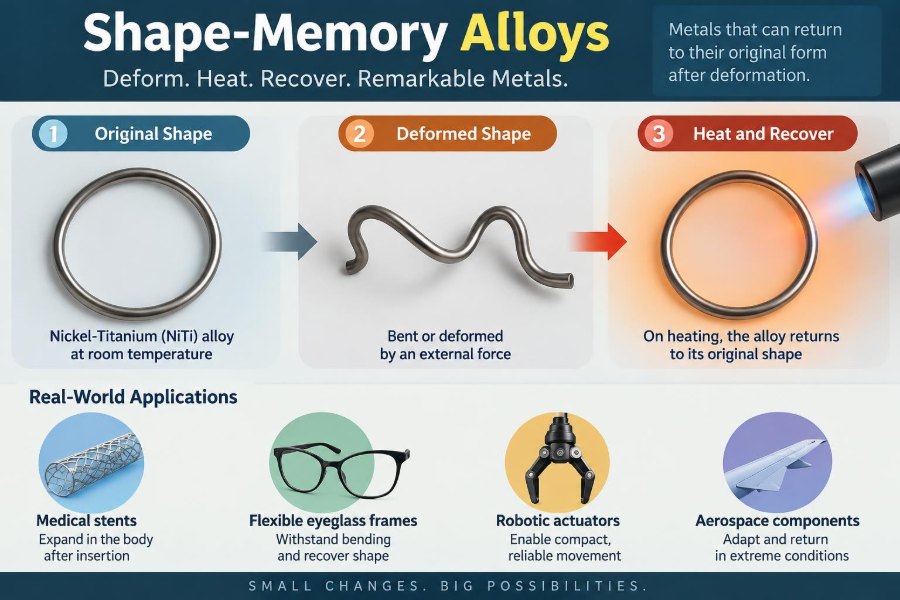
Consider a wire trained to be straight. In a cool martensitic condition, it can be bent into a loop or curve without immediately returning to straightness. Heating changes the balance of stability between the phases.
As austenite forms, the reoriented martensite transforms back into the lattice arrangement compatible with the trained straight shape. The visible result is shape recovery.
The recovery force can be significant, but it is not unlimited. If the wire was bent too severely, damaged, or constrained beyond its design load, it may not fully recover and can accumulate permanent strain.
🌡️ Transformation Temperatures Are a Range, Not One Point
The phase change occurs over a temperature interval rather than at one exact temperature. Engineers commonly describe four characteristic temperatures: martensite start and finish during cooling, and austenite start and finish during heating.
Transformation also shows thermal hysteresis: the temperatures observed while heating are not exactly the same as those observed while cooling. This is useful in some thermal switches because it prevents rapid on-off chatter near a single threshold.
Composition, heat treatment, stress, manufacturing history, and repeated cycling can all influence the effective transformation behavior. A catalog value is therefore a design starting point, not a substitute for testing the actual part.
⚡ The One-Way Shape-Memory Effect
The most familiar SMA behavior is the one-way shape-memory effect. The alloy is deformed in its low-temperature martensitic state, then heated and returns to its trained high-temperature shape.
After cooling again, it does not automatically return to the bent low-temperature shape. An external load, spring, bias force, or mechanical mechanism must deform it for the next cycle.
This is not a drawback in every design. A return spring can provide the reset motion while the SMA provides compact, thermally triggered actuation.
↔️ Superelasticity: Recovery Without Heating
Some SMAs, particularly appropriately processed nickel-titanium, show superelasticity, also called pseudoelasticity. In this case, the material begins in austenite at the operating temperature.
When stressed, it transforms into stress-induced martensite. On unloading, the martensite reverses to austenite and the component largely recovers its original shape without an intentional heating step.
Superelasticity is valuable when a device must flex repeatedly at nearly constant ambient or body temperature. Flexible eyeglass frames and many guidewires illustrate the general principle.
📏 Why Superelastic Metals Can Bend So Far
Ordinary spring steel stores deformation mainly through elastic strain. Once its yield stress is exceeded, dislocations move and a permanent set remains. A superelastic SMA has an additional reversible deformation mechanism: stress-induced phase transformation.
On a stress-strain graph, this often appears as a plateau-like region where strain increases substantially with a more gradual rise in stress than ordinary elastic loading would produce. The exact curve depends on temperature, alloy state, loading rate, and specimen geometry.
Large recoverable strain does not mean limitless flexibility. Repeated sharp bending, surface damage, or stress concentrations can still initiate fatigue cracks.
🧪 Nickel-Titanium and Other SMA Families
Nickel-titanium is widely used because it can provide substantial recoverable strain, useful transformation temperatures, corrosion resistance in many environments, and strong functional performance. Its properties are highly sensitive to the nickel-to-titanium balance and processing history.
Other shape-memory alloy families include copper-based systems and iron-based systems. They may be considered where cost, transformation temperature, manufacturability, damping, or compatibility with a specific application matters.
| Alloy family | Common engineering attraction | Typical design consideration |
|---|---|---|
| Nickel-titanium | Strong shape-memory and superelastic behavior | Processing and machining can be demanding |
| Copper-based SMAs | Potentially lower material cost and useful thermal actuation | Ductility and fatigue behavior require careful evaluation |
| Iron-based SMAs | Promising for certain structural and civil applications | Recovery characteristics differ from nickel-titanium systems |
No alloy family is automatically “best.” The correct choice depends on the motion required, temperature window, life cycle, environment, joining method, and allowable cost.
🔥 How Engineers Set a Shape into an SMA
Shape setting usually begins by forming the material around a mandrel, fixture, or tool that defines the desired final geometry. The constrained part is heated according to a controlled process, then cooled before the fixture is removed.
The specific time and temperature window is alloy- and supplier-dependent. Excessive heat treatment can change transformation temperatures, create undesirable precipitates, alter surface condition, or reduce functional performance.
For this reason, shape setting is not simply “heating until it looks right.” Production parts need validated fixtures and process controls, especially when dimensions or actuation force are critical.
🧷 A Simple Wire-and-Spring Analogy
Imagine a straight, shape-set SMA wire connected to an ordinary steel return spring. At low temperature, the return spring pulls the SMA into a bent position. When electrical current heats the SMA wire, it tries to straighten and pulls against the spring.
When power is removed, the wire cools and becomes easier to deform into its martensitic state. The steel spring then resets the mechanism. This arrangement converts a temperature-driven material transformation into repeatable linear motion.
The example is simplified, but it highlights a practical rule: SMA actuators are often part of a system, not stand-alone “smart wires.”
🔌 Electrical Heating and Joule Actuation
Because most SMAs are electrically conductive, a common actuation method is Joule heating. Passing current through the component generates heat from electrical resistance, raising the alloy temperature toward or above its austenite transformation range.
Electrical heating can be compact and easy to integrate. Yet the response depends strongly on heat loss to the surrounding air, structure, fluid, or insulation. The same current may produce different motion on a cold day, in still air, or in a liquid environment.
Robust designs often use temperature sensing, resistance-based feedback, position feedback, or carefully calibrated timing. Open-loop control alone may be insufficient where force and position must remain accurate.
💨 Cooling Often Limits Actuator Speed
Heating an SMA wire can be fast because electrical power can be delivered directly to the material. Cooling usually relies on convection, conduction, radiation, or active cooling, and may take longer.
This creates an asymmetry: an actuator may pull quickly but reset slowly. Increasing current to force faster operation can overheat the wire rather than solve the cooling problem.
Engineers can improve cycle time by reducing thermal mass, improving airflow, conducting heat into a designed heat sink, using thinner elements, or using an active cooling strategy. Each choice affects force, efficiency, packaging, and durability.
🏥 Medical Devices and Minimally Invasive Deployment
SMAs are particularly useful in medical devices because a compact component can change shape after it reaches a target location. Superelastic nickel-titanium can also navigate curved pathways while recovering from substantial bending.
For example, some implantable structures are compressed for delivery through a catheter and then expand when released. Whether temperature, stress release, or both drive the final behavior depends on the particular device design.
Medical use demands more than attractive material behavior. Biocompatibility, corrosion performance, surface finish, sterilization effects, fatigue life, imaging needs, and regulatory validation must all be assessed for the finished device.
🚗 Aerospace, Automotive, and Industrial Uses
In aerospace and industrial equipment, SMAs can support compact latches, couplings, thermal release mechanisms, vibration-control concepts, and adaptive components. Their ability to actuate with few moving parts can be useful where space or maintenance access is limited.
Automotive applications may use thermally responsive or electrically activated elements where noise, weight, packaging, and reliability are key constraints. However, conventional motors, solenoids, wax actuators, and mechanical springs may still be preferable when speed or low cost dominates.
An SMA should be selected because its transformation behavior solves a real system problem, not merely because the material is novel.
🦷 Eyeglass Frames, Orthodontics, and Consumer Products
Everyday examples help separate the two major behaviors. Flexible nickel-titanium eyeglass components are often chosen for superelastic recovery: they can bend substantially and spring back after unloading.
Orthodontic archwires can use superelasticity to apply comparatively sustained forces over a useful range of tooth movement. The clinical behavior of any specific wire depends on its alloy state, geometry, treatment, and loading conditions.
Consumer products also use SMA springs, clips, and small actuators. In these applications, simple assembly and perceived durability must be balanced against the cost of specialized material and processing.
🌉 Structural Strengthening and Civil Engineering Interest
Some iron-based SMAs are being explored and used in specialized structural-strengthening concepts. A prestrained material can be installed and heated to create recovery stress, which may introduce beneficial prestressing in a structural member.
This approach is attractive where conventional tensioning equipment is difficult to use. Still, structural applications require careful attention to anchorage, thermal input, compatibility with surrounding materials, long-term loading, and the behavior of the entire assembly.
A material-level recovery effect does not automatically guarantee a safe structural solution. Design must account for load paths, failure modes, inspection access, and relevant project requirements.
🛠️ Designing for Force, Stroke, and Bias Load
An SMA actuator design begins with three connected questions: How far must it move? How much force must it provide? What must reset it after cooling? A long stroke and a high force generally demand more material volume or a different mechanism.
Bias loads can come from coil springs, gravity, elastic flexures, opposing SMA elements, or the load itself. Their force-displacement behavior must be compatible with the SMA’s transformation behavior across the operating temperature range.
- Use geometry to convert a small material strain into useful system motion.
- Avoid demanding maximum force and maximum stroke from the same small element.
- Include margins for variation in ambient temperature and heat loss.
- Test the complete mechanism, including friction and misalignment.
📐 Geometry Can Be More Important Than Material Mass
A straight SMA wire contracts only by a limited fraction of its length during actuation. If a mechanism needs larger displacement, designers often use levers, pulleys, flexures, antagonistic arrangements, or coil-spring geometries.
Coiling a wire can create a longer effective path in a compact volume and can produce larger visible motion. But coil geometry also changes stress distribution, electrical resistance, heat transfer, and fatigue performance.
Sharp corners, poorly finished hooks, and abrupt diameter changes are especially undesirable. They concentrate stress and can turn an otherwise capable SMA component into an early fatigue failure.
📊 Characterizing an SMA Before Final Design
Material datasheets provide useful nominal properties, but functional SMA design needs component-level characterization. Differential scanning calorimetry can help identify transformation behavior in material samples, while mechanical testing shows force, displacement, hysteresis, and cycling response.
Testing should reflect actual use conditions: expected preload, motion range, electrical input, ambient temperature, mounting arrangement, and cooling path. A wire tested freely in laboratory air may act very differently after being bonded into a plastic housing.
For high-consequence applications, manufacturing lots and finished assemblies may need verification because small processing differences can influence behavior.
🔁 Functional Fatigue and Cycle Life
All actuators wear in some way, and SMAs are no exception. Their concern is often functional fatigue: gradual changes in transformation temperatures, recoverable strain, force, or hysteresis over repeated cycles.
Mechanical fatigue can also lead to cracking, especially under high local stress, corrosion, surface defects, or large strain amplitudes. The number of usable cycles is not a single property that can be quoted without defining load, temperature, environment, and failure criterion.
Conservative strain limits, smooth surfaces, controlled heat input, and realistic life testing are more meaningful than assuming that a shape-memory alloy will recover indefinitely.
🌧️ Environment, Corrosion, and Surface Condition
The operating environment can strongly affect SMA reliability. Moisture, salts, cleaning agents, biological fluids, temperature extremes, and contact with dissimilar metals may alter corrosion risk or surface condition.
Surface scratches matter because they can act as crack initiation sites under cyclic loading. Manufacturing methods such as cutting, grinding, and joining therefore require attention to heat-affected zones, recast layers, residual stresses, and finishing.
Protective coatings or surface treatments may help in some applications, but they can also change thermal response or introduce adhesion concerns. The surface strategy must be validated with the system rather than chosen in isolation.
⚠️ Common Design Mistakes with SMAs
A frequent mistake is treating an SMA as a direct drop-in replacement for a motor or spring. Its force depends on temperature and transformation state, while its speed is usually constrained by heat transfer.
Other recurring problems include:
- Ignoring the effect of ambient temperature on actuation onset and force.
- Using excessive current without temperature protection or feedback.
- Designing around free recovery but adding friction or constraints later.
- Overstraining the material during assembly or operation.
- Assuming a supplier’s straight-wire data apply unchanged to a formed component.
- Neglecting the need for a reset mechanism in one-way actuators.
Most of these issues are preventable when thermal, mechanical, and electrical design are developed together.
🧯 Safety, Failure Modes, and Fail-Safe Behavior
For safety-related mechanisms, designers should ask what happens during power loss, overheating, sensor failure, blocked motion, or unexpected ambient temperature. An SMA actuator can remain hot after power is removed, and an obstructed actuator may develop forces that damage itself or nearby parts.
Thermal fuses, current limits, position sensing, mechanical stops, redundant return mechanisms, and fault detection may be appropriate depending on the consequence of failure. In some systems, a conventional mechanical solution offers a clearer fail-safe state.
The right question is not whether SMAs are safe in general. It is whether the complete device has predictable and acceptable behavior across credible fault conditions.
⚖️ Comparing SMAs with Conventional Actuators
SMAs offer quiet operation, compact form, simple mechanical construction, and high force relative to their size in certain configurations. They can be especially compelling when motion is infrequent and the device can tolerate thermal cycling.
Motors and solenoids often provide faster repetitive motion, easier continuous control, and more straightforward efficiency calculations. Springs are inexpensive and dependable for passive energy storage but cannot independently sense or respond to temperature in the same way.
A practical selection process compares the whole system: driver electronics, cooling, transmission, sensors, lifecycle, serviceability, and failure behavior—not only the actuator’s size.
🧭 A Practical Selection Checklist
Before specifying a shape-memory alloy, define the required operating window rather than beginning with a material name. The following questions expose whether the application is a good fit.
- What motion, force, and response time are actually required?
- What temperatures will the device experience when inactive and operating?
- Can the mechanism tolerate hysteresis and a cooling-limited reset?
- How many cycles are required, and what counts as end of life?
- What environmental exposure and surface damage are likely?
- How will the part be controlled, inspected, and protected from overheating?
If the answers remain uncertain, build a representative prototype early. SMA behavior is strongly coupled to the finished geometry and surrounding system.
🔮 Where Shape-Memory Alloy Development Is Heading
Ongoing development focuses on improving fatigue resistance, tailoring transformation temperatures, simplifying manufacturing, and integrating SMAs into adaptive structures and compact devices. Researchers and manufacturers also continue to refine processing routes that give more consistent functional properties.
Progress does not mean every mechanism will become shape-memory based. The most promising opportunities are usually those where an SMA’s unusual combination of compact actuation, recoverable deformation, or temperature response creates a clear system-level advantage.
For engineers, the key is to evaluate the material as a thermomechanical component with real limits—not as a novelty that eliminates ordinary design trade-offs.
✅ The Core Principle to Remember
Shape-memory alloys return toward a trained shape because their crystal structure can transform reversibly between martensite and austenite. In the one-way effect, heating supplies the trigger for recovery; in superelasticity, unloading reverses a stress-induced transformation.
The same mechanism that makes SMAs useful also makes them sensitive to temperature, stress, geometry, processing, and cycling. Successful designs account for all five from the earliest concept stage.
Shape-memory alloys are most powerful when their phase transformation is designed into the whole mechanism, rather than treated as an isolated material trick.
Metals that recover their form are not breaking the laws of mechanics—they are using crystal-scale transformations to produce useful motion at the scale of products, machines, and medical devices. When engineers respect their thermal and mechanical limits, SMAs offer an elegant tool for solving problems that conventional actuators do not address as neatly. ⚙️🌡️🔧