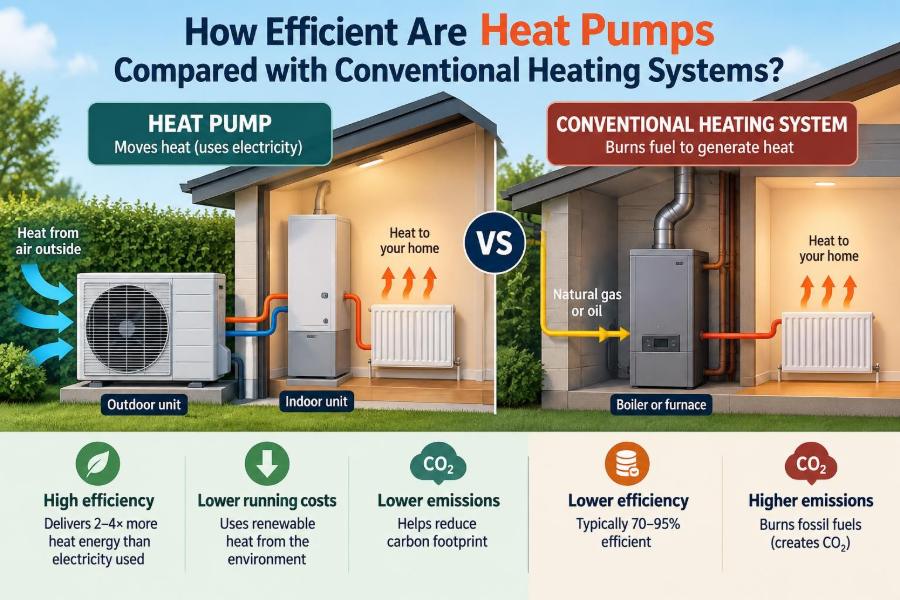

On a cold morning, a furnace may switch on with a familiar rush of warm air, while a boiler quietly circulates hot water through radiators. Both systems feel straightforward: fuel or electricity goes in, and the house gets warmer.
A heat pump can seem less intuitive. Its outdoor unit may be sitting in frosty air, yet it is supposed to heat the building efficiently. That apparent contradiction leads to a reasonable question: can moving heat really outperform burning fuel or using electric resistance heaters?
The answer depends on what “efficient” means, the weather, the building, the heating distribution system, and the energy source being displaced. A heat pump is often remarkably efficient, but it is not magic and it is not automatically the best design for every site.
Understanding the comparison is useful for engineering students, facility managers, homeowners, and anyone evaluating low-carbon heating. It starts with a distinction that is easy to overlook: heat pumps do not primarily make heat; they move it.
🌡️ Efficiency Means More Than Fuel Burned
For a conventional combustion heater, efficiency usually describes the fraction of fuel energy that becomes useful heat delivered to the building. Losses occur through flue gases, incomplete combustion, casing losses, and cycling.
For a heat pump, the central metric is usually coefficient of performance, or COP. It is the heat delivered divided by the electrical energy consumed over a particular operating condition.
A COP of 3 means one unit of electricity powers the delivery of roughly three units of heat. The additional heat comes from the air, ground, or water outside the building rather than being created from electricity alone.
🔄 A Heat Pump Works Like a Reversible Refrigerator
A refrigerator removes heat from its cold interior and rejects it into the warmer kitchen. A heat pump uses the same thermodynamic idea, but it moves useful heat into a building.
A refrigerant evaporates at low pressure in an outdoor heat exchanger, absorbing energy from the source. A compressor raises the refrigerant pressure and temperature, allowing it to release heat indoors as it condenses.
An expansion device then drops the pressure, and the cycle repeats. Electricity is needed mainly for the compressor, fans, pumps, and controls—not to supply all of the delivered heat directly.
🔥 Combustion Systems Convert Chemical Energy
Gas, oil, biomass, and propane systems release chemical energy by combustion. Their useful efficiency is limited because some energy leaves with exhaust gases and some is lost before heat reaches occupied spaces.
Modern condensing boilers and furnaces reduce losses by cooling exhaust enough to recover latent heat from water vapor. They can be highly efficient at the appliance boundary when correctly sized, installed, and operated in condensing conditions.
However, an appliance that converts nearly all incoming fuel energy to heat is still doing something different from a heat pump that transfers environmental heat using a smaller input of electricity.
⚡ Electric Resistance Heat Sets a Useful Baseline
Electric resistance heaters—baseboards, portable heaters, electric boilers, and many radiant panels—turn electricity into heat at the point of use with close to one unit of heat per unit of electrical input.
That makes them simple and reliable, but usually expensive to operate where electricity costs more per unit of energy than fuel. A heat pump can reduce electrical consumption for the same heat demand because it draws much of the heat from its surroundings.
Resistance heaters still have useful roles: small spaces, occasional use, backup heat, and situations where low installation complexity outweighs annual operating cost.
📏 COP Is an Instantaneous Snapshot
COP changes continuously with operating conditions. Manufacturers may report values at defined outdoor temperatures and water or air delivery temperatures, which allows equipment comparison but does not predict every building’s annual performance.
A unit delivering low-temperature heat on a mild day may show a high COP. The same unit working through a severe cold spell and producing hotter water for old radiators will have a lower COP.
When comparing systems, ask which conditions the stated COP represents. A single favorable test point should not be treated as the efficiency for an entire winter.
🗓️ Seasonal Performance Tells the Bigger Story
Seasonal COP, often expressed through regional seasonal rating methods, compares total heat supplied with total electricity used across a heating season. It includes changing weather and, depending on the method, part-load behavior and auxiliary energy.
This is generally more useful than a peak COP because buildings spend much of winter in moderate conditions rather than at the design minimum temperature.
Actual seasonal performance can differ from a rating because local climate, thermostat settings, duct leakage, hot-water temperatures, commissioning, and occupant behavior all change the result.
❄️ Cold Air Still Contains Recoverable Heat
Outdoor air feels cold because it contains less thermal energy than indoor air, but it remains far above absolute zero. A properly designed air-source heat pump can extract heat from it.
The challenge is not the absence of heat; it is the growing temperature lift. As outdoor temperature falls, the compressor must raise refrigerant temperature farther to provide indoor heat, which increases work and reduces COP.
Modern cold-climate designs can continue operating at low temperatures, but capacity and efficiency must be evaluated for the local design conditions rather than assumed from mild-weather performance.
🏔️ Temperature Lift Drives Energy Use
Temperature lift is the difference between the heat source temperature and the temperature required by the building’s heat emitters. It is one of the most powerful practical ideas in heat-pump design.
Consider two hypothetical homes at the same outdoor temperature. One uses a large underfloor system needing relatively warm water; the other has compact radiators requiring much hotter water. The second system asks the heat pump to do more compression work for each unit of heat delivered.
Lowering required supply temperature often improves seasonal efficiency more effectively than simply choosing a larger machine.
🏠 Building Fabric Comes Before Equipment Size
Insulation, airtightness, glazing, and thermal bridges determine how fast a building loses heat. Reducing heat loss lowers the required heating capacity and reduces the periods when any heating system must operate at its hardest.
Fabric improvements also make lower-temperature heating practical. That creates a double benefit: less heat is needed, and a heat pump can often provide it with a better COP.
Ventilation must still be intentional. Airtight buildings need appropriate fresh-air provision; sealing uncontrolled leakage is not the same as eliminating ventilation.
🧮 Heat Load Is Not a Guessing Exercise
Equipment should be selected from a room-by-room or whole-building heat-loss calculation that accounts for local outdoor design temperature, envelope properties, infiltration assumptions, and internal gains where relevant.
Oversizing is a common response to uncertainty. It may cause frequent cycling, reduced comfort, louder operation, and lower efficiency at mild loads. Undersizing can leave a building dependent on costly backup heat during cold weather.
For retrofits, actual fuel history can be useful evidence, but it should be interpreted carefully because past thermostat settings and old-equipment efficiency may be unknown.
💨 Air-to-Air Heat Pumps Deliver Warm Air
Air-to-air systems transfer heat directly into indoor air through wall-mounted units, ducted air handlers, or other terminal units. In heating mode, they are often a practical option where there is no hydronic radiator system.
They usually work best when indoor units are placed to distribute heat effectively. Closed doors, long corridors, and poorly planned locations can leave distant rooms cooler than expected.
Because they do not normally make domestic hot water, another solution may be needed for showers and taps. Their cooling capability can nevertheless add significant value in warm climates.
🚰 Air-to-Water Systems Serve Hydronic Heating
Air-to-water heat pumps provide water for radiators, fan coils, underfloor loops, and sometimes domestic hot water. They can be a natural retrofit pathway for buildings that already use boilers.
The key question is whether existing emitters can meet room heat losses at lower water temperatures. Larger radiators, fan-assisted units, or envelope upgrades may be needed if the old system relied on very hot boiler water.
Domestic hot water often requires higher temperatures than space heating, so its production usually has a lower COP and deserves separate consideration.
🌍 Ground-Source Systems Benefit From Stable Temperatures
Ground-source heat pumps use buried loops or groundwater as the heat source. Below the surface, temperature varies less through the season than outdoor air, which can provide more stable operating conditions.
That stability can improve winter performance, particularly where winters are harsh. But drilling, trenching, ground-loop design, land constraints, and site permitting can make installation more complex and capital-intensive.
A ground-source system is not automatically superior. Its value depends on geology, available space, cooling needs, operating hours, and the feasibility of installing the ground heat exchanger well.
💧 Water-Source Heat Pumps Need Careful Site Design
Lakes, rivers, aquifers, and shared water loops can offer attractive heat sources when permitted and engineered responsibly. Water temperatures may be more favorable than winter air temperatures.
Water chemistry, fouling, freezing risk, pumping energy, environmental rules, and long-term thermal balance all matter. A high source-side pumping load can erode the apparent advantage of a good heat source.
These systems are often most suitable for campuses, dense developments, or sites with a well-characterized local resource rather than as a universal residential solution.
🧊 Defrost Is a Real Air-Source Penalty
When an outdoor coil operates below the dew point and below freezing, moisture can form frost on it. Frost blocks airflow and insulates the coil, so the heat pump must periodically defrost.
During defrost, the system briefly reverses or uses another strategy to melt ice. This consumes energy and temporarily reduces net heating output, especially in damp conditions near freezing.
Good controls, drainage, coil design, and correct installation reduce problems, but defrost should be included in realistic cold-weather performance expectations.
🌀 Part-Load Operation Separates Good From Average Systems
Heating demand changes hour by hour. A fixed-speed unit can meet a small load by switching on and off repeatedly, while an inverter-driven compressor can reduce output and run more continuously.
Longer, steadier operation often improves comfort and avoids some cycling losses. It can also make airflow and water temperatures more consistent.
Modulation has limits: every machine has a minimum stable output. In a small or highly insulated building, poor matching between that minimum capacity and the load can still cause cycling in mild weather.
🔧 Distribution Losses Can Hide Appliance Efficiency
Useful heat is what reaches occupied rooms, not simply what leaves a heat generator. Leaky ducts in an unconditioned attic, poorly insulated pipes, and unbalanced hydronic circuits can waste energy regardless of the heat source.
Duct systems need adequate airflow and sealed joints. Hydronic systems need correct pump settings, air removal, balancing, and insulated distribution piping where losses are undesirable.
Evaluating the complete system prevents a misleading comparison between a laboratory-rated appliance and a poorly performing installation.
🎛️ Controls Determine How Equipment Actually Runs
A heat pump commonly performs best with stable indoor setpoints and a heating curve that adjusts water temperature as outdoor conditions change. This is called weather compensation or outdoor reset.
For example, a hydronic system may supply only as much water temperature as the building needs on a mild day, then gradually increase it as weather becomes colder. That reduces temperature lift without sacrificing comfort.
A thermostat strategy copied directly from a combustion system—large overnight setbacks followed by aggressive morning recovery—may trigger backup heat or high supply temperatures in some heat-pump installations.
🧯 Backup Heat Is Not a Design Failure
Backup heat may be electric resistance, a boiler, or another source. It can cover rare peak conditions, assist during defrost, provide resilience, or allow a smaller heat pump to handle the majority of annual demand.
The important engineering question is when backup operates and how controls prioritize it. If resistance heat engages too readily, seasonal electricity use can rise sharply even though the heat pump itself is capable.
A well-designed hybrid system can be sensible where fuel infrastructure already exists or electrical capacity is limited. Its performance should be judged over the full operating season, not by ideology.
⚖️ Efficiency and Carbon Are Related, Not Identical
A heat pump’s site efficiency may be high because it moves heat, but its emissions depend on how electricity is generated at the times it operates. Combustion equipment emissions depend on the fuel, combustion performance, and fuel supply chain.
Grid emissions can vary by region and hour. Therefore, an engineering assessment should distinguish energy use, operating emissions, local air pollution, and lifecycle impacts rather than collapsing them into one simple label.
Electrification can also shift peak demand to cold periods. Building upgrades, thermal storage, demand-aware controls, and adequate grid planning help manage that system-level challenge.
💸 Operating Cost Depends on Local Tariffs
A heat pump uses less purchased energy than resistance heating for the same delivered heat when its COP exceeds one. But operating cost depends on electricity price, fuel price, fixed charges, and the seasonal COP actually achieved.
A useful comparison is cost per unit of delivered heat. For a heat pump, divide electricity cost by seasonal COP. For a fuel heater, divide fuel cost by its seasonal efficiency, using consistent energy units.
This approach avoids simplistic claims that electricity is always cheaper or fuel is always cheaper. Local prices and system performance can reverse the result.
🏭 Source Energy Requires a Wider Boundary
Site energy is measured at the building meter. Source or primary energy also considers energy used upstream to extract fuels, generate electricity, and deliver energy through networks.
That broader comparison can be useful, but it requires region-specific assumptions. Electricity generation mix and power-plant efficiency vary, and they can change over time.
For transparent engineering work, state the boundary clearly. A system can look different when assessed at the appliance, the building meter, or the full energy supply chain.
🔊 Noise, Space, and Comfort Also Matter
Efficiency is not the only performance criterion. Outdoor units create fan and compressor noise, so location, vibration isolation, clearances, and consideration of neighboring properties are essential.
Heat pumps often provide steady, lower-temperature heat rather than short bursts of very hot air. Many occupants find this comfortable, but expectations matter when replacing a system with a different delivery pattern.
Indoor unit placement, condensate drainage, electrical service capacity, and access for maintenance should be resolved before purchase rather than treated as site details afterward.
🛠️ Installation Quality Can Decide the Outcome
Refrigerant piping, airflow, water flow, electrical protection, condensate management, refrigerant charge, and control setup all affect performance. A capable model cannot compensate for fundamental installation errors.
Commissioning should verify that the equipment delivers the intended flow temperatures or air temperatures, that emitters are balanced, and that backup heat settings match the design strategy.
Refrigerants also require proper handling because leaks can reduce performance and some refrigerants have substantial climate impacts. Work on refrigerant circuits should be performed by qualified personnel under applicable rules.
📉 Common Comparison Mistakes
Several shortcuts lead to poor conclusions when comparing heat pumps with conventional heating:
- Comparing a heat pump’s best-case COP with a boiler’s annual efficiency.
- Ignoring domestic hot water, backup heat, fans, pumps, and defrost energy.
- Assuming an existing radiator system will work unchanged at lower temperatures.
- Selecting equipment by floor area alone instead of calculated heat loss.
- Using fuel cost alone without converting to cost per unit of delivered heat.
- Treating mild-climate performance as proof of cold-climate suitability.
A fair comparison uses the same boundary, climate assumptions, comfort target, and annual service demand for each option.
🏢 Commercial Buildings Need a Different Lens
Offices, schools, hospitals, factories, and retail spaces have diverse schedules and internal heat gains. In some commercial buildings, people, lighting, equipment, and processes can substantially reduce heating demand during occupied hours.
Heat recovery can be especially valuable. A building rejecting heat from cooling, refrigeration, data equipment, or ventilation may be able to redirect part of it to domestic water or another zone.
Plant design must consider redundancy, simultaneous heating and cooling, maintenance access, load diversity, and demand charges. A residential rule of thumb rarely transfers directly to these applications.
📊 A Practical Evaluation Workflow
A disciplined assessment does not begin with a product brochure. It begins with the building and its loads.
- Calculate design heat loss and estimate annual heating and hot-water demand.
- Inspect the envelope, ducts or pipes, heat emitters, electrical capacity, and available equipment locations.
- Determine the lowest practical supply temperature for the required indoor comfort.
- Compare candidate systems using seasonal performance at local weather conditions.
- Include auxiliary electricity, backup operation, maintenance, noise, and installation constraints.
- Commission the selected system and review real operating data after the first season.
This process reveals whether insulation, emitter upgrades, controls, or a different heat source should accompany the equipment change.
🧠 The Core Engineering Takeaway
Heat pumps are typically more energy-efficient at the building meter than combustion heaters and electric resistance heaters because they transfer heat rather than generate all of it from purchased energy. Their advantage is strongest when the source is relatively mild, the required delivery temperature is low, and the system runs steadily.
Conventional heating can still be appropriate where site constraints, extreme peak loads, legacy systems, installation cost, resilience requirements, or fuel availability change the balance. The technically sound choice is a whole-system decision, not a contest between appliance labels.
Good heat-pump performance is therefore engineered: reduce demand, design distribution for low temperatures, size equipment correctly, install it carefully, and control it intelligently.
A heat pump’s efficiency is not a fixed number—it is the outcome of thermodynamics, building design, and real operating conditions working together. When those pieces align, it can deliver substantial heat with surprisingly little electrical input. ⚙️🌡️🏠