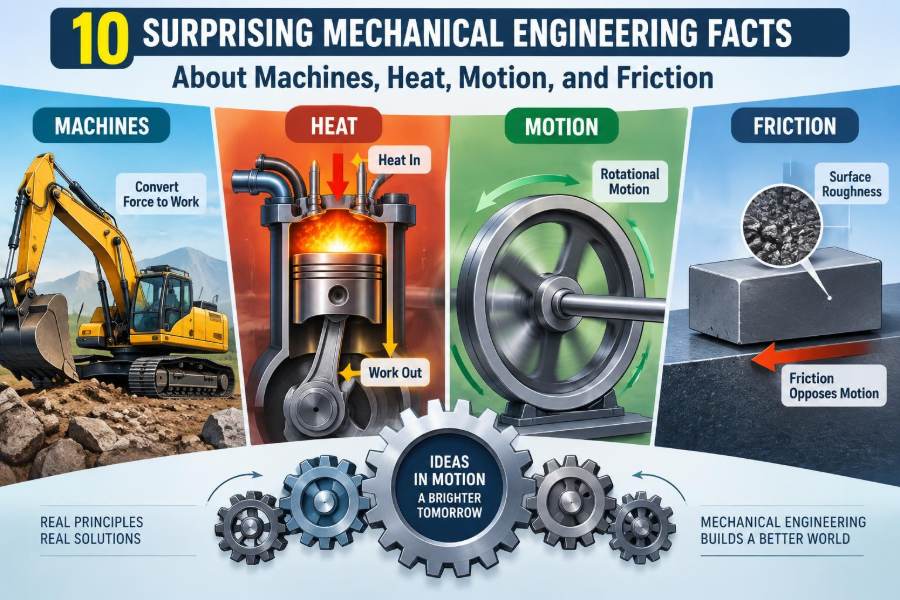

A bicycle chain clicks under load, a laptop fan speeds up during a video call, and a car’s brakes become hot after one steep descent. These are ordinary moments, but each is a small mechanical engineering lesson in motion, energy, materials, and heat.
Machines rarely fail or succeed for just one reason. A bearing that runs quietly may be protecting a shaft from wear; a tiny clearance may allow a metal assembly to survive a temperature change; a rough-looking tire surface may be providing the grip needed to turn safely.
Mechanical engineering gives us a practical way to read these everyday clues. It explains why machines move, where their energy goes, what limits their performance, and why the details that seem small often determine whether a design lasts.
Here are ten surprising facts, followed by the engineering ideas that make them useful in real machines.
🔋 Energy Is Not Used Up—It Changes Form
A machine does not consume energy in the literal sense. It converts energy from one form to another. An electric motor changes electrical energy into rotating mechanical motion, while a brake converts the vehicle’s motion mainly into heat.
The useful output is only part of the story. Sound, vibration, air movement, and heating are also energy pathways. This is why engineers trace an energy balance: energy entering a system must equal energy leaving it or being stored within it.
When a cordless drill battery drains, the energy has not disappeared. It has become hole-making work, motor heat, gearbox heat, noise, and a small amount of stored kinetic energy in the rotating parts.
🌡️ Waste Heat Is Often the Hidden Cost of Motion
Many machines are designed around a heat problem before they are designed around a strength problem. Heat can reduce lubricant life, change material properties, distort precision parts, and create uncomfortable or unsafe surface temperatures.
Friction, electrical resistance, fluid stirring, and repeated material deformation all generate heat. A gearbox may transmit substantial power while losing only a modest fraction, yet that loss still has to be carried away continuously.
Cooling fins, fans, oil circulation, radiators, and heat sinks are not decorative additions. They create paths for thermal energy to move from a hot component to the surrounding air, liquid, or another structure.
🧊 Metals Expand More Than Many Designs Expect
Most solid materials expand when heated and contract when cooled. The dimensional change may look tiny over a short part, but it becomes significant in long rails, engine components, piping, and tightly fitted assemblies.
Consider a steel shaft fitted inside a housing. If the shaft and housing heat at different rates, their fit can change while the machine is operating. A clearance can disappear, or an interference fit can loosen.
Engineers accommodate this behavior with expansion joints, sliding supports, appropriate tolerances, and material choices. Thermal expansion is a major reason precise equipment needs a controlled operating temperature before its dimensions are trusted.
🛞 Friction Can Be Essential, Not Wasteful
Friction is often described as an enemy of efficiency, but without it, cars could not accelerate or corner, shoes could not grip the floor, and belt drives could not transmit power. The question is not whether friction exists; it is whether it appears in the right place and amount.
A tire needs friction at the road contact patch. A brake pad needs friction at the rotor. By contrast, a rotating shaft in a bearing is usually designed to have as little damaging friction as practical.
This distinction helps explain why machines can contain both lubricated surfaces and deliberately rough surfaces. Mechanical design directs friction instead of simply trying to eliminate it.
🧈 Lubrication Does More Than Make Parts Slippery
Lubricant can form a thin separating film between moving surfaces. When that film is maintained, direct contact between microscopic surface peaks is reduced, which can lower wear, noise, and heat generation.
Oil and grease can also carry heat away, protect surfaces from corrosion, transport contaminants toward filters, and cushion loaded contacts. The correct lubricant depends on speed, load, temperature, environment, and the design of the contact.
More lubricant is not always better. Excess grease can churn, heat up, and increase resistance. Too little lubricant can allow metal-to-metal contact. Correct amount and condition matter as much as lubricant type.
⚙️ Gears Trade Speed for Torque, Not Free Power
A gear reduction can make a small motor turn a heavy load because it increases torque at the output. In exchange, the output turns more slowly. This is a trade, not a creation of extra power.
Torque is the turning effect of a force. Power combines torque and rotational speed. Ignoring losses, reducing speed by a gear ratio increases available torque by roughly the same ratio.
A low gear on a bicycle illustrates the principle. Pedaling becomes easier on a hill because the wheel turns fewer times for each crank revolution, but the rider covers less distance per pedal stroke.
🌀 Flywheels Store Motion for Later
A flywheel stores kinetic energy in rotation. Its ability to do so depends on its rotational speed and on how its mass is distributed relative to the axis. Mass farther from the center contributes strongly to rotational inertia.
In engines, flywheels help smooth the uneven torque produced by intermittent combustion events. In industrial machinery, they can help a system ride through brief demand peaks without requiring an oversized motor.
A flywheel does not make energy. It stores energy supplied earlier and releases it later. Safety matters because high-speed rotating parts carry substantial stored energy and must be properly contained and balanced.
📳 Vibration Is Information, Not Just Annoyance
A vibration is a repeated motion around an equilibrium position. It can be harmless, useful, or destructive depending on its frequency, amplitude, and location. A phone’s vibration motor is intentional; a shaking washing machine may indicate an unbalanced load.
Machines have natural frequencies at which they prefer to vibrate. If a repeating force occurs near one of those frequencies, resonance can amplify motion dramatically, even when the forcing input is relatively small.
Engineers use stiffness, mass distribution, damping, isolation mounts, and operating-speed limits to manage vibration. Maintenance teams also measure vibration because changes can reveal bearing damage, imbalance, looseness, or misalignment.
🔩 Bolts Hold Better Because They Stretch
A properly tightened bolt behaves like a stiff spring. Tightening creates preload: a controlled tensile stretch in the bolt that clamps the joint members together.
Under an external load, a well-designed joint often keeps the parts clamped rather than allowing them to slide or separate. This is one reason torque specifications matter. Under-tightening can allow movement; excessive tightening can damage threads or push the bolt beyond its intended elastic range.
The fact that a bolt stretches is not a flaw. Within its elastic limit, that stretch helps it maintain clamping force as the joint experiences vibration and changing loads.
🧲 Materials Remember Their Manufacturing History
Two parts made from the same nominal metal can perform differently if they were cast, forged, welded, machined, heat-treated, or cold-worked differently. Processing changes grain structure, residual stress, hardness, and toughness.
For example, a hardened steel surface may resist wear well but can be less tolerant of impact if the entire part becomes too brittle. Engineers often seek a balance: a hard exterior where wear occurs and a tougher interior to resist cracking.
Material selection is therefore more than choosing “steel” or “aluminum.” It includes the specific alloy, condition, treatment, surface finish, and manufacturing route.
📐 Stress Is Not the Same as Force
Force is a push or pull. Stress is force distributed over an area. The same load concentrated on a small section can create far greater stress than it would over a large section.
This is why a thin wire can break under a load that a thick rod carries comfortably. It also explains why holes, sharp internal corners, and abrupt changes in shape require care: they can concentrate stress in a small region.
Engineers reduce stress concentrations with smooth fillets, gradual transitions, adequate section thickness, and careful placement of holes. A part can look strong overall while still being vulnerable at one overlooked geometric detail.
🪢 Fatigue Can Break a Part Below Its One-Time Strength
A paper clip can often be bent once without breaking, but repeated bending eventually causes it to fracture. This is fatigue: damage that accumulates under repeated or fluctuating stresses.
Fatigue cracks often begin at surface scratches, thread roots, weld features, corrosion pits, or other locations with high local stress. They can grow gradually and then lead to a sudden final break when the remaining intact section becomes too small.
Designing against fatigue involves controlling stress range, improving geometry and surface quality, selecting suitable materials, and inspecting critical components. A load that seems modest in one moment may be severe after millions of cycles.
💨 Air Resistance Rises Quickly With Speed
At low speed, rolling resistance and mechanical losses may dominate. As speed increases, aerodynamic drag becomes much more significant. For many common shapes moving through air, drag force increases approximately with the square of speed.
The power needed to overcome that drag rises even faster because power equals force multiplied by speed. That is why a modest increase in highway speed can noticeably increase the effort required from a vehicle, cyclist, or fan.
Smoother airflow, a smaller frontal area, and reduced turbulence can improve performance. Aerodynamics is not limited to race cars; it affects wind turbines, drones, cooling equipment, trains, and ordinary vehicles.
🌊 Fluids Can Carry Force Without Being Compressed Much
Hydraulic systems use pressurized liquid to transmit force. Because liquids are much less compressible than gases in typical operating conditions, a hydraulic brake pedal can produce a controlled clamping force at the wheels through fluid-filled lines.
Area matters. Pressure acting on a larger piston creates a larger force, which allows hydraulic systems to multiply force while requiring a corresponding change in movement distance. This is another engineering trade rather than a source of free energy.
Air trapped in a hydraulic line is a problem because gas compresses readily. It can make the system feel soft and reduce precise response, which is why bleeding procedures are critical in applicable systems.
🫧 Cavitation Can Damage Metal Using Tiny Bubbles
Cavitation occurs when local pressure in a liquid falls low enough for vapor bubbles to form, followed by collapse as the pressure recovers. The collapse can create intense local effects near a surface.
Pumps, propellers, valves, and hydraulic equipment can suffer pitting, noise, vibration, and performance loss when cavitation is persistent. It is not merely “air in the system”; it is vapor forming and collapsing because of local pressure conditions.
Preventing it may involve changing inlet conditions, reducing flow restriction, selecting a better pump configuration, lowering liquid temperature, or adjusting operating speed. The right solution depends on the complete fluid system.
🔥 Heat Engines Are Limited by Temperature Differences
Combustion engines, steam turbines, and many power plants convert heat into work, but they cannot turn all supplied heat into useful work. A heat engine needs a hot region and a cooler region, and some heat must ultimately be rejected.
This is a consequence of thermodynamics, not simply imperfect construction. Larger usable temperature differences can improve the theoretical opportunity for conversion, but real designs face material limits, emissions requirements, cooling demands, cost, and reliability constraints.
That is why efficient engines still need radiators, exhaust systems, condensers, or other ways to manage rejected heat. The “waste” heat is built into the basic physics of heat-to-work conversion.
❄️ Refrigerators Move Heat Rather Than Create Cold
A refrigerator does not manufacture cold as a substance. It uses work, usually from an electric compressor, to move heat from the cooled compartment to the warmer room.
The refrigerant repeatedly evaporates and condenses as it circulates. Evaporation absorbs heat at low pressure inside the appliance; condensation releases heat outside it. The warm coils at the back or bottom are evidence of this heat transfer.
This is why leaving a refrigerator door open will not cool a kitchen. The appliance moves heat out of its cabinet but releases that heat, plus motor and compressor losses, into the same room.
🔊 Sound Often Reveals Mechanical Conditions
Sound is vibration traveling through a medium, usually air. A new squeal, click, rumble, or whine does not diagnose a machine by itself, but it can be a valuable early clue.
A belt squeal may suggest slip or contamination. A repeating click might track with wheel rotation. A low bearing rumble can indicate a developing issue, though professionals should verify symptoms with inspection and measurement rather than guessing from sound alone.
Listening works best alongside evidence such as temperature, vibration level, lubricant condition, load history, and visual inspection. Good troubleshooting gathers several clues before replacing parts.
🧭 Tolerances Decide Whether Parts Assemble and Move
No manufactured dimension is perfectly exact. A tolerance defines the acceptable variation around a nominal size. It allows designers, machinists, and inspectors to agree on what counts as a functional part.
Fits between shafts and holes can be designed for free sliding, controlled clearance, light pressing, or permanent interference. The intended fit depends on whether the part must rotate, transmit torque, seal fluid, or remain fixed.
Tighter tolerances can improve precision but usually raise manufacturing and inspection effort. The best tolerance is not the smallest possible one; it is the one that reliably delivers the required function at reasonable cost.
🧩 Clearance Is Sometimes a Feature
Engineers deliberately leave gaps for lubrication, thermal expansion, manufacturing variation, and assembly. A bearing needs an appropriate internal clearance; a piston needs room to expand; a valve mechanism may need a specified gap to operate correctly when hot.
Too much clearance can cause noise, impact loading, leakage, or poor positional accuracy. Too little can cause binding, overheating, or seizure. The correct gap is tied to material, temperature, speed, lubricant, and load.
When a machine feels “tight,” that is not automatically a sign of quality. In moving assemblies, controlled freedom can be more reliable than an overly snug fit.
🧰 Maintenance Protects Design Assumptions
Every machine is designed around assumptions: lubricant condition, alignment, clean cooling passages, fastener preload, allowable load, and operating environment. Maintenance preserves those assumptions as real components age and conditions change.
Practical routines often include cleaning, inspection, lubrication where specified, checking for leaks, monitoring temperatures, and replacing wear items before they damage more expensive parts. The exact schedule must come from the equipment manufacturer and actual service conditions.
A useful habit is to investigate trends. A gradually rising operating temperature or increasing vibration is often more informative than one isolated reading, especially when compared under similar loads.
⚠️ Overdesign Is Not Always Safer
Adding material can increase strength, but it may also add weight, cost, inertia, heat retention, or manufacturing difficulty. A heavier moving arm, for instance, requires more force to accelerate and may increase loads elsewhere in the machine.
Likewise, selecting an extremely hard material can create brittleness concerns, while making a part very stiff can shift vibration into another component. Engineering is usually an exercise in balancing competing requirements.
Safety factors are valuable, but they must be chosen thoughtfully with realistic loads, uncertainty, failure consequences, and applicable standards. “Bigger” is not a substitute for understanding the load path and failure mode.
🧪 Testing Finds What Equations Cannot Fully Capture
Calculations and simulation are powerful, but real products still need testing. Material variability, assembly variation, surface condition, user behavior, and environmental exposure can all influence results.
Engineers may test prototypes for strength, fatigue life, thermal performance, vibration, noise, wear, and durability. A test does not prove every possible future outcome, but it can expose weak assumptions and show how a design behaves under defined conditions.
The strongest development process connects analysis, experiment, and observation. When test results disagree with a model, the result is not automatically a failure; it is information that can improve the model or the design.
🧠 Mechanical Engineering Is Mostly About Managing Trade-Offs
Lightweight structures may be less stiff. High friction may improve grip while increasing wear. Fast heat transfer may require fins, fans, space, or added complexity. Quiet operation can require damping that adds mass or cost.
These trade-offs explain why different machines solve similar problems in different ways. A racing bicycle, a cargo bicycle, and a stationary exercise bike all use mechanical principles, but their priorities are not the same.
The useful question is rarely “What is the best design?” More often, it is “What design is best for this load, environment, user, maintenance plan, and acceptable risk?”
🔍 A Simple Way to Read Any Machine
When you encounter a machine, follow the energy and the forces. Ask where energy enters, what motion is produced, where heat leaves, which parts carry load, and what surfaces move against one another.
- What converts the input into useful motion?
- Where can friction, vibration, or fluid resistance create losses?
- Which parts expand when hot or bend when loaded?
- What failure would repeated use make more likely?
- What maintenance action preserves the intended operating conditions?
This method works for a hand tool, pump, vehicle, HVAC unit, factory robot, or household appliance. It turns an unfamiliar mechanism into a set of understandable engineering questions.
🏁 The Core Lesson: Machines Direct Energy Under Constraints
The surprising part of mechanical engineering is not that machines contain gears, motors, bolts, and bearings. It is that each component participates in several systems at once: force, motion, heat, materials, fluids, manufacturing, and maintenance.
Friction can be useful or destructive. Heat can be a by-product, a transport problem, or the driving source of an engine. A small dimensional change can matter more than a large-looking component, and a quiet change in vibration can matter before visible damage appears.
The central skill is learning to see every machine as an energy-and-force system with real material limits, deliberate trade-offs, and clues that reveal how it is behaving.
Once you begin looking for those connections, everyday machines become less mysterious—and far more impressive. ⚙️🌡️🔧