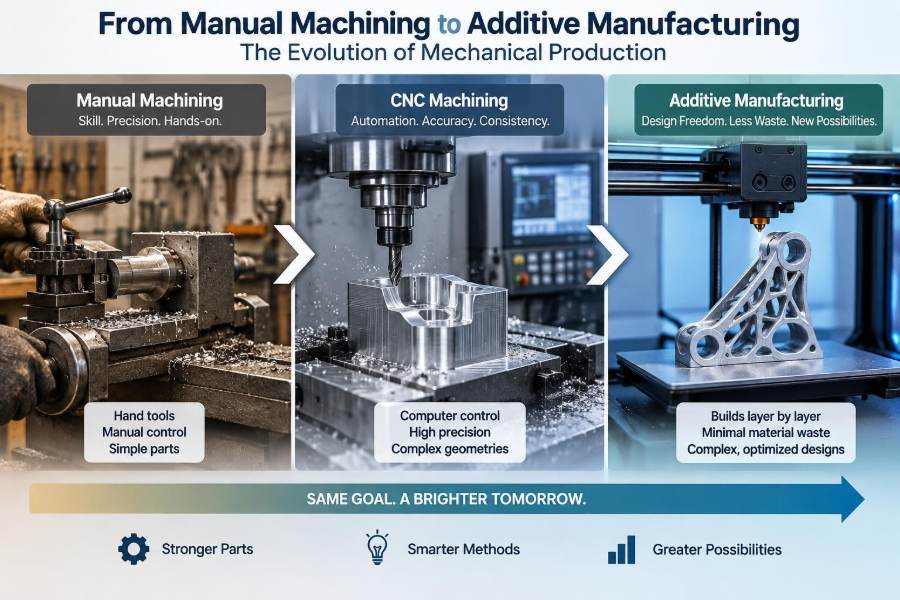

A worn machine shaft fails on a production line. A technician measures the damaged section, a machinist considers how to turn a replacement, and an engineer checks whether the part could be redesigned to last longer. The job may involve a manual lathe, a CNC mill, a laser scanner, or even a metal 3D printer.
That single repair captures a much larger story. Mechanical production has moved from skilled hands guiding individual cutting tools to digitally controlled systems that can remove, shape, join, and build material in radically different ways.
The change matters because manufacturing choices affect cost, lead time, reliability, energy use, repairability, and product design. They also change what engineers need to know: geometry alone is no longer enough; they must understand processes, data, materials, and inspection.
Manual machining has not disappeared, and additive manufacturing has not replaced conventional production. Each method occupies a useful place in a broader, increasingly connected manufacturing system.
🧭 What Mechanical Production Actually Means
Mechanical production is the set of processes used to convert raw material into useful components and assemblies. It includes material removal, forming, casting, joining, heat treatment, finishing, measurement, and assembly.
A gearbox housing, for example, may be cast near its final shape, machined at bearing bores, heat treated where needed, cleaned, inspected, and assembled with shafts and seals. Production is therefore a chain of decisions, not simply the moment a machine starts cutting.
🪚 The Foundations of Manual Machining
Manual machining relies on an operator to position work, select tools, set feeds and speeds, and judge the cutting process. Lathes, milling machines, drill presses, grinders, and saws remain familiar equipment in workshops worldwide.
The machinist reads a drawing, plans an order of operations, and physically controls axes through handwheels or levers. Accuracy depends on machine condition, setup quality, measuring practice, and the operator’s judgment.
👋 Why Skilled Hands Were Central
Before programmable controls became widespread, the ability to visualize a part and create it from stock was a major production capability. A skilled machinist could compensate for minor material variation, recognize chatter by sound, and alter a setup when a drawing omitted a practical detail.
Those skills still matter. Process knowledge is particularly valuable in prototype work, repair, maintenance, and low-volume jobs where formal programming may take longer than direct setup.
🔩 The Logic of Subtractive Manufacturing
Machining is primarily subtractive manufacturing: material is removed from a larger blank to create the final geometry. Turning produces rotational features, milling creates flats and pockets, drilling makes holes, and grinding refines surfaces.
This approach is exceptionally capable for tight tolerances and functional interfaces. Its basic limitation is geometric access: a cutting tool must be able to reach the surface it is creating, and the removed material becomes chips.
📐 Drawings, Datums, and Process Planning
A drawing does more than state dimensions. It identifies datums, or reference features, from which other dimensions and geometric requirements are controlled. Choosing how to locate a part from those datums is one of the most consequential setup decisions.
For instance, machining a bearing bore before its mounting face may make later alignment difficult. Sound process planning establishes stable references early and avoids repeatedly moving a part between setups.
🔍 Measurement Became Part of Production
Calipers, micrometers, height gauges, dial indicators, bore gauges, and surface plates turned machining from an approximate craft into a controlled process. Inspection is not merely a final gate; it gives feedback that helps prevent the next defective part.
A dimension can be numerically correct while a part still fails to fit. Roundness, flatness, perpendicularity, surface finish, and position all influence function, especially in moving or sealing assemblies.
⚙️ Interchangeability Changed Manufacturing
Interchangeable parts made it possible to assemble products without hand-fitting every component. This required consistent dimensions, defined tolerances, repeatable gauges, and disciplined production methods.
The idea is easy to take for granted. A replacement bearing, bolt, or gear works only because its critical features fall within controlled limits. Modern mass production extends this principle through automated handling and statistical process control.
🧮 Numerical Control Introduced Programmed Motion
Numerical control, or NC, replaced some direct hand motion with instructions that commanded machine axes. Early systems used coded information to position tools and execute defined movements.
The key shift was separation of the geometry from the immediate hand movements of the operator. A prepared instruction set could be reused, revised, and applied more consistently than a purely manual sequence.
💻 CNC Made Geometry Digital
Computer numerical control, or CNC, made machine instructions easier to create, edit, store, and connect with design software. A CNC program specifies tool paths, spindle speeds, feed rates, tool changes, coolant actions, and other machine functions.
CNC does not eliminate skill. It moves much of the work toward programming, fixturing, tool selection, simulation, setup verification, and troubleshooting. A poor program can make bad parts very efficiently.
🖥️ CAD and CAM Closed a Critical Gap
Computer-aided design (CAD) creates the digital model of a part. Computer-aided manufacturing (CAM) uses that geometry to help generate machining strategies and tool paths.
CAM is especially useful for complex surfaces, multi-axis machining, and families of similar parts. Yet the software cannot fully infer every practical choice: an engineer or programmer must decide how the work is clamped, which tools can reach it, and where distortion may occur.
🧰 Tooling and Fixtures Determine Repeatability
A fixture holds and locates a workpiece in a known position. Good fixturing resists cutting forces without deforming the part, exposes the necessary surfaces, and allows parts to be loaded consistently.
In production, a well-designed fixture can reduce setup time and variation more effectively than a small change in cutting parameters. In low-volume work, modular vises, soft jaws, and simple locating pins often balance speed with flexibility.
🤖 Automation Extended Beyond the Machine Tool
A CNC machine operating unattended is not automatically a complete automated system. Material must still arrive, parts may need to be flipped, tools wear, chips accumulate, and finished components require identification and inspection.
Robots, pallet changers, bar feeders, conveyors, automatic tool monitoring, and in-process probing address these surrounding tasks. Their value is greatest when the whole workflow—not just spindle cutting time—has been considered.
📊 From Inspection to Process Control
Traditional quality control often found problems after a batch had been made. Modern process control aims to detect drift sooner by measuring critical features, monitoring tool condition, and reviewing production data.
A bore gradually becoming oversize may indicate tool wear, thermal growth, or an unstable setup. Acting on that trend can prevent scrap, but measurement systems must themselves be capable and regularly checked.
🔥 Materials Expanded the Manufacturing Challenge
Mechanical products now use a wide range of steels, aluminum alloys, titanium alloys, nickel-based superalloys, polymers, composites, and engineered ceramics. Each responds differently to cutting heat, tool pressure, residual stress, and finishing operations.
Harder is not always more difficult in the same way. Some materials generate heat, some work-harden, some form long chips, and some are abrasive. Process selection must account for the material’s behavior as well as the desired shape.
🏭 Lean Production Changed the Question
Lean production focuses attention on wasted motion, waiting, excess inventory, overprocessing, defects, and unnecessary transport. It asks whether each activity adds value from the customer’s perspective.
For a machined component, reducing waste may mean placing inspection close to the machine, standardizing tool offsets, simplifying part flow, or designing a part that needs fewer setups. Lean does not mean removing every buffer; some inventory or inspection is justified when it protects reliability.
🧱 Additive Manufacturing Reversed the Build Direction
Additive manufacturing creates a component by joining material layer by layer from digital data. The phrase includes polymer extrusion, vat photopolymerization, powder-bed fusion, directed energy deposition, binder-based processes, and other methods.
Instead of asking which tool can remove material from a block, engineers can ask how material might be placed only where it is needed. That creates different opportunities and different constraints.
🖨️ The Main Additive Process Families
Additive technologies should not be treated as one process. Their feedstocks, energy sources, accuracy, mechanical properties, build rates, and post-processing needs vary substantially.
| Process family | Typical material form | Common use |
|---|---|---|
| Material extrusion | Polymer filament or pellets | Concept models, fixtures, functional polymer parts |
| Vat photopolymerization | Liquid resin | Fine-detail prototypes and patterns |
| Powder-bed fusion | Polymer or metal powder | Complex, high-value components |
| Directed energy deposition | Metal wire or powder | Repair and addition to existing parts |
The correct choice depends on required performance, not simply on what a printer can produce visually.
🧬 Design Freedom Is Real but Not Unlimited
Additive manufacturing can create internal channels, lattice-like structures, and shapes that would require multiple conventional parts or be inaccessible to cutters. A heat exchanger with winding internal passages is a common example of geometry that may benefit.
However, every process has rules. Overhangs may need support, enclosed powder may be difficult to remove, thin walls can distort, and some orientations produce better surfaces or strength than others. Freedom comes with new design discipline.
🌡️ Heat, Residual Stress, and Distortion
Many metal additive processes apply concentrated heat repeatedly in small regions. Rapid heating and cooling can generate residual stresses, meaning locked-in stresses that remain after the part cools.
These stresses can cause distortion, support failure, or cracking in demanding geometries and materials. Preheating, build orientation, support strategy, stress-relief heat treatment, and machining allowance are among the ways manufacturers manage the risk.
🧹 Post-Processing Is Not Optional
A printed part is rarely ready to install straight from the machine. It may require support removal, depowdering, curing, heat treatment, hot isostatic pressing in certain metal applications, machining, polishing, and inspection.
Internal features deserve special attention. If powder, uncured resin, or support material cannot be removed or verified, the geometry may be unsuitable for the selected process even if it prints successfully.
🎯 Surface Finish and Tolerances Still Matter
As-built additive surfaces often have texture that is unacceptable for seals, bearing seats, sliding interfaces, or fatigue-sensitive regions. Conventional machining remains a practical finishing method for these critical features.
Engineers should place tight tolerances where function truly requires them. Applying precision tolerances everywhere raises cost in both additive and subtractive production, while indiscriminate surface-finish requirements can eliminate the advantage of a near-net-shape process.
🔗 Hybrid Manufacturing Combines Strengths
Hybrid manufacturing deliberately combines additive and subtractive operations. A machine may deposit material and then machine it, or a printed near-net component may be precision-finished on a CNC machine.
A repaired turbine-like component illustrates the logic: directed energy deposition can restore worn material to a damaged zone, while machining returns the interface to its specified dimensions. The goal is not allegiance to one method, but efficient control of shape and properties.
♻️ Material Efficiency Requires a Full View
Additive manufacturing can reduce buy-to-fly waste for some high-value metal parts because it places material near the final geometry. This can be meaningful where a conventional blank would require extensive machining.
That does not automatically make every printed part lower impact. Powder production, machine energy, inert gas use, failed builds, supports, post-processing, and recycling limits all matter. Environmental comparisons need to consider the complete process and the product’s service life.
💰 Economics Depend on Volume and Complexity
Production economics are shaped by setup cost, cycle time, labor, material use, tooling, inspection, and risk. CNC machining often performs very well for moderate to high quantities of prismatic or rotational parts, especially when standard stock and established tooling are available.
Additive manufacturing can be attractive for low quantities, difficult internal geometry, rapid iteration, spare parts, or customized products. A simple bracket made in large volume may still be better stamped, cast, or machined than printed.
🧪 Qualification Is Harder Than Printing a Sample
A successful demonstration part proves that a machine can produce a shape. It does not by itself establish consistent material properties, dimensional capability, or reliability in service.
For safety-critical applications, qualification can involve controlling feedstock, machine parameters, build orientation, thermal treatment, testing coupons, non-destructive examination, and traceability. The appropriate level of evidence depends on the consequence of failure and the application’s requirements.
🛡️ Safety Changes with Each Technology
Conventional shops manage rotating equipment, sharp tools, hot chips, cutting fluids, noise, lifting, and pinch points. Guards, correct clothing, lockout procedures, chip control, and training are practical essentials.
Additive systems add hazards that may include fine powders, reactive materials, high-power lasers, hot surfaces, solvents, and resin exposure. Safety procedures must follow the specific equipment and material documentation; a process that looks clean from outside may still require rigorous containment and handling.
👩🏭 The Workforce Is Evolving, Not Being Replaced
Production roles increasingly blend mechanical judgment with digital fluency. Machinists may edit programs and use probes; engineers may design for support removal; quality specialists may interpret scan data; technicians may manage powder handling or robotic cells.
The most valuable capability is often the ability to connect decisions across disciplines. A designer who understands machining access, or a programmer who understands functional tolerances, prevents problems before production begins.
📚 Skills Worth Building for Students and Professionals
Strong fundamentals remain the best starting point: engineering drawings, tolerances, materials, mechanics, metrology, cutting principles, and safe workshop practice. Digital tools become much more useful when grounded in those fundamentals.
- Learn to read and question a part drawing.
- Understand datum schemes and basic geometric tolerancing.
- Observe real setups, tool changes, and inspections when possible.
- Use CAD and CAM, but verify outputs against process reality.
- Compare alternative production routes before choosing one.
Even a short period on the shop floor can reveal constraints that are invisible in a clean digital model.
⚠️ Common Mistakes When Choosing a Process
A frequent mistake is selecting additive manufacturing because the part “looks complex,” without checking whether complexity improves function. Another is assuming CNC machining is always slow or wasteful without considering modern multi-axis machines, automation, and near-net starting forms.
Other avoidable errors include ignoring post-processing, tolerancing every feature tightly, designing inaccessible internal cavities, and treating prototype results as production evidence. Process selection should begin with function, quantity, material, risk, and lifecycle needs.
🧩 Designing for Manufacturing Means Designing for Reality
Design for manufacturability means adapting geometry to the capabilities and limits of the intended process. For machining, that may mean using sensible corner radii, accessible tool paths, and stable clamping surfaces.
For additive manufacturing, it may mean orienting load paths thoughtfully, adding escape holes for powder, allowing for finishing stock, and avoiding unsupported features. The best design is not the one with the fewest visible constraints; it is the one that can be made reliably for its intended purpose.
🔮 The Factory Is Becoming More Connected
Machine sensors, production records, inspection results, and digital models can increasingly be connected across a component’s lifecycle. This supports traceability, preventive maintenance, process improvement, and more informed decisions about repair or redesign.
Data alone is not insight. Inconsistent naming, weak measurement practice, and poorly defined processes can create misleading dashboards. A connected factory needs sound engineering discipline before it needs more data.
🌍 Repair, Localization, and Production Resilience
Digital manufacturing can make certain replacement parts easier to reproduce near the point of need, particularly when stock is unavailable or transport is difficult. Additive repair and CNC remanufacturing may extend the life of expensive equipment.
Still, a digital file is not a universal permission to manufacture. Material equivalence, intellectual property, inspection capability, safety requirements, and the original part’s service conditions must all be considered before producing a replacement.
🏁 The Core Lesson: Choose the Process, Not the Hype
Mechanical production has evolved from direct manual control to programmable, automated, and layer-by-layer methods. The evolution expands options, but it does not erase fundamental engineering questions about loads, materials, tolerances, heat, cost, and failure.
Manual machining teaches process awareness. CNC brings repeatability and scalable digital control. Additive manufacturing enables new geometries and repair strategies. The strongest production plans combine these capabilities where each one genuinely adds value.
The future of mechanical production belongs not to one “winning” technology, but to engineers and makers who can select, combine, and validate processes based on real functional needs. ⚙️🧠🏭