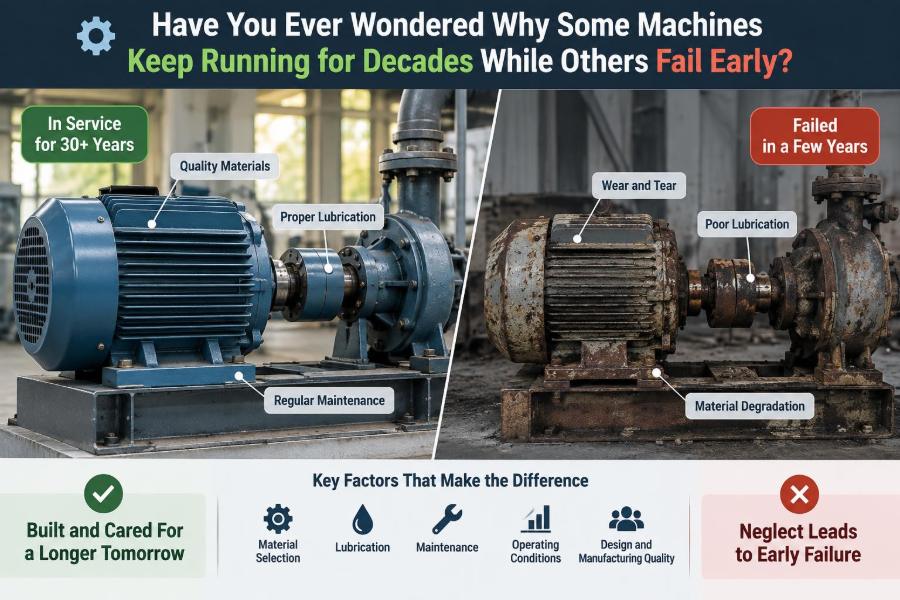

A factory may have two pumps installed in the same year, handling the same fluid, on the same production line. Ten years later, one still runs quietly with routine service. The other has already consumed bearings, seals, couplings, and maintenance hours.
The difference is rarely a single “good” or “bad” component. Long machine life is usually the result of many decisions that reinforce one another: sound design, correct installation, suitable operation, timely inspection, and repairs that address causes rather than symptoms.
This matters well beyond heavy industry. The same principles affect the lifespan of a car gearbox, an HVAC fan, a conveyor, a wind turbine, a household washing machine, and the tools used in a workshop.
Machines do not simply fail because they become old. They fail when loads, heat, contamination, motion, materials, and maintenance practices gradually exceed what their parts can tolerate. Understanding that process changes maintenance from a series of emergencies into a controlled engineering activity.
🔍 Machine Life Is More Than Calendar Age
A machine’s age tells only part of its story. A lightly loaded motor in a clean, cool room may remain serviceable for decades, while an identical motor exposed to vibration, moisture, overload, and repeated starts may deteriorate much sooner.
Engineers often think in terms of service life: the period during which equipment performs its required function safely and economically. Service life depends on operating conditions, not just the date stamped on a nameplate.
A useful question is not “How old is it?” but “What has it experienced?” Hours of operation, load cycles, start-stop frequency, temperature history, lubrication condition, and shock events can all matter more than calendar years.
🧩 Reliability Begins Before Manufacturing
Long-lived equipment starts with a design that matches its intended duty. A machine designed for intermittent use can fail early if treated as continuous-duty equipment, even when every part was manufactured correctly.
Designers must define loads, speeds, temperatures, environments, expected maintenance access, and consequences of failure. Ambiguous requirements lead to components chosen for nominal conditions rather than real conditions.
Reliability is therefore not an optional feature added later. It is built into decisions about shaft diameter, bearing arrangement, cooling capacity, sealing, structural stiffness, material selection, and allowable stress.
📏 Safety Margins Absorb Real-World Variation
Engineering calculations often include a factor of safety, a margin between expected working stress and a material or component limit. This margin accounts for uncertainty in loads, material properties, manufacturing variation, and operating conditions.
Too little margin leaves a machine vulnerable to small deviations. Too much can add unnecessary weight, cost, or inertia. The goal is not to make every part as large as possible; it is to choose a defensible margin for the duty and failure consequences.
A lifting mechanism, for example, needs a different approach from a lightly loaded office fan. Both require sound engineering, but their acceptable risks and load uncertainty are not the same.
🔁 Fatigue Makes Repeated Loads Dangerous
Many machine parts fail through fatigue, in which repeated stress creates and grows a crack over time. The stress may be below the level that would break the part in a single pull.
A rotating shaft bends slightly once per revolution if it is misaligned or carries an unbalanced load. After enough cycles, a tiny surface imperfection can become a fatigue crack. Final fracture may appear sudden, but the damage usually developed gradually.
Fatigue explains why smooth transitions, rounded corners, proper surface finish, and controlled loading matter. Sharp geometric changes concentrate stress and provide likely crack initiation sites.
📉 Stress Concentrations Create Weak Points
A notch, keyway, threaded section, abrupt diameter change, or corrosion pit disrupts the smooth flow of stress through a component. Engineers call the local increase a stress concentration.
Consider tearing paper: a small notch makes it much easier to start a tear. In metal components, the effect is less visible but similar. Repeated loading focuses damage around the discontinuity.
Good design reduces these effects with fillets, gradual transitions, suitable thread placement, and finishing methods that avoid damaging surfaces. During repair, grinding a defect without restoring the intended geometry can unintentionally create a new fatigue risk.
⚖️ Correct Load Assumptions Prevent Overload
Machines often fail because their actual duty differs from the original assumption. A conveyor may receive heavier products, a compressor may operate at higher discharge pressure, or a vehicle may tow more frequently than expected.
Overload does not always cause immediate failure. It can shorten bearing life, raise temperatures, increase gear tooth stress, deflect shafts, and accelerate fatigue. Small chronic overloads are especially easy to overlook because the machine may still appear functional.
Monitoring process changes is therefore part of mechanical reliability. When production rate, material properties, operating speed, or duty cycle changes, equipment capability should be reviewed rather than assumed.
🌀 Alignment Protects Shafts, Bearings, and Couplings
When connected shafts do not share the intended centerline, the system is misaligned. Misalignment can be angular, parallel, or a combination of both.
Flexible couplings can accommodate limited movement, but they do not make significant misalignment harmless. Excessive misalignment creates cyclic forces that overload bearings, heat couplings, loosen fasteners, and bend shafts.
Precision alignment during installation is valuable, but it must account for thermal growth. A machine that is aligned while cold may move as it warms. The target should reflect its normal operating condition, not merely a convenient measurement condition.
🎯 Balance Reduces Unnecessary Vibration
An unbalanced rotating part has its center of mass offset from its axis of rotation. As speed rises, the resulting centrifugal force can become substantial, producing vibration that travels into bearings, frames, foundations, and nearby equipment.
Fans, pumps, rotors, grinding wheels, and impellers can lose balance through material buildup, erosion, damaged blades, or poorly performed repairs. A clean rotor is not automatically balanced, but uneven buildup is a common warning sign.
Balancing removes or redistributes mass to reduce vibration. It cannot correct every vibration problem, so it should follow diagnosis rather than become a default response to any noisy machine.
📳 Vibration Is a Symptom, Not a Diagnosis
Vibration is often one of the earliest measurable signs that something has changed. Its source may be imbalance, misalignment, looseness, bearing damage, gear defects, hydraulic pulsation, resonance, or a process disturbance.
A vibration reading becomes more useful when it is compared with the machine’s own baseline and operating condition. A single measurement without speed, load, sensor location, and historical context can be misleading.
Condition monitoring seeks patterns: increasing amplitude, changing frequency content, or vibration that appears only at a certain speed. These clues help maintenance teams plan intervention before secondary damage spreads.
🎼 Resonance Can Magnify Small Forces
Every structure has natural frequencies at which it prefers to vibrate. Resonance occurs when a forcing frequency, such as a rotating speed or gear-meshing frequency, approaches a natural frequency.
A modest excitation can then create unexpectedly large motion. Thin guards may rattle, a skid-mounted pump may shake, or a long shaft may develop severe deflection at a particular speed.
Solutions include changing operating speed, increasing stiffness, adding damping, changing mass distribution, or improving support conditions. Adding material without understanding the vibration mode may shift the problem rather than solve it.
🛢️ Lubrication Separates Moving Surfaces
Lubricants reduce friction and wear by forming a film between moving surfaces. In bearings, gears, and sliding guides, that film can prevent direct metal-to-metal contact under suitable conditions.
The correct lubricant must have appropriate viscosity, additives, and temperature behavior for the application. Oil that is too thin may not sustain a protective film; oil that is too thick can create excess drag, heating, and poor flow at startup.
“More grease” is not always better. Over-greasing rolling-element bearings can churn lubricant, raise temperature, damage seals, and eventually shorten bearing life.
🧪 Contamination Turns Lubricant Into an Abrasive
Clean lubricant is a reliability tool. Dirt particles, water, fuel dilution, process chemicals, and wear debris can reduce film strength or scratch highly loaded surfaces.
A particle that seems tiny to the eye can be large relative to the oil film in a precision bearing or hydraulic component. Contamination can therefore initiate wear long before a machine looks obviously damaged.
Useful controls include sealed storage containers, clean transfer equipment, effective breathers, filter maintenance, and careful cleaning around fill points. These basic habits often matter as much as selecting a premium lubricant.
🌡️ Heat Accelerates Several Failure Mechanisms
Excess temperature can reduce lubricant viscosity, age elastomeric seals, change clearances, weaken some materials, and raise electrical losses in motor-driven equipment. Heat is often an effect as well as a cause.
A hot bearing might indicate insufficient lubrication, excessive preload, misalignment, contamination, or a damaged rolling surface. Simply adding lubricant may temporarily change the symptom while leaving the cause untouched.
Temperature trends are generally more informative than isolated readings. A stable warm gearbox may be operating normally, while a steady rise from its usual temperature deserves investigation.
💧 Corrosion Begins Where Protection Fails
Corrosion is an electrochemical process that removes or changes material, especially when moisture, oxygen, salts, or reactive chemicals are present. It is not merely cosmetic when it occurs on shafts, fasteners, pipe walls, or precision fits.
Corrosion pits are particularly harmful because they can act as stress concentrators. Under cyclic loading, a pit on a shaft can become the origin of a fatigue crack.
Coatings, drainage, material selection, environmental control, and regular cleaning all help. The best choice depends on the exposure: a stainless alloy may resist one environment well but be unsuitable for another chemical or temperature range.
🔩 Material Choice Must Match the Failure Mode
Strength alone does not make a material suitable. Designers may need hardness for wear resistance, toughness for impact resistance, corrosion resistance for the environment, or thermal stability at elevated temperature.
A very hard material can resist surface wear but may be less tolerant of sudden impact than a tougher alternative. Likewise, a light alloy can reduce inertia but may require special attention to fatigue behavior, joining methods, and corrosion protection.
Successful material selection asks what is most likely to damage the part in service. Abrasion, fracture, creep, corrosion, heat, and fatigue demand different properties.
🏭 Manufacturing Quality Sets the Starting Condition
A well-designed machine can still begin life with hidden weaknesses. Poor machining marks, improper heat treatment, residual stresses, incorrect tolerances, inclusions, and assembly damage may all reduce durability.
Tolerances control acceptable dimensional variation. A press fit that is too loose may slip; one that is too tight may distort a bearing race or produce excessive assembly stress. Surface finish also matters where seals run or fatigue cracks may start.
Quality control is not a guarantee that no defect exists. It is a system for reducing variation and detecting unacceptable conditions before equipment reaches service.
🧱 Foundations and Mounting Matter More Than They Seem
A machine transfers forces into its base. If the foundation is weak, cracked, uneven, or poorly grouted, the support can allow movement that changes alignment and amplifies vibration.
Soft foot occurs when one machine foot does not sit flat on its base. Tightening the hold-down bolts bends the machine frame, often creating alignment problems that return after careful adjustment.
Before blaming a coupling or bearing, technicians should verify the base, bolt condition, shims, pipe strain, and structural rigidity. The machine may be reacting to its support rather than generating the original problem.
🔧 Installation Errors Can Shorten Life Immediately
Installation is a critical transition from design intent to real operation. Bearings can be damaged by incorrect mounting force, seals can be nicked, bolts can be improperly tightened, and contamination can enter during assembly.
For example, pressing a bearing onto a shaft by applying force through the wrong ring can transmit load through the rolling elements and mark the raceways. The bearing may run initially, but its life has already been compromised.
Clear procedures, calibrated tools where needed, clean work areas, and recorded measurements help prevent these errors. Good installation is not slow for its own sake; it avoids failures that are expensive to diagnose later.
🧰 Maintenance Must Fit the Failure Pattern
Not every component benefits from the same maintenance strategy. Some parts wear gradually and respond well to inspection or replacement at planned intervals. Others fail randomly, making condition monitoring or functional testing more appropriate.
Replacing a healthy component too early can introduce installation errors and waste useful life. Waiting too long can allow failure to damage adjacent equipment. The right interval depends on duty, failure history, consequences, and the ability to detect deterioration.
Maintenance should therefore be evidence-based where practical, using inspections, operating data, oil condition, vibration trends, and documented work history.
📈 Predictive Maintenance Looks for Change
Predictive maintenance uses condition information to estimate when intervention may be needed. Common methods include vibration analysis, infrared temperature surveys, ultrasonic monitoring, oil analysis, and motor electrical testing.
These techniques have limits. A thermal camera can identify an unusually hot location, but it cannot by itself confirm why it is hot. Oil analysis can reveal contamination or wear particles, but interpretation depends on the component, sample quality, and trend history.
The value comes from combining condition data with knowledge of the machine and process. A measurement should lead to a specific question, not an automatic replacement order.
🗓️ Preventive Maintenance Still Has a Role
Preventive maintenance is scheduled work intended to reduce the chance of failure: cleaning, lubricating, inspecting, adjusting, testing, or replacing selected items at defined intervals.
It remains essential for tasks such as checking guards, testing protective devices, changing filters where condition cannot be monitored reliably, and servicing components with known time-related degradation.
The common mistake is treating a calendar as proof of equipment health. Scheduled work should be reviewed when operating conditions change or when repeated findings show that the interval is poorly chosen.
🕵️ Root Cause Analysis Stops Repeat Failures
Replacing a failed bearing restores operation, but it does not necessarily solve the failure. If the bearing failed because of contamination, misalignment, electrical current, incorrect fit, or overload, the replacement may follow the same path.
Root cause analysis asks why the failure occurred and why safeguards did not prevent it. It should examine physical evidence, operating records, maintenance practices, component selection, and process changes.
A practical investigation separates observations from assumptions. “The bearing outer race is damaged” is an observation. “The bearing was defective” is a possible explanation that requires evidence.
📚 Records Turn Experience Into Knowledge
Maintenance records are often treated as paperwork, yet they provide the history needed to identify recurring defects. Useful records capture asset identity, symptoms, measurements, parts used, work performed, likely cause, and post-repair verification.
Vague notes such as “fixed pump” make future diagnosis difficult. A note that records seal leakage, shaft runout, alignment condition, seal type, and process temperature creates a much more useful trail.
Over time, this information helps teams identify chronic offenders, improve spare-part choices, adjust maintenance intervals, and justify design modifications.
👂 Operators Often Detect the First Clue
Operators see, hear, and feel equipment during normal work. A new clicking sound, slower actuator, unusual odor, recurring alarm, leaking seal, or higher-than-usual effort can be an early warning.
They should not be expected to diagnose every defect, but they should have a clear route for reporting changes. Training is most effective when it explains what normal operation looks like and which abnormalities need prompt attention.
A culture that dismisses early reports encourages hidden deterioration. A culture that investigates credible observations protects both equipment and people.
🚦 Operating Discipline Preserves Design Intent
Even robust machinery has limits on speed, load, temperature, pressure, and starting frequency. Bypassing an interlock, running through severe vibration, or repeatedly operating beyond rated conditions may keep production moving briefly while consuming equipment life.
Operating discipline does not mean never adapting equipment to changing needs. It means evaluating changes deliberately, confirming capacity, and updating procedures rather than relying on informal workarounds.
Clear startup, shutdown, warm-up, and cleaning procedures are especially valuable for systems affected by thermal expansion, lubrication delay, fluid viscosity, or contamination.
🧯 Safety and Reliability Often Support Each Other
A loose guard, damaged support, leaking hydraulic line, overheated bearing, or fractured fastener can be both a reliability concern and a safety concern. Equipment that is degrading unpredictably can create hazards before complete failure occurs.
However, reliability work should never encourage unsafe inspection or repair practices. Isolate energy sources, follow site procedures, use appropriate guarding, and involve qualified personnel for tasks involving stored energy, high speed, high temperature, or hazardous materials.
When safety controls are treated as obstacles, failures become harder to inspect and manage. When they are built into work planning, maintenance becomes more repeatable and less dependent on risky improvisation.
💰 Lowest Purchase Cost Is Not Lowest Ownership Cost
A cheaper machine or component may be appropriate when duty is light and replacement is easy. But for critical equipment, the initial price can be small compared with downtime, lost output, emergency labor, collateral damage, and safety exposure.
Life-cycle cost considers the costs of acquisition, installation, energy, maintenance, spares, downtime, and disposal over the equipment’s useful life. It helps reveal why a slightly more durable seal, bearing arrangement, or motor enclosure can be economical.
This does not mean the most expensive option is automatically best. The sensible choice depends on actual duty, maintainability, criticality, and the cost of failure.
🔄 Repair Quality Determines the Next Service Interval
A repair can either restore the original capability or merely postpone another outage. Shaft sleeves, weld repairs, re-machined fits, rebuilt gearboxes, and replacement components must be evaluated for geometry, material effects, balance, alignment, and inspection needs.
For example, welding can introduce heat and residual stress. On a highly loaded rotating shaft, an apparently convenient repair may require engineering review, post-repair machining, or a replacement strategy instead.
Verification is the final step: check clearances, fastener security, lubrication, alignment, guards, and operating response after the machine returns to service.
🧠 The Core Principle: Control Damage Before It Grows
Machines that last for decades are not usually free from wear. They survive because small forms of damage are detected, understood, and controlled before they become destructive.
That requires a chain of sound decisions: design for real loads, build and install accurately, keep moving parts clean and lubricated, monitor changing condition, investigate repeat failures, and operate within known limits.
The central lesson is simple: reliability is not luck, and it is not one maintenance task. It is the disciplined management of stress, motion, heat, contamination, and human decisions throughout a machine’s life.
The machines that endure are the ones whose small problems are treated as engineering signals, not ignored until they become failures. ⚙️🔧📈