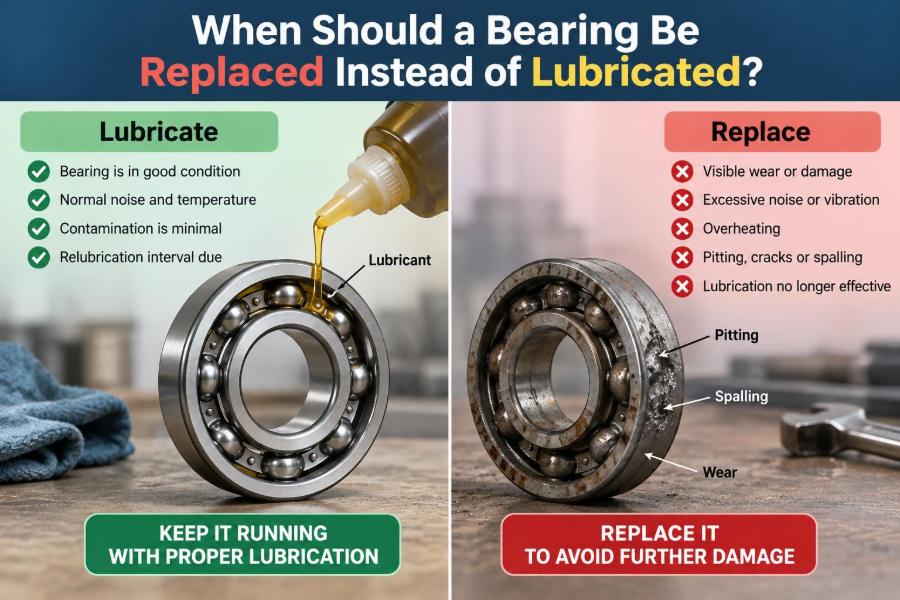

A conveyor begins to sound rough near the end of a shift. A pump housing feels warmer than usual. The first instinct is often sensible: check the grease gun, add lubricant, and see whether the noise settles down.
Sometimes that is exactly the right response. Bearings need the correct lubricant, delivered in the correct quantity, to separate moving surfaces and carry heat away. But lubrication cannot rebuild damaged raceways, remove fatigue cracks, or restore a bearing that no longer fits securely on its shaft.
The practical challenge is deciding whether a bearing has a lubrication problem or a damage problem. Treating a failed bearing with more grease can delay diagnosis, contaminate the machine, and allow a small fault to develop into an unplanned shutdown.
A good decision combines inspection, operating history, condition-monitoring evidence, and an understanding of what lubrication can—and cannot—do.
🔩 Start with the Bearing’s Real Job
A rolling-element bearing supports a rotating shaft while allowing relative motion with low friction. Balls or rollers travel between an inner ring, an outer ring, and cages that keep the rolling elements spaced apart.
Lubricant forms a thin separating film between these surfaces. It also reduces sliding friction in contact regions, protects against corrosion, and helps move heat out of the bearing. When that film is inadequate, metal-to-metal contact can begin long before a bearing visibly fails.
Replacement becomes necessary when the bearing’s geometry, surface condition, internal clearance, or mounting integrity has been permanently compromised.
🧭 Lubrication Problems and Bearing Failures Are Different
Not every noisy or hot bearing is worn out. A dry bearing, a bearing filled with the wrong grease, or one contaminated by moisture may improve after the root cause is corrected and lubrication is renewed properly.
In contrast, lubrication is not a repair for pitting, spalling, fractured cages, brinelling, or severe corrosion. Those defects alter how load is carried and usually continue progressing even if fresh lubricant temporarily quiets the machine.
The key distinction is simple: lubrication restores a protective operating condition; replacement removes damaged components.
🛢️ What Proper Lubrication Can Actually Fix
Relubrication is appropriate when the bearing remains mechanically sound but the lubricant is depleted, degraded, incorrectly selected, or applied poorly. Grease can harden with age, oil can oxidize, and lubricant can be lost through seals or leakage paths.
For example, a lightly loaded electric-motor bearing may run hotter after its grease has aged beyond useful life. If inspection finds no abnormal vibration, no roughness, and no seal damage, planned regreasing with the specified lubricant may return it to normal operation.
This assumes the old lubricant and the cause of its deterioration are addressed. Adding fresh grease on top of incompatible or contaminated grease does not create a clean lubrication system.
🚫 What Lubricant Cannot Repair
Grease does not fill a fatigue pit in a raceway in any reliable structural sense. Oil does not straighten a bent cage. Neither can restore a worn interference fit between an inner ring and a shaft.
Some defects may seem less obvious after lubrication because the new lubricant changes the sound level or damps vibration. This is a masking effect, not recovery. The damaged contact surfaces remain under cyclic stress each time the shaft rotates.
When a defect is confirmed, continued operation should be based on a deliberate risk assessment and replacement plan—not on the hope that more lubricant has solved it.
🌡️ Rising Temperature Is a Clue, Not a Verdict
Temperature is useful because excess friction, overgreasing, misalignment, inadequate clearance, and poor heat removal can all raise bearing temperature. But a single temperature reading does not identify the cause.
Compare the current value with the machine’s normal trend, equivalent bearings, ambient conditions, load, and speed. A gradual increase after a lubrication interval may point to lubricant condition. A sharp rise immediately after greasing often points to excess grease or a blocked relief path.
A bearing that stays unusually hot after the correct quantity of lubricant has had time to distribute needs further investigation. Do not keep adding grease in response to heat alone.
🎧 Listen for Changes in Sound
A healthy bearing often produces a steady, low mechanical sound. Rumbling, grinding, clicking, or periodic knocking can indicate damaged rolling surfaces, loose fits, contamination, or a cage problem.
Sound is most useful when compared with the machine’s previous condition. A pump may be naturally louder than an electric motor, but a new rhythmic click that follows shaft speed deserves attention.
Lubricant starvation can create a dry, harsher sound that improves quickly after correct relubrication. Persistent roughness after lubrication is more consistent with physical damage and should prompt inspection or vibration analysis.
📈 Use Vibration Trends Instead of Guesswork
Vibration monitoring can detect bearing faults before they are visible during a routine walk-around. A defect on an inner ring, outer ring, rolling element, or cage tends to create characteristic repeating impacts as components move through the load zone.
Interpreting vibration data requires care. Imbalance, misalignment, looseness, gear defects, hydraulic effects, and structural resonance can also raise vibration. The goal is not merely to find a high reading but to identify a repeatable pattern and trend.
When vibration data indicates an advancing bearing defect, lubrication should not be used as the only response. Plan replacement before damage spreads to the shaft, housing, seals, or connected equipment.
🔍 Check for Roughness During Safe Inspection
With the machine isolated and unable to start, a trained technician may be able to turn a shaft slowly by hand. A damaged bearing can feel gritty, notchy, or uneven, especially when lightly loaded.
This method has limits. Large machines, preloaded bearings, seals, gears, and couplings can hide the feel of the bearing. Never place hands near equipment that has not been properly isolated under the site’s energy-control procedure.
Still, obvious roughness is a strong warning. A bearing that does not rotate smoothly after cleaning and correct lubrication is generally a replacement candidate.
🕳️ Replace Bearings with Spalling or Flaking
Spalling is the breaking away of small pieces of material from a raceway or rolling element. It is commonly associated with rolling-contact fatigue, although severe surface damage can have other origins.
Once material begins to flake, each pass of a rolling element creates impacts and releases debris into the lubricant. That debris can damage otherwise healthy surfaces and accelerate failure.
Spalling is not a lubrication-service condition. The bearing should be replaced, and the lubricant path, housing, seals, and nearby components should be cleaned to prevent debris from entering the new bearing.
💥 Recognize Brinelling and False Brinelling
Brinelling appears as permanent indentations in raceways, often spaced at rolling-element intervals. It can result from shock loads, improper installation forces, or impacts transmitted through a stationary machine.
False brinelling looks similar but is caused by small oscillatory movements while stationary, such as vibration during transport or standby. The lubricant film is repeatedly displaced, and fretting damage develops at the contact points.
Neither condition is reversed by fresh grease. If indentations cause vibration, noise, or rough rotation, replace the bearing and address the vibration, shipping restraint, or installation practice that caused them.
🧲 Treat Corrosion Pits as Structural Damage
Moisture, process vapors, washdown water, and long storage periods can corrode bearing surfaces. A stained surface is not always catastrophic, but pitting in the rolling path creates stress concentrations and disrupts the lubricant film.
Corrosion also produces abrasive oxide particles. If pitting is in an active raceway, if rolling elements are affected, or if the bearing feels rough, replacement is usually the dependable option.
Then investigate the route of water entry. Better sealing, correct storage, appropriate grease, ventilation control, or a revised washdown method may be needed to prevent repeat failures.
🧱 Replace a Cracked, Deformed, or Broken Cage
The cage guides and spaces rolling elements. A cracked polymer cage, distorted steel cage, loose rivet, or broken cage pocket can allow rollers or balls to bunch together and slide where they should roll.
Cage damage may produce intermittent noise, sudden vibration changes, or a rapid temperature rise. In severe cases, it can lead to seizure.
There is no safe relubrication remedy for a damaged cage. Replace the bearing and examine whether excessive speed, poor lubrication, contamination, misalignment, electrical damage, or incorrect handling contributed to the failure.
📏 Excessive Internal Clearance Signals Wear
Internal clearance is the small amount of relative movement possible between bearing rings before mounting and operating effects are considered. The correct operating clearance depends on bearing type, fit, temperature, and load.
Too much clearance can develop from raceway wear, spinning of a ring on its seat, or loss of preload in an arrangement designed for preload. The shaft may then move more than intended, affecting seal performance, gear mesh, belt tracking, or process accuracy.
Lubricant can reduce friction but cannot restore lost geometry. Measurements that confirm excessive play should lead to replacement and an inspection of fits and assembly settings.
🔄 A Loose Ring Fit Needs More Than Grease
A bearing ring should have the specified fit on its shaft or in its housing. If the loaded ring creeps or spins relative to its seat, it can polish, fret, and wear the mating surface.
Common clues include reddish-brown fretting debris, a polished shaft seat, localized heat, or a bearing that slides on too easily during disassembly. Eventually, the shaft or housing may be too worn to hold a replacement bearing correctly.
Replace the failed bearing, but do not stop there. A new bearing installed on a damaged seat may fail quickly unless the shaft, sleeve, housing, or retention method is repaired.
⚡ Watch for Electrical Damage in Motors and Drives
Stray electrical currents can pass through motor bearings, particularly where variable-frequency drives, grounding conditions, or shaft-voltage paths create a discharge route. Repeated discharges can leave fluting: a patterned, washboard-like texture on raceways.
The noise may be high-pitched, and vibration can increase as the pattern worsens. Lubricant may darken from debris, but fresh grease cannot remove the electrical surface damage.
Replace affected bearings and investigate current paths. Grounding provisions, shaft-grounding devices, insulated bearings, and system-specific design measures may be relevant, depending on the equipment.
🧪 Inspect the Lubricant for Evidence
Used lubricant often tells part of the story. Metallic particles may indicate wear; darkened grease may reflect age or heat; milky oil can indicate water contamination; and gritty grease may reveal dust ingress.
Evidence must be interpreted in context. Some discoloration is normal over time, and sampling itself can introduce contamination. For critical machines, structured oil analysis or grease sampling performed under a consistent procedure is more useful than an informal visual judgment.
If debris is substantial or magnetic particles are repeatedly found, replace the bearing when inspection supports damage and thoroughly clean the lubrication system.
💧 Contamination Can Turn a Service Issue into a Replacement Issue
A small amount of contamination may be removed during a controlled lubricant change before damage becomes severe. But hard particles entering a loaded contact act like tiny cutting tools, denting raceways and creating more debris.
Water reduces lubricant-film effectiveness and encourages corrosion. Process chemicals may attack grease thickeners, seals, or bearing materials. The longer contaminated lubricant remains in service, the more likely the bearing will need replacement rather than simple relubrication.
For dusty or wet environments, focus on seals, breathers, grease fittings, cleaning methods, and storage practices—not just on shortening grease intervals.
🧯 Overgreasing Is Also a Failure Mechanism
More grease is not automatically safer. In many rolling bearings, excess grease is churned by rotating components, raising fluid friction and temperature. The grease can oxidize faster and may force its way past seals.
Overgreasing can be mistaken for underlubrication because both conditions can produce heat. The difference matters: adding more grease to an already overfilled bearing makes the situation worse.
Use the manufacturer’s method or site procedure to determine quantity and interval. Where fittings are used, provide a route for old grease to escape and remove purged grease safely.
🧴 Use the Right Lubricant, Not Just Any Grease
Grease selection involves base-oil viscosity, thickener type, additives, operating temperature, speed, load, and compatibility with seals and existing lubricant. A grease that works well in a slow, heavily loaded bearing may be unsuitable for a high-speed motor.
Mixing incompatible greases can soften or harden the mixture, alter oil release, and reduce consistency. If a change is necessary, follow a controlled changeover process rather than assuming all multipurpose greases behave alike.
An incorrect lubricant does not always mean the bearing must immediately be replaced. But if overheating, wear, or surface damage has already occurred, correct lubricant selection must accompany replacement.
🧰 Installation Damage Often Reveals Itself Later
A bearing can be damaged before the machine ever runs. Striking a ring with a hammer, pressing through the wrong ring, applying force through rolling elements, or overheating during mounting can create dents, cracks, or altered internal clearance.
For example, pressing a bearing onto a shaft by pushing on the outer ring transmits mounting force through balls or rollers. That can indent raceways and create future vibration.
When a recently installed bearing becomes noisy early in service, investigate installation practice before blaming lubrication. Replace damaged units and use suitable pullers, induction heaters, presses, and fitting tools.
📐 Misalignment and Overload Can Consume a Good Bearing
Misalignment causes load to concentrate in a smaller portion of the bearing than intended. Overload can do the same, whether caused by a process upset, excessive belt tension, pipe strain, or an incorrectly selected bearing.
Fresh lubricant may reduce symptoms briefly, but it cannot redistribute a fundamentally wrong load path. Replacing a bearing without correcting alignment or loading merely restarts the failure cycle.
Check coupling alignment, shaft deflection, belt and chain tension, housing condition, machine base rigidity, and the actual process load before commissioning the repair.
🧭 Consider Duty Cycle and Criticality
A lightly loaded standby fan and a process-critical compressor do not require the same response to an early fault indication. The bearing condition may be similar, but the consequence of failure, available redundancy, repair access, and shutdown opportunity differ.
For a noncritical machine, a known defect may be monitored until a planned outage if failure consequences are controlled. For equipment that could create a safety hazard, environmental release, or major process interruption, replacement may be justified much sooner.
This is not permission to run a damaged bearing indefinitely. It is a reminder that maintenance decisions should combine condition evidence with operational risk.
🗓️ Replace by Condition, Not Calendar Alone
Time-based replacement is useful where bearing access is difficult, consequences are high, or operating conditions are predictable. Yet a calendar alone cannot account for actual load, contamination, installation quality, or lubrication history.
Condition-based maintenance uses temperature, vibration, ultrasound, lubricant evidence, inspections, and operating trends to decide when action is needed. It can reduce unnecessary replacement while helping teams plan repairs before a functional failure.
The best approach is often mixed: scheduled lubrication and inspection, supported by condition monitoring for important assets.
📝 Record the Evidence Before Making the Call
A clear record makes bearing decisions more repeatable. Note the machine, bearing location, operating speed and load, temperature trend, vibration observations, lubricant type, quantity added, dates, and visible symptoms.
During replacement, document damage with photographs where site rules permit. Record the bearing designation, fit condition, seal condition, and likely failure mechanism. These details are far more useful than simply writing “bearing failed.”
Over several repairs, this history can reveal patterns such as repeated water ingress, a poor grease interval, recurring misalignment, or a component-selection problem.
🛑 Know When to Stop the Machine Promptly
Some symptoms justify urgent shutdown or a rapid engineering review: severe overheating, smoke, seized rotation, a sudden loud grinding sound, rapidly escalating vibration, a broken housing, or evidence that a bearing fault could affect a safety-critical function.
Site procedures, equipment manuals, and risk controls should govern the exact response. Do not improvise around rotating equipment or remove guards to inspect a running bearing.
When in doubt, protect people first, isolate the equipment correctly, and have qualified personnel assess the condition.
🧩 A Practical Decision Sequence
- Confirm the symptom and compare it with the machine’s normal operating baseline.
- Check lubrication type, quantity, delivery path, age, and signs of contamination.
- Look for root causes such as misalignment, overload, poor seals, loose fits, electrical discharge, or installation damage.
- Use available evidence—temperature, vibration, sound, lubricant condition, and safe inspection—to determine whether damage is present.
- Relubricate only when the bearing is mechanically sound and the lubrication problem can be corrected.
- Replace the bearing when damage, excessive play, cage failure, corrosion in the rolling path, or loss of fit is confirmed.
- Correct the cause before installing the replacement.
This sequence avoids the common mistake of treating every symptom as a grease-shortage problem.
⚖️ Replace the Bearing, Repair the System
A replacement bearing is only one part of a complete repair. If contamination entered through a failed seal, if a shaft seat is worn, or if alignment is poor, the surrounding system must be restored as well.
Before restart, verify bearing orientation, fit, locking arrangement, lubrication quantity, seal condition, coupling alignment, and guard installation. Then establish a baseline temperature and vibration condition for future comparisons.
The central principle is straightforward: lubricate a sound bearing with a lubricant problem; replace a bearing with a material, geometric, cage, fit, or electrical-damage problem—and eliminate the cause that created it.
A grease gun is a maintenance tool, not a universal cure. Careful diagnosis protects the bearing, the machine around it, and the maintenance time needed to keep both running reliably. ⚙️🔍🛠️