
A car engine can contain dozens of moving surfaces that slide, roll, or rotate against one another thousands of times each minute. A factory gearbox, hydraulic cylinder, bicycle chain, or household fan faces the same basic challenge: motion creates contact, and contact can create damage.
At first glance, lubrication seems simple. Add oil or grease, and the parts move more easily. Yet the protective layer doing most of the work may be thinner than a human hair—and in some machine contacts, thinner still.
That thin film is not merely “slippery stuff” between parts. It is an engineered barrier that carries load, controls heat, limits wear, resists corrosion, and transports contaminants away from critical surfaces.
Understanding how this film forms helps engineers select lubricants, design bearings, diagnose failures, and avoid the common mistake of treating all oils as interchangeable.
🔩 Friction Begins at the Surface
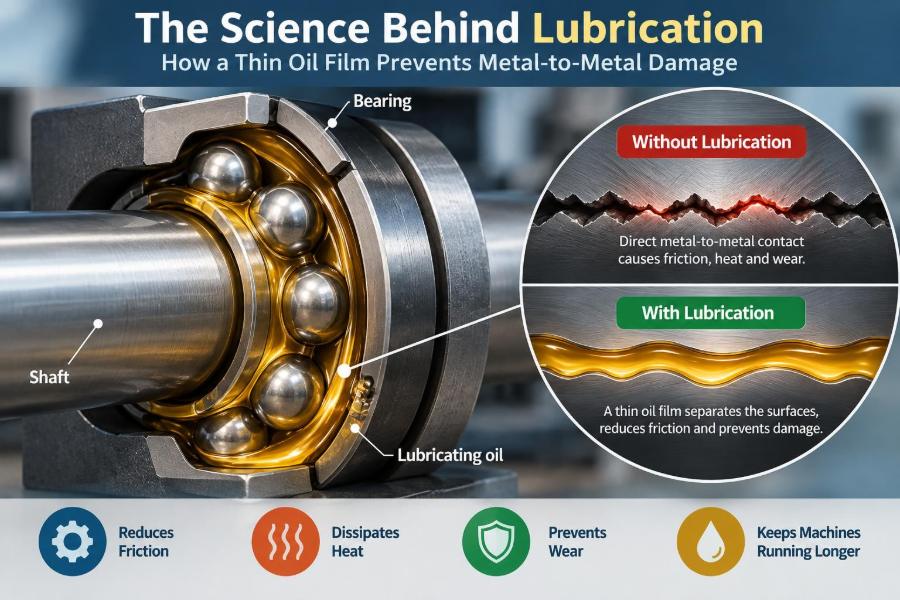
No manufactured metal surface is perfectly smooth. Even a polished shaft or bearing race contains microscopic peaks and valleys called asperities. When two nominally smooth parts touch, initial contact occurs mainly at these small high points.
Without adequate lubrication, asperities can scrape, deform, or weld together under pressure. Breaking those tiny junctions during motion requires force, which appears as friction, heat, and material loss.
🧭 What Lubrication Actually Does
The primary purpose of lubrication is to separate moving surfaces enough that damaging solid-to-solid contact is reduced. A lubricant can also remove heat, carry debris to a filter or sump, protect against corrosion, and cushion shock loads.
Its role depends on the machine. In a rolling-element bearing, it must lubricate concentrated contacts and prevent raceway damage. In an engine, it must work across bearings, piston rings, valve-train components, and gears under changing temperature and speed.
🫧 The Thin-Film Principle
A lubricant film works because a fluid can develop pressure when it is forced into a narrowing space or squeezed between moving surfaces. That pressure supports part of, or sometimes nearly all of, the applied load.
The key idea is simple: if the oil film keeps the opposing asperities apart, the surfaces do not need to carry the load directly. Friction then comes mostly from shearing the fluid rather than tearing metal from metal.
📏 Film Thickness Is Relative, Not Absolute
There is no single “safe” oil-film thickness for every machine. What matters is the relationship between film thickness and the combined roughness of the two surfaces.
A film that is adequate for a finely finished journal bearing may be insufficient for rough gear teeth. Engineers often describe this relationship with a film parameter, comparing estimated lubricant-film thickness with surface roughness.
When the film is large compared with surface roughness, separation is likely. When it approaches the height of the asperities, mixed contact and wear become more likely.
🌊 Viscosity: A Fluid’s Resistance to Flow
Viscosity describes how strongly a fluid resists flowing. Honey has higher viscosity than water; a heavy gear oil generally has higher viscosity than a light hydraulic oil.
Viscosity strongly affects film formation. A more viscous oil can often build a thicker film at a given speed and load, but it also takes more energy to circulate and shear. The best lubricant is not automatically the thickest one.
🌡️ Why Temperature Changes Everything
Most oils become thinner as temperature rises. If a machine runs hotter than expected, its lubricant may lose enough viscosity that the separating film becomes too thin.
Cold conditions create the opposite problem. Oil may become so viscous that it circulates slowly, increases churning losses, or fails to reach remote contact points promptly during startup. Viscosity selection must therefore reflect the machine’s actual operating temperature range.
🏎️ Speed Helps Build a Wedge of Oil
In many sliding contacts, motion draws oil into a converging gap between surfaces. This produces a pressure-generating wedge, much like water lifting a fast-moving board as it skims across a shallow surface.
Higher relative speed often helps establish this hydrodynamic film. That is why a journal bearing may operate with very low wear once it reaches normal speed, while its most vulnerable period is often during starting and stopping.
⚖️ Load Pushes the Film Thinner
Load acts against film formation. As the force on a bearing, gear tooth, or cam contact rises, the lubricant must generate greater pressure over a small area to keep the surfaces separated.
If speed, viscosity, and geometry remain unchanged, a heavier load generally reduces film thickness. Momentary overloads, vibration, misalignment, and shock can therefore move a contact from safe fluid separation into damaging asperity interaction.
🌀 Hydrodynamic Lubrication: Full Fluid Separation
Hydrodynamic lubrication occurs when motion and geometry create enough fluid pressure to fully separate the surfaces. The load is supported by the oil film, not by direct metal contact.
A classic example is a rotating shaft in a plain journal bearing. As the shaft turns, it settles slightly off-center and drags oil into a wedge-shaped clearance. Pressure builds in that wedge and supports the shaft.
Under stable conditions, friction can be low because the resistance comes primarily from fluid shear. However, hydrodynamic operation requires the right clearance, oil supply, speed, and viscosity.
🧲 Hydrostatic Lubrication: Pressure Supplied Externally
Hydrostatic lubrication uses an external pump to force fluid into a bearing clearance at sufficient pressure to support the load, even when there is little or no relative motion.
This approach is useful in some precision machine tools, heavy positioning systems, and specialized equipment where smooth low-speed motion matters. Its advantage is protection at zero or very low speed; its trade-off is added pumps, controls, power use, and system complexity.
🧬 Elastohydrodynamic Lubrication in Concentrated Contacts
Rolling bearings and gear teeth experience very high contact pressures over small areas. In these contacts, the surfaces deform elastically and the oil’s viscosity rises sharply under pressure. This regime is called elastohydrodynamic lubrication, or EHL.
The resulting film can still be extremely thin, yet it can separate the surfaces under demanding conditions. Gear and bearing oils are formulated with EHL behavior in mind, but film survival still depends on cleanliness, surface condition, loading, and temperature.
🤝 Mixed Lubrication: Oil Film and Surface Contact Together
Mixed lubrication occurs when the oil film supports much of the load but some asperity contact remains. It is common during starts, stops, low-speed operation, or when load briefly rises.
Because direct interaction has not disappeared, lubricant chemistry becomes especially valuable here. Additives can form protective boundary layers that reduce scuffing and adhesive wear when the fluid film alone is not enough.
🧱 Boundary Lubrication at the Limit
In boundary lubrication, the separating fluid film is too thin to prevent substantial asperity contact. Protection relies largely on molecules and reaction products attached to or formed on the surface.
This condition can occur in heavily loaded sliding mechanisms, piston-ring reversals, slow oscillating joints, and poorly lubricated contacts. Boundary films are helpful, but they are not a substitute for adequate machine design and lubricant supply.
📉 The Stribeck Curve Connects the Regimes
The Stribeck curve is a useful conceptual map of lubrication behavior. It relates friction to a combined effect of viscosity, speed, and load.
| Operating tendency | Dominant condition | Main friction source |
|---|---|---|
| Low speed, high load, low viscosity | Boundary lubrication | Asperity contact and boundary-film shear |
| Increasing speed or viscosity | Mixed lubrication | Both asperity contact and fluid shear |
| Suitable speed and film thickness | Full-film lubrication | Fluid shear |
| Very high speed or excessive viscosity | Full film with rising losses | Viscous drag and churning |
The curve explains an important design compromise: too little viscosity risks wear, while excessive viscosity can waste energy and raise operating temperature.
🧪 Base Oils Provide the Fluid Foundation
Lubricants begin with a base oil that supplies much of the fluid film, heat-transfer behavior, and low-temperature performance. Mineral oils, synthetic hydrocarbons, esters, and other base-stock families differ in their properties and compatibility.
Synthetic oils can offer useful performance advantages in demanding temperature ranges or long service conditions, but they are not universally required. Seal materials, additive systems, cost, service practices, and manufacturer specifications all affect suitability.
⚗️ Additives Strengthen Weak Operating Conditions
Additives are chemical components blended into the base oil for specific jobs. They may improve oxidation resistance, reduce foam, prevent corrosion, keep contaminants suspended, or help protect surfaces under boundary and extreme-pressure conditions.
Anti-wear additives are designed to form sacrificial protective layers in suitable contacts. Extreme-pressure additives are commonly used in heavily loaded gear applications, where they can reduce the risk of scoring or welding at tooth contacts.
Additives are carefully balanced. More additive is not automatically better, and mixing unrelated lubricants can upset that balance.
🧼 Clean Oil Protects the Film
A clean lubricant film is more reliable than a contaminated one. Hard particles can become rolling or cutting abrasives, damaging both surfaces and the film that separates them.
Water can promote corrosion, interfere with additives, reduce film strength in some situations, and accelerate oil degradation. Air bubbles and foam may impair lubrication supply and can contribute to oxidation or pump problems.
- Use clean containers and dedicated transfer equipment.
- Keep filler caps, breathers, and seals in good condition.
- Use filtration appropriate to the machine and its sensitivity.
- Investigate repeated water ingress rather than simply topping up oil.
💨 Aeration and Foam Are Not the Same Problem
Aeration means air is dispersed within the oil, often as small bubbles. Foam is a more visible layer of bubbles at the oil surface. Both can be troublesome, but they arise and behave differently.
Aerated oil can compress, reducing the stability of hydraulic systems and the consistency of a lubricating supply. Foam may overflow reservoirs or prevent proper separation of air before oil returns to a pump inlet.
🔥 Heat Is Both a Result and a Cause of Trouble
Friction generates heat, especially when a film thins and asperity contact rises. The higher temperature then lowers oil viscosity, which can thin the film further. This feedback loop can accelerate damage if not corrected.
Oil also ages faster when exposed to prolonged excessive temperature and oxygen. Oxidation can produce acidic compounds, varnish, sludge, and viscosity changes that impair flow and surface protection.
⚙️ Surface Finish Influences Film Survival
Surface texture affects how easily a film separates two parts. Very rough surfaces have taller asperities that require a thicker film to avoid contact. Directional machining marks can also influence lubricant entrainment and leakage.
Extremely smooth is not always automatically ideal for every contact. The desired finish depends on the mechanism, material pair, lubricant, manufacturing method, and intended lubrication regime. Designers specify finish in relation to the complete tribological system, not as an isolated number.
📐 Clearance Must Be Designed, Not Guessed
Plain bearings require a carefully controlled clearance: enough room for lubricant to enter and form a wedge, but not so much that pressure generation and shaft stability are compromised.
Clearance changes with thermal expansion, wear, housing distortion, and assembly quality. Using a thicker oil to hide an incorrect bearing clearance may temporarily alter symptoms, but it does not correct the underlying geometry.
🔄 Lubricant Delivery Matters as Much as Selection
The correct oil provides little protection if it cannot reach the contact. Pumps, splash systems, wick feeds, grease paths, grooves, nozzles, and passages must deliver lubricant consistently where and when it is needed.
Blocked passages, a failing pump, low reservoir level, incorrect grease placement, or a misplaced spray nozzle can cause localized starvation. The rest of the machine may appear normal while one critical contact overheats or wears rapidly.
🛢️ Oil and Grease Solve Different Delivery Problems
Oil flows readily, carries heat effectively, and can be filtered and recirculated. It is often preferred for high-speed, high-temperature, or continuously lubricated machinery.
Grease is oil held in a thickener structure. It stays in place more easily and suits many sealed or intermittently serviced bearings, but it does not remove heat or contaminants as effectively as a circulating oil system.
Grease selection involves base-oil viscosity, thickener type, consistency, additives, and compatibility. Treating grease simply as “thick oil” can lead to poor choices.
🚗 Startup Is a High-Risk Moment
When a machine stops, a full hydrodynamic film may collapse because relative speed falls to zero. Some oil remains on the surfaces, but the next start often begins in boundary or mixed lubrication.
Engine wear is therefore influenced by oil drain-back, low-temperature viscosity, anti-wear chemistry, component design, and the time required for pressure and flow to stabilize. Repeated short cycles can impose a different lubrication duty than steady, fully warmed operation.
🦷 Gears Need More Than Slipperiness
Gear teeth roll and slide simultaneously as they mesh. Their contacts face concentrated load, changing speed, surface temperature, and potential contamination. A suitable gear lubricant must create an EHL film while also offering protection during transient mixed-lubrication conditions.
Wrong viscosity can cause inadequate film thickness or excessive drag. Wrong additive chemistry can also be unsuitable for particular metals or gearbox designs. The equipment manufacturer’s lubricant specification is the starting point, not a suggestion to replace with a visually similar product.
🧰 Bearings Fail in Recognizable Ways
Lubrication problems leave clues, although a diagnosis should consider alignment, load, electrical damage, installation, and contamination as well. Discoloration may indicate overheating; scoring can point to debris or film failure; smearing may reflect sliding under inadequate conditions.
In rolling bearings, insufficient lubricant, excessive grease, incompatible grease, water contamination, and improper relubrication intervals can all shorten service life. Adding more grease after every problem is a common but unreliable response.
🔍 Condition Monitoring Turns Oil Into Evidence
Used oil can carry information about machine condition. Trends in viscosity, water content, particle levels, oxidation indicators, and wear debris may reveal developing issues before obvious failure occurs.
Oil analysis is most useful when samples are taken consistently from meaningful locations and interpreted alongside operating history. A single test result rarely explains an entire machine; changes over time are often more informative.
🧯 Common Lubrication Mistakes to Avoid
Many failures originate not in exotic chemistry but in ordinary maintenance errors. The following practices deserve particular attention:
- Using a lubricant based only on color, brand familiarity, or availability.
- Mixing oils or greases without checking compatibility.
- Overfilling gearboxes or bearing housings, causing churning and heat.
- Underfilling systems or ignoring leaks that reduce supply.
- Relubricating on a calendar alone while ignoring duty cycle and condition.
- Leaving new lubricant containers open in dusty or humid areas.
- Assuming a noise or temperature rise is solved by adding more lubricant.
🧑🔧 A Practical Selection Workflow
Choose lubricant by starting with the machine’s documented requirement. Then examine operating reality: ambient temperature, actual load, speed, duty cycle, contamination exposure, relubrication method, and whether the equipment is new, worn, or modified.
- Identify the component and its specified lubricant grade or performance requirement.
- Confirm the required viscosity at operating temperature, not just at room temperature.
- Check material and seal compatibility.
- Select the needed additive performance without introducing unnecessary incompatibilities.
- Plan storage, filtration, application quantity, and monitoring before filling the machine.
When conditions depart significantly from the original design, consult the equipment maker or a qualified lubrication specialist rather than changing grades by intuition.
🧠 Lubrication Is a Tribology Problem
Tribology is the study of friction, wear, and lubrication between interacting surfaces. It reminds us that lubricant performance cannot be separated from material selection, surface finish, load, speed, alignment, temperature, and contamination control.
An excellent oil cannot fully compensate for a bent shaft, overloaded bearing, blocked line, damaged seal, or incorrect assembly. Equally, a well-designed contact can fail early if it is starved of the lubricant it was designed to use.
✅ The Core Principle: Separate, Support, and Protect
The science behind lubrication comes down to managing a very small gap. Viscosity, speed, geometry, and pressure help build a film that separates surfaces. Additives provide backup when that film becomes thin, while cleanliness and delivery preserve the system’s ability to work.
Successful lubrication is therefore not just adding oil. It is maintaining the right fluid, at the right condition and quantity, delivered to a properly designed contact under realistic operating conditions.
A thin oil film prevents metal-to-metal damage by carrying load before microscopic surface peaks can collide, weld, scrape, and wear away. When engineers protect that film, they protect the machine’s efficiency, reliability, and service life. ⚙️🛢️🔧