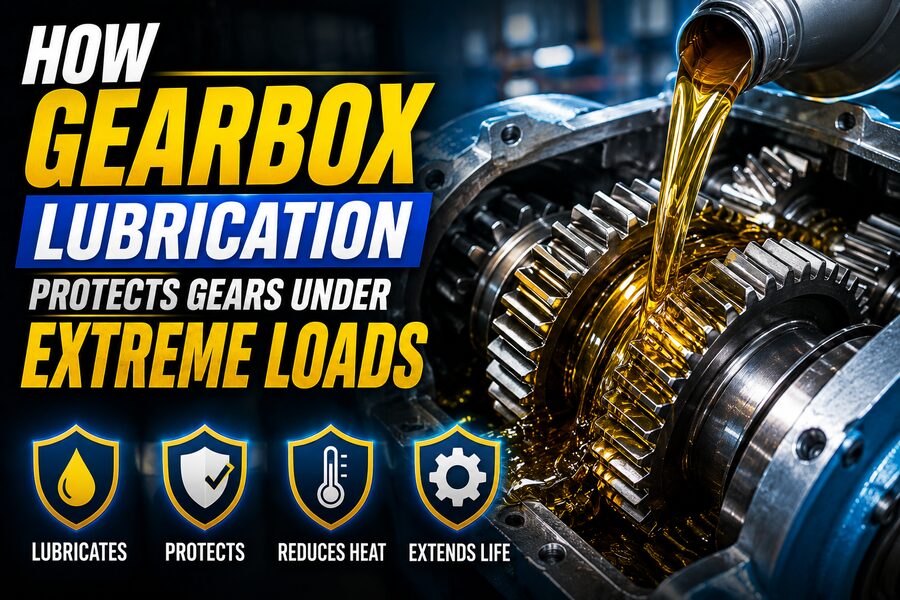

Gearboxes are designed to transmit enormous amounts of power through relatively small metal surfaces. Inside an industrial gearbox, automotive transmission, wind turbine, mining machine, or marine drive, gear teeth repeatedly contact one another under pressures that can be extremely high. 🏭🚗
Without proper lubrication, those metal surfaces would experience intense friction, heat, wear, and eventually catastrophic damage.
That is why gearbox lubrication is far more than simply “adding oil.”
A properly selected lubricant creates a protective film between gear teeth, carries heat away, reduces friction, prevents corrosion, suspends contaminants, and protects surfaces when operating loads become so high that a full oil film can no longer completely separate the metals.
In simplified terms:
Gear teeth carry the load ⚙️
Lubricant protects the surfaces 🛢️
Together, they allow gearboxes to operate reliably for thousands—or sometimes tens of thousands—of hours.
⚙️ Why Gear Teeth Experience Such High Loads
A gearbox transfers torque by allowing one gear’s teeth to push against another gear’s teeth.
Although a gear may contain dozens of teeth, only a few teeth are sharing the load at any one moment.
Even more importantly, the actual contact area between two curved tooth surfaces can be surprisingly small.
That means a large force may be concentrated into a narrow region.
The result is extremely high contact stress.
In heavily loaded industrial gearboxes, contact pressures may reach levels where ordinary oil behavior is no longer enough to explain what happens at the surface.
The lubricant must survive these conditions without allowing damaging metal-to-metal contact. 💪
🛢️ The Primary Job of Gear Oil
The most important function of gearbox lubricant is to create a film separating moving surfaces.
Instead of:
Steel tooth rubbing directly against steel tooth
the goal is:
Steel tooth → oil film → steel tooth
This thin film dramatically reduces friction and wear.
The lubricant also protects:
- Bearings
- Shafts
- Bushings
- Synchronizers in some transmissions
- Seals
- Other moving components
A gearbox lubricant therefore has to serve several mechanical components simultaneously.
🌊 Hydrodynamic Lubrication
One important lubrication regime is called hydrodynamic lubrication.
When two surfaces move relative to each other, they can drag oil into a narrowing gap.
The moving surfaces create pressure in the lubricant film.
That pressure can support the load while keeping the surfaces completely separated.
This principle is especially important in journal bearings.
In gear contacts, however, conditions are more complicated because tooth surfaces both roll and slide, and the contact zone is very small.
For gears, another lubrication regime becomes especially important.
🔬 Elastohydrodynamic Lubrication
Gear teeth often operate under elastohydrodynamic lubrication, commonly abbreviated EHL.
This happens when:
- Contact pressure is extremely high
- The contact area is very small
- Surfaces move rapidly
- The lubricant becomes temporarily more viscous under pressure
Under these conditions, two interesting effects occur.
First, the gear surfaces elastically deform slightly under load.
Second, the lubricant’s viscosity increases dramatically inside the high-pressure contact zone.
Together, these effects allow an extremely thin but strong oil film to support the load.
The film may be only fractions of a micrometer thick, yet it can prevent direct metal contact. 🔬⚙️
🧠 Why Viscosity Matters
Viscosity describes a fluid’s resistance to flow.
A lubricant with low viscosity flows easily.
A high-viscosity lubricant is thicker and resists flowing.
Gearbox lubrication requires the right balance.
If the oil is too thin:
- The lubricant film may become insufficient
- Metal contact may increase
- Wear can accelerate
If the oil is too thick:
- Frictional losses increase
- The gearbox may run hotter
- Pumping losses rise
- Cold-start performance worsens
Engineers therefore select viscosity according to factors such as:
- Gear type
- Load
- Speed
- Operating temperature
- Gearbox design
🌡️ Temperature Changes Oil Viscosity
Oil becomes thinner as temperature rises.
This means a lubricant that provides a strong film at 40°C may become much less viscous at 90°C.
Likewise, very cold oil can become excessively thick.
The relationship between viscosity and temperature is described partly by the lubricant’s viscosity index.
A high viscosity index generally means the oil changes viscosity less dramatically as temperature changes.
This is useful in gearboxes operating across wide temperature ranges. 🌡️
💥 What Happens Under Extreme Loads?
Under very high loads, the oil film can become so thin that microscopic surface peaks begin touching.
Even highly polished gear teeth are not perfectly smooth.
At microscopic scale, their surfaces contain tiny high points called asperities.
When the lubricant film is thick enough, asperities remain separated.
When the film becomes very thin:
Asperity ↔ Asperity contact
can occur.
This creates intense localized friction and heat.
Without additional protection, the gear surfaces may score, scuff, or weld together momentarily.
This is where extreme-pressure additives become important.
🧪 What Are Extreme-Pressure Additives?
Extreme-pressure additives, often called EP additives, are chemical compounds blended into many industrial gear oils.
These additives become active under conditions of high temperature and pressure.
Instead of relying only on the liquid oil film, EP additives react with the metal surface and form a protective chemical layer.
This layer is designed to shear more easily than the underlying steel.
So under severe contact:
Protective chemical film wears first
instead of:
Gear tooth surface being damaged
This sacrificial protection is extremely valuable in heavily loaded gears. 🛡️
⚗️ Sulfur-Phosphorus Additives
Many EP gear oils use sulfur-phosphorus chemistry.
Under severe contact conditions, these compounds react with iron-containing surfaces.
They create protective reaction films capable of reducing scuffing and adhesive wear.
These additives are especially common in applications such as:
- Industrial gearboxes
- Automotive differentials
- Heavy machinery
However, lubricant chemistry must be compatible with the materials inside the gearbox.
Some additive packages can interact aggressively with certain copper-containing alloys, so manufacturers specify the correct lubricant for each application.
🔩 Boundary Lubrication
When a complete oil film does not separate the surfaces, the system enters boundary lubrication.
Here, protection comes mainly from molecules attached to or reacting with the metal.
Boundary lubrication can occur during:
- Startup
- Shutdown
- Low-speed operation
- High load
- Shock loading
- Temporary oil starvation
Anti-wear and EP additives become particularly important during these conditions.
The lubricant’s chemical properties can therefore be just as important as its viscosity.
🧱 How Lubrication Prevents Scuffing
Scuffing is a severe form of adhesive wear.
It can occur when two sliding metal surfaces become hot enough and close enough for local welding to occur.
The welded areas then tear apart as the gears continue moving.
This damages the tooth surface.
Scuffing may appear as:
- Rough streaks
- Torn metal
- Discolored surfaces
- Rapid tooth damage
A good lubricant reduces scuffing by maintaining a protective film and providing EP chemistry when the film becomes insufficient. ⚠️
🕳️ Preventing Micropitting
Another important gear failure mode is micropitting.
Micropitting involves tiny fatigue cracks and pits forming on the tooth surface.
It is often associated with repeated high contact stress and inadequate film thickness.
The surface can develop a gray or frosted appearance.
Over time, micropitting may:
- Change tooth geometry
- Increase noise
- Increase vibration
- Reduce gear life
Lubricants designed for good micropitting protection help maintain film thickness and reduce damaging surface interaction.
💢 Preventing Pitting
Pitting is a fatigue failure that occurs beneath or near the contact surface.
Repeated stress cycles create cracks.
Eventually, small pieces of metal break away, leaving pits.
Lubrication cannot eliminate all contact fatigue, but proper lubrication can reduce surface damage and friction that contribute to the problem.
Correct viscosity, cleanliness, and operating temperature all influence pitting life.
🔥 Lubricant Also Removes Heat
Gearboxes generate heat through:
- Sliding friction
- Bearing losses
- Oil churning
- Seal friction
- Gear meshing
Lubricant absorbs heat from these components.
It then carries that heat toward the gearbox housing, oil cooler, or circulating lubrication system.
In large gearboxes, oil may be continuously pumped through:
Gearbox → filter → cooler → gearbox
This prevents excessive temperature buildup.
Heat control is important because high temperature accelerates lubricant degradation. 🌡️➡️🛢️
🔄 Splash Lubrication
Many smaller gearboxes use splash lubrication.
Part of one or more gears dips into an oil reservoir at the bottom of the housing.
As the gears rotate, they throw oil throughout the gearbox.
The oil reaches:
- Gear teeth
- Bearings
- Housing surfaces
Splash lubrication is simple and reliable.
However, oil level must be correct.
Too little oil can cause starvation.
Too much oil can cause excessive churning and heat.
💧 Forced Lubrication Systems
Large, high-speed, or heavily loaded gearboxes may use forced lubrication.
A pump delivers oil directly to critical components.
The system may include:
- Oil pumps
- Filters
- Coolers
- Pressure sensors
- Temperature sensors
- Flow switches
Oil can be sprayed directly into gear mesh zones.
This ensures that enough lubricant reaches the contact region even when gravity or splash alone would be inadequate.
Forced lubrication also improves cooling and filtration. ⚙️
🚿 Why Oil Delivery Location Matters
Simply having oil inside the gearbox does not guarantee proper lubrication.
The lubricant must actually reach the gear contact at the right time.
At high speed, gears can create air flow and centrifugal forces that throw oil away from the mesh.
Engineers may position oil jets carefully so lubricant enters the tooth contact effectively.
Poor jet placement can cause oil starvation even when the pump is delivering sufficient total flow.
🧽 Clean Oil Is Essential
Gearboxes are highly sensitive to contamination.
Hard particles such as:
- Sand
- Metal fragments
- Dust
- Wear debris
can enter the contact zone between gear teeth.
When trapped between highly loaded surfaces, these particles behave like abrasive tools.
They can:
- Scratch tooth surfaces
- Damage bearings
- Create stress concentrations
- Accelerate fatigue
Filtration is therefore an important part of lubrication management. 🧼
🔍 Oil Filters Protect Gear Surfaces
Circulating lubrication systems often include fine filters.
As oil passes through the filter, particles are removed.
Filters may also include indicators that show when they are becoming clogged.
Cleanliness targets are often specified according to the sensitivity of the gearbox and bearings.
High-performance gear systems can require extremely clean oil.
💧 Water Contamination Is Dangerous
Water can enter a gearbox through:
- Condensation
- Damaged seals
- Washdown operations
- Humid air
- Cooling-system leaks
Even relatively small amounts of water can cause problems.
Water may:
- Promote rust
- Reduce lubricant film strength
- Accelerate additive depletion
- Damage bearings
- Promote foaming or emulsification
Gearbox oils are often formulated to separate water efficiently so it can be drained from the system.
🫧 Why Foaming Is a Problem
Oil can trap air and create foam.
Foaming reduces lubrication effectiveness because air does not carry load or heat as well as oil.
Foamed oil can also cause:
- Pump cavitation
- Incorrect oil-level readings
- Oxidation
- Unstable pressure
Gear oils often include anti-foam additives.
Proper reservoir design also allows entrained air to escape before the lubricant returns to the gearbox.
🌬️ Air Release Matters Too
Even when visible foam is absent, small air bubbles may remain trapped in oil.
This is called air entrainment.
Good gear oils release air relatively quickly.
If they do not, bubbles can pass through pumps and gear contacts.
This can reduce film strength and contribute to noise, vibration, and oxidation.
🧪 Oxidation Degrades Lubricant
Gear oil does not last forever.
Exposure to heat, oxygen, and contaminants causes oxidation.
Oxidized oil may:
- Become more viscous
- Form sludge
- Create varnish
- Develop acidic compounds
- Lose additive effectiveness
Antioxidant additives slow this degradation.
However, once the lubricant deteriorates beyond acceptable limits, it must be replaced.
🧫 Additives Do More Than Prevent Wear
A modern gear oil may contain several types of additives.
These can include:
- Extreme-pressure additives
- Anti-wear agents
- Antioxidants
- Rust inhibitors
- Corrosion inhibitors
- Anti-foam agents
- Demulsifiers
Each solves a different problem.
The finished lubricant is therefore an engineered chemical system rather than simply refined oil.
🛢️ Mineral vs. Synthetic Gear Oils
Gear lubricants may use mineral or synthetic base oils.
🔹 Mineral Oils
Advantages may include:
- Lower cost
- Wide availability
- Good performance in many ordinary applications
🔹 Synthetic Oils
Synthetic lubricants can provide advantages such as:
- Better low-temperature flow
- Improved high-temperature stability
- Longer service life
- Lower friction
- Higher viscosity index
Synthetic oils are often used in demanding gearboxes where temperature, efficiency, or service interval is especially important.
🌬️ Synthetic Lubricants in Wind Turbines
Wind turbine gearboxes operate under particularly demanding conditions.
They may experience:
- Variable loads
- Shock loading
- Temperature changes
- Difficult maintenance access
- Long service intervals
Replacing gearbox oil hundreds of feet above the ground is expensive.
Synthetic lubricants can be attractive because of their oxidation stability and long operating life.
Lubrication condition is closely monitored to reduce the risk of unexpected gearbox failure. 🌬️⚙️
🚗 Automotive Gearbox Lubrication
Vehicle transmissions and differentials also rely on specialized lubricants.
Automotive gear oils may protect:
- Helical gears
- Hypoid gears
- Bearings
- Differential components
Hypoid gears are especially demanding because their tooth contact contains significant sliding.
This requires strong EP protection.
That is why differential lubricants may differ substantially from ordinary engine oil.
Using the wrong lubricant can reduce component life.
⚙️ Why Hypoid Gears Need Strong Protection
Hypoid gears are common in automotive differentials.
Their shafts are offset from each other.
This geometry creates a combination of rolling and substantial sliding motion between tooth surfaces.
Sliding increases friction and scuffing risk.
EP additives are therefore particularly important.
The lubricant must protect the surfaces while still flowing effectively at low temperatures.
🏭 Gearbox Loads in Heavy Industry
Industrial gearboxes may drive:
- Crushers
- Conveyors
- Mills
- Mixers
- Extruders
- Hoists
Some of these machines experience severe shock loads.
For example, a rock crusher may suddenly encounter a much harder piece of material.
Torque can rise rapidly.
A properly formulated lubricant helps the gear surfaces survive these momentary high-pressure events.
💥 Shock Loading
Steady load and shock load are not the same.
A gear may handle a constant 10,000 N force reliably.
But a sudden impact could briefly multiply the load.
During shock events, lubricant films can collapse locally.
EP additives then provide critical protection.
This is one reason heavy-duty gearbox oils are formulated differently from lubricants intended for light loads.
🧮 Film Thickness and Surface Roughness
The effectiveness of lubrication depends partly on the relationship between:
Lubricant film thickness
and
Surface roughness
If the oil film is much thicker than the surface roughness, the teeth can remain almost completely separated.
If the film thickness becomes comparable to the surface roughness, asperity contact increases.
Engineers sometimes use a lambda ratio to compare these quantities.
Higher lambda values generally indicate better separation of the surfaces.
🔧 Gear Surface Finish Matters
Gear tooth surfaces are carefully finished.
Processes may include:
- Grinding
- Honing
- Superfinishing
A smoother surface can reduce asperity contact and improve lubrication behavior.
This can increase resistance to micropitting and reduce friction.
Lubricant design and gear manufacturing therefore work together.
📉 Too Much Lubricant Can Also Be Harmful
It may seem that more oil is always better.
It is not.
If gears are deeply submerged, they must continuously push large volumes of oil around.
This creates churning losses.
Consequences include:
- Higher power consumption
- Increased temperature
- Foaming
- Oil degradation
Gearbox manufacturers therefore specify the correct oil level.
Following that specification is important.
📈 High-Speed Gearboxes Have Different Needs
At high rotational speed:
- Oil is thrown outward strongly
- Churning losses can become large
- Heat generation increases
- Oil delivery becomes challenging
A lower-viscosity lubricant may sometimes be preferred to reduce losses, provided it still creates sufficient film thickness.
High-speed turbine gearboxes therefore require careful lubricant selection.
🐢 Low-Speed, High-Load Gearboxes
Low-speed gearboxes create a different challenge.
Low surface speed reduces the ability of moving surfaces to draw lubricant into the contact zone.
At the same time, loads may be enormous.
This can push lubrication toward mixed or boundary regimes.
Higher-viscosity oils and strong EP additive packages may therefore be required.
Large mining and cement-industry gearboxes are examples where this can be important.
🧲 Open Gears Require Special Lubrication
Some very large gears are not enclosed inside conventional housings.
Examples include gears on:
- Kilns
- Ball mills
- Draglines
These open gears may use very thick lubricants or specialized compounds.
The lubricant must adhere to exposed teeth and remain in place despite slow rotation and heavy loading.
Open-gear lubrication is a specialized field because contamination and weather exposure create additional challenges.
🔬 Oil Analysis Reveals Gearbox Health
Maintenance teams can analyze used gearbox oil to learn what is happening inside the machine.
Laboratory testing may measure:
- Viscosity
- Water content
- Particle contamination
- Oxidation
- Additive depletion
- Wear metals
For example, increasing iron concentration could indicate abnormal gear or bearing wear.
Oil analysis can detect developing problems before the gearbox fails. 🔍🧪
🧲 Magnetic Wear Debris Monitoring
Some gearboxes use magnetic plugs or sensors to collect ferrous wear particles.
A small amount of fine metallic debris can be normal during operation.
However, a sudden increase in large particles may indicate serious damage.
Monitoring debris provides another early-warning method.
Modern industrial systems may automatically detect changes in wear-particle concentration.
📡 Condition Monitoring
High-value gearboxes may also be monitored using:
- Temperature sensors
- Vibration sensors
- Oil pressure sensors
- Flow sensors
- Particle counters
The data can reveal lubrication problems.
For example:
Oil temperature rising
plus
Gear vibration increasing
may indicate deteriorating lubrication or developing tooth damage.
Predictive maintenance systems combine these signals to estimate gearbox health.
🧠 Why Oil Pressure Alone Is Not Enough
In forced-lubrication systems, normal oil pressure does not necessarily mean every component is properly lubricated.
A blocked nozzle could prevent oil from reaching one gear mesh while the pump still maintains pressure elsewhere.
Engineers therefore may monitor:
- Pressure
- Flow
- Temperature
together.
The goal is to confirm that lubricant reaches critical areas in sufficient quantity.
🧊 Cold Starts Are Difficult
When equipment starts in very cold weather, gear oil may be extremely thick.
The pump can struggle to move it.
Splash lubrication may also be poor until the oil warms.
Cold oil can create:
- High starting torque
- Slow circulation
- Temporary starvation
Some industrial systems use:
- Oil heaters
- Low-temperature synthetic oils
- Controlled warm-up procedures
to reduce these problems.
🌡️ Overheating Creates a Vicious Cycle
Suppose a gearbox begins running too hot.
The lubricant becomes thinner.
A thinner film can increase metal contact.
That increases friction.
More friction creates even more heat.
This can produce a damaging feedback loop:
Heat ↑ → viscosity ↓ → film thickness ↓ → friction/wear ↑ → heat ↑
Monitoring operating temperature helps detect this problem early. 🚨
🧯 Lubrication Failure Can Destroy a Gearbox Quickly
A gearbox may operate for years with good lubrication but fail very rapidly if oil supply is lost.
Loss of lubrication can lead to:
- Rapid temperature rise
- Scuffing
- Bearing failure
- Gear tooth seizure
- Broken teeth
Large industrial gearboxes may include automatic shutdown protection if oil pressure or flow falls below safe limits.
Stopping the machine early can prevent a lubrication problem from becoming catastrophic mechanical destruction.
🛠️ Correct Lubricant Selection Is Crucial
Gearbox manufacturers typically specify lubricant requirements such as:
- Viscosity grade
- Base oil type
- Additive performance
- Operating temperature range
- Industry specifications
Using a lubricant simply because it “looks similar” can be risky.
Different oils may have very different:
- Additive chemistry
- Seal compatibility
- Load-carrying capability
- Water separation behavior
The manufacturer’s recommendation should be followed unless a qualified engineering evaluation supports an alternative.
🔄 Mixing Gear Oils Can Cause Problems
Two individually good lubricants are not necessarily compatible when mixed.
Additive packages may interact.
Mixing can potentially cause:
- Foaming
- Precipitation
- Reduced performance
- Filter plugging
When changing lubricant type, maintenance procedures may require draining and flushing the system.
Compatibility should be checked before mixing oils.
🌱 Efficiency and Lubrication
Lubrication influences energy consumption.
Every gearbox loses some input power through:
- Gear friction
- Bearing friction
- Churning
Reducing unnecessary friction can improve efficiency.
In large continuously operating industrial systems, even a small percentage improvement can save substantial energy over time.
Advanced low-friction synthetic lubricants are sometimes selected partly for this reason. 🌱⚡
📏 Oil Change Intervals
Oil should not automatically be replaced according to one universal schedule.
Service life depends on:
- Temperature
- Contamination
- Load
- Oil type
- Operating hours
- Environment
Some machines use fixed maintenance intervals.
Others use condition-based oil changes determined through laboratory analysis.
Condition-based maintenance can extend lubricant life without sacrificing protection.
⚠️ Common Gearbox Lubrication Problems
Typical lubrication-related problems include:
- Wrong viscosity
- Low oil level
- Excessive oil level
- Contamination
- Water ingress
- Foaming
- Clogged filters
- Blocked oil jets
- Overheated lubricant
- Incorrect additive chemistry
Many gearbox failures that appear purely mechanical have lubrication issues somewhere in their history.
🧠 The Deeper Tribology Behind Gear Lubrication
The science of friction, wear, and lubrication is called tribology.
Gearbox lubrication is a classic tribological problem.
Engineers must understand interactions among:
- Surface geometry
- Material hardness
- Load
- Velocity
- Temperature
- Lubricant viscosity
- Additive chemistry
Changing any one of these variables can change the lubrication regime.
This is why lubricant selection is part of gearbox engineering rather than a simple maintenance afterthought.
🏁 Final Thoughts
Gearbox lubrication protects gears under extreme loads by creating multiple layers of defense between highly stressed metal surfaces.
At normal operating conditions, the lubricant forms a thin film that separates gear teeth and reduces friction.
Under high contact pressure, elastohydrodynamic lubrication allows the oil to temporarily become more resistant to flow while the tooth surfaces deform slightly, creating a strong load-carrying film.
When loads become so severe that the film becomes extremely thin, anti-wear and extreme-pressure additives provide chemical protection that helps prevent scuffing and destructive metal-to-metal contact. 🛡️⚙️
At the same time, the lubricant:
- Removes heat 🌡️
- Protects against corrosion
- Carries contaminants toward filters
- Lubricates bearings
- Reduces friction
- Helps remove wear debris
Successful lubrication therefore depends on much more than simply having oil inside the gearbox.
The correct viscosity, additive package, oil level, cleanliness, temperature, delivery method, and maintenance condition must all work together.
A heavily loaded gearbox may contain gears made from extremely strong hardened steel, yet those gears can still fail quickly if the lubricant disappears or loses its protective properties.
The essential engineering principle is simple:
The gears transmit the force, but the lubricant keeps their surfaces alive. 🛢️⚙️✨
That invisible film—sometimes only microscopic in thickness—is what allows machines ranging from automobile differentials and factory conveyors to mining equipment and wind turbines to transmit tremendous power repeatedly without destroying their own gear teeth.