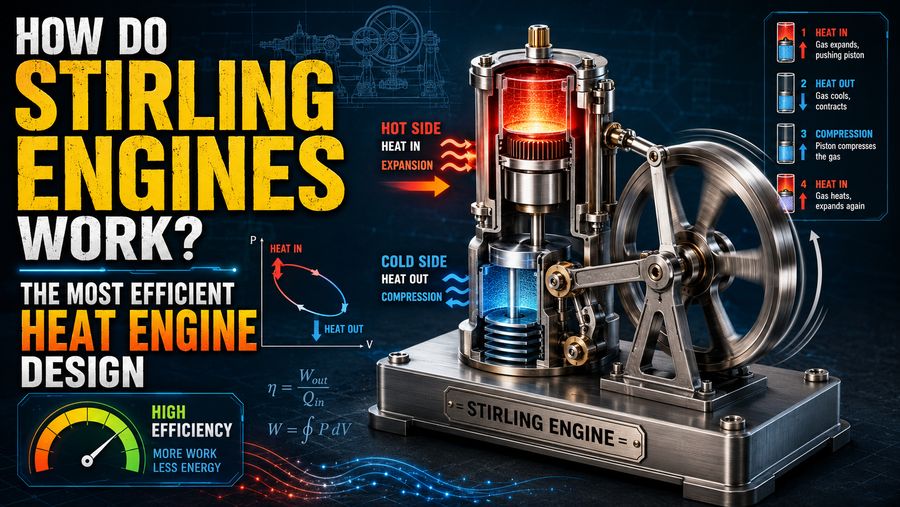

Most engines create power by burning fuel inside cylinders. A Stirling engine takes a very different approach. Instead of combustion occurring inside the engine, it operates by repeatedly heating and cooling a sealed quantity of gas. That temperature difference causes the gas to expand and contract, producing mechanical motion. 🔥❄️⚙️
Invented more than two centuries ago, the Stirling engine remains one of the most fascinating examples of thermodynamic engineering. It can theoretically operate with very high efficiency, run quietly, and use almost any external heat source—from concentrated solar energy to biomass, waste heat, or conventional fuels.
This has led to Stirling engines being described as some of the most efficient heat-engine designs in theory. However, an important distinction is necessary: while an ideal Stirling cycle can approach the maximum efficiency permitted by thermodynamics, real Stirling engines experience friction, heat-transfer losses, leakage, and other practical limitations.
So how does a Stirling engine actually convert heat into useful power? Let’s examine its components, thermodynamic cycle, different configurations, advantages, limitations, and modern applications. 🔬
⚙️ What Is a Stirling Engine?
A Stirling engine is a closed-cycle heat engine that produces mechanical power by repeatedly heating and cooling a working gas contained inside the engine.
The gas remains sealed within the system rather than being continuously drawn in and exhausted like the gases in an internal combustion engine.
Common working gases include:
- Air
- Helium
- Hydrogen
The engine requires two temperature regions:
- 🔥 A hot side
- ❄️ A cold side
Heat added to the hot side causes the working gas to expand. Cooling the gas causes it to contract.
By moving the gas repeatedly between hot and cold regions, the engine creates pressure changes that move one or more pistons.
Those pistons can then rotate a crankshaft, operate machinery, or drive an electrical generator. ⚡
🕰️ Who Invented the Stirling Engine?
The Stirling engine was invented by Robert Stirling, a Scottish clergyman and engineer, in 1816.
Early steam engines operated using high-pressure boilers that could be dangerous when poorly constructed or maintained. Stirling developed his engine partly as an alternative heat-engine concept.
One of his important ideas was the use of a device called a regenerator, which temporarily stores heat inside the engine and returns it to the working gas later in the cycle.
The regenerator remains one of the defining features of efficient Stirling-engine designs today.
🔥 The Basic Principle: Heat Makes Gas Expand
The fundamental physics behind a Stirling engine is relatively simple.
When a gas is heated, its pressure tends to increase if its volume is restricted. If it is allowed to expand, it can push against a piston.
When the gas is cooled, its pressure decreases and it contracts.
A Stirling engine repeatedly exploits this relationship:
Heat gas → Gas expands → Piston moves → Gas moves to cold region → Gas cools → Pressure falls → Piston returns
The process then repeats continuously.
The engine therefore transforms a temperature difference into mechanical work.
🧪 The Ideal Gas Relationship
The behavior of the working gas can be approximated using the ideal gas law:
PV = nRT
Where:
- P = pressure
- V = volume
- n = amount of gas
- R = gas constant
- T = absolute temperature
If the gas temperature rises, either its pressure, volume, or both must change.
Stirling engines carefully control these pressure and volume changes so that some of the expanding gas’s energy becomes mechanical output.
🔄 The Four Main Stages of the Stirling Cycle
An ideal Stirling cycle can be explained using four main thermodynamic processes.
🔥 1. Isothermal Expansion
The working gas is located in the hot portion of the engine.
Heat flows into the gas while it expands.
As the gas expands, it pushes against the power piston and performs mechanical work.
Ideally, the gas remains at approximately constant high temperature during this stage because heat continues entering from the hot source.
🌡️ 2. Constant-Volume Heat Removal
The gas is then moved from the hot side toward the cold side.
On the way, it passes through the regenerator.
The regenerator absorbs some of the gas’s heat.
Ideally, the gas volume remains nearly constant during this transfer.
❄️ 3. Isothermal Compression
The working gas reaches the cold region and releases heat to the cooling system.
Because the gas is colder, it requires less work to compress than the amount of work produced when it expanded at the higher temperature.
This difference between expansion work and compression work creates useful net output.
♻️ 4. Constant-Volume Heat Addition
The cooler gas moves back toward the hot side.
As it passes through the regenerator again, it recovers heat that was stored earlier.
The gas enters the hot region already partially warmed, reducing the amount of new external heat required.
The cycle then repeats. 🔄
♻️ Why Is the Regenerator So Important?
The regenerator is one of the most important components in an efficient Stirling engine.
It acts as a temporary heat-storage device.
Imagine hot gas traveling toward the cold side. Instead of allowing all its thermal energy to be lost to the cooling system, the gas passes through a heat-absorbing material.
The regenerator captures some of that energy.
Later, when cold gas travels back toward the hot side, the stored energy flows back into the gas.
The process can be represented as:
Hot gas → Regenerator stores heat → Gas becomes cooler
Then:
Cold gas → Regenerator returns heat → Gas becomes warmer
A highly effective regenerator can significantly improve thermal efficiency because less external heat needs to be supplied during every cycle.
Materials used in regenerators may include fine metal mesh, porous metal structures, or other high-surface-area materials capable of rapidly absorbing and releasing heat. 🔥♻️
🧩 Main Components of a Stirling Engine
Although Stirling engines come in different configurations, most contain several essential components.
🔥 Hot-Side Heat Exchanger
The heater transfers energy from the external heat source into the working gas.
Possible heat sources include:
- Natural gas
- Biomass
- Solar energy
- Industrial waste heat
- Nuclear heat
- Geothermal energy
Because combustion does not need to occur inside the cylinder, the Stirling engine is considered an external-combustion engine when combustion is used as the heat source.
❄️ Cold-Side Heat Exchanger
The cooler removes heat from the working gas.
Cooling may involve:
- Ambient air
- Water
- Radiators
- Other heat-transfer systems
A larger temperature difference between the hot and cold sides generally creates greater potential for useful work.
♻️ Regenerator
The regenerator stores and returns heat between stages of the cycle.
Its performance strongly affects overall efficiency.
🧯 Working Gas
The sealed working gas transfers energy through changes in pressure and volume.
Helium and hydrogen are often attractive for high-performance designs because of their favorable thermal properties.
⚙️ Pistons and Mechanical Linkage
Pistons convert changes in gas pressure into mechanical movement.
A crankshaft or other mechanism can turn reciprocating piston motion into rotation.
🏗️ Three Main Types of Stirling Engines
Stirling engines are generally grouped into alpha, beta, and gamma configurations.
🔴 1. Alpha Stirling Engine
An alpha Stirling engine uses two separate power pistons located in different cylinders.
One cylinder is maintained at a high temperature, while the other operates at a lower temperature.
The working gas moves between them through heat exchangers and a regenerator.
Advantages
- High power potential
- Efficient thermodynamic arrangement
- Suitable for high-performance systems
Challenges
The hot piston and its seals must operate at elevated temperatures, creating demanding material and engineering requirements.
🔵 2. Beta Stirling Engine
A beta engine typically uses one cylinder containing:
- A power piston
- A displacer
The displacer does not primarily produce mechanical power. Instead, it moves the working gas between the hot and cold ends of the cylinder.
The power piston responds to pressure changes and produces useful work.
Beta designs can be compact and are commonly seen in educational demonstrations.
🟢 3. Gamma Stirling Engine
A gamma engine is mechanically similar to a beta engine, but the power piston is placed in a separate cylinder from the displacer.
This configuration can simplify construction and sealing.
Many hobbyist and low-temperature Stirling engines use gamma arrangements.
🔧 What Does the Displacer Do?
The displacer is one of the most distinctive parts of certain Stirling engines.
Unlike a conventional piston, it usually fits loosely within its cylinder.
Its job is to move gas between:
- The hot region 🔥
- The cold region ❄️
When the displacer pushes gas toward the hot side, pressure tends to increase.
When it moves gas toward the cold side, pressure tends to decrease.
Carefully timing the displacer relative to the power piston creates continuous rotation.
This phase relationship is essential to proper operation.
🌀 Why Does the Flywheel Keep Turning?
Many Stirling engines use a flywheel attached to the crankshaft.
The engine’s torque is not perfectly constant throughout each thermodynamic cycle.
The flywheel stores rotational energy during portions of the cycle that produce more power and releases it during portions requiring energy.
This helps the engine rotate smoothly through every stage.
Without sufficient rotational inertia, some simple Stirling engines may stall before completing the cycle.
📊 How Efficient Can a Stirling Engine Be?
This is where Stirling engines become especially interesting.
An ideal Stirling cycle with perfect regeneration can achieve the same theoretical efficiency as a Carnot cycle operating between the same hot and cold temperatures.
The maximum theoretical heat-engine efficiency is related to temperature by:
η = 1 − Tc / Th
Where:
- η = maximum theoretical efficiency
- Tc = absolute temperature of the cold reservoir
- Th = absolute temperature of the hot reservoir
Temperatures must be expressed in kelvin.
For example, suppose:
- Hot side = 700 K
- Cold side = 300 K
Then:
η = 1 − 300 / 700
η ≈ 0.571
So the theoretical maximum would be approximately:
57.1%
However, this does not mean a real Stirling engine operating at those temperatures will achieve 57.1% efficiency.
Real machines have unavoidable losses.
⚠️ Is the Stirling Engine Really the Most Efficient Heat Engine?
It is more accurate to say that the ideal Stirling cycle is one of the theoretically most efficient heat-engine cycles because, with perfect regeneration, it can reach Carnot efficiency.
Real engines cannot achieve the ideal cycle perfectly.
Practical losses include:
- Mechanical friction
- Gas leakage
- Imperfect regeneration
- Heat conduction between hot and cold sections
- Pressure drops
- Limited heat-transfer rates
- Pumping losses
- Seal friction
- Dead volume
Other modern technologies—including combined-cycle gas turbines and certain large power-generation systems—can achieve extremely high real-world efficiencies.
Therefore, Stirling engines should not automatically be described as the most efficient practical engine for every application.
Their attraction comes from the combination of high theoretical efficiency, external heating, quiet operation, and fuel flexibility.
🔥 Why External Combustion Is Important
In an internal combustion engine, fuel burns directly within cylinders or combustion chambers.
A Stirling engine only needs heat.
That heat can come from almost anywhere.
Possible sources include:
☀️ Concentrated Solar Energy
Mirrors can focus sunlight onto a Stirling engine’s heater.
The engine then converts thermal energy into mechanical power and electricity.
🔥 Biomass
Wood, agricultural waste, or other biomass can provide external heat.
♻️ Industrial Waste Heat
Factories, furnaces, and industrial equipment often release thermal energy that might otherwise be wasted.
A suitable heat engine could potentially recover part of that energy.
☢️ Nuclear Heat
Specialized Stirling systems can use heat from radioactive decay for power generation in certain engineering applications.
🌋 Geothermal Energy
Where sufficient temperature differences exist, geothermal heat can potentially drive externally heated engines.
This heat-source flexibility makes the Stirling principle highly versatile.
🤫 Why Are Stirling Engines So Quiet?
Stirling engines can operate much more quietly than many internal combustion engines.
There are several reasons.
Combustion occurs continuously outside the engine rather than through rapid explosions inside cylinders.
The engine also does not require conventional intake and exhaust valve events for every cycle.
This can reduce:
- Combustion noise
- Exhaust noise
- Mechanical vibration
Quiet operation has made Stirling engines attractive for applications where acoustic signatures matter. 🤫⚙️
🌱 Environmental Advantages of Stirling Engines
Because the heat source is external, combustion can potentially be controlled more steadily than in an intermittent internal combustion process.
This may enable cleaner combustion under suitable conditions.
Environmental advantages can include:
- Compatibility with renewable heat
- Potential waste-heat recovery
- Low operating noise
- Ability to use multiple heat sources
- Potentially efficient energy conversion
However, the actual environmental benefit depends on the source of heat, engine efficiency, manufacturing requirements, and the complete energy system.
A Stirling engine heated by fossil fuel still generates emissions associated with that fuel.
🚗 Why Aren’t Stirling Engines Used in Most Cars?
If Stirling engines have so many advantages, why do automobiles overwhelmingly use internal combustion engines or electric motors?
The main problem is response time and power density.
A conventional engine can respond quickly when the driver presses the accelerator.
A Stirling engine must transfer heat through heat exchangers into its sealed working gas.
Heating and cooling physical materials takes time.
Challenges for automotive applications include:
- Slow startup
- Slower throttle response
- Large heat exchangers
- Cooling requirements
- Complex seals
- High-pressure working gas
- Added system weight
- Cost
Although Stirling-powered vehicles have been experimentally developed, the technology has not become dominant in conventional transportation.
📉 Major Limitations of Stirling Engines
Despite their impressive thermodynamic characteristics, Stirling engines have several engineering challenges.
⏱️ Slow Startup
The hot-side heat exchanger must reach operating temperature before substantial power can be produced.
This can take longer than starting many internal combustion engines.
🌡️ Difficult Heat Transfer
The engine relies on rapidly transferring large quantities of heat through solid heat-exchanger surfaces.
Heat transfer can become the limiting factor in compact, high-power engines.
💨 Gas Leakage
High-performance Stirling engines may use helium or hydrogen at elevated pressures.
Preventing these gases from escaping through seals can be difficult.
Hydrogen molecules in particular are extremely small and can present significant sealing challenges.
🧱 Expensive Materials
Hot-side components may operate at very high temperatures.
They require materials that resist:
- Thermal stress
- Corrosion
- Creep
- Fatigue
These advanced materials can increase cost.
⚡ Lower Power Density
A Stirling engine may be larger and heavier than some competing technologies producing similar power.
🧊 Low-Temperature-Difference Stirling Engines
One fascinating variation is the low-temperature-difference Stirling engine, often abbreviated LTD Stirling engine.
These engines can operate with surprisingly small temperature differences.
Small demonstration versions may run from:
- Warm water
- Hot beverages ☕
- Sunlight
- A warm hand ✋
- Ice and ambient air
Such engines generally produce very little useful power, but they provide excellent demonstrations of thermodynamics.
They show that a heat engine does not fundamentally require flames—it only requires a sufficiently usable temperature difference.
⚡ Stirling Engines for Electricity Generation
A Stirling engine can be connected to an electrical generator.
The process becomes:
Heat source → Stirling engine → Mechanical rotation → Generator → Electricity
Potential applications include:
- Solar thermal electricity
- Remote power systems
- Combined heat and power
- Waste-heat recovery
- Specialized backup systems
Some Stirling machines use conventional rotating generators, while others use free-piston designs coupled to linear alternators.
🧲 What Is a Free-Piston Stirling Engine?
A free-piston Stirling engine operates without a traditional crankshaft.
Instead, pistons move back and forth in response to pressure oscillations.
Their motion can drive a linear electrical alternator.
Advantages can include:
- Fewer mechanical linkages
- Reduced lubrication requirements
- Hermetically sealed construction
- Potentially long operating life
- Low maintenance
Free-piston Stirling technology is especially attractive for applications requiring reliability and minimal servicing.
🚀 Stirling Engines in Space
Stirling technology has attracted interest for spacecraft power systems because it can convert thermal energy into electricity efficiently.
Radioisotope heat sources naturally produce heat through radioactive decay.
A Stirling converter can theoretically convert some of that heat into electricity more efficiently than certain purely thermoelectric approaches.
Higher conversion efficiency can reduce the amount of heat-source material required for a given electrical output.
Space applications also value:
- Long life
- Reliability
- High efficiency
- Closed-cycle operation
The engineering requirements, however, are extremely demanding. 🚀🌌
🏠 Stirling Engines and Combined Heat and Power
Another promising application is combined heat and power, often called CHP.
Ordinary electricity generation can waste large amounts of thermal energy.
A CHP system attempts to use both:
- Electricity ⚡
- Useful heat 🔥
For example, a Stirling engine could generate electricity while its rejected heat contributes to water or space heating.
When both outputs are useful, overall fuel utilization can become much higher than when electricity is produced alone.
🔁 Can a Stirling Engine Run Backward?
Yes—and this reveals an interesting connection between heat engines and refrigeration.
If mechanical energy is supplied to a Stirling-cycle machine instead of extracting mechanical energy from it, the device can move heat from one location to another.
This principle is used in certain Stirling cryocoolers.
Such systems can produce very low temperatures for applications involving:
- Infrared detectors
- Scientific instruments
- Sensors
- Specialized electronics
- Research equipment
So essentially similar thermodynamic principles can be used either to:
Heat difference → Mechanical power
or:
Mechanical power → Temperature difference
🆚 Stirling Engine vs. Internal Combustion Engine
The two technologies operate very differently.
| Feature | Stirling Engine | Internal Combustion Engine |
|---|---|---|
| Combustion | External | Internal |
| Working gas | Sealed | Continuously exchanged |
| Heat sources | Many possible sources | Usually specific fuels |
| Noise | Generally low | Typically higher |
| Startup | Often slower | Usually rapid |
| Regeneration | Often important | Usually absent |
| Power density | Often lower | Generally higher |
| Emissions | Depend on heat source | Depend on fuel and combustion |
| Heat recovery potential | Strong | Possible but different |
Neither technology is universally superior.
Each is suited to different engineering requirements.
🔧 Can You Build a Small Stirling Engine at Home?
Small demonstration Stirling engines are popular educational projects.
Simple designs can illustrate:
- Gas expansion
- Heat transfer
- Thermodynamics
- Crank mechanisms
- Flywheel operation
- Regeneration
However, high-performance Stirling engines are far more challenging.
Serious engines may involve:
- High-pressure gas
- Very hot surfaces
- Precision machining
- Strong pressure vessels
- Specialized seals
High-pressure or high-temperature systems should not be improvised without appropriate engineering knowledge and safety measures.
Educational low-temperature models provide a much safer way to explore the principle. 🔬
🎓 Why Stirling Engines Are Important for Engineering Students
Stirling engines demonstrate several fundamental concepts at once.
Students can use them to study:
- Thermodynamics
- Heat transfer
- Fluid mechanics
- Mechanical design
- Material science
- Kinematics
- Energy conversion
They also demonstrate one of the most important concepts in thermal engineering:
Heat becomes useful mechanical power only when there is a temperature difference.
A heat source by itself is not enough. A heat engine also needs somewhere for rejected heat to go.
🌡️ Why the Cold Side Is Just as Important as the Hot Side
It may seem that making the hot side hotter is all that matters.
But Stirling-engine performance depends on the difference between hot-side and cold-side temperatures.
Improved cooling can therefore increase potential efficiency and power output.
Suppose the hot side remains at 700 K.
If the cold side is 400 K, the theoretical Carnot limit is:
1 − 400/700 ≈ 42.9%
If the cold side can be reduced to 300 K:
1 − 300/700 ≈ 57.1%
This illustrates why heat rejection is a critical engineering challenge.
A powerful heat engine needs both an effective heater and an effective cooler. 🔥❄️
🔮 The Future of Stirling Engines
Stirling engines are unlikely to replace every combustion engine or electric motor, but they remain relevant in specialized energy applications.
Future opportunities may include:
- ♻️ Industrial waste-heat recovery
- ☀️ Concentrated solar power
- 🏠 Micro combined heat and power
- 🚀 Space power conversion
- ❄️ Cryogenic cooling
- 🔥 Biomass energy systems
- ⚡ Distributed electricity generation
Advances in high-temperature materials, additive manufacturing, thermal management, seals, and control systems could improve future Stirling machines.
Growing interest in energy efficiency may also create new opportunities for technologies capable of converting otherwise wasted heat into useful power.
❓ Frequently Asked Questions About Stirling Engines
What makes a Stirling engine move?
Heating and cooling a sealed working gas creates pressure changes. Those pressure changes act on pistons and produce mechanical motion.
Does a Stirling engine burn fuel inside the cylinder?
No. Heat is supplied externally. This allows the engine to operate from many different thermal sources.
What gas is used inside a Stirling engine?
Small models may use air, while higher-performance systems may use helium or hydrogen because of their favorable heat-transfer properties.
Can a Stirling engine run on solar power?
Yes. Concentrated sunlight can heat the hot side of a Stirling engine, allowing thermal solar energy to be converted into mechanical power and electricity.
Are Stirling engines more efficient than gasoline engines?
An ideal Stirling cycle has extremely high theoretical efficiency. Real efficiency depends on design, temperatures, regeneration, heat exchangers, friction, and operating conditions, so a Stirling engine is not automatically more efficient than every practical engine.
Why do Stirling engines need a temperature difference?
Heat engines produce useful work by allowing energy to flow from a hotter region to a colder region. Without sufficient temperature difference, there is little ability to extract mechanical work.
Can a Stirling engine operate without combustion?
Yes. Combustion is not required. Any suitable external heat source can potentially operate it.
🎯 Conclusion
The Stirling engine is one of the most elegant demonstrations of thermodynamics in mechanical engineering. 🔥❄️⚙️ Rather than relying on explosions inside a cylinder, it uses a sealed working gas that repeatedly moves between hot and cold regions.
As the gas is heated, it expands and produces work. As it cools, it becomes easier to compress. A regenerator captures and reuses heat inside the engine, helping improve efficiency.
An ideal Stirling cycle with perfect regeneration can theoretically approach the same maximum efficiency as a Carnot engine operating between identical temperatures. That makes Stirling engines exceptionally important from a thermodynamic perspective.
In practical engineering, however, perfect regeneration and perfectly reversible heat transfer are impossible. Real engines experience friction, leakage, thermal losses, pressure drops, and heat-exchanger limitations. For this reason, Stirling engines are not automatically the world’s most efficient practical engines in every application.
Their real strength lies in a unique combination of characteristics: they can be quiet, use many different external heat sources, recover waste heat, and potentially achieve high efficiency under suitable conditions. 🌱⚡
More than 200 years after Robert Stirling introduced the concept, the Stirling engine continues to demonstrate a fundamental lesson of energy engineering: wherever there is a useful temperature difference, there may be an opportunity to turn heat into mechanical power. 🔥➡️⚙️➡️⚡