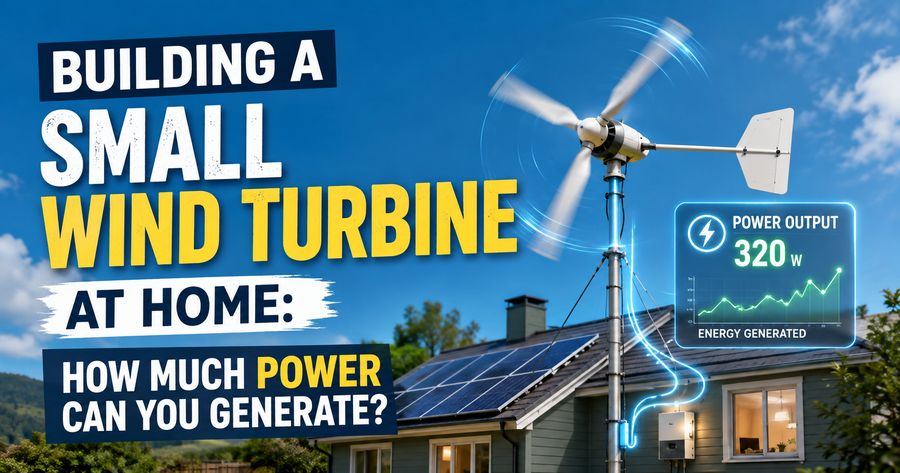

Small wind turbines are an appealing way to experiment with renewable energy, especially for homeowners, hobbyists, off-grid enthusiasts, and anyone interested in generating electricity from the wind. 🌱⚡ Unlike solar panels, which depend primarily on sunlight, a wind turbine can potentially generate electricity during cloudy weather and even at night—as long as the wind is blowing.
But there is an important question to answer before buying blades, building a tower, or wiring a generator:
How much electricity can a small home wind turbine actually produce?
The answer depends much more on wind speed, turbine size, tower height, and location than on the generator’s advertised wattage. A turbine labeled “1,000 watts,” for example, will rarely produce 1,000 watts continuously.
Here is how small wind power works, what you can realistically generate, and what to consider before building a turbine at home. 🏠🌬️
🌪️ How Does a Small Wind Turbine Generate Electricity?
A wind turbine converts the kinetic energy of moving air into electrical energy.
When wind moves across the turbine blades, aerodynamic forces cause the rotor to spin. The rotating shaft then drives a generator or permanent-magnet alternator, producing electricity. ⚙️⚡
A basic residential wind-energy system may contain:
- 🌬️ Rotor blades
- ⚙️ Hub and generator
- 🗼 Tower or mast
- 🔌 Rectifier and electrical wiring
- 🔋 Charge controller
- 🔋 Battery bank, if energy storage is required
- 🔄 Inverter for converting battery DC power into household AC power
- 🛑 Brake or diversion/dump-load system for controlling the turbine in strong winds
Small DIY turbines are frequently designed as battery-charging systems, such as 12 V, 24 V, or 48 V systems.
Grid-connected installations are considerably more complicated because they must use approved equipment, protection systems, permits, utility interconnection procedures, and electrical work that complies with local regulations.
📐 The Physics Behind Wind Power
The energy available in wind can be approximated using:
P = ½ × ρ × A × v³
Where:
- P = power available in the wind
- ρ = air density, approximately 1.225 kg/m³ at sea level
- A = swept area of the turbine rotor in square meters
- v = wind speed in meters per second
The most important part is v³.
Wind power increases with the cube of wind speed. 🌬️📈
That means doubling wind speed theoretically produces eight times as much wind power:
2³ = 8
For example, a site averaging 6 m/s wind can have dramatically more energy potential than one averaging only 3 m/s.
This is why installing a large turbine in a poor wind location often accomplishes less than installing a smaller turbine at an excellent windy site.
🌀 Rotor Diameter Matters Too
The turbine captures energy from the circular area swept by its blades.
Swept area is:
A = πr²
where r is the blade radius.
Suppose you build a turbine with a rotor diameter of 2 meters.
Its radius is 1 meter, giving:
A ≈ 3.14 m²
A 3-meter-diameter rotor has a radius of 1.5 meters:
A ≈ 7.07 m²
So increasing rotor diameter from 2 to 3 meters gives the turbine more than twice the swept area.
That can substantially increase potential output. ⚡
⚡ Why You Cannot Capture All the Wind’s Energy
A turbine cannot remove 100% of the kinetic energy from moving air because air must continue flowing through and beyond the rotor.
The theoretical maximum fraction a conventional wind turbine can extract is approximately 59.3%, known as the Betz limit.
Real small turbines capture less because of:
- Blade aerodynamic losses
- Generator losses
- Bearing friction
- Wiring resistance
- Rectifier losses
- Controller losses
- Turbulence
- Rotor misalignment with the wind
- Battery charging losses
Therefore, calculating the energy contained in the wind does not tell you exactly how much electricity will reach your battery or appliances.
📊 How Much Power Can a Small Wind Turbine Produce?
Small turbines come in many sizes.
Approximate advertised ratings may look like this:
| Turbine Size | Typical Rated Output | Common Application |
|---|---|---|
| Micro turbine | 50–200 W | Sensors, experiments, small batteries |
| Small turbine | 300–500 W | Battery charging, sheds, cabins |
| Medium DIY turbine | 500–1,500 W | Off-grid supplemental power |
| Larger residential turbine | 2–5 kW | Significant household supplementation |
| Residential system | 5–10+ kW | Suitable windy properties |
However, rated power is not average power.
A 1-kW turbine may be rated to produce 1 kW at something like 11–13 m/s wind speed, depending on its design.
Your property might average only 4–6 m/s.
Consequently, its average production could be only a fraction of its nameplate rating.
🔋 Rated Power vs. Energy Production
Power and energy are commonly confused.
Power is measured in watts or kilowatts.
Energy is power generated over time and is usually measured in kilowatt-hours.
For example:
A turbine producing an average of 200 watts for 24 hours would generate:
0.2 kW × 24 h = 4.8 kWh
Over 30 days:
4.8 × 30 = 144 kWh
That can represent useful energy, but it is far less than assuming a “1-kW turbine” generates 1 kW every hour.
If a 1-kW turbine genuinely operated at its full rating around the clock, it would make:
1 × 24 × 30 = 720 kWh/month
Real wind conditions rarely allow that.
📈 Capacity Factor: A More Useful Number
The capacity factor describes how much energy a turbine actually generates compared with what it would generate if it operated at rated power continuously.
For example, consider a 1-kW turbine with a 20% capacity factor.
Average power would be:
1,000 W × 0.20 = 200 W
Annual energy production would be:
1 kW × 8,760 hours × 20% = 1,752 kWh/year
At a 10% capacity factor:
876 kWh/year
At 25%:
2,190 kWh/year
Actual capacity factor depends heavily on the turbine’s power curve and the wind-speed distribution at the installation height.
This is one reason a proper wind-resource assessment is so valuable before investing significant money. 🌬️📊
🏠 Why Rooftop Wind Turbines Often Underperform
Putting a turbine on the roof may initially sound ideal. The roof is high, the structure already exists, and wiring can potentially be shorter.
Unfortunately, rooftops are often poor wind-turbine locations.
Buildings, trees, fences, neighboring houses, and roof edges disturb airflow and create turbulence.
Instead of receiving smooth wind, the rotor encounters constantly changing wind speed and direction.
Turbulence can:
- Reduce energy production 📉
- Increase vibration
- Increase blade fatigue
- Increase bearing loads
- Create additional noise
- Shorten turbine life
A freestanding tower that raises the rotor into smoother airflow usually performs much better than a low rooftop installation.
🗼 Tower Height Can Make a Huge Difference
Wind generally becomes faster and less turbulent as height increases above the ground.
A turbine located only slightly above nearby trees may receive poor-quality wind even in a region that is considered windy.
Ideally, the rotor should have substantial clearance above nearby obstructions.
Before construction, check:
- Local zoning requirements
- Tower-height restrictions
- Property setbacks
- Building permits
- Electrical codes
- Noise rules
- Homeowners’ association requirements, where applicable
- Aviation or other height restrictions where relevant
A tower also needs proper engineering for wind loads and turbine forces. 🏗️
Improvising a tall tower without structural calculations can create a serious safety hazard.
🔧 Can You Build the Turbine Yourself?
Yes, small educational wind turbines can be built using commonly available components.
A DIY system might include:
🌀 1. Rotor Blades
Blades can be manufactured from materials such as:
- Wood
- Fiberglass
- Composite materials
- Carefully engineered plastics
Blade geometry is important. A proper airfoil performs much better than a flat piece of material.
Poorly balanced blades can also produce dangerous vibration.
⚙️ 2. Permanent-Magnet Generator
Permanent-magnet alternators are popular for small turbines because they can generate electricity at relatively low rotational speeds.
Generator design should match the rotor’s operating RPM.
Simply attaching blades to an arbitrary automotive alternator often gives disappointing results because conventional alternators typically require relatively high RPM and field excitation.
🔄 3. Rectifier
Many permanent-magnet wind generators produce three-phase AC electricity.
A bridge rectifier converts that output into DC electricity for battery charging.
🔋 4. Wind Charge Controller
Wind systems need controllers specifically designed for wind power.
Unlike many solar installations, a wind turbine should generally not simply be disconnected when the battery becomes full.
Removing the electrical load can allow the rotor to accelerate excessively.
Instead, a wind controller may redirect excess energy into a dump load, such as a resistive heating element.
🛑 5. Overspeed Protection
Strong winds can produce dangerous rotor speeds.
Depending on turbine design, protection may include:
- Mechanical braking
- Electrical braking
- Blade furling
- Pitch control
- Automatic shutdown
- Diversion loads
Overspeed protection should be treated as a fundamental design requirement rather than an optional upgrade.
⚠️ Safety Considerations
A homemade turbine is much more than a small electrical project.
Fast-moving blades store significant energy. A blade failure can send fragments outward at dangerous speeds.
Electrical systems can also cause fire, shock, or battery hazards if improperly installed.
Important precautions include:
- 🥽 Never operate a rotor close to people
- 🛑 Provide reliable shutdown and braking
- 🔩 Use properly rated fasteners and structural components
- ⚖️ Balance blades carefully
- ⚡ Install correct fuses and circuit protection
- 🌎 Provide appropriate grounding and lightning protection
- 🔥 Use correctly sized cables to avoid overheating
- 🔋 Follow battery manufacturer safety requirements
- 🗼 Have towers and foundations properly engineered
Household or grid-connected wiring should be handled according to local electrical regulations, with a qualified electrician involved where required.
Never connect a homemade generator directly to household mains or the utility grid without appropriate certified interconnection equipment and approval. ⚡
🌬️ Is Your Property Windy Enough?
Before building a large turbine, measure your wind resource.
A small weather station or anemometer can collect wind-speed data over time.
Long-term measurements at or near the proposed hub height are much more useful than observations such as:
“It feels windy here.”
Wind energy is especially sensitive to average wind speed, so even modest measurement errors can significantly affect projected output.
For meaningful residential generation, locations with consistently strong, unobstructed wind are far more promising than sheltered suburban lots.
Coastal areas, exposed ridges, open agricultural land, and some rural regions can have excellent potential. 🌊⛰️🌾
☀️ Wind Turbine vs. Solar Panels
For many ordinary residential properties, solar is easier to predict.
Solar systems have:
- No moving rotor
- Low mechanical maintenance
- Highly standardized components
- Predictable generation models
- Easy modular expansion
Wind may have an advantage in locations where wind is strong during evenings, winter months, or cloudy weather.
This makes solar + wind + battery storage an interesting combination for some off-grid systems. ☀️🌬️🔋
Solar may dominate during calm sunny days, while wind contributes during storms, nights, or seasons with lower solar production.
However, adding wind only makes sense when there is a genuinely useful wind resource.
💡 Example: What Could a 1-kW Turbine Run?
Imagine a well-sited 1-kW turbine generating approximately 1,500 kWh annually.
Its average daily generation would be:
1,500 ÷ 365 ≈ 4.1 kWh/day
That might contribute enough energy for several daily loads such as:
- 💡 LED lighting
- 💻 Computers
- 📱 Phone charging
- 📺 Television
- 🌐 Internet equipment
- 🧊 Part of a refrigerator’s consumption
- 🔋 Battery charging
But it would not normally mean you have 1,000 watts available continuously.
During calm weather, generation could fall nearly to zero. During sufficiently strong wind, output might approach its rated level.
Storage or another energy source is therefore important for off-grid systems.
💰 Will a DIY Wind Turbine Save Money?
Possibly—but saving money should not automatically be assumed.
Costs can include:
- Turbine components
- Generator
- Tower
- Concrete foundation
- Guy wires
- Batteries
- Charge controller
- Dump load
- Inverter
- Wiring
- Protection equipment
- Permits
- Maintenance
A cheap rotor placed in weak or turbulent wind may produce extremely little energy.
In contrast, a correctly sized turbine mounted high in a strong, consistent wind resource can become a valuable part of an off-grid energy system.
The key lesson is simple:
🌬️ Good wind is more important than a big generator rating.
✅ Final Thoughts
Building a small wind turbine at home can be an excellent engineering and renewable-energy project. It provides hands-on experience with aerodynamics, generators, electrical systems, battery storage, structural design, and energy management. 🔧🌱
However, expectations need to be realistic.
A turbine advertised as 500 W, 1 kW, or even 2 kW does not generate that output continuously. Actual electricity production depends on the turbine’s power curve, rotor diameter, tower height, wind-speed distribution, turbulence, mechanical efficiency, and electrical losses.
For a small experimental turbine, generating tens or hundreds of watts during suitable winds can already be a successful project. Larger residential installations in genuinely windy locations can produce hundreds or thousands of kilowatt-hours annually.
Before investing heavily, measure the wind, study the turbine’s complete power curve rather than only its headline wattage, select an appropriate tower location, and design the electrical and mechanical safety systems carefully.
When it comes to small wind power, location + rotor area + wind speed + proper engineering determine your results far more than the number printed on the generator. 🌬️⚡🏡