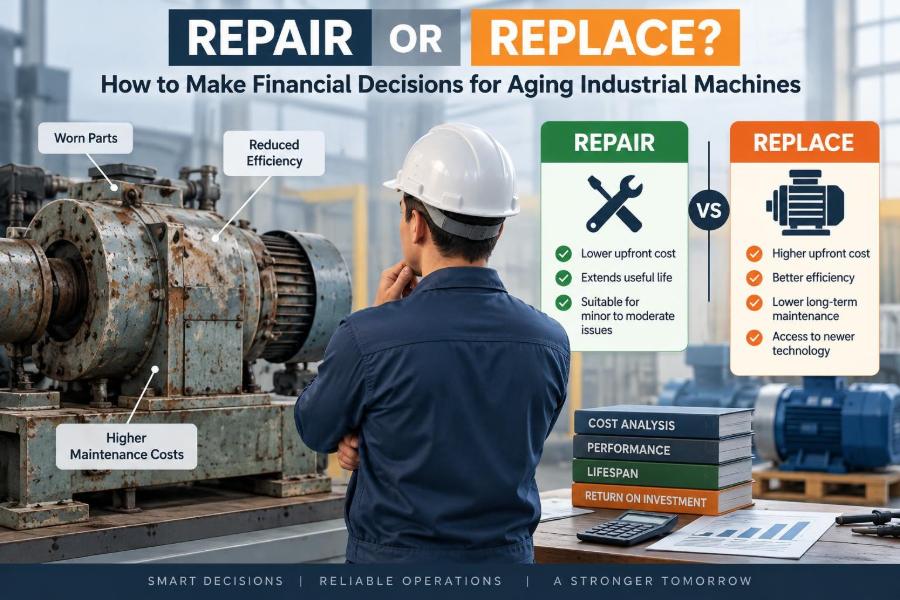

A production supervisor hears a familiar sound from a machine that has been running for years: a bearing rumble, a hydraulic pump that takes longer to build pressure, or a drive that trips once a week instead of once a year. Maintenance can probably restore it. But the repair quote is substantial, the spare part has a long lead time, and the machine’s output is now a bottleneck.
The difficult question is not simply whether the machine can be repaired. Most industrial equipment can be repaired in some form. The real question is whether putting more money into it is the best use of limited capital, maintenance labor, and production time.
Replacing a machine is equally complicated. A new asset may promise lower energy use, safer operation, and better controls, but its purchase price is only one part of the commitment. Installation, commissioning, training, tooling, and production disruption can change the economics considerably.
A sound repair-or-replace decision turns an emotional debate about “old equipment” into a structured engineering and financial assessment. It combines condition data, failure risk, operating costs, production needs, and realistic alternatives.
🔍 Start With the Actual Decision
“Repair or replace?” often hides several different choices. The options may include a minor corrective repair, an overhaul, a modernization retrofit, a used replacement, a new equivalent machine, or redesigning the process so the machine is no longer needed.
Define the decision in operational terms. For example: “How can we provide this forming capacity safely and reliably for the next five years?” This prevents a team from comparing a one-month repair with a twenty-year capital asset as though they were identical solutions.
🏭 Identify the Machine’s Production Role
Equipment deserves different financial treatment depending on what happens when it stops. A noncritical shop air compressor with backup capacity is not evaluated like a single furnace that holds up an entire heat-treatment line.
Classify the asset by its role: constraint, critical support equipment, quality-critical machine, safety-critical equipment, or noncritical utility. A machine that limits total plant throughput has a larger economic impact than its maintenance budget alone suggests.
📌 Separate Age From Condition
Calendar age is an imperfect proxy for health. A twenty-year-old gearbox that has been correctly lubricated, aligned, and lightly loaded may be in better condition than a five-year-old unit exposed to contamination and frequent overloads.
Assess condition through evidence: inspection findings, vibration trends, oil analysis, thermal measurements, control-system faults, accuracy checks, and maintenance history. Age matters most when it brings obsolescence, fatigue, degraded insulation, unavailable support, or technology limitations.
🩺 Build a Condition Baseline
Before requesting capital approval or authorizing a major repair, document what is known. Record the machine’s present output, quality capability, operating hours, downtime events, recurring defects, safety gaps, and major component condition.
A baseline makes future claims testable. If an overhaul is expected to improve availability, the team should know the starting availability and the mechanisms causing lost time. “It seems unreliable” is a useful warning, but not yet a business case.
📉 Calculate the Full Cost of Downtime
Downtime cost is not always equal to a machine’s hourly labor rate. It can include lost contribution margin, idle operators, missed shipments, expedited freight, spoiled material, restart losses, and the cost of operating a backup process.
Be careful not to count the same loss twice. If a downstream buffer keeps customer shipments intact, the immediate cost may be overtime or reduced inventory rather than lost sales. The correct number depends on the specific production system.
🧾 Distinguish Repair Cost From Failure Cost
A repair invoice captures only the direct cost of restoring equipment: parts, labor, contractor work, and perhaps rental equipment. A failure can create additional costs when it damages adjacent components, interrupts production, or creates a safety incident.
For example, replacing a worn coupling during planned maintenance may be modest. Waiting until it fails can damage shafts, overload a motor, and consume a weekend shutdown. The comparison should use the expected cost of each path, not only the cheapest immediate invoice.
🎲 Use Expected Cost for Uncertain Failures
Future failures are uncertain, but uncertainty does not mean it should be ignored. An expected cost combines a plausible failure likelihood with the consequence if it occurs. It is a planning tool, not a promise about exactly what will happen.
If a failure is plausible within a planning period and would cause a costly outage, its risk belongs in the analysis. Use ranges when information is weak, and show how the decision changes if the probability or outage duration is higher or lower.
📚 Read the Maintenance History Properly
Maintenance records tell more than total spending. Look for repeated work orders on the same subsystem, increasing time between repair and failure, temporary fixes becoming permanent, and failures that occur after particular loads or shifts.
Also distinguish corrective maintenance from preventive work. A high maintenance total is not automatically bad if it includes planned inspections that prevent major losses. The concern is a pattern of unplanned intervention, unstable performance, and escalating scope.
🔧 Ask Whether the Failure Mode Is Curable
Some recurring problems are symptoms of a correctable root cause. Misalignment, poor lubrication practices, loose foundations, contaminated compressed air, or inadequate cooling can damage otherwise serviceable machinery.
Other problems are inherent to the asset: undersized structure, worn ways, obsolete control architecture, chronic inability to meet tolerance, or a design with inaccessible and unavailable parts. Repair makes more sense when it eliminates the mechanism of failure rather than merely resetting the clock.
⏳ Consider Remaining Useful Life
Remaining useful life is the time an asset can reasonably provide required service, not the time until every component becomes unusable. It depends on load, environment, maintenance quality, wear condition, and future production requirements.
Estimate it as a range. A major overhaul may reasonably provide several more years of dependable service, while a patch to a deteriorated system may provide only uncertain months. The value of the repair depends heavily on this difference.
💵 Compare Options Over a Common Time Horizon
Do not compare a repair paid this quarter with a replacement purchase price paid today without considering the years of service each option provides. Choose a planning horizon aligned with the operation, often several years, then estimate costs and benefits for every option over that same period.
Include acquisition, installation, operating costs, planned maintenance, expected corrective maintenance, downtime exposure, and end-of-horizon value. A repair may be economical for a short bridge period even when replacement is clearly better over a longer horizon.
🧮 Understand Life-Cycle Cost
Life-cycle cost is the total cost of owning and operating equipment over the decision period. It broadens the question from “Which option costs less to buy?” to “Which option costs less to deliver the required service?”
| Cost category | Repair or overhaul | Replacement |
|---|---|---|
| Initial outlay | Usually lower, but scope can expand | Usually higher, including installation |
| Operating cost | May remain unchanged or high | May improve through efficiency and controls |
| Downtime risk | Depends on root cause and parts support | Lower after commissioning, but startup risk exists |
| Supportability | May worsen as parts disappear | Typically stronger early in asset life |
| Capability | Often retains existing limits | May add capacity, quality, or flexibility |
Life-cycle estimates are only as good as their assumptions. State assumptions plainly, especially expected service life, annual usage, energy price assumptions, and planned production changes.
🏦 Account for the Time Value of Money
Money spent today is not identical to money spent years from now. Discounted cash-flow methods account for this time value of money by converting future costs and benefits into present values.
Finance teams may use net present value, internal return measures, or payback periods. Engineers do not need to become accountants, but they should understand the purpose: compare cash flows occurring at different times without misleading arithmetic.
📏 Use Payback Without Letting It Dominate
Simple payback asks how long savings take to recover an investment. It is easy to communicate and useful for an initial screen, particularly when cash is constrained.
Its limitation is equally simple: it can ignore savings after the payback point, differences in equipment life, residual value, and risk. A replacement with a longer payback may still be the better decision if it avoids a major reliability or capability problem.
⚡ Include Energy and Utility Demand
An aging machine can consume more electricity, compressed air, fuel, water, or process heat than a newer alternative. Variable-speed drives, improved motors, better controls, and reduced leakage can change operating cost materially for high-utilization equipment.
Measure where practical instead of assuming. Metered load profiles reveal whether a machine runs near its rated demand, idles for long periods, or creates peak demand. Energy savings should be credited only when the plant can actually capture them.
🧑🏭 Price Labor, Setup, and Usability
Machine economics include the people required to operate, set up, troubleshoot, inspect, and maintain it. A modern machine may reduce manual adjustments or shorten changeovers, while an older machine may remain productive because experienced operators know it exceptionally well.
Do not assume labor savings mean headcount reductions. In many plants, saved hours are redeployed to capacity-constrained work, quality improvement, or maintenance. Describe the practical benefit accurately: fewer hours per unit, reduced overtime, or increased available capacity.
✅ Value Quality Capability
Wear, backlash, thermal drift, inconsistent pressure, and outdated sensing can affect product quality before they cause a complete breakdown. Scrap, rework, sorting, customer returns, and additional inspection all have economic consequences.
A replacement is more attractive when it provides a capability the old machine cannot reliably deliver, such as tighter repeatability, traceable process data, or stable operation across a required product range. Verify that the new machine, tooling, and process together can achieve the target.
🦺 Treat Safety and Compliance as Decision Inputs
Safety deficiencies should not be hidden inside a financial spreadsheet as though they are merely another operating expense. Missing guarding, unsafe controls, poor ergonomics, unacceptable emissions, or degraded electrical protection may require corrective action regardless of the asset’s apparent profitability.
Repair, retrofit, and replacement options must be reviewed against applicable workplace, machine safety, environmental, and electrical requirements. Requirements vary by location and application; involve qualified safety, engineering, and compliance personnel rather than assuming a generic solution is sufficient.
🧩 Examine Obsolescence and Spare-Part Risk
A machine can be mechanically sound but operationally fragile if its controller, servo drive, sensors, software, or proprietary parts are unsupported. The relevant issue is not whether a part is difficult to buy today, but whether a credible recovery path exists after a failure.
Identify single-source components, obsolete electronics, undocumented programs, and long-lead castings or motors. A strategic spare, a controls retrofit, or reverse-engineering plan can extend life, but each option has cost and technical risk.
🔄 Consider Modernization Between Repair and Replacement
Modernization is often the overlooked middle path. It may combine mechanical refurbishment with new controls, drives, sensors, guarding, and diagnostic capability while retaining a robust frame, vessel, press, or machine base.
It works best when the fundamental machine structure is sound and the production requirement remains appropriate. It is less convincing when the basic machine lacks capacity, accuracy, energy performance, or process flexibility that the business now needs.
🚚 Count Installation and Transition Costs
New equipment does not become productive when the purchase order is issued. Site preparation, foundations, electrical service, ventilation, piping, material handling, tooling, automation integration, acceptance testing, and operator training all require time and money.
Similarly, an overhaul can require rigging, teardown, alignment, recommissioning, and qualification. A credible estimate includes the transition period and a contingency for discoveries that are plausible but not yet visible.
🧪 Plan for Commissioning Risk
A replacement can underperform initially because of programming errors, integration problems, tooling adjustments, unexpected material behavior, or incomplete operator training. This does not make replacement a poor choice; it means projected benefits should begin after a realistic ramp-up period.
Define acceptance criteria before purchase. Typical criteria include output rate, product quality, uptime during a trial period, safety function verification, utility consumption, and documentation delivery. Clear criteria reduce disagreement when the machine reaches site.
📦 Check Capacity, Flexibility, and Demand Forecasts
Future demand changes the answer. Repairing a machine that will soon be underutilized can waste capital, while installing a larger replacement before demand is credible can create avoidable fixed cost.
Ask whether the new machine needs to match today’s output or support future products, shorter batch sizes, more frequent changeovers, or automation. Scenario planning is useful when forecasts are uncertain: low, expected, and high-demand cases can expose an option that is only attractive under optimistic assumptions.
🧱 Avoid the Sunk-Cost Trap
Money spent in the past cannot be recovered by spending more in the future. This is the sunk-cost trap: keeping an asset solely because it has already received expensive repairs, even when the next repair offers poor value.
Past history still matters as evidence. Repeated investment may reveal a deteriorating asset or poor maintenance strategy. But the decision should be based on future costs, risks, and benefits from this point forward.
🛑 Do Not Replace Just Because Equipment Is Old
The opposite mistake is treating age as a verdict. Mature equipment can be highly economical when it is stable, maintainable, safe, sufficiently capable, and supported by available parts and skilled technicians.
Replacement should solve a defined problem: unacceptable risk, excessive life-cycle cost, missing capability, safety deficiency, or inability to support the production plan. “Newer” is an attribute, not automatically a financial justification.
📊 Build a Transparent Decision Model
A useful model need not be elaborate. It should show the options, assumptions, one-time costs, annual operating costs, planned and expected unplanned maintenance, downtime exposure, savings, and nonfinancial constraints.
Keep the model visible to maintenance, operations, engineering, finance, and safety teams. Transparency matters because disagreements usually arise from assumptions—such as realistic availability, installation duration, or production value—not from the arithmetic itself.
🌦️ Test Sensitivity, Not Just the Base Case
Sensitivity analysis asks what happens when uncertain inputs change. Test the assumptions most likely to alter the conclusion: repair life, replacement lead time, energy savings, downtime cost, demand, and commissioning duration.
If one option remains preferable across reasonable ranges, confidence improves. If the answer reverses easily, the organization may need more condition data, a phased investment, a short-term repair, or a risk-mitigation plan rather than false precision.
👥 Bring the Right Functions Into the Decision
Maintenance understands failure modes and repair scope. Operations understands bottlenecks and schedule consequences. Engineering evaluates capability and integration, finance tests cash flow, and safety or quality staff identify requirements that cannot be traded away.
Involving these groups early prevents a common failure: selecting the least expensive technical fix only to discover that it creates a production, safety, or qualification problem later.
🗂️ Create a Decision Record
Document the chosen option, the alternatives considered, the assumptions used, the approval rationale, and the triggers that would cause reconsideration. For a repair, a trigger might be another major failure, loss of parts support, or inability to meet quality targets.
This record supports learning. After implementation, compare actual downtime, maintenance spending, output, and energy use with the forecast. The goal is not to punish imperfect forecasts; it is to improve the next decision.
🛠️ A Practical Repair-or-Replace Workflow
- Define the service the machine must provide and the planning horizon.
- Establish current condition, performance, safety status, and failure modes.
- Develop realistic repair, overhaul, retrofit, and replacement options.
- Estimate complete cash flows, including downtime and transition effects.
- Review nonfinancial constraints: safety, quality, capacity, and supportability.
- Test uncertain assumptions and document the final rationale.
This workflow scales from a modest pump replacement to a major production-line investment. More critical decisions require better data and wider review, not a different underlying logic.
🧠 The Core Principle: Buy Reliable Service, Not Just Equipment
The best choice is the one that provides the required production service at an acceptable total cost and risk over the relevant period. Sometimes that means a targeted repair with clear root-cause correction. Sometimes it means an overhaul, a controls retrofit, or a carefully planned replacement.
Financial discipline does not require pretending uncertainty is absent. It requires making assumptions explicit, recognizing constraints that money cannot override, and comparing alternatives on a consistent basis.
Aging machinery should be judged by the value and risk of its future service—not by its age, its last repair bill, or the appeal of a new purchase. That perspective leads to decisions that are easier to defend, execute, and learn from. ⚙️📈🛠️