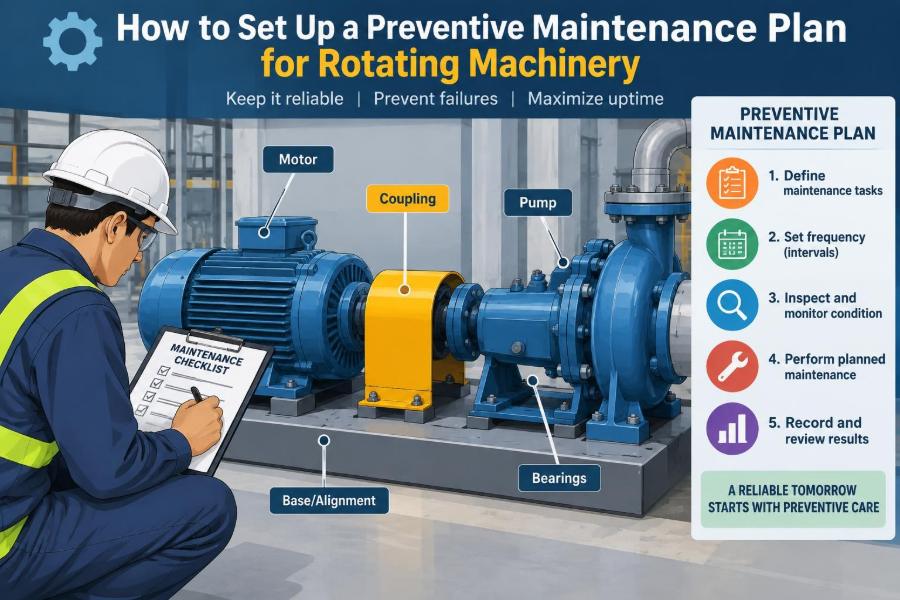

A pump begins to sound slightly rougher than usual. A fan motor runs a little warmer after lunch. A gearbox needs a small oil top-up more often than it did last month. None of these observations necessarily means failure is imminent, but each can be an early clue.
In many plants, rotating equipment receives attention only after output falls, vibration becomes obvious, or a bearing fails. The resulting repair may be manageable; the unplanned shutdown, damaged coupled equipment, lost production, and hurried safety decisions are often the larger problem.
A preventive maintenance plan turns routine attention into a repeatable system. It identifies what equipment matters, what can fail, what to check, who checks it, and what action follows when a reading or observation is abnormal.
The goal is not to inspect every machine constantly. It is to apply the right maintenance at the right interval, using evidence rather than habit, so machinery remains safe, reliable, and economical to operate.
🔄 What Preventive Maintenance Means for Rotating Equipment
Preventive maintenance is planned work performed before functional failure occurs. For rotating machinery, it commonly includes inspection, lubrication, cleaning, alignment checks, fastener checks, and periodic replacement of known wear items.
Rotating equipment includes pumps, fans, blowers, motors, compressors, mixers, conveyors, turbines, gearboxes, and other machines that transfer energy through rotating shafts. Their components experience repeating loads, friction, heat, contamination, and vibration, so small defects can grow during normal operation.
A sound plan does not assume every failure can be prevented by time-based service. Some faults develop unpredictably. The plan should therefore combine scheduled tasks with condition monitoring, which uses the machine’s actual condition to guide decisions.
🎯 Start with the Purpose, Not a Checklist
Generic checklists are useful prompts, but they are not a maintenance strategy. A cooling-water pump serving a critical process deserves a different plan from a spare exhaust fan with no production or safety consequence.
Define what the plan is meant to protect: personnel, environment, production capacity, product quality, equipment life, energy use, or a combination. This purpose helps a team resolve practical questions, such as whether a standby unit needs the same inspection frequency as a continuously running duty unit.
Clear objectives also make later review possible. Instead of saying “improve reliability,” a team can ask whether critical equipment is available when required, whether repeat defects are declining, and whether planned work is replacing emergency work.
🗂️ Build a Complete Equipment Register
Begin with an equipment register: a controlled list of every maintainable asset in the area. Each item needs a unique tag or identifier that matches plant drawings, labels, maintenance records, and the computerized maintenance management system, if one is used.
For each rotating asset, record the manufacturer and model where available, location, service, driver, driven equipment, rated speed, power, coupling type, bearing arrangement, lubrication method, and relevant spares. A photograph can help technicians confirm they are working on the intended machine.
Also record connected items. A motor, flexible coupling, pump, baseplate, piping, and control system operate as a system. Treating only the motor or only the pump as the asset can hide the real source of recurring trouble.
🚦 Rank Machines by Criticality
Criticality ranks equipment according to the consequence of its loss. It is not simply a judgment about purchase price or physical size. A modestly priced pump can be highly critical if there is no standby and its loss stops a process or creates a safety concern.
Consider several consequences together:
- Risk to people, environment, and regulatory compliance.
- Production loss, quality loss, and recovery time after shutdown.
- Availability of installed standby equipment or practical temporary alternatives.
- Repair lead time, specialist requirements, and spare-part availability.
- Potential for secondary damage if the machine fails in service.
A simple high, medium, and low ranking is often enough to begin. High-criticality assets generally receive closer condition monitoring, stronger documentation, planned spares, and more carefully defined maintenance tasks.
🧩 Understand the Machine as a System
A rotating machine rarely fails in isolation. Consider a motor-driven centrifugal pump: the motor provides torque, the coupling transmits it, bearings support shafts, the pump creates flow, seals contain fluid, piping imposes loads, and the foundation keeps alignment stable.
For example, replacing a repeatedly failed bearing without checking shaft fit, lubricant condition, coupling alignment, pipe strain, and operating point may only reset the failure clock. The bearing is the damaged component, not always the initiating cause.
System thinking also includes controls and utilities. Low suction level, blocked cooling, unstable voltage, incorrect rotation, or a valve left in the wrong position can create mechanical symptoms while originating outside the machine.
🧠 Identify Failure Modes Before Selecting Tasks
A failure mode is the specific way an item can fail to perform its required function. “Pump failure” is too broad. Seal leakage, impeller erosion, bearing damage, coupling-element deterioration, and motor winding insulation failure are distinct failure modes with different warning signs and responses.
Ask four practical questions for each important component: What function does it provide? How can that function be lost? What causes that loss? What observable evidence appears before, during, or after the failure?
This is a simplified form of failure-mode analysis. It prevents a common mistake: assigning a maintenance task because it is traditional, rather than because it addresses a credible failure mechanism.
⚖️ Match the Maintenance Strategy to the Failure Pattern
Not every component benefits from routine replacement. Some items have predictable wear, while others fail randomly or due to installation errors, contamination, overload, and operating conditions. Replacing a healthy component too early can introduce new defects through unnecessary disturbance.
| Failure pattern or condition | Suitable primary approach | Typical example |
|---|---|---|
| Predictable wear or service life | Scheduled restoration or replacement | Renewing a known-wear coupling element |
| Gradual measurable deterioration | Condition-based maintenance | Trending bearing vibration or lubricant condition |
| Sudden failure with low detectability | Functional test, redundancy, or contingency planning | Testing an automatic standby pump start |
| Failure driven by use or contamination | Operator care and control of operating conditions | Maintaining correct lubricant cleanliness |
The best strategy often combines methods. A gearbox may receive regular oil-level checks, periodic oil analysis, vibration monitoring, and a planned overhaul only when evidence and operating history justify it.
📚 Use Manuals, Drawings, and History Carefully
Manufacturer manuals provide baseline information: lubrication grades, grease quantities, tightening guidance, inspection points, permissible operating ranges, and disassembly procedures. They are a starting point, not a substitute for understanding actual site service.
Review piping and instrumentation diagrams, electrical drawings, alignment records, commissioning reports, and repair history. Repeated seal replacements, for instance, may reveal dry running, excessive vibration, unsuitable seal materials, or an operating condition outside the pump’s preferred range.
Historical records can be incomplete or inconsistent. Treat them as evidence to investigate, not unquestioned truth. A maintenance record that says “bearing replaced” is more useful when it also records bearing location, observed damage, lubrication condition, suspected cause, and corrective work performed.
👀 Create Effective Operator Care Routes
Operators are often closest to the equipment and can notice change before an instrument alarm or scheduled inspection. A short, consistent route turns ordinary observation into an early-warning process.
Route checks should be safe and specific: unusual noise, visible leakage, oil level, guard condition, temperature indication, vibration felt only where approved, flow or pressure stability, and housekeeping around the machine. Operators should not remove guards or approach hazardous moving parts to complete a route.
Define what needs reporting. “Check pump” is vague; “report a new rattling sound, continuous seal leakage, low sight-glass level, or a temperature outside the established normal range” gives useful direction.
🛢️ Design Lubrication as a Precision Task
Lubrication failure is not limited to too little oil or grease. Wrong viscosity, incompatible grease, water ingress, dirt, overgreasing, undergreasing, and mixing products can all shorten component life.
A lubrication instruction should identify the exact lubricant, application point, quantity or target level, method, interval, cleanliness requirement, and any precautions. “Grease motor bearings monthly” is not enough, especially when bearings are sealed for life or designed for a defined relubrication procedure.
Overgreasing can churn lubricant, raise bearing temperature, and force grease into areas where it does not belong. Use the manufacturer’s guidance and machine-specific evidence; more lubricant is not automatically better.
🧪 Use Oil Analysis Where It Answers a Decision
Oil analysis can reveal viscosity change, contamination, water, oxidation, additive condition, and wear debris. It is most valuable for oil-lubricated gearboxes, circulating oil systems, compressors, and other assets where an oil sample represents an important internal condition.
The sample must be representative. Taking oil from a stagnant drain point may produce misleading results. Sample ports located in a live zone of oil flow, clean bottles, consistent timing, and documented machine operating conditions all improve trend quality.
Do not order tests merely because a laboratory offers them. Choose tests that can change an action: filter the oil, find a water-ingress path, investigate abnormal wear, adjust the oil-change interval, or plan an inspection.
📈 Add Vibration Monitoring with a Clear Baseline
Vibration analysis is a powerful technique because many mechanical defects influence the vibration signal before catastrophic failure. Imbalance, misalignment, looseness, bearing defects, gear mesh issues, and hydraulic disturbances can produce characteristic patterns.
However, a vibration reading has meaning only in context. Establish a baseline after correct installation or confirmed healthy operation, measure at repeatable locations and operating conditions, and trend changes over time. A single value without speed, load, direction, and historical comparison is limited evidence.
Condition monitoring requires competent interpretation. It can identify a need for investigation, but it does not remove the need to inspect the whole system and confirm the fault mechanism before major repair.
🌡️ Monitor Temperature Without Guesswork
Temperature can indicate excess friction, lubrication problems, restricted cooling, electrical issues, or process changes. It is easy to measure with installed sensors or an infrared device, but surface readings are affected by emissivity, viewing angle, airflow, and surrounding hot surfaces.
Trend comparable readings instead of relying only on a universal alarm number. A bearing housing that normally operates steadily may warrant investigation when its temperature changes persistently, even if it has not crossed a generic limit.
Use temperature alongside other evidence. A hot bearing with rising vibration suggests a different investigation from a hot motor casing with normal mechanical readings but poor ventilation.
🎧 Treat Sound and Visual Clues as Useful Data
Experienced technicians often detect problems through sound: a rhythmic knock, high-pitched bearing noise, belt squeal, gear whine, or cavitation-like crackle. These observations are valuable, but they should be recorded in clear language and verified where possible.
Visual inspection can reveal loose fasteners, damaged guards, stained seal areas, oil leaks, fretting dust near couplings, corroded foundations, worn belts, and blocked cooling fins. Good lighting and clean equipment make defects easier to see.
A clean machine is not necessarily a healthy machine, but poor housekeeping conceals leaks and encourages contamination. Cleaning should be controlled so it does not force water or debris into bearings, electrical enclosures, or breathers.
📐 Control Alignment, Balance, and Soft Foot
Misalignment creates forces that couplings, bearings, seals, and shafts must absorb. It may be angular, parallel, or a combination, and it can change after startup as equipment expands thermally.
Check alignment after foundation work, motor replacement, piping modifications, major maintenance, repeated coupling or bearing problems, and any event that may have moved the machine. Precision alignment methods are often justified for critical or high-speed equipment.
Soft foot occurs when a machine foot does not sit flat on its base, causing frame distortion as bolts are tightened. Correct soft foot before final alignment. Also check pipe strain: piping that pulls a pump casing out of position can undo accurate alignment work.
🏗️ Inspect Foundations, Guards, and Structural Supports
A machine’s foundation and support structure influence vibration and alignment. Cracked grout, loose anchor bolts, corroded frames, weak supports, or deteriorated shims can allow movement that appears later as a coupling, seal, or bearing problem.
Guards deserve equal attention. They must prevent access to rotating hazards while allowing safe inspection and maintenance. Bent, loose, or missing guards are not minor cosmetic defects; they can create serious entanglement and contact hazards.
Include structural observations in routine inspections, particularly after impacts, nearby construction, repeated vibration, or major changes in process piping.
💧 Protect Seals and Manage Leakage Intelligently
Mechanical seals and packing are affected by shaft movement, alignment, fluid properties, pressure, temperature, solids, dry running, and support-system condition. A seal leak is often a symptom rather than a standalone problem.
Define acceptable and unacceptable leakage based on equipment design, fluid hazard, environmental controls, and site procedures. Some packed equipment may require controlled leakage for lubrication, while a hazardous-fluid mechanical seal requires a much different response.
When seals fail repeatedly, inspect the operating context: suction conditions, pump operation, flush supply, seal support pressure, vibration, shaft sleeve condition, and operator practices. Simply installing another seal may not address the driver.
🌊 Keep Pumps Near Suitable Operating Conditions
Centrifugal pumps are designed to operate within a range where hydraulic forces, vibration, efficiency, and internal recirculation remain manageable. Persistent operation far from the intended range can increase radial loads, temperature, vibration, and seal or bearing stress.
Cavitation occurs when local pressure falls sufficiently for vapor bubbles to form and collapse as pressure recovers. It may sound like gravel or crackling, but sound alone is not a definitive diagnosis. Suction restrictions, insufficient liquid level, excessive temperature, or unsuitable flow conditions should be investigated.
A maintenance plan should therefore include process checks such as suction pressure, discharge pressure, flow, valve position, and evidence of blocked strainers where relevant.
⚡ Include Motors and Electrical Interfaces
Mechanical reliability depends partly on electrical health. Loose connections, voltage imbalance, poor cooling, unsuitable starting frequency, overload, insulation deterioration, and variable-speed drive settings can affect motor temperature and torque.
Coordinate mechanical and electrical tasks. A motor change requires confirmation of rotation direction, coupling condition, alignment, guard replacement, correct overload protection, and a controlled test run. Treating these as separate handoffs creates gaps.
Electrical inspection and testing must be performed by qualified personnel under site safety procedures. The maintenance plan should state the required competency and isolation method rather than assuming any technician can perform every task.
🔒 Build Safety into Every Work Instruction
Maintenance plans should make safe work the default, not an afterthought. Before work begins, isolate electrical, hydraulic, pneumatic, thermal, gravitational, and process energy as applicable. Lockout/tagout procedures must match the equipment and site rules.
Stored energy deserves special attention. Pressurized piping, elevated loads, hot casings, rotating inertia, spring-loaded devices, and automatic-start systems can remain hazardous after a normal stop command.
Instructions should identify required personal protective equipment, lifting points, chemical hazards, confined-space considerations where applicable, and verification steps before return to service. A clear restart checklist prevents guards, tools, drain plugs, and temporary restraints from being overlooked.
🧾 Write Job Plans That Technicians Can Execute
A maintenance job plan should describe the task well enough that qualified personnel can perform it consistently. It needs more than a title and an interval.
- Asset identification, purpose, and required access conditions.
- Safety isolations, permits, tools, consumables, and spare parts.
- Step-by-step work scope and measurable acceptance criteria.
- Required readings, photographs, or observations to record.
- Reassembly, alignment, testing, and handback requirements.
Use precise language. “Inspect coupling” becomes more useful as “inspect coupling element for cracking, hardening, missing material, bolt security, and evidence of fretting; record defects and replace according to approved criteria.”
🗓️ Set Intervals Using Risk and Evidence
Intervals should reflect criticality, run hours, environment, duty cycle, failure history, manufacturer guidance, and condition-monitoring results. Calendar-based intervals are convenient, but some tasks are better tied to operating hours, starts, load cycles, or process campaigns.
Begin conservatively where history is limited, then review. If repeated inspections find no degradation and monitoring remains stable, an interval may be extended with documented justification. If defects are found too late, shorten the interval or improve the detection method.
Changing intervals should be a controlled engineering decision, not an informal response to workload. The question is whether the revised task still detects or prevents the failure with adequate time to act.
📏 Define Alarm Limits and Escalation Paths
Measurements are useful only when people know what to do with them. Define normal, alert, and action states for relevant readings, using manufacturer information, site experience, baseline trends, and qualified engineering judgment.
An alert should trigger review or more frequent measurement; an action state should trigger a defined response such as inspection, load reduction, standby changeover, or planned repair. Immediate shutdown is appropriate only where the risk and equipment instructions justify it.
Avoid rigid limits divorced from context. A change in vibration trend may matter more than a single broad threshold, while a rapid temperature rise may demand prompt action even before a formal limit is reached.
🔧 Plan Corrective Work Before Breakdown
Condition monitoring creates value only if abnormal findings lead to timely corrective work. When a developing defect is identified, assess the likely progression, consequence of continued operation, available standby capacity, repair scope, spares, and suitable outage window.
Prepare the repair in advance: verify bearing and seal part numbers, arrange lifting equipment, review drawings, identify alignment tools, and establish post-repair acceptance checks. Planned work is usually safer and more accurate than a rushed response after failure.
Not every abnormality requires immediate replacement. A low-risk defect may be monitored deliberately until a planned stop, provided the decision, inspection frequency, and operating restrictions are documented.
📦 Manage Spares by Consequence and Lead Time
A spare-parts strategy supports the maintenance plan. Stocking every part ties up resources, while stocking nothing can turn a modest repair into a long outage. Focus first on items with long procurement lead times, high criticality, or a history of emergency need.
Critical spares may include bearings, seals, coupling elements, belts, lubricants, filters, motors, gear units, or complete rotating assemblies, depending on the site. Preserve stored parts correctly; an unprotected bearing or moisture-damaged motor is not a reliable spare.
Verify part identity at receipt and before issue. Similar-looking bearings, seal kits, and coupling components can have materially different dimensions or materials.
💻 Use a CMMS to Preserve Knowledge
A computerized maintenance management system, or CMMS, can schedule tasks, retain equipment history, control work orders, track labor and parts, and report overdue work. Its value comes from disciplined data entry, not from software alone.
Use structured failure codes where practical, but leave room for meaningful technician notes. “Repaired” is not a useful history entry; “replaced inboard bearing after water-contaminated grease was found; renewed damaged bearing seal and corrected washdown practice” supports future learning.
Keep master data under control. Duplicate asset tags, vague task names, obsolete job plans, and unreviewed failure codes gradually make a system less trustworthy.
📊 Measure Whether the Plan Is Working
Useful measures reveal both reliability and maintenance-process health. Examples include overdue preventive tasks, repeat failures, emergency work proportion, condition-monitoring exceptions, planned-work completion, downtime causes, and recurring spare consumption.
Metrics need interpretation. A high completion rate does not prove tasks are effective if inspections are superficial. Likewise, a temporary increase in reported defects can be positive if better inspection is uncovering issues before failure.
Review a small set of measures regularly with operations, maintenance, and engineering. The discussion should lead to actions: revise a route, improve access, change a lubricant practice, investigate a repeat failure, or update a job plan.
🔍 Investigate Repeated Failures, Not Just the Latest One
When the same component fails repeatedly, use root-cause thinking. Start with facts: operating history, failed-part condition, vibration and temperature trends, installation records, lubrication observations, process conditions, and changes made since the previous repair.
Then distinguish between the event and the cause. A failed bearing may be the event; contamination, incorrect fit, misalignment, electrical fluting, overload, or inadequate lubrication may be the cause. Several contributing causes can coexist.
The corrective action should alter the failure mechanism. Replacing parts without changing the condition that damaged them is corrective maintenance in appearance, not in outcome.
🚫 Avoid Common Preventive Maintenance Traps
One trap is maintenance by calendar alone: servicing every machine at identical intervals regardless of duty, criticality, or condition. Another is excessive intrusive work, which can introduce contamination, assembly errors, and alignment problems into healthy equipment.
Other frequent weaknesses include ignoring minor leaks, recording only “okay” on inspections, collecting condition data without reviewing trends, and closing work orders before follow-up actions are complete. Each breaks the link between observation and reliability improvement.
Do not confuse activity with control. A plan is mature when each task has a purpose, each finding has an owner, and each recurring problem is examined for a mechanism-based solution.
🤝 Make Operations and Maintenance Joint Owners
Reliable rotating machinery depends on cooperation. Operators understand process demand and day-to-day behavior; maintainers understand mechanical condition and repair quality; engineers can resolve design, operating-envelope, and chronic-failure issues.
Short cross-functional reviews are often more useful than long reports. Discuss new noises, abnormal trends, recent process changes, upcoming outages, recurring work orders, and equipment that has been operating on temporary restrictions.
Shared ownership also improves handovers. Maintenance should know when equipment has been run dry, throttled unusually, started repeatedly, or exposed to a process upset. Operations should know what limitations apply after a repair or while a defect is being monitored.
🛠️ A Practical Rollout Sequence
Trying to create detailed plans for every machine at once can overwhelm a team. Start with a pilot group of high-criticality rotating assets, then improve the approach before expanding it.
- Verify the asset register and rank equipment by criticality.
- Gather manuals, drawings, operating information, and repair history.
- Identify credible failure modes and choose suitable tasks.
- Create operator routes, lubrication instructions, condition-monitoring routes, and job plans.
- Set initial intervals, acceptance criteria, escalation actions, and spare requirements.
- Train users, execute the work, review findings, and refine the plan.
A pilot exposes practical issues early, such as inaccessible inspection points, unclear ownership, missing baseline data, or work orders that take longer than assumed.
🧭 The Core Principle: Detect, Decide, and Act
A preventive maintenance plan succeeds when it creates a dependable loop: detect deterioration or harmful operating conditions, decide what the evidence means, and act before the consequence becomes unacceptable.
Detection may come from an operator’s observation, lubricant sample, vibration route, temperature trend, functional test, or scheduled inspection. Decisions require equipment context and defined escalation. Action may mean correcting a process condition, planning a repair, changing to standby equipment, or continuing controlled monitoring.
The strongest plans are living systems. They retain what works, remove low-value work, respond to repeat failures, and become more specific as the organization learns how its machines behave.
Preventive maintenance is most effective when it is a risk-based, evidence-led routine that protects the entire rotating system—not merely a calendar of tasks. Build the plan carefully, use findings to improve it, and let every completed job add to the reliability knowledge of the plant. ⚙️🔍🛠️