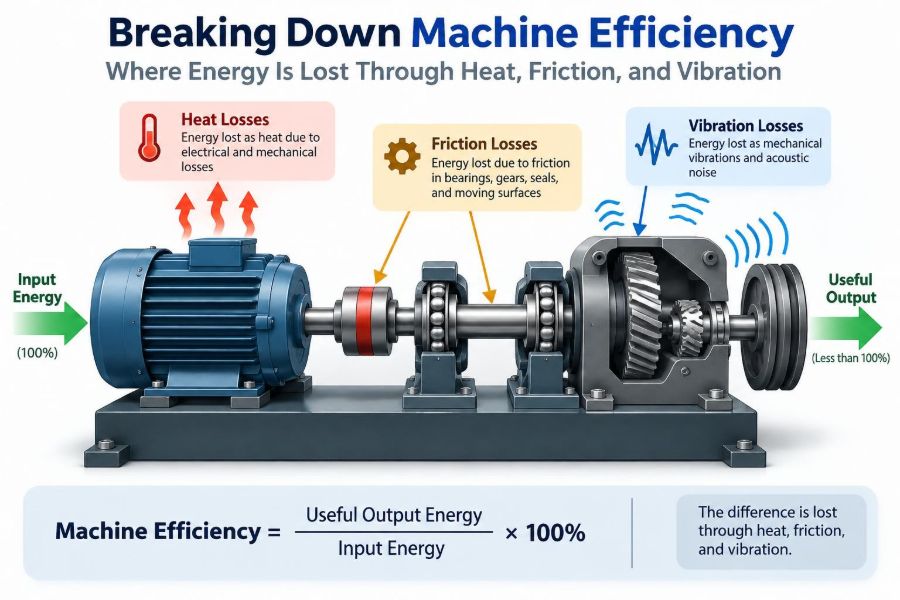

A bicycle that feels unusually hard to pedal, a pump motor that runs hot, and a car that develops a new shudder at speed can seem like unrelated problems. In each case, however, the machine may be consuming useful input energy while quietly sending part of it somewhere else.
That “somewhere else” is often heat, friction, vibration, noise, or unwanted fluid motion. Energy is not simply disappearing; it is being converted into forms that do not help the machine perform its intended job.
For students, this is the bridge between ideal textbook models and real mechanisms. For working professionals, it is central to operating cost, reliability, product quality, maintenance planning, and safety.
Machine efficiency is therefore more than a percentage on a datasheet. It is a disciplined way to trace energy through a system, identify losses, and decide which improvements are technically worthwhile.
⚙️ What Machine Efficiency Actually Means
Efficiency compares the useful output of a machine with the energy or power supplied to it. In its simplest form, efficiency = useful output ÷ input. It may be expressed as a decimal or as a percentage.
A motor might receive electrical power and deliver shaft power. A pump might receive shaft power and deliver useful hydraulic power to a fluid. The definition of “useful” depends on the machine’s intended function, so setting the system boundary correctly is essential.
🔋 Energy Is Conserved, but Useful Energy Is Not
An efficiency loss does not violate conservation of energy. The input energy still exists after the process, but some has become low-grade heat, acoustic energy, turbulent fluid motion, or vibration that cannot contribute effectively to the desired output.
This distinction matters because a machine can be energetically accountable while still being inefficient. A gearbox that warms its housing has not lost energy mysteriously; it has converted some input power into heat through internal losses.
📏 Power, Work, and the Operating Point
Work is energy transferred through force acting over a distance, while power is the rate at which work is done. For rotating systems, shaft power is commonly described by torque multiplied by angular speed.
Efficiency is never fully detached from operating conditions. Speed, load, temperature, supply voltage, fluid properties, and control settings can all change losses. A machine can be efficient near its design point and perform poorly when lightly loaded, overloaded, or operated far from its intended speed.
🧭 Define the Useful Output Before Calculating
Before using an efficiency equation, ask: what is the machine supposed to accomplish? For a hoist, useful output may be the rate of increase in a load’s gravitational potential energy. For a compressor, it may be the fluid power associated with the required pressure rise and flow rate.
Counting the wrong output leads to misleading results. The heat produced by an electric heater is useful, but the heat produced by a bearing in a conveyor drive is usually a loss. Function, not the energy form alone, determines whether an output is useful.
🧱 The Loss Chain Through a Real Machine
Most machines consist of stages, and each stage can have its own efficiency. Electrical input may pass through a drive, motor, coupling, gearbox, and final mechanism before useful work reaches the load.
The overall efficiency is the product of the stage efficiencies when each is expressed as a decimal. This is why several modest losses can become substantial together. Improving a downstream component cannot recover energy already dissipated upstream.
- Electrical losses occur in conductors, windings, and power electronics.
- Mechanical losses occur in bearings, gears, seals, and sliding contacts.
- Fluid losses occur in pipes, valves, passages, and leakage paths.
🔥 Heat: the Most Common Visible Loss
Heat is often the easiest loss to notice because it raises component temperature. Electrical resistance in motor windings, friction in bearings, churning in lubricants, and deformation inside materials all generate heat.
Warmth alone is not proof of a fault. Every real machine produces some heat. The practical question is whether the temperature, its trend, and its location are consistent with the operating load and the component’s allowable limits.
🧲 Electrical Resistance and Copper Losses
When current passes through a conductor, electrical resistance produces heat. In motors and transformers, these are often called copper losses because windings are commonly copper. They rise strongly as current rises.
That behavior explains why overload is especially damaging. A modest increase in current can create a disproportionately larger heating effect, reducing efficiency and accelerating insulation aging. Poor terminals and undersized conductors can add localized resistance and create hot spots.
🌀 Magnetic and Core Losses
Alternating magnetic fields in electrical machines can also produce losses in iron cores. Hysteresis loss is associated with repeated magnetization reversal, while eddy currents are circulating currents induced within conductive material.
Core laminations and suitable magnetic materials reduce these effects, but cannot remove them entirely. Some magnetic losses are present even at light mechanical load, which is one reason a motor’s efficiency may fall when it runs far below its rated operating range.
🧊 Why Cooling Is Not the Same as Efficiency
A fan, coolant circuit, or finned housing can prevent overheating by carrying heat away. This protects the machine, but it does not undo the energy conversion that created the heat. In fact, cooling equipment itself may consume additional power.
Good thermal management is necessary for reliability. Better efficiency, however, usually requires reducing the source of the loss: lowering resistance, selecting the right motor size, correcting alignment, reducing friction, or improving the flow path.
🧽 Friction: Useful in Some Places, Wasteful in Others
Friction is not inherently undesirable. Brakes, clutches, belt drives, and tire-road contact all rely on it to transmit force or control motion. In these cases, designers manage friction deliberately.
In bearings, seals, guideways, and gear meshes, excessive friction wastes energy and generates wear. The engineering task is not to eliminate friction universally; it is to place the right amount in the right location and minimize parasitic friction elsewhere.
⚙️ Rolling, Sliding, and Fluid Friction
Rolling-element bearings generally have lower friction than unlubricated sliding contact, but they still experience losses from rolling resistance, lubricant shear, seals, and internal sliding. Plain bearings can perform very well when a stable lubricant film separates surfaces.
Fluid friction occurs when a liquid or gas shears between moving surfaces or through passages. Thick oil can protect a heavily loaded gearset, yet excessive viscosity can increase churning losses, especially during cold starts.
| Loss mechanism | Typical location | Common symptom | Useful first check |
|---|---|---|---|
| Sliding friction | Guides, seals, brakes | Heat, wear, high force | Lubrication and surface condition |
| Rolling friction | Bearings, rollers | Noise, temperature rise | Preload, alignment, contamination |
| Fluid shear | Gearboxes, pumps | Warm lubricant, drag | Oil grade and fill level |
| Flow restriction | Pipes, valves, ducts | Pressure drop, poor delivery | Flow path and restrictions |
🛢️ Lubrication Has a Delicate Balance
A lubricant must reduce surface contact, carry heat, resist breakdown, and sometimes protect against corrosion. Too little lubricant can allow asperities—the microscopic high points on surfaces—to contact and wear. Too much can cause churning, leakage, seal drag, or aeration.
The correct lubricant is not simply the thickest available. Viscosity must suit speed, load, temperature, component geometry, and the manufacturer’s requirements. Mixing incompatible lubricants or using contaminated oil can defeat an otherwise sensible maintenance plan.
📐 Misalignment Turns Motion into Heat
When shafts, pulleys, couplings, or gears are misaligned, the machine must continually force components through an unintended path. Bearings can see extra load, couplings can flex repeatedly, and seals can rub unevenly.
Even a drive that still operates can pay an efficiency penalty through elevated friction and vibration. Alignment should be checked after installation, after a significant repair, and when symptoms such as recurring bearing failures or coupling wear appear.
🦷 Gear Mesh Losses and Backlash
Gears transmit torque through tooth contact, but each mesh has rolling and sliding components. Surface finish, tooth geometry, lubricant condition, load distribution, and alignment affect how much energy becomes heat.
Backlash—the intentional clearance between mating teeth—is needed to prevent binding and allow lubrication and thermal expansion. Too little can cause interference; too much can increase impact during reversals and contribute to noise or positional error. It is a controlled design parameter, not a defect by itself.
💨 Windage and Churning Losses
A rapidly rotating component must push aside surrounding air, oil, or another fluid. This resistance is called windage in gases and is often associated with churning when rotating parts stir lubricant.
At high rotational speeds, these losses can become meaningful even without an external mechanical load. Enclosures, oil levels, rotor geometry, and ventilation paths influence the result. Reducing drag must be balanced against cooling, lubrication, and containment needs.
🌊 Hydraulic Losses: Pressure That Does No Useful Work
In hydraulic systems, useful power is associated with flow rate and pressure difference. Pressure drops across hoses, fittings, valves, filters, and narrow passages require pump energy, but may not contribute to actuator work.
Some pressure loss is unavoidable and some is purposeful, such as throttling for control. Yet a clogged filter, undersized line, unnecessarily restrictive fitting, or valve held in an inefficient control position can turn pumping power directly into heat.
🫧 Leakage and Internal Slip
Leakage is fluid that bypasses the intended working path. In a hydraulic pump or cylinder, internal leakage can reduce delivered flow or force while the prime mover continues consuming energy. External leakage also wastes fluid and creates housekeeping and safety concerns.
Clearances cannot always be made arbitrarily small because components need to move, lubricate, and accommodate thermal expansion. Wear, damaged seals, unsuitable fluid viscosity, and pressure beyond design intent can increase leakage beyond acceptable levels.
🌪️ Turbulence and Poor Flow Paths
Fluid flowing through abrupt expansions, sharp bends, rough passages, and poorly designed junctions can separate and form eddies. The resulting turbulence converts organized flow energy into random motion and heat.
Not all turbulence is harmful; mixers and heat exchangers may rely on it. In a pipe system meant to deliver flow efficiently, though, smoother transitions and appropriately sized passages usually reduce unnecessary pressure loss.
📳 Vibration Is Energy in Unwanted Motion
Vibration occurs when a component moves back and forth around an equilibrium position. Some motion is expected in reciprocating machines and rotating equipment, but uncontrolled vibration consumes energy, creates noise, loosens fasteners, and raises stress cycles in parts.
Its energy may eventually dissipate as heat through material damping, friction, mounts, and surrounding air. More importantly, vibration often signals an underlying condition that can become a reliability issue if ignored.
⚖️ Unbalance and Rotating Mass
A rotor is unbalanced when its mass distribution does not align with its intended axis of rotation. As speed rises, the rotating unbalance force rises rapidly, which is why a small mass error that seems harmless at low speed can become severe at high speed.
Fans, grinding wheels, pump impellers, and motor rotors are typical examples. Deposits, erosion, missing material, damaged blades, and incorrect assembly can all alter balance after manufacturing.
🎵 Resonance Can Magnify Small Excitations
Every elastic structure has natural frequencies. Resonance occurs when an excitation frequency approaches one of them, allowing vibration amplitude to build significantly if damping is limited.
A machine may operate smoothly at one speed and shake at another because it passes through a critical speed. The solution may involve changing speed, stiffness, mass distribution, damping, or the forcing source—not merely tightening every visible bolt.
🔊 Noise Is a Clue, Not a Complete Diagnosis
Noise often accompanies friction, impacts, turbulent flow, or vibration, so it can be a valuable early warning. A new whine from a gearbox, hiss from a pneumatic leak, or rumble from a bearing deserves investigation.
However, sound alone rarely identifies the exact fault. Ambient noise, mounting conditions, and human perception complicate interpretation. Pair observations with temperature, vibration, power draw, lubricant condition, and process performance before reaching a conclusion.
🧪 Measuring Losses Without Guesswork
Direct efficiency measurement requires reliable input and output measurements taken at the same operating condition. Electrical input may be measured with suitable power instrumentation; mechanical shaft output may require torque and speed; hydraulic output requires flow and pressure information.
Measurements have uncertainty. Sensor accuracy, placement, calibration, sampling rate, and transient behavior can affect the result. A small calculated difference between two configurations may not be meaningful unless the measurement method can resolve it.
📈 Build an Energy Balance
An energy balance provides a structured way to account for input, useful output, stored energy changes, and losses. For steady operation, stored energy may be approximately constant, making the bookkeeping simpler.
For a hypothetical motor-driven pump, electrical input becomes motor losses, shaft losses, pump losses, useful hydraulic output, and perhaps auxiliary fan power. Mapping this chain helps engineers avoid treating the pump, motor, and piping as isolated problems.
🌡️ Temperature Trends Reveal Developing Losses
Single temperature readings can be ambiguous because ambient conditions and load vary. Repeated measurements under comparable operation are more useful. A gradual upward trend in bearing housing or gearbox oil temperature can reveal growing friction before failure is obvious.
Infrared inspection can quickly identify relative hot spots, but surface emissivity, reflections, and viewing angle can influence readings. It is a useful screening tool, not a substitute for understanding what temperature is actually being measured.
📊 Vibration Monitoring Needs Context
Vibration data can be evaluated by overall level, frequency content, phase, and changes over time. Frequency analysis is especially helpful because rotating components often produce signatures related to shaft speed, gear mesh frequency, blade passage, or bearing behavior.
Interpretation requires machine knowledge. An elevated vibration level may arise from unbalance, misalignment, looseness, a structural resonance, hydraulic excitation, or several causes at once. Baselines from known healthy operation are often more valuable than a single universal threshold.
🧰 Maintenance Practices That Protect Efficiency
Efficiency improvement often starts with basic discipline rather than a major redesign. Clean filters, correct belt tension, sound electrical connections, proper lubrication, alignment, and leak repair prevent common losses from accumulating.
- Inspect for leaks, rubbing, contamination, and abnormal noise.
- Use condition trends to plan intervention rather than reacting only after failure.
- Follow specified lubricant grades, quantities, and change practices.
- Record operating load and environment when comparing performance.
Maintenance should be targeted. Replacing parts without diagnosing the failure mechanism can temporarily hide symptoms while leaving the loss source intact.
🎛️ Controls and Part-Load Operation
Many machines spend substantial time away from their rated condition. A constant-speed pump controlled by throttling, for example, can waste pressure across a valve when demand is low. A variable-speed drive may reduce that waste in suitable applications, though it introduces its own electronic losses and control complexity.
There is no universal upgrade. The duty cycle, required response, process stability, maintenance capability, and lifecycle cost determine whether control changes improve the whole system rather than one component in isolation.
🏭 Component Efficiency Versus System Efficiency
A highly efficient component does not guarantee an efficient installation. An efficient pump connected to restrictive piping, an efficient motor driving an oversized fan, or a low-loss gearbox operating an unnecessary process load can still yield poor system performance.
System efficiency asks whether energy reaches the outcome that the process actually needs. This wider view can reveal opportunities such as reducing flow demand, removing pressure drops, shortening idle operation, or selecting a better machine size.
🚫 Common Efficiency Mistakes
Several shortcuts repeatedly lead to poor decisions. One is assuming that a hot component must simply need more cooling. Another is fitting a larger motor to solve a mechanical fault, which may mask overload without correcting friction or process demand.
- Comparing measurements taken at different loads or ambient temperatures.
- Using nameplate ratings as proof of actual operating efficiency.
- Ignoring auxiliary loads such as fans, compressors, and control equipment.
- Reducing lubricant quantity without checking the lubrication regime.
- Treating vibration as only a comfort issue rather than a fatigue and loss mechanism.
🛡️ Safety and Design Limits Still Come First
Efficiency measures must never compromise guarding, braking, containment, cooling margin, lubrication reliability, or structural integrity. Removing a protective enclosure might reduce windage, for example, but create unacceptable hazards and contamination risk.
Likewise, operating nearer a limit may look efficient in a narrow calculation while increasing failure consequences. Engineering optimization requires constraints: safe operation, required life, product quality, regulations, and maintainability are part of the design problem.
🧠 A Practical Troubleshooting Sequence
When a machine seems inefficient, begin with the intended output and the actual operating condition. Confirm the problem before changing hardware, then trace energy from supply to load while looking for heat, resistance, leakage, abnormal motion, and restrictions.
- Establish a normal baseline and define the useful output.
- Check load, speed, temperature, electrical supply, and process demand.
- Inspect accessible mechanical, fluid, and electrical loss points.
- Measure the suspected stage with instruments suited to the task.
- Correct the root cause and verify performance under comparable conditions.
This sequence prevents a common failure mode in troubleshooting: treating the most visible symptom while missing the energy path that created it.
✅ The Core Principle: Follow the Energy
Heat, friction, and vibration are not separate topics competing for attention. They are interconnected routes through which useful input energy is diverted. Friction creates heat; misalignment can create both friction and vibration; turbulence can raise temperature and reduce delivered fluid power.
The most effective efficiency work follows energy through the entire machine, identifies where it stops serving the intended function, and reduces that loss without compromising reliability or safety. That perspective turns efficiency from a single percentage into a practical engineering method.
A machine rarely becomes more efficient through one magic adjustment. It improves when sound design, correct operation, careful measurement, and disciplined maintenance keep energy moving toward useful work instead of heat, drag, and unwanted motion. ⚙️🔧📈