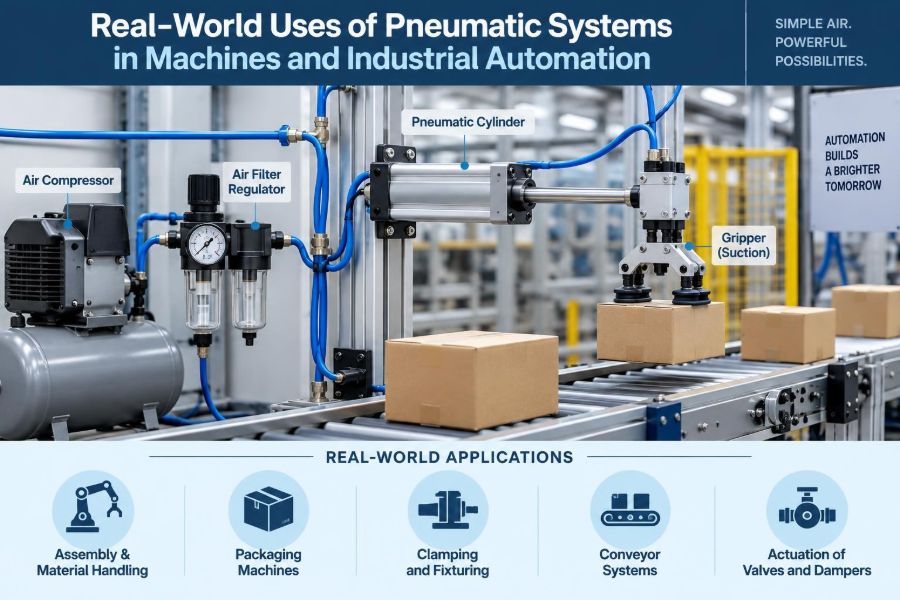

A carton moves along a packaging line, pauses for a fraction of a second, receives a printed label, and continues toward a palletizer. Nearby, a robot gripper lifts a delicate plastic tray without crushing it. At a service garage, an impact wrench removes wheel nuts in seconds. Different workplaces, same invisible helper: compressed air.
Pneumatic systems convert the energy stored in compressed air into controlled motion. Because the equipment can be fast, clean at the point of use, and relatively straightforward to install, it appears in far more machines than many people notice.
For students, pneumatics is a practical bridge between fluid mechanics, machine design, controls, and maintenance. For working professionals, understanding its limits is just as valuable as understanding its strengths: an air cylinder that seems simple can become a source of wasted energy, inconsistent motion, or safety risk when poorly selected.
The most useful question is not whether pneumatic automation is better than every alternative. It is: where does compressed air provide the right combination of force, speed, cleanliness, flexibility, and cost?
💨 Pneumatics: Motion Powered by Compressed Air
A pneumatic system uses pressurized gas—almost always air—to transmit power and control movement. A compressor raises the pressure of ambient air, a distribution network carries it to the machine, and valves direct that air to actuators such as cylinders, grippers, air motors, or vacuum generators.
The basic idea resembles inflating a balloon, but machinery uses regulated pressure and purpose-built components. When air enters one side of a cylinder piston, it creates force and moves a rod; air on the opposite side is exhausted to atmosphere or routed through a muffler.
Unlike hydraulic systems, which generally use a liquid, pneumatic systems work with a compressible fluid. That property shapes both their appeal and their limitations.
🔋 The Energy Chain Behind Every Pneumatic Machine
Compressed air is often called a utility, like electricity or water. The full energy chain starts at the compressor, continues through treatment and piping, and ends at the machine actuator. Each stage affects performance.
A typical arrangement includes a compressor, receiver tank, dryer, filters, main pipework, local shutoff valve, pressure regulator, directional control valve, and actuator. Sensors and a programmable controller may coordinate the movement with conveyors, motors, and safety devices.
Thinking in terms of this entire chain prevents a common mistake: blaming the cylinder when the real problem is pressure loss, dirty air, an undersized valve, or inadequate compressor capacity upstream.
📐 Pressure, Flow, and Force Are Different Quantities
Pressure is force per unit area. In pneumatic work, it is commonly specified in bar, kilopascals, or pounds per square inch. A pressure regulator sets the available pressure at a machine, but pressure alone does not tell us how quickly an actuator can move.
Flow rate describes how much air can pass through a component in a given time. A cylinder may have adequate theoretical force yet extend slowly if the valve, fittings, or tubing restrict airflow.
Cylinder force is approximately pressure multiplied by effective piston area. On rod extension, the effective area is the full piston face; on retraction, the rod occupies part of that area. Real available force is lower than a simple calculation because of friction, pressure drops, seal resistance, and dynamic effects.
🧠 Why Compressed Air Suits Automation
Pneumatic actuators are especially useful for repetitive, short-stroke jobs: push, clamp, lift, index, separate, eject, grip, and stop. They can produce quick motion with compact equipment and respond well to simple on-off valve control.
Air is also suitable where a small leak is less hazardous than an oil leak, such as food handling areas or clean assembly spaces. That does not mean pneumatic equipment is automatically clean; it still needs properly filtered, dry air and materials compatible with the process.
Another advantage is overload tolerance. A stalled cylinder generally does not suffer the same immediate damage risk as an overloaded electric motor or a rigid mechanical transmission, although repeated stalling wastes air and can still damage tooling.
🏭 Factory Assembly and Pick-and-Place Stations
Assembly machines commonly use cylinders to position components, operate stops, clamp a workpiece, and eject finished parts. A simple workstation might use one cylinder to locate a housing and another to press a cover into place while sensors confirm each position.
Pneumatic pick-and-place mechanisms are effective when the part path is simple and the payload is modest. They can move between two or three fixed locations without the cost or programming complexity of a multi-axis robot.
For example, a hypothetical electronics station may use a pneumatic slide to transfer a molded enclosure from a conveyor to a fixture. If product variants increase and positions become more complex, a servo-driven axis may become the better choice.
📦 Packaging Machines and Carton Handling
Packaging is one of the clearest real-world homes for pneumatics. Carton erectors use air cylinders to fold flaps; case packers use them to guide, push, and retain products; labellers use compact cylinders to apply a label at the correct moment.
These tasks often need fast, repeatable motion over a limited distance rather than highly precise continuously variable positioning. Pneumatic stops can separate products on a conveyor, while rodless cylinders can move a lightweight carriage across a wider horizontal span.
Machine designers must still account for changing package mass, line speed, and surface friction. A pusher that works well for empty cartons may require different cushioning or flow control when cartons are full.
🤖 Robot End Effectors and Pneumatic Grippers
Many industrial robots are electrically driven, but their end-of-arm tooling is pneumatic. A robot may use compressed air to open and close parallel grippers, angle grippers, expanding mandrels, or soft fingers.
The attraction is low mass at the wrist. A compact pneumatic gripper can deliver a useful gripping force without adding a large motor and gearbox to the moving arm. Lower tool mass can preserve robot speed and payload capacity.
Gripper design must match the part. Smooth metal parts may need shaped jaws or adequate friction material, while fragile items require controlled force. A gripper’s quoted force should never be treated as the same as guaranteed holding force; part geometry, acceleration, contamination, and jaw alignment all matter.
🫧 Vacuum Handling for Delicate Products
Vacuum cups are often supplied by pneumatic vacuum generators, also called ejectors or Venturi generators. Pressurized air flows through a constriction, creating a low-pressure region that can draw air from a suction cup.
This method is widely used for sheet metal, glass, cardboard, plastic film, pouches, and flat packaged goods. A cup can lift a product without the jaw marks or squeeze force associated with a mechanical gripper.
Vacuum handling is not a universal solution. Porous cardboard, rough surfaces, leaks, and dusty cup seals reduce holding ability. Good systems use vacuum sensing, reserve volume where appropriate, and safe motion planning so a lost grip does not create a hazardous drop.
🚗 Automotive Manufacturing and Service Tools
Automotive plants use pneumatics for fixture clamping, part transfer, dispensing support equipment, and tool operation. Production tooling is often designed for high repetition, so maintainability and rapid replacement of cylinders, valves, and fittings are major practical concerns.
In repair shops, pneumatic impact wrenches, ratchets, grinders, and tire inflators remain common. Air tools can be durable and compact for their output, especially where a workshop already has a compressed-air supply.
However, the hose creates drag and trip hazards, and tool performance depends on the pressure and flow actually available at the tool inlet. A long narrow hose can make a powerful-rated wrench feel weak in use.
🍞 Food, Beverage, and Pharmaceutical Equipment
In process-sensitive industries, compressed air can operate gates, diverters, fillers, cappers, and product-handling devices without placing hydraulic oil close to the product. Pneumatic valves can also automate washdown-compatible equipment when components are selected for the environment.
The key phrase is appropriate air quality. Moisture, oil aerosols, particles, and microorganisms may matter depending on whether air contacts a product, package interior, or only external machine components. Requirements vary by process and site procedures.
Stainless hardware, corrosion-resistant fittings, suitable seals, drainage, and careful placement of exhausts are often as important as the actuator itself. A system designed for a dry assembly room may fail quickly in a humid washdown area.
🧪 Laboratories, Medical Devices, and Clean Motion
Laboratory automation can use miniature cylinders and valves to move sample carriers, open instrument doors, switch fluid paths, or position lightweight components. Pneumatics is attractive where compact linear motion is needed without placing electric motors near a sensitive location.
Medical and laboratory equipment requires special caution. Material compatibility, noise, cleanliness, controllability, and applicable regulations must be considered at the equipment-design level. Compressed air used for a device function may need a defined quality standard rather than ordinary plant air.
Pneumatic logic also has a role in certain specialized environments because it can function without an electrical signal at the point of actuation. That does not remove the need for rigorous validation and risk control.
⛏️ Mining, Construction, and Harsh-Site Tools
Jackhammers, rock drills, chipping hammers, and some material-handling tools demonstrate the rugged side of pneumatics. Air-powered tools can tolerate demanding work and can be practical where an existing compressor supports several tools.
In locations with dust, vibration, moisture, or potentially flammable materials, equipment selection requires a careful hazard assessment. Pneumatic tools do not eliminate every ignition source or safety concern, but they may avoid some electrical hazards at the tool itself.
Noise, vibration exposure, hose management, and compressor fuel or electrical demand remain serious considerations. A robust tool is not automatically a low-risk tool.
🚆 Transport, Doors, and Vehicle Braking
Heavy vehicles have long used compressed air for braking because air systems can store energy in reservoirs and distribute braking commands across a large vehicle. Railway equipment and buses may also use pneumatic actuators for doors, suspension-related functions, horns, and auxiliary mechanisms.
Braking is a safety-critical application, so its design philosophy is very different from a packaging pusher. Redundancy, fail-safe behavior, inspection, drainage of moisture, and regulated maintenance are essential.
This contrast teaches a useful engineering lesson: the same physical medium can serve both simple and high-consequence functions, but the required design assurance depends on what happens when it fails.
🛑 Pneumatic Stops, Gates, and Part Separation
Not every pneumatic application is dramatic. A small stopper cylinder can halt a pallet at a workstation, release one bottle at a time, or direct a component into one of two lanes. These simple devices are foundational in material flow.
Timing matters. If a stop rises too late, a moving pallet can overshoot; if it rises too early, it can create impact and product damage. Sensors, conveyor speed, load mass, and actuator response time should be considered together.
Where a stop may be struck repeatedly, designers should use robust mechanical geometry and suitable shock absorption rather than expecting the cylinder seals alone to absorb every impact.
🧰 Clamping, Pressing, and Holding Workpieces
Pneumatic clamps hold parts during drilling, welding, inspection, adhesive application, and assembly. Toggle clamps with pneumatic actuation are popular because their linkage can create a stable locked geometry near the end of travel.
For pressing, a pneumatic cylinder can be effective for light assembly operations such as seating a cap, fitting a gasket, or staking a small feature. The actual force must be verified across the operating pressure range, not assumed from nominal pressure.
If the process requires tightly controlled force throughout a stroke, precise displacement control, or detailed force-versus-position data, electro-mechanical or hydraulic equipment may be more appropriate. Pneumatic pressing is capable, but it is not naturally a precision force-testing system.
🎨 Paint, Dispensing, and Process Valves
Pneumatic actuators are widely used to open and close process valves. A control signal can switch a solenoid valve, which then pilots a larger pneumatic actuator on a butterfly, ball, diaphragm, or other valve type.
In paint and coating work, air can atomize material or operate triggers and valves. In adhesive and sealant systems, pneumatic control can sequence dispense heads and clamps, although the material itself may be pumped by another method.
These applications depend on repeatable timing and clean operation. Contamination in pilot air or a sticking valve can cause missed shots, poor coating patterns, or unwanted material release.
🧩 The Core Components and Their Jobs
A machine becomes easier to troubleshoot when each component’s role is clear.
| Component | Primary job | Typical concern |
|---|---|---|
| Compressor and receiver | Generate and store compressed air | Capacity, heat, condensate |
| Filter and dryer | Remove particles, water, and sometimes oil | Air-quality suitability |
| Regulator | Set local operating pressure | Pressure drop under demand |
| Directional valve | Route air to and from an actuator | Flow capacity, response, contamination |
| Cylinder or gripper | Convert air pressure into motion | Force, stroke, side load, cushioning |
| Flow control and muffler | Manage speed and exhaust noise | Restriction, clogging, back-pressure |
A failure in one component often changes the behavior of the others. For instance, a clogged muffler can slow cylinder motion by restricting exhaust, even when supply pressure appears normal.
↔️ Choosing the Right Pneumatic Actuator
Rod cylinders are the familiar choice for direct linear motion. Guided cylinders add resistance to side loads and rotation. Rodless cylinders can move a carriage over a long stroke without requiring a long projecting rod.
Rotary actuators provide limited-angle rotation, while air motors provide continuous rotation. Bellows and compact cylinders can suit tight spaces, and grippers are designed specifically to hold parts rather than merely extend a rod.
Selection should begin with the load, required force, stroke, speed, duty cycle, mounting arrangement, and environment. Choosing by bore size alone ignores the side loading and alignment problems that commonly shorten actuator life.
🎛️ Valves, Solenoids, and Control Logic
Directional control valves are described by the number of ports and positions. A common valve for a double-acting cylinder has ports to supply air, exhaust air, and feed each side of the cylinder. Switching the valve reverses motion.
Solenoids allow electrical control of pneumatic valves. A programmable logic controller can read sensors, decide when a sequence condition is met, and energize the valve coil. This combination is central to industrial automation: electrical logic controls fluid power.
Some valves are directly operated, while others use pilot air to shift a larger internal mechanism. Pilot-operated valves can control higher flows with a small electrical signal, but they require adequate pilot pressure and clean air.
🏃 Controlling Speed Without Losing Control
Most cylinders use flow-control valves to regulate speed. A common arrangement restricts exhaust air rather than supply air, called meter-out control. Back pressure on the exhausting side helps resist runaway motion caused by a light load or gravity.
Meter-in control can be useful in particular conditions, but it may allow unstable motion when air compression and changing load interact. The correct method depends on the load direction, friction, and desired behavior.
Speed adjustment should be made with the real tooling and payload installed. A cylinder that moves smoothly with no load can slam at the end of stroke once the fixture configuration changes.
🎯 Position Sensing and Repeatability Limits
Magnetic piston sensors can detect when a cylinder reaches a position. They are practical for confirming fully extended or retracted states, initiating the next sequence step, and detecting some failures to complete a move.
They do not turn a standard cylinder into a high-precision positioning axis. Air compressibility, load changes, seal friction, end cushioning, mechanical play, and pressure variation limit repeatability, especially at intermediate positions.
For a simple example, a cylinder can reliably push a part against a fixed hard stop. It is less suitable for stopping a carriage precisely halfway along its stroke under varying load. Mechanical stops, locking devices, proportional control, or servo axes may be needed.
⚡ Pneumatics Compared with Electric and Hydraulic Drives
Electric actuators excel at programmable position, speed, and torque control. They are often preferred for flexible automation, long travel, and traceable precision motion. Pneumatics tends to win where motion is simple, fast, and repetitive.
Hydraulics can produce very high forces with compact cylinders because liquids are far less compressible than air. They are often used for heavy presses and mobile equipment, but fluid leakage, maintenance, and power-unit complexity can be disadvantages.
- Choose pneumatic for short strokes, simple end positions, quick clamping, light handling, and air-tool applications.
- Choose electric for controlled profiles, variable positions, coordinated axes, and data-rich processes.
- Choose hydraulic where very high force and stiff load control are central requirements.
Hybrid machines are common. A servo robot may carry a pneumatic gripper, while an electrically driven conveyor presents parts to pneumatic stops and clamps.
📉 The Hidden Cost of Leaks and Pressure Loss
Compressed air is convenient at the machine, but generating it requires energy. Leaks through fittings, worn tubing, damaged seals, and open blow-off lines make the compressor work harder without producing useful motion.
Pressure loss also changes machine behavior. A cylinder may fail to produce enough force during peak demand, or a vacuum ejector may lose gripping performance when several neighboring machines cycle at once.
Leak detection should be part of ordinary maintenance, not a once-only campaign. Listening for leaks can find obvious faults, while systematic inspection during quiet periods can reveal persistent losses that operators have learned to ignore.
💧 Air Preparation: Water, Oil, and Particles
Atmospheric air contains water vapor and airborne contaminants. Compression concentrates the practical consequences: as air cools, water can condense in receivers, pipes, and filters. Compressor lubricants may also introduce oil aerosols depending on compressor type and system design.
Water can corrode components, wash away lubrication, freeze in cold conditions, and cause sticky valve behavior. Particles can damage seals and obstruct small passages. Filtration and drying should be selected according to the point-of-use requirement.
Over-filtering without maintenance is not a solution. A neglected filter element creates pressure drop. Drains must function, and filters, dryers, and lubricators—where lubrication is appropriate—need a documented service plan.
🔇 Noise, Exhaust, and Worker Comfort
Exhausting air can be loud, especially from fast cylinders, blow guns, vacuum generators, and air motors. Mufflers reduce noise, but they must be sized and maintained so they do not create excessive exhaust restriction.
Air jets can also stir dust, move small debris, and create uncomfortable drafts. Using open compressed-air blow-off for routine cleaning is often inefficient and may expose people to flying particles.
Better designs may use engineered nozzles, guarded cleaning stations, low-noise exhaust components, or mechanical alternatives such as brushes and vacuum extraction. The best choice depends on the material, contamination risk, and task.
🦺 Safety Design and Stored-Energy Hazards
Compressed air stores energy. Before maintenance, technicians need a controlled way to isolate supply air, vent downstream pressure, and prevent unexpected machine movement. Simply switching off electrical control does not necessarily remove pneumatic energy.
Designers should consider what a cylinder, gripper, or vertical load does when pressure is lost. Depending on the hazard, a system may need mechanical locking, load-holding devices, controlled exhaust, guards, or a defined safe position.
Never use compressed air to clean clothing or direct it toward a person. Air injection injuries and eye injuries are serious risks. Safe practice includes proper fittings, secured hoses, rated components, and procedures aligned with the machine’s risk assessment.
🔧 Installation Details That Determine Reliability
Good pneumatic design is physical as well as schematic. Tubing should be cut squarely, routed away from sharp edges and hot surfaces, and supported to prevent rubbing. Fittings must match tube material, outside diameter, and operating conditions.
Cylinder rods should be aligned with the load. Side loading can bend rods, wear bearings, increase friction, and damage seals. When a moving fixture cannot stay aligned, use guide rails or a guided actuator rather than asking a basic cylinder to act as both drive and structural support.
Place regulators and valves near high-demand actuators when practical. Long small-diameter lines act like restrictions and can make a fast cylinder unpredictable.
🛠️ Troubleshooting Slow, Jerky, or Weak Motion
A cylinder that behaves poorly is usually giving useful clues. Slow extension may result from restricted supply flow, clogged exhaust, low regulator setting, leakage, an undersized valve, or excessive mechanical resistance. Jerky movement can point to stick-slip friction, poor alignment, dry seals, or unstable flow control.
A practical troubleshooting sequence is:
- Make the machine safe and confirm the intended sequence.
- Check supply pressure at the machine while the actuator is moving.
- Inspect tubing, fittings, valves, mufflers, and visible leaks.
- Check mechanical alignment, load condition, and external interference.
- Verify sensor signals and valve command signals before replacing parts.
Replacing a cylinder first may restore operation temporarily, but it can hide an upstream restriction or fixture misalignment that will damage the replacement.
📋 Sizing a Cylinder for a Real Task
Start with the required process force, then include friction, load direction, acceleration, variation in supply pressure, and a sensible engineering margin. A vertical lift requires enough force to overcome weight as well as friction; a horizontal slide may need more force during breakaway than during steady travel.
Next, check stroke length, mounting, rod buckling risk for long strokes, speed, end cushioning, and expected cycles. Faster movement consumes air more quickly and can create greater impact energy at the end of travel.
Do not forget retraction force. Because the rod reduces the pressurized area, a double-acting cylinder has less retracting force than extending force at the same pressure. This matters when the return stroke performs real work.
🌱 Designing for Efficient Compressed-Air Use
Efficiency starts by using air only where its strengths matter. A continuously blowing nozzle or an oversized vacuum generator may be convenient, but it can consume far more air than a brief cylinder stroke.
Useful design practices include reducing unnecessary operating pressure, minimizing leaks, using appropriately sized tubing and valves, shutting off idle equipment, and selecting vacuum cups and generators for the real leakage condition rather than oversizing by habit.
Energy optimization must not compromise process reliability or safety. Lowering pressure is beneficial only if the actuator still has adequate force during worst-case operating conditions.
🔄 Preventive Maintenance and Condition Checks
Preventive maintenance should cover the air supply as well as the visible machine actuators. Drain management, filter inspection, dryer performance, compressor service, leak checks, and regulator verification all influence production reliability.
At the machine level, inspect rods for damage, listen for leaks, check sensor mounting, observe cycle time, and look for worn tubing. A change in sound or motion is often an early warning before a complete failure.
Maintenance records are especially useful for recurring issues. If one valve repeatedly sticks or one cylinder seal fails early, investigate contamination, side load, temperature, or switching frequency instead of treating each replacement as an isolated event.
🧭 A Practical Selection Checklist
Before committing to pneumatic automation, ask questions that connect the application to the technology rather than choosing based on familiarity.
- Is the required motion mainly between fixed end positions?
- What force is needed at the lowest expected operating pressure?
- Will the load create side force, rotation, or a falling hazard?
- What air quality does the process and component design require?
- How much precision, speed control, and motion data are actually needed?
- What happens during a pressure loss, hose failure, or controller fault?
- Can the equipment be maintained safely and economically over its full duty cycle?
Clear answers often reveal whether a simple cylinder is ideal, whether guided pneumatic hardware is needed, or whether electric or hydraulic motion is the better engineering decision.
🌟 The Core Takeaway: Match the Tool to the Motion
Pneumatic systems remain deeply useful because industrial machines need countless quick, repeatable physical actions: hold this part, move that carton, separate one item, lift a sheet, open a gate, or operate a tool. Compressed air handles many of those actions with compact, durable equipment and straightforward control.
Its limitations are equally real. Air compressibility limits precision, poor air quality shortens component life, leaks consume energy, and stored pressure demands thoughtful safety design. The strongest pneumatic systems are not merely those with large cylinders or high pressure; they are systems in which force, flow, mechanics, controls, air treatment, and safety all fit the task.
Use pneumatics where simple, rapid, robust motion is needed—and engineer the entire air system, not just the actuator. That approach turns compressed air from a convenient utility into reliable, efficient machine automation. ⚙️💨🛠️