
A heavy sofa has to move up one flight of stairs. A bicycle chain turns a small force at the pedals into motion at the wheel. A construction crane raises tonnes of material while its operator applies a controlled input. These are ordinary scenes, but each depends on an idea people learned thousands of years ago: work can be redirected, multiplied, and managed.
Mechanical engineering did not begin with computer-aided design, turbines, or factory robots. It began when people noticed patterns in force and motion, then shaped wood, stone, rope, and metal to use those patterns reliably.
That long history matters because modern machines still obey the same physical rules. A gearbox, hydraulic excavator, and automated production line may look far removed from a lever or ramp, but their core purpose is familiar: make useful work possible with available energy.
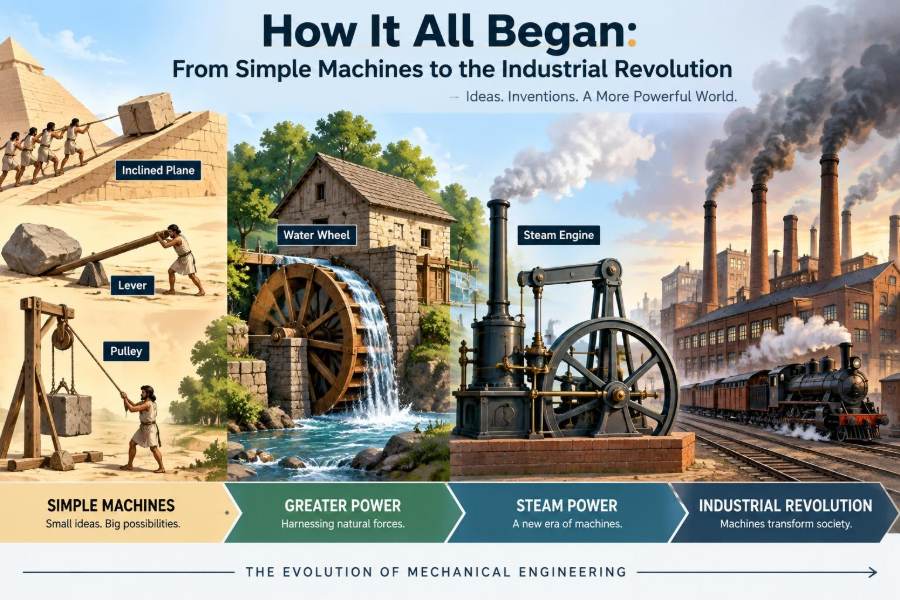
Following this path from simple machines to the Industrial Revolution reveals more than a timeline of inventions. It shows how materials, power sources, measurement, manufacturing, and human needs gradually came together to create mechanical engineering as a profession.
🧭 Mechanical Engineering Begins with Useful Work
In physics, work occurs when a force causes movement in the force’s direction. Pushing a loaded cart, lifting a bucket, or turning a drill all involve work. Mechanical engineering is largely concerned with controlling these actions safely, efficiently, and repeatedly.
Early builders did not use modern equations, yet they understood practical relationships: a longer handle made lifting easier, a smoother surface reduced resistance, and a stronger material allowed a larger load. Observation came first; formal theory followed much later.
🪨 The Challenge of Moving Heavy Things
Before engines, most useful power came from human muscles, animals, wind, and flowing water. Each source was limited, variable, or difficult to apply directly. Moving large stones, irrigating fields, and transporting goods therefore demanded clever arrangements rather than simply more effort.
A machine does not create energy from nothing. Instead, it changes the size, direction, distance, or speed of an applied force. This trade-off is the foundation of mechanical advantage.
⚖️ The Lever: A Force Multiplier
A lever is a rigid bar that rotates around a support point called a fulcrum. Place the fulcrum close to a load and apply force farther away, and a smaller input force can lift a larger load.
A crowbar under a stuck stone is a simple example. The person using it moves the long end through a greater distance, while the stone moves only a short distance. The reduced force requirement is exchanged for more input travel.
🛞 The Wheel and Axle: Turning Force into Motion
The wheel and axle combines a large rotating wheel with a smaller shaft. Turning the larger radius can provide torque, the rotational equivalent of force, at the axle. A well crank is a familiar example.
Wheeled transport also reduced sliding friction. Rolling is not friction-free, but it generally requires far less force than dragging a load across rough ground. This change made trade, agriculture, and construction more practical over distance.
🧱 The Inclined Plane: Trading Force for Distance
An inclined plane, or ramp, makes lifting easier by spreading a vertical rise over a longer path. A loading ramp does not eliminate the energy needed to raise a crate, but it reduces the force needed at any moment.
Its limitation is equally instructive: friction can consume much of the advantage. A steep, rough ramp may demand substantial effort, while a longer and smoother ramp can be easier to use but needs more space. Engineers always work within such constraints.
🪓 The Wedge: Directing Force Sideways
A wedge is essentially two inclined planes joined together. A blade, axe head, chisel, and splitting tool use a force applied along one direction to produce forces that push material apart sideways.
The wedge demonstrates why material choice matters. A sharp edge concentrates stress over a small area, helping it cut or split. But an edge that is too thin for its material or use can chip, bend, or wear quickly.
🌀 The Screw: Rotation Becomes Linear Motion
A screw wraps an inclined plane around a cylinder. Each turn advances it a small distance, allowing rotational motion to produce controlled linear movement. Fasteners, presses, vices, and lifting jacks all use this principle.
A finer thread can generate high mechanical advantage, but it advances more slowly. Thread friction also matters: it helps many fasteners stay in place, yet it means not all turning effort becomes useful clamping force.
🪢 The Pulley: Changing Direction and Sharing Load
A single fixed pulley mainly changes the direction of a pull, allowing someone to pull downward to lift a load upward. Multiple pulleys arranged in a block-and-tackle system can reduce the force required by sharing the load across several rope sections.
The price is a longer pull and losses from rope bending and pulley friction. Real systems are less efficient than ideal textbook diagrams, which is why rope condition, alignment, and safe working limits matter in lifting practice.
📐 The Six Simple Machines as a Useful Framework
Levers, wheel-and-axle systems, inclined planes, wedges, screws, and pulleys are traditionally called the six simple machines. They are not a complete catalogue of all mechanisms, but they remain a useful way to recognize basic force transformations.
| Simple machine | Typical function | Everyday example |
|---|---|---|
| Lever | Multiplies or redirects force | Crowbar |
| Wheel and axle | Converts torque and rotation | Door handle |
| Inclined plane | Reduces lifting force | Loading ramp |
| Wedge | Splits or cuts material | Chisel |
| Screw | Converts rotation to advance | Bench vice |
| Pulley | Guides force or shares load | Hoist |
🔗 Combining Simple Machines into Mechanisms
Complex machines are usually combinations of simpler elements. A bicycle includes levers in the brake handles, wheel-and-axle motion, chain-and-sprocket transmission, bearings, and fasteners. A crane combines pulleys, drums, gears, structural members, and control systems.
This is a central engineering habit: break a system into functions. How is energy supplied? How is motion transmitted? Where is the load supported? What prevents failure? Answering these questions turns a complicated object into manageable design problems.
🏛️ Ancient Engineering Was More Than Simple Tools
Ancient societies developed sophisticated construction, water management, mining, and transport systems. Large buildings and public works required organized labor, surveying, lifting methods, material knowledge, and repeatable processes.
Surviving structures should not be treated as evidence of effortless construction. They represent careful planning and enormous human effort, often carried out under social arrangements very different from modern engineering workplaces. Their achievement was practical coordination as much as mechanical ingenuity.
💧 Water Wheels Introduced Continuous Power
Water wheels were a major step because flowing water could provide motion for long periods without continuous human or animal effort. Depending on the arrangement, water could strike paddles, flow beneath a wheel, or descend onto it to create rotation.
That rotation could drive millstones, hammers, pumps, or other equipment through shafts and gears. Water power was location-dependent, however: a mill needed a dependable flow, suitable head of water, and a structure able to survive changing conditions.
🌬️ Windmills Expanded Where Work Could Be Done
Windmills similarly converted a natural energy flow into shaft rotation. They ground grain, pumped water, and supported drainage in regions where wind conditions and geography made them useful.
Wind is intermittent and changes direction, so mill design had to include ways to orient sails, regulate speed, and avoid damage in severe weather. This is an early example of a problem still familiar in renewable-energy engineering: useful natural resources are not always steady or located where demand is greatest.
⚙️ Gears Made Motion More Controllable
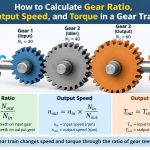
Gears transmit rotation between shafts while changing speed, direction, or torque. When a small gear drives a larger one, the output typically turns more slowly but with greater torque. Reversing the arrangement increases speed while reducing available torque.
Accurate gears require controlled tooth shapes, spacing, and alignment. Poorly made or badly mounted gears can bind, wear rapidly, vibrate, or fail to transfer power smoothly. Their development encouraged better metalworking and more precise manufacturing.
🔧 Cams, Cranks, and the Language of Motion
A crank converts rotary motion into back-and-forth motion, as seen in pedals driving a bicycle wheel or a piston driving a crankshaft. A cam uses a shaped rotating profile to produce a planned pattern of motion in a follower.
These mechanisms made machines capable of timed, repeated sequences. Once motion could be programmed mechanically by shape and geometry, equipment could perform specialized work such as pumping, hammering, or operating valves with less direct human control.
🏗️ Materials Set the Limits of Machines
Wood was accessible and useful but could rot, split, or change shape with moisture. Stone carried compressive loads well but was weak in tension. Metals offered new possibilities for tools, fasteners, shafts, and load-bearing parts.
Material selection remains a balance rather than a search for a universally “best” substance. Engineers consider strength, stiffness, toughness, wear resistance, weight, cost, corrosion behavior, manufacturability, and the consequences of failure.
🔥 Iron, Heat, and Better Metalworking
As ironworking advanced, stronger and more durable components became possible. Forging, casting, machining, and heat treatment allowed makers to shape metal for different purposes. A tool edge, a structural member, and a rotating shaft need different combinations of properties.
Early production was inconsistent by modern standards. Variations in composition, hidden voids, and uneven heating could produce unreliable parts. Learning to control materials was therefore as important as inventing new machine layouts.
📏 Measurement Turned Craft into Repeatable Production
A skilled craftsperson can fit one part to another by hand. Factories need something more scalable: components made in different places or at different times must fit predictably. That requires agreed dimensions, measuring tools, gauges, and controlled processes.
Interchangeability does not mean every part is identical in an absolute sense. It means variation is kept within a specified tolerance, allowing intended assembly and function. This principle later transformed maintenance, manufacturing, and design practice.
🧪 From Rules of Thumb to Engineering Science
For centuries, builders relied heavily on accumulated experience. That knowledge was valuable, but scientific investigation gradually supplied mathematical tools for analyzing forces, motion, fluids, heat, and material behavior.
Mechanics made it possible to predict, rather than only test, how loads and movement interacted. Predictions still require good assumptions and reliable data. A calculation is powerful, but it cannot rescue an unrealistic model or poorly understood operating conditions.
🌡️ Heat Became a Source of Mechanical Power
The crucial shift toward industrialization came when heat was used to produce sustained mechanical motion. Steam engines used heated water to create steam, whose pressure could act on a piston or other moving component.
The basic concept was not enough by itself. Practical engines required boilers, valves, cylinders, seals, condensers in some designs, and structures able to withstand heat and pressure. They also required fuel, water, maintenance, and trained operators.
🚂 Why the Steam Engine Changed Production
Water wheels tied factories to suitable waterways, while steam engines could be installed in many locations if fuel and water could be supplied. They could also provide more controllable power for mines, mills, workshops, and eventually transport.
Early engines were often inefficient by modern expectations, and their benefits came with significant fuel use and safety hazards. Yet their ability to deliver continuous mechanical power at a larger scale changed how work could be organized.
⛏️ Mining, Pumping, and the Demand for Engines
Deep mines faced persistent flooding. Pumping water out was laborious, and water-powered solutions were not always available where needed. Steam pumping engines addressed a specific and costly problem, helping mining operations reach deeper deposits in some regions.
This relationship was circular: mines supplied fuel for engines, and engines helped mines operate. Industrial change rarely comes from one invention acting alone; it develops through connected needs, resources, skills, and infrastructure.
🏭 The Factory System Reorganized Work
Large machines encouraged the concentration of workers and equipment in factories. Centralized power transmission, often through line shafts and belts, could drive many machines from one engine or water wheel.
Factories increased output and enabled closer supervision of processes, but they also imposed schedules, repetitive work, noise, dust, and serious injury risks. Industrial growth brought technical progress alongside difficult social and workplace conditions; both belong in an honest account.
🧵 Textiles Show How Mechanization Spreads
Textile production became a prominent area of mechanization because spinning and weaving involved repeatable motions that machines could assist or perform. Improvements in one stage created pressure to improve connected stages, from fiber preparation to finishing and transport.
This illustrates a common engineering pattern: a faster subsystem can expose the next bottleneck. Increasing spindle speed matters less if material supply, maintenance, quality inspection, or packaging cannot keep pace.
🚆 Railways Connected Machines, Markets, and Materials
Steam locomotives combined boilers, engines, wheels, valves, bearings, frames, and track into a transportation system. Railways moved raw materials, manufactured goods, and people more rapidly and predictably than many earlier land routes.
But a railway was never only a locomotive. It depended on surveying, bridges, tunnels, signaling, track maintenance, stations, finance, labor, and operating rules. Major technologies succeed when the surrounding system is designed as carefully as the machine itself.
🛡️ Safety Lessons Were Written into Design
Rotating shafts, exposed belts, boilers, lifting equipment, and crowded workshops created hazards. Failures could result from weak materials, poor maintenance, inadequate guarding, operator error, excessive pressure, or designs that did not account for realistic use.
Modern safety engineering uses layers of protection: sound design, inspection, pressure relief where appropriate, guards, procedures, training, and maintenance. No single measure is sufficient in every situation. Safety improves when hazards are anticipated rather than addressed only after an accident.
🌍 Industrialization Had Environmental Costs
Coal-powered industry increased smoke, waste, and demand for extracted resources. Dense industrial areas often experienced degraded air and water, while rapid urban growth placed new pressure on housing and sanitation.
Mechanical engineering is therefore not only about making machines perform. It also involves evaluating lifecycle effects: where materials come from, how energy is used, what emissions or waste occur, how long equipment lasts, and what happens at end of life.
🧑🏭 The Rise of the Mechanical Engineer
As machines became larger and more interconnected, specialist knowledge became increasingly valuable. The mechanical engineer emerged as someone who could unite practical workshop experience with analysis of structures, mechanisms, heat, power, and production.
The profession did not replace skilled trades. It depends on them. Effective engineering still requires communication between designers, machinists, technicians, operators, maintenance teams, and those affected by a machine’s operation.
🖥️ What Modern Engineers Still Inherit
Digital tools can simulate stress, optimize a mechanism, and control complex equipment, but they do not repeal basic mechanics. Torque, friction, fatigue, heat transfer, vibration, and material limits remain present whether a device is hand-operated or software-controlled.
A useful modern habit is to ask simple-machine questions first: Where does the energy enter? Which parts carry force? What motion is needed? Where are losses occurring? These questions often expose design issues before a detailed model is built.
🧠 Common Misconceptions About Machines
One misconception is that mechanical advantage gives “free” force. It does not. A machine can reduce the input force, but usually requires a longer distance, more time, or both. Friction and deformation mean real machines also lose energy.
Another is that industrialization was caused by one heroic invention. The historical reality is more connected: materials, science, capital, workers, fuel, transport, machine tools, and institutions all shaped what became possible.
🧰 A Practical Way to Study Mechanical History
When examining an old or modern machine, trace the flow of energy from source to output. Identify the supporting structure, moving links, bearings, transmission elements, controls, and likely failure points. Sketching these relationships is often more instructive than memorizing dates.
- Find the energy source: muscle, water, wind, steam, electricity, or fuel.
- Identify the mechanism that changes motion or force.
- Look for losses from friction, heat, noise, vibration, or leakage.
- Ask what material and manufacturing limits shaped the design.
- Consider who operates, maintains, and is exposed to the machine.
✨ The Core Principle: Progress Comes from Controlled Energy
From a wedge splitting wood to a steam engine turning a factory shaft, the recurring goal is controlled energy conversion. Machines guide available energy into a useful form of motion while managing force, time, precision, reliability, and risk.
The Industrial Revolution was not a sudden break from simple machines. It was their expansion through better materials, more reliable power, scientific understanding, precision production, and systems large enough to reshape daily life.
Mechanical engineering began with the practical question of how to do more useful work, and it continues by answering that question with greater care for efficiency, safety, people, and the planet. ⚙️🛠️🌍