
A production line is running smoothly until a conveyor bearing begins to overheat. Nothing has stopped yet. The motor still turns, parts still move, and the shift schedule appears safe.
Then the bearing seizes. The conveyor stops, downstream stations starve for material, maintenance staff scramble for a replacement, and a small defect becomes a plant-wide disruption.
For decades, manufacturers largely responded to this situation in one of two ways: repair equipment after it failed, or replace parts on a calendar. Predictive maintenance offers a third option: use evidence from the machine to intervene when its condition actually calls for it.
That change matters because modern manufacturing depends on tightly connected equipment, skilled labor, reliable delivery, and controlled quality. Predictive maintenance is not a magic warning system, but when designed well, it turns machine condition into better maintenance decisions.
🔍 What Predictive Maintenance Means
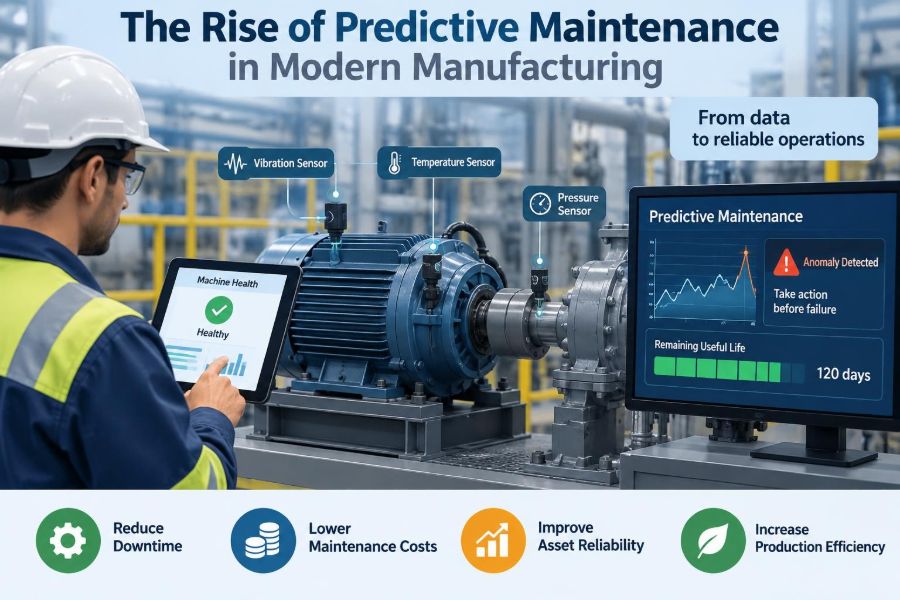
Predictive maintenance, often shortened to PdM, is a maintenance strategy that uses condition data to estimate when equipment may need attention. The objective is to detect developing faults early enough to plan a repair before functional failure occurs.
It is different from merely collecting sensor readings. A temperature value, vibration spectrum, oil sample, or controller alarm becomes useful only when it is interpreted against normal behavior, operating conditions, and a practical maintenance decision.
🧰 The Three Basic Maintenance Strategies
Most plants use a mix of reactive, preventive, and predictive work. The appropriate choice depends on safety consequences, repair cost, failure mode, available redundancy, and how easily the asset can be monitored.
| Strategy | Trigger for action | Best suited to |
|---|---|---|
| Reactive maintenance | Failure has occurred | Low-cost, noncritical, easily replaced items |
| Preventive maintenance | Time, cycles, or usage interval | Wear items with known service intervals |
| Predictive maintenance | Measured condition or fault indicator | Critical assets with detectable deterioration |
Reactive maintenance is not always careless. Replacing a cheap light fitting after it burns out can be sensible. Predictive methods become more compelling when unplanned failure has large safety, quality, environmental, or production consequences.
⚙️ Why Modern Factories Need Earlier Warnings
Manufacturing systems have become more automated and interconnected. A fault in one motor, gearbox, pump, robot, or utility system can interrupt equipment that is physically far away but operationally dependent on it.
Shorter production runs and just-in-time material flow also reduce the cushion available to absorb breakdowns. An early warning gives planners time to align labor, spare parts, permits, and a suitable production window.
📉 The Hidden Cost of Unplanned Downtime
The cost of a breakdown is rarely limited to the failed component. It can include lost throughput, overtime, expedited shipping, scrapped work-in-process, restart losses, and missed customer commitments.
There is also a human cost. Emergency repairs often happen under time pressure, sometimes in awkward locations or during shutdown conditions. Planning work from a credible condition alert can make the job safer and more controlled.
🩺 Machines Have Detectable Symptoms
Many mechanical failures develop through a period of detectable degradation. A rolling-element bearing may first show a subtle vibration pattern, later generate heat and noise, then progress to damage severe enough to affect shaft motion.
This interval is sometimes described with the P-F interval: the time between a potential failure being detectable and functional failure occurring. Its length varies widely with the defect, load, speed, environment, and measurement method.
📡 Sensors Are the Data Source, Not the Solution
Sensors can measure vibration, temperature, pressure, current, speed, position, acoustic emissions, humidity, or other signals. Industrial control systems may already contain useful process data, such as flow rate, valve position, cycle time, and motor load.
Adding sensors without a decision process creates more data rather than more reliability. Before installation, a team should ask: what failure mode is being targeted, what signal should change, and what action will follow an alert?
📳 Vibration Analysis for Rotating Equipment
Vibration analysis is widely used for motors, pumps, fans, compressors, gearboxes, and machine-tool spindles. Accelerometers measure motion, while analysis software examines signal amplitude and frequency content.
Specific frequency patterns can be associated with conditions such as imbalance, misalignment, looseness, gear damage, or bearing defects. Interpretation requires care: the same overall vibration level can have different meanings on different machines.
🎵 Why Frequency Matters
A machine does not vibrate at one single frequency. Shaft rotational speed, gear mesh frequency, and bearing defect frequencies can all appear in a spectrum. Looking at frequency content helps separate possible causes that a single overall value would obscure.
🌡️ Temperature and Thermal Monitoring
Excess temperature can indicate friction, inadequate lubrication, electrical resistance, poor cooling, blocked flow, or process overload. Thermocouples, resistance temperature detectors, and infrared inspections are common monitoring tools.
Heat alone is not a diagnosis. A gearbox may run warmer because ambient temperature rose or because production rate increased. The most useful comparison is often against the asset’s own baseline under similar operating conditions.
🛢️ Oil Analysis Reveals Internal Wear
Lubricating oil carries evidence from inside gearboxes, hydraulic systems, compressors, and engines. Laboratory analysis can examine viscosity, contamination, water content, oxidation indicators, additive condition, and wear debris.
Particle type and concentration may help identify abnormal wear, but sampling quality matters greatly. A sample drawn from a stagnant location or contaminated container can produce misleading conclusions.
🔌 Electrical Signatures Can Expose Mechanical Problems
Motor current, voltage, power factor, and electrical waveform data can reveal conditions affecting motors and their driven loads. Changes may be linked to overload, rotor issues, poor supply conditions, or altered mechanical resistance.
Motor current signature analysis is particularly useful where installing a vibration sensor is difficult. Still, electrical data should be interpreted alongside process demand; a pump drawing more current may simply be moving more fluid.
👂 Ultrasound Finds What Humans Cannot Hear
Ultrasound instruments detect high-frequency sound beyond normal human hearing. They can help identify compressed-air leaks, early bearing lubrication issues, steam trap problems, and some forms of electrical discharge.
A technician uses the instrument to convert ultrasonic energy into an audible or recorded signal. Trend data and consistent inspection technique matter more than a single listening result.
📷 Visual Inspection Still Has a Place
Predictive maintenance does not eliminate basic observation. Leaks, corrosion, loose fasteners, damaged guards, abnormal belt tracking, discoloration, and debris often provide important clues before sophisticated analytics are needed.
Thermal cameras and machine-vision systems can extend visual inspection, especially in inaccessible or hazardous areas. But a well-trained operator walking the line remains one of the most valuable sensing systems in a factory.
🧠 From Raw Signals to Useful Information
Raw data must be cleaned, time-stamped, associated with the correct asset, and placed in operating context. A signal gathered while a machine is stopped should not be compared directly with one collected at full production speed.
Good condition monitoring usually begins with a baseline: measurements taken when the machine is known to be healthy. Trends away from that baseline are often more informative than universal alarm values.
📈 Trend Monitoring Beats One-Off Readings
A single high reading may result from a transient load, a loose sensor, or a changed operating state. Repeated measurements show direction, rate of change, and whether the condition is stable, improving, or deteriorating.
For example, a gradual rise in bearing vibration across several comparable inspections deserves more attention than one isolated spike. Trend-based thinking also helps teams avoid replacing components merely because they are old.
🤖 Where Machine Learning Fits
Machine learning can identify complex patterns, classify operating states, and flag behavior that differs from historical norms. It can be useful when data volumes are large or when relationships between many variables are difficult to model manually.
However, an algorithm does not remove the need for engineering judgment. If training data represent only normal operation, a model may recognize unusual behavior without reliably identifying its cause. Explainable alerts and human review remain essential.
🧪 Failure Modes Must Come First
The most reliable PdM programs start with a failure-mode review, often informed by failure modes and effects analysis. Teams identify how an asset can fail, what consequences matter, whether deterioration is detectable, and which monitoring method is appropriate.
Monitoring every available parameter is rarely economical. A low-risk component may justify run-to-failure, while a critical pump may warrant vibration, temperature, process, and lubrication checks.
🏷️ Criticality Determines Where to Start
Asset criticality ranks equipment by the consequences of its failure. A machine may be critical because it creates a safety hazard, limits total plant output, affects product quality, has a long replacement lead time, or lacks backup capacity.
Starting with a small group of high-criticality assets creates a manageable pilot. It also makes it easier to learn which alerts are valuable before expanding across hundreds or thousands of tags.
🔄 Connecting PdM to the Maintenance Workflow
An alert is only the beginning. Someone must review it, assess severity, create a work request, plan the job, reserve parts, schedule downtime, execute the repair, and verify that the condition improved.
This connection commonly happens through a computerized maintenance management system, or CMMS. If condition alerts remain in a separate dashboard, valuable warnings can be overlooked or never translated into work.
🗂️ Data Quality Is an Engineering Problem
Incorrect asset names, missing failure codes, uncalibrated sensors, inconsistent units, and undocumented repairs weaken analysis. A system cannot make reliable comparisons if the data do not identify what was measured and under what conditions.
Useful foundations include a consistent asset hierarchy, clear measurement routes, defined sensor locations, and work-order records that describe the actual failure mechanism rather than only “repaired” or “adjusted.”
🧑🔧 Operators and Technicians Make the System Work
Reliability engineers may design the program, but operators and maintenance technicians see the equipment every day. Their observations can validate an alert, reveal changes in operation, and prevent remote analysts from misreading a signal.
Training should explain both the technology and the reason behind it. People are more likely to record observations carefully when they understand how those observations affect planned work and plant reliability.
🏭 A Hypothetical Pump Example
Consider a process pump whose vibration trend rises slowly near a bearing-related frequency while discharge flow remains normal. A condition analyst reviews the data, checks whether the pump’s operating point changed, and recommends an inspection during the next planned outage.
During that outage, the team finds early bearing damage and corrects a contributing alignment issue. This is a hypothetical example, but it illustrates the intended sequence: detect, validate, plan, repair, and confirm rather than reacting after a seizure.
✅ Benefits Beyond Avoiding Breakdowns
When used appropriately, predictive maintenance can improve maintenance scheduling, spare-parts planning, repair quality, and understanding of chronic equipment problems. It may also reduce unnecessary intrusive work on assets that remain healthy.
Avoiding premature disassembly matters because maintenance itself can introduce errors. Incorrect fits, contamination, poor alignment, or incomplete reassembly can create failures that were not present before the intervention.
⚠️ Limits and Situations Where PdM Fails
Not every failure gives a useful warning. Sudden electrical faults, accidental damage, some control-system faults, and certain random failures may occur too quickly or leave no practical measurable signature.
PdM also cannot compensate for poor machine design, inadequate installation, bad lubrication practices, or absent operating discipline. It should sit within a broader reliability program that includes precision maintenance and root-cause problem solving.
🚨 False Alarms and Missed Faults
A false positive sends a team to investigate a problem that is not serious; a false negative misses a developing problem. Both erode confidence, though their consequences differ according to asset criticality.
Alarm thresholds should be reviewed using actual inspection and repair outcomes. Excessively sensitive thresholds create alert fatigue, while thresholds set too high can delay action until little planning time remains.
🔐 Cybersecurity and Data Ownership
Connected sensors, edge devices, cloud platforms, and remote access can expand the attack surface of industrial systems. Technology choices should be reviewed with operational technology and cybersecurity teams, not added informally to production networks.
Access control, network segmentation, patching procedures, backup plans, and clear ownership of data are practical concerns. The goal is to gain visibility without compromising availability or safety.
💰 Building a Sensible Business Case
A credible business case compares program costs with avoidable consequences, not with an unrealistic promise to eliminate all failures. Costs include sensors, installation, software, training, analysis time, integration, calibration, and ongoing program management.
Benefits may include avoided unplanned downtime, fewer secondary damages, better spare-parts decisions, and reduced emergency labor. Assumptions should be documented and revisited after pilot results are known.
🪜 Starting Small and Scaling Carefully
Begin with a defined production area or a handful of critical, failure-prone assets. Establish baseline data, assign alert ownership, document response rules, and track whether alerts led to verified findings or useful maintenance actions.
- Select assets using criticality and known failure history.
- Choose monitoring methods that match specific failure modes.
- Integrate alerts into existing work management.
- Review outcomes and refine thresholds, routes, and procedures.
- Expand only after the workflow is producing trusted results.
📏 Measuring Program Performance
Counting sensor installations or dashboard alerts does not measure reliability improvement. Better measures connect the program to outcomes, such as condition findings confirmed during inspection, lead time between detection and repair, and repeat failures after corrective work.
Metrics need interpretation. A rise in identified defects may mean equipment is worsening, but it may also mean the team has become better at detecting existing conditions. Context prevents misleading conclusions.
🔧 Precision Maintenance Closes the Loop
Finding a defect is not enough if the repair recreates its cause. Shaft alignment, balancing, proper bearing installation, torque control, contamination exclusion, lubrication selection, and correct commissioning all influence future machine condition.
Condition data after the repair provide feedback. If vibration remains elevated after alignment work, the team should investigate rather than closing the job simply because the scheduled task was completed.
🌱 Energy, Quality, and Sustainability Connections
Mechanical problems can waste energy. Misalignment, excessive friction, blocked filters, compressed-air leaks, and poor lubrication may require more input energy for the same useful output.
Equipment condition can also affect quality. Unstable motion, worn tooling, pressure variation, or temperature-control faults may create defects before they cause a visible breakdown. These links make maintenance a production partner rather than a separate support function.
🎓 Skills for the Next Generation of Engineers
Mechanical engineers working with PdM benefit from both physical understanding and data literacy. They need to recognize mechanisms such as fatigue, wear, resonance, lubrication breakdown, and thermal distortion while also questioning sensor placement, signal quality, and model assumptions.
The strongest practitioners communicate across disciplines. They can discuss a vibration spectrum with a technician, a process change with an operator, a data pipeline with an analyst, and a shutdown plan with production leadership.
🧭 The Core Principle of Predictive Maintenance
Predictive maintenance is best understood as a decision discipline, not a collection of sensors or artificial-intelligence tools. It asks what can fail, what evidence appears before failure, how much warning is needed, and what action should follow.
The most effective programs combine condition monitoring with criticality analysis, skilled people, sound repair practices, and a work process that converts evidence into timely action. Technology supports that system; it does not replace it.
The real value of predictive maintenance is not predicting every failure, but making better maintenance decisions early enough to protect safety, quality, and production. When machine data, engineering judgment, and disciplined execution work together, reliability becomes a planned capability rather than a last-minute rescue. 🏭📈🔧