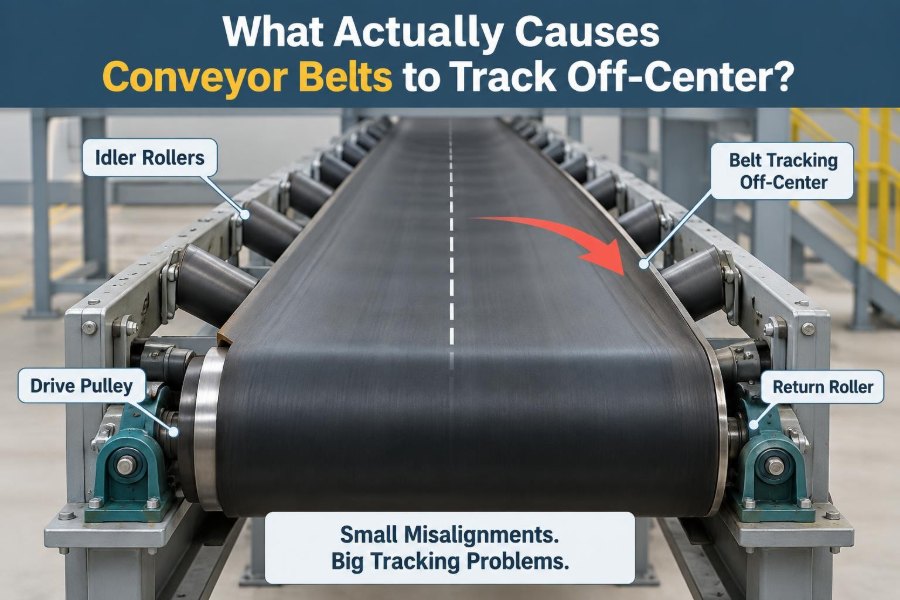

A conveyor that runs neatly down the middle at startup can begin rubbing a frame rail an hour later. Dust builds up, a load changes shape, or a mechanic replaces one idler, and suddenly the belt edge is fraying against steel.
This is not merely an appearance problem. Off-center tracking can damage the belt, spill material, overload bearings, trip safety switches, and stop an entire production line. In bulk handling systems, it can also create cleanup work and expose workers to moving equipment hazards.
It is tempting to blame the belt whenever it wanders. But a conveyor belt is usually responding to the geometry, forces, friction conditions, and loading it experiences along its route.
Understanding those causes turns troubleshooting from repeated adjustment into a disciplined engineering task. The goal is not to force the belt back momentarily; it is to identify why the belt has developed a sideways force in the first place. 🏭
🧭 1. What “Tracking” Actually Means
Tracking is the belt’s tendency to run in a stable lateral position, normally centered on pulleys and idlers. A correctly tracking belt may make small movements, but it does not persistently migrate into a structure or off a pulley.
Tracking is not the same as belt tension. Tension holds the belt sufficiently taut to transmit drive force and maintain wrap; tracking concerns where the belt travels across the conveyor width.
A belt tracks off-center when the net forces acting on it include a sideways component. That component may be tiny, but over repeated revolutions it can move the belt significantly.
⚖️ 2. The Core Principle: Belts Move Toward the Higher-Tension Side
The most useful rule is that a conveyor belt tends to move toward the side with the greater effective tension. This can arise from pulley misalignment, unequal stretch, skewed idlers, uneven loading, or localized changes in friction.
A belt is flexible, so it seeks a path that balances the forces imposed by the rotating components. If one side is pulled slightly harder or travels through a longer path, the belt steers toward that side.
This principle explains why a correction made near one location can affect belt behavior far away. Tracking is a system-level result, not a property of a single roller.
📐 3. Square Geometry Is the Starting Condition
For stable tracking, the major pulleys and idler sets must be correctly positioned relative to the conveyor centerline and intended belt path. In practical terms, their axes must be square to the direction of belt travel where they are meant to be square.
If a pulley axis is not perpendicular to the belt path, one side of the belt encounters a different effective path and tension condition than the other. The belt then has a reason to drift.
Alignment should be assessed relative to the actual conveyor structure and belt route, not simply by visual comparison to nearby guards or floor lines.
🔄 4. A Misaligned Head Pulley Can Steer the Whole System
The head pulley is especially influential because it is commonly the drive pulley and the location where the belt changes direction. A head pulley that is not square can create a persistent tracking tendency on the approach and return runs.
Suppose one end of the pulley is slightly advanced in the direction of belt travel. The belt tends to migrate toward that end. The exact observed behavior depends on the belt path and other components, but the underlying mechanism is unequal tension across the belt.
Because drive pulleys operate under meaningful traction forces, correcting their alignment should come before making aggressive adjustments to training idlers.
🛞 5. Tail Pulley Alignment Matters Just as Much
The tail pulley establishes the belt’s return path and often incorporates a take-up or tensioning arrangement. If it is skewed, the belt can enter the carrying run already displaced or with uneven tension.
Tail pulley problems are often mistaken for loading problems because the visible drift may become obvious only after the belt reaches the loading zone. A careful inspection starts upstream of where the symptom appears.
When a tail pulley is adjusted, both its squareness and its effect on overall belt tension should be considered. Changing one side alone can unintentionally alter both.
📏 6. Idlers That Are Not Square Create Small Steering Inputs
Every idler contacts the belt and can influence its path. A single slightly skewed idler may have little effect, but several idlers pointing in the same unintended direction can continuously steer the belt sideways.
The effect is strongest where the belt is under higher tension or where the idler has clean, consistent contact with the belt. It is often more important to find a repeated alignment pattern than to focus on one visibly imperfect roller.
Common sources of skewed idlers
- Idler frames installed unevenly on the conveyor stringers.
- Damaged brackets, bent supports, or shifted cross-members.
- Replacement idlers mounted without checking alignment.
- Built-up material beneath an idler frame that changes its position.
↩️ 7. Return Idlers Can Cause Carrying-Side Symptoms
The return run is frequently overlooked because it carries no material. Yet return idlers strongly affect the belt’s incoming position at the tail pulley and therefore the path of the carrying run.
A belt that visibly walks at the loading point may be responding to an incorrectly aligned return idler several metres upstream. Troubleshooting only the loaded side can miss the actual cause.
Inspect the full circuit: head, return run, tail, carrying run, and loading zone. The belt remembers the steering influences it encountered on the previous part of its loop.
🧱 8. A Bent Structure Prevents Lasting Alignment
A conveyor frame can be locally straight-looking while its overall centerline has shifted. Settlement, impacts, thermal movement, poor support conditions, and accumulated structural damage can distort the supporting geometry.
When the frame is not straight, technicians may repeatedly adjust rollers to compensate. That can produce a short-term improvement, but it creates a chain of conflicting settings that is difficult to maintain.
Before fine tracking work, verify that the stringers, supports, pulley mounting locations, and take-up path are structurally sound and correctly located.
🧰 9. Belt Splice Squareness Is a Major Clue
A splice that is not square to the belt centerline can act like a steering feature every time it passes around pulleys and idlers. The belt may track acceptably between splice passes, then move sideways in a repeating cycle.
This pattern is diagnostically valuable. If the belt’s lateral movement repeats at the interval of one belt revolution, mark the splice and observe whether the tracking event follows it.
Mechanical fasteners can make a splice problem more visible, but vulcanized splices can also be misaligned. The important issue is the geometry of the completed belt, not only the splice type.
🪢 10. Unequal Belt Stretch Changes the Force Balance
Belts can develop unequal elongation across their width through loading history, damage, construction variation, or operating conditions. One side then effectively has a different length or stiffness than the other.
This is particularly troublesome because normal alignment adjustments may appear to work in one operating condition and fail in another. The belt itself is introducing a changing tension difference.
Inspect for uneven edge wear, distorted carcass areas, localized stiffness, and signs that one side has suffered more loading or heat exposure than the other.
🧵 11. A Crooked Belt Cannot Be Fully Corrected by Rollers
A belt may be manufactured or damaged with a curved centerline, commonly described as a camber. As the belt travels, it naturally tends to follow that curved geometry.
Camber differs from a temporary tracking error. It travels with the belt: the same physical section may create the same drift wherever it goes.
If a belt has significant camber, localized training devices may reduce the visible effect but cannot remove the underlying geometric condition. Replacement or a more comprehensive design response may be necessary.
🧼 12. Material Build-Up Changes Pulley and Roller Shape
Material adhering to a pulley, idler, or belt surface changes the effective diameter at the point of contact. If build-up occurs more on one side than the other, the component no longer presents a symmetrical rolling surface.
A crowned layer of sticky material can steer a belt as effectively as a deliberately shaped pulley, except unpredictably. Build-up also creates vibration, accelerates bearing loading, and can damage belt covers.
Places that deserve close inspection
- Head pulleys after discharge.
- Snub and bend pulleys near sticky material zones.
- Return idlers beneath a loading point.
- Scraper blades and their discharge paths.
- The inside surface of the return belt.
🧽 13. Poor Belt Cleaning Often Becomes a Tracking Problem
Carryback is material that remains attached to the belt after it passes the discharge point. It falls along the return path or accumulates on components, altering contact conditions and geometry.
Effective cleaners do more than keep a plant tidy. They help preserve consistent pulley and idler surfaces, which supports stable tracking.
A cleaner that is worn, incorrectly set, or unable to handle the material may permit recurring build-up. Correcting only the belt position without correcting carryback invites the problem to return.
📦 14. Off-Center Loading Pushes the Belt Sideways
Material should be delivered near the belt centerline and at a direction and speed compatible with belt travel. A load placed heavily on one side creates unequal indentation, drag, and tension across the belt width.
Large lumps, side discharge from a chute, or an asymmetric material stream can drive the belt toward one edge. The effect may be intermittent if the feed pattern changes with upstream process conditions.
The best response is often to correct the transfer chute, not to install stronger tracking devices downstream.
🚚 15. Material Direction and Speed Matter at Transfer Points
Even a centered material stream can disturb tracking if it strikes the belt at an angle. The moving material transfers momentum to the belt and creates longitudinal and lateral drag.
When material speed differs substantially from belt speed, impact and sliding increase. This can produce uneven wear and make the belt behave differently when loaded than when empty.
Good transfer design guides material in the direction of belt travel and supports the belt beneath the loading zone. It reduces both tracking disturbance and belt damage.
🏗️ 16. Uneven Support Under the Load Alters Belt Shape
In a loading zone, the belt relies on impact beds, impact idlers, or support bars to resist the incoming load. Uneven support can let one side sag more deeply than the other.
That asymmetry changes contact pressure, belt tension distribution, and the way material settles. It can become a persistent steering influence even when the chute appears centered.
Check worn impact elements, missing rollers, seized idlers, and support bars that are not level across the belt width.
🔩 17. Seized or Damaged Idlers Add Drag
An idler that does not rotate freely turns rolling contact into sliding contact. The resulting drag can pull on the belt unevenly, particularly if the failed roller is on one side of a troughing set.
Damaged shells, collapsed bearings, and misaligned rollers may all cause local steering. They can also gouge the belt cover and generate heat.
Do not judge idler condition only by whether it turns when empty. Inspect under safe conditions for noise, roughness, shell damage, and accumulated material that restricts rotation.
🔺 18. Troughing Geometry Must Be Symmetrical
On a troughed conveyor, the center and wing idlers shape the belt into a trough. If the wing angles or idler elevations differ from side to side, the belt has unequal support geometry.
One wing may carry more of the load or exert greater lateral influence. This is especially important near transitions, where the belt changes from flat around a pulley to troughed on the carrying run.
Use matching idler components and verify that the frames are installed consistently. A mixed collection of worn or nonstandard parts can create subtle but cumulative asymmetry.
🛤️ 19. Transition Zones Are Sensitive Locations
A transition zone is the section where the belt changes shape between a flat pulley and a troughed idler arrangement. The belt’s tension distribution changes significantly in this region.
If transition distance, trough angle, pulley position, or belt tension is unsuitable, the belt edges and center can experience different strains. Tracking difficulties, edge stress, and splice problems may appear together.
These are design-sensitive regions. Repeated local adjustment may mask a geometry issue that needs review at the conveyor layout level.
🎯 20. Crowned Pulleys Can Help, but They Are Not a Cure-All
A crowned pulley has a slightly larger diameter near its center than near its edges. Under appropriate conditions, it encourages a flat belt to seek the center because the belt experiences a stabilizing tension pattern.
Crowning is commonly effective on suitable flat-belt arrangements, but it is not universally appropriate for every conveyor belt, pulley, or application. Modern systems may rely more heavily on accurate alignment and purpose-designed tracking equipment.
Adding crown to solve a structural, loading, or belt defect can hide the root cause while introducing other operating concerns.
🧲 21. Lagging Condition Changes Traction Across the Width
Pulley lagging provides grip, protects the pulley shell, and can improve drive performance. If lagging is worn, detached, contaminated, or unevenly bonded, traction can differ across the pulley face.
Uneven traction does not always produce obvious belt slip. It may instead create a subtle lateral pull, especially at a drive pulley where forces are high.
Examine lagging for missing strips, glazing, embedded material, edge damage, and an uneven surface profile. Address the condition before using tracking adjustments to compensate.
🌡️ 22. Temperature and Moisture Can Change Behavior
Temperature affects belt stiffness, elongation, material adhesion, and the performance of cleaners and lagging. Moisture can reduce friction in some contacts while making other materials more likely to stick and build up.
A conveyor that tracks well during one shift may misbehave after ambient conditions change or after warm process material begins flowing. Such variation is evidence, not randomness.
Record operating conditions when a problem occurs. A pattern tied to temperature, wet feed, or washdown can narrow the search quickly. 🌡️
🧪 23. The Empty-Belt Test Separates Major Causes
Observing the conveyor empty and loaded is one of the most informative troubleshooting steps. If the belt tracks poorly when empty, alignment, belt condition, pulley condition, or return-side issues are likely suspects.
If it tracks well empty but moves under load, investigate the transfer point, material distribution, impact support, and load-dependent structural deflection first.
| Observed behavior | Likely direction for investigation |
|---|---|
| Drift occurs empty and loaded | Pulleys, idlers, frame alignment, splice, belt camber, build-up |
| Drift begins only under load | Chute alignment, material stream, impact support, unequal loading |
| Drift repeats with one belt revolution | Splice condition, belt camber, localized belt damage |
| Drift changes after cleaning or rain | Carryback, contamination, moisture-related friction changes |
🔍 24. Watch the Direction of Movement Before Adjusting
A useful observation is where the belt first begins moving sideways. The point where it finally rubs the frame is often not the point that caused the movement.
Mark a reference location on the belt and observe its approach to successive components. Look for a gradual movement beginning after a specific pulley, idler group, or transfer zone.
Avoid making several adjustments at once. If many variables change together, the evidence needed to identify the cause is lost.
🧭 25. Training Idlers Are Corrective Devices, Not Root-Cause Replacements
Training idlers are designed to respond to belt movement and steer the belt toward center. They can be valuable on long conveyors or systems subject to normal operating variation.
However, a training idler continuously fighting a large misalignment, crooked belt, or off-center load is being asked to compensate for a defect. It may oscillate, wear quickly, or merely move the problem elsewhere.
Install and maintain trainers according to their intended orientation and location. A trainer installed incorrectly can become another source of steering.
⚠️ 26. “Adjust It Until It Stops Rubbing” Is a Risky Method
A common but unreliable practice is to shift the nearest roller whenever a belt rubs a side rail. This can produce an immediate visual improvement while worsening the underlying belt path.
Random adjustment also creates a conveyor with idlers pointing in many directions. Future technicians then inherit a system whose settings cannot be interpreted logically.
Better adjustment discipline
- Lock out and isolate equipment before physical work.
- Clean and inspect before changing alignment.
- Correct major pulleys and structure before fine idler work.
- Make one controlled change at a time.
- Observe enough belt revolutions to confirm the result.
- Document the cause found and the correction made.
🦺 27. Safe Troubleshooting Comes Before Fast Troubleshooting
Conveyor belts create nip points at pulleys, idlers, and belt contact zones. Loose clothing, tools, and hands can be drawn into moving machinery with little warning.
Inspection methods must follow the site’s safety procedures. Adjustments requiring access to guarded or hazardous areas should be performed only with appropriate isolation, verification of zero energy, and authorized work practices.
Never use hands, improvised bars, or material placement near a moving belt to “guide” tracking. A tracking problem is not worth bypassing basic machine safety.
📝 28. A Practical Root-Cause Inspection Sequence
A consistent sequence prevents the most visible symptom from dominating the investigation. Start with broad conditions, then move toward local adjustments.
- Confirm the belt path and identify where lateral movement begins.
- Compare empty and loaded behavior.
- Remove build-up and check cleaners, pulleys, and return components.
- Inspect the belt, splice, edges, and carcass for geometry or damage.
- Verify head and tail pulley alignment and take-up condition.
- Check frame straightness, idler alignment, and trough symmetry.
- Inspect the loading stream and support in transfer zones.
- Apply controlled corrections and record their effects.
This order addresses root causes before compensating devices. It also makes repeat problems easier to diagnose because the inspection record becomes part of the conveyor’s maintenance history.
✅ 29. The Core Principle: Off-Center Tracking Is Evidence of Unequal Forces
A conveyor belt does not normally wander without a physical reason. It moves off-center because something in the system creates unequal tension, path length, drag, traction, support, or loading from one side of the belt to the other.
The most durable fix comes from restoring symmetry: square pulleys and idlers, a sound structure, a straight and properly spliced belt, clean contact surfaces, centered loading, and even support. Training devices then handle minor variation rather than concealing defects.
When a conveyor belt tracks off-center, treat the drift as diagnostic evidence—not as a problem to push away at the nearest roller. 🧭🔧🏭