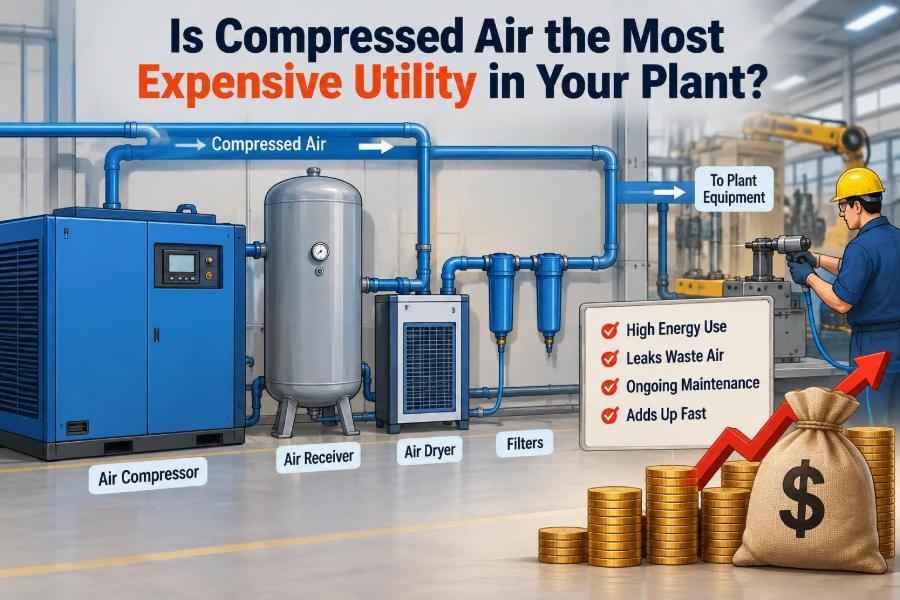

The production line is running, but the compressor room rarely seems to rest. A hiss near a packaging station goes unnoticed, a regulator is set higher than necessary, and a pneumatic blow-off nozzle runs through every shift.
None of these details looks dramatic on its own. Together, they can make compressed air a large and persistent operating cost—often much larger than teams expect when they focus only on the purchase price of a compressor.
Compressed air is convenient, clean at the point of use, and easy to route around a plant. Those strengths can also hide waste: electricity is consumed centrally, while losses occur quietly throughout the distribution system.
For mechanical engineers, maintenance teams, and production leaders, the important question is not whether compressed air is useful. It is whether every unit of air being generated is necessary, delivered at the right condition, and used in the most effective way.
💨 1. Why Compressed Air Gets the “Expensive Utility” Label
Compressed air is not an energy source; it is an energy carrier. Electrical energy drives a compressor, which raises the pressure of air so that it can later perform work at a tool, cylinder, valve, or process device.
Each conversion introduces losses. Heat generated during compression, pressure drops in piping, leakage, inappropriate end use, and poor control all mean that the electrical input is far greater than the useful mechanical work obtained at the point of use.
This does not automatically make compressed air the largest utility bill in every plant. Electricity for process heating, refrigeration, pumping, or furnaces may dominate. But compressed-air systems deserve scrutiny because their avoidable losses are often substantial and widely distributed.
⚡ 2. The Energy Path Has Many Losses
A compressed-air system should be viewed as a chain rather than a single machine. Improving only the compressor while ignoring the rest of the chain can leave most of the opportunity untouched.
- Electrical supply and motor
- Compressor and compression controls
- Aftercooler, moisture separator, dryer, and filters
- Receiver storage and distribution piping
- Regulators, hoses, fittings, and valves
- End-use equipment and the actual production task
At every stage, pressure can fall, air can leak, or flow can be restricted. A useful audit follows the air from the utility room all the way to the final actuator or nozzle.
🏭 3. Start with the Plant’s Actual Demand
Compressor capacity is often mistaken for plant demand. A compressor rated for a certain flow may spend much of its time unloaded, modulating, or cycling because the facility’s real requirement changes by shift, product, and operating condition.
Demand is the air the plant requires at a specified pressure and quality. It is not simply the maximum flow a compressor can theoretically provide.
Build a demand profile before selecting solutions. Record operating hours, pressure, flow where measurement is available, compressor loading, production state, and large intermittent uses. The profile frequently reveals that a short high-demand event is dictating energy use for many hours.
🔍 4. Leaks Are Small Holes with Long Operating Hours
Leaks are familiar, but their impact is easy to underestimate because they continue when no product is being made. A leak can exist at a quick coupling, drain, fitting, hose, thread connection, valve stem, damaged pipe, or disconnected drop.
The audible hiss is only the obvious case. In noisy areas, leaks may be masked by machinery, and some leaks occur inside enclosures or above ceiling level.
Leak management is not a one-time campaign. It is a recurring maintenance process: find, tag, prioritize, repair, verify, and revisit. If new leaks are not prevented or repaired, savings from an initial survey gradually disappear. 🔧
👂 5. Finding Leaks Requires the Right Conditions
A walk-through during full production can identify major leaks, but it may not reveal the system’s baseline loss. A better opportunity is a quiet period when production equipment is stopped but the compressed-air system remains pressurized.
If compressor operation continues despite little or no intended demand, leakage and inappropriate background loads are likely present. This simple observation does not quantify each loss, but it provides a valuable starting point.
Ultrasonic detection is useful because escaping compressed air produces high-frequency sound that can be located even in a noisy industrial setting. Soap solution can help confirm accessible points, while flow and power measurements help establish priorities.
📉 6. Pressure Is Not Free
Higher pressure generally requires more compressor work. It can also intensify leakage and create problems at end uses, including harder impacts in cylinders, excess air consumption at open blowing points, and premature wear in some pneumatic components.
Plants sometimes increase the main header pressure to compensate for one poorly supplied machine. That response treats the symptom while raising energy consumption across the entire system.
First identify why the machine sees inadequate pressure. The cause may be an undersized hose, clogged filter, restrictive fitting, poor regulator setting, undersized branch line, or a peak-flow event that needs local storage rather than a higher plant-wide pressure.
🧭 7. Distinguish Supply Pressure from Point-of-Use Pressure
A compressor discharge pressure, a receiver pressure, a main header pressure, and a tool inlet pressure are different measurements. Confusing them can lead to incorrect conclusions about system performance.
The relevant value is usually the pressure required at the end use while it is operating. A gauge on an idle tool or static line may look acceptable even though pressure collapses during a rapid cylinder stroke or a high-flow blow-off event.
Measure at multiple locations and under realistic loading. This makes pressure-drop problems visible and helps avoid the blunt solution of raising the compressor setpoint.
🛠️ 8. Pressure Drop Often Points to a Physical Restriction
Air flowing through pipes, bends, hoses, filters, couplings, and regulators loses pressure because of friction and local restrictions. The loss grows when flow rises, which is why an issue may appear only during a short but demanding cycle.
Common sources of avoidable restriction
- Long, narrow, or damaged flexible hoses
- Undersized branch piping and fittings
- Filters loaded beyond their service condition
- Quick couplings with insufficient flow capacity
- Partially closed isolation valves
- Complex piping routes with unnecessary bends
Correcting restrictions improves delivery without raising system pressure. It may also make machine behavior more repeatable, which is valuable for quality as well as energy use.
🗺️ 9. Distribution Design Shapes Operating Cost
A piping network should move air with manageable pressure loss, drain condensate effectively, and support maintenance without disrupting the entire plant. Distribution is a mechanical design problem, not merely a routing exercise.
Looped or ring arrangements can provide more than one path to a demand area, reducing the dependence on a single long branch. Branches, drop legs, isolation points, and properly placed drains make the system easier to operate and repair.
Pipe sizing should reflect expected flow, acceptable pressure drop, future changes, and the duty cycle of major users. Oversizing every line is not automatically economical, but undersizing a main distribution route can impose a permanent energy penalty.
💧 10. Water Management Protects the Whole System
Atmospheric air contains water vapor. Compression concentrates that moisture, and cooling after compression can cause liquid water to condense. If it is not removed, water can damage tools, corrode piping, contaminate processes, and obstruct components.
Aftercoolers, separators, receivers, drains, dryers, and filters have distinct functions. A dryer does not replace a separator, and a filter does not solve a poorly draining distribution system.
Drain reliability matters. A drain stuck open wastes air; one stuck closed allows water to accumulate. Both conditions are common enough to justify routine inspection and a clear maintenance standard.
🧼 11. Air Quality Should Match the Application
Not every use needs the same air quality. Instrumentation, painting, food-related processes, sensitive assembly, breathing-air systems, and general pneumatic actuation may have very different requirements.
Over-treating all air to the highest quality level can add unnecessary pressure drop, maintenance, and energy consumption. Under-treating it can create corrosion, product defects, equipment failures, or safety risks.
The practical approach is to define the required pressure, dryness, particulate control, and oil control for each application. Then provide appropriate treatment centrally, locally, or in stages as the process requires.
🧪 12. Filters Need Monitoring, Not Blind Replacement
Filters protect downstream equipment, but a loaded filter becomes a restriction. Its pressure drop can encourage operators to raise upstream pressure, masking the actual maintenance need.
Use differential-pressure indication or another suitable condition-monitoring method where the application warrants it. Replace elements based on condition, contamination risk, and manufacturer guidance—not solely because a calendar date has arrived.
When evaluating a filter problem, check installation direction, bypass condition, element compatibility, and moisture load. Repeated clogging can indicate an upstream separation or drying issue rather than an isolated filter failure.
🎛️ 13. Compressor Controls Must Follow Demand
Compressed-air demand rarely remains constant. It changes with machine cycles, shift patterns, product mix, manual activity, and planned downtime. Compressor control strategy determines how efficiently the supply responds to those changes.
Fixed-speed machines may use start-stop, load-unload, or modulation behavior, while variable-speed machines can adjust motor speed over a working range. No control approach is universally best; the best fit depends on the demand profile and the interaction of all compressors on the system.
A poorly coordinated group can cause several machines to fight one another, oscillate, or run unloaded. Sequencing and control-band design should be reviewed at the system level, not one compressor at a time.
📦 14. Receivers Do More Than Store Air
Receivers add storage volume, damp pressure fluctuations, support short high-flow events, and allow some cooling and moisture separation. They can reduce cycling and help the compressor operate more steadily when demand is intermittent.
Storage is especially helpful when a process needs a brief burst of flow but the average demand is much lower. Local storage near that event may be more effective than increasing main header pressure or installing oversized central capacity.
Receiver placement matters. A receiver before drying and a receiver after drying serve different purposes, and both may be useful in a carefully designed system. Pressure vessels also require appropriate inspection, protection, and safe operation.
⏱️ 15. Match Equipment to the Demand Profile
A plant with a nearly constant base load has different needs from one with sharp peaks, long idle periods, or highly variable production. The compressor room should be designed around these patterns.
| Demand pattern | Typical system consideration |
|---|---|
| Stable, continuous demand | Efficient base-load operation and low pressure drop are central concerns. |
| Large intermittent peaks | Storage, piping capacity, and peak management may matter more than average flow. |
| Wide demand variation | Control coordination and a suitable trim strategy become important. |
| Frequent off-shift idle time | Automatic shutdown, leak control, and isolated zones can offer strong value. |
The table is a starting point, not a selection rule. Measurements and operating constraints should guide final decisions.
🌙 16. Off-Shift Consumption Is a Powerful Clue
During nights, weekends, changeovers, and maintenance windows, intended air demand may fall sharply. If energy use remains high, the system is revealing a problem or an unmanaged load.
Some consumption is legitimate: equipment may need purge air, instrument air, safety functions, or controlled standby pressure. The goal is not to shut down air blindly, but to distinguish essential demand from waste.
Trend compressor power, pressure, and run state alongside production schedules. A mismatch between production activity and compressed-air energy use is one of the clearest prompts for investigation.
🚫 17. Open Blow-Off Is Often a Design Question
Compressed-air blow-off is convenient for cleaning, drying, cooling, ejecting parts, and clearing scrap. It is also easy to leave running longer than needed or to apply where another method would perform the task better.
Before changing a nozzle, ask what the process actually needs: force, velocity, cooling, removal of loose material, drying, or a controlled air curtain. The answer may suggest a guarded blower, mechanical wiper, vacuum system, fan, redesigned fixture, or timed low-flow nozzle.
Any change must preserve product quality, machine safety, worker protection, and process validation. Energy savings never justify directing debris toward people or compromising a required process outcome.
🔩 18. Pneumatic Actuators Need Sensible Sizing
A cylinder converts air pressure acting over piston area into force, subject to friction, load direction, speed, cushioning, and dynamic effects. Oversizing a cylinder or running it at excessive pressure can consume more air than the task requires.
Undersizing is also harmful: it causes unreliable motion, stalls, and operator adjustments that may lead to pressure increases. Select bore, stroke, valve capacity, and supply conditions from the actual load and cycle requirements.
Metering, cushioning, and motion control can reduce impacts and improve repeatability. A smoother motion profile may improve both equipment life and air consumption.
🧰 19. Tools and Hoses Can Create Hidden Demand
Portable pneumatic tools offer durability and flexibility, but their real air consumption depends on duty cycle, inlet pressure, hose condition, and operator practice. A tool left connected with a leaking coupler can consume air even when it is not doing useful work.
At the point of use, provide a regulator, appropriate hose size, a maintained connector, and a means to isolate unused drops. Avoid compensating for poor hose or fitting capacity by turning up the central pressure.
Where feasible, compare pneumatic tools with electric alternatives based on safety, ergonomics, mobility, environmental suitability, maintenance, and total energy use. The right choice depends on the task, not on a blanket rule.
🌡️ 20. Compression Produces Valuable Heat
Most of the electrical energy supplied to a compressor eventually becomes heat. That heat is usually removed by cooling air or water, but in some facilities it can be recovered for a useful low-temperature purpose.
Potential uses may include space heating, makeup-air preheating, process-water preheating, or other nearby thermal loads. Feasibility depends on temperature, timing, distance, heat-transfer equipment, and whether there is a dependable demand for the recovered heat.
Heat recovery does not eliminate the need to reduce leaks or pressure. It is best considered after, or alongside, efforts to avoid generating unnecessary compressed air in the first place. ♨️
📏 21. Measure Flow, Pressure, and Power Together
A single pressure gauge cannot explain system efficiency. Pressure may remain steady while compressor power rises because leakage increases, a control mode changes, or a compressor operates inefficiently at part load.
Useful measurements include electrical power, compressor run state, delivered flow, pressure at key locations, dew point where relevant, and production output. Time-stamped data is especially valuable because it connects changes in air use to actual events.
Metering need not begin as a complex digital project. Even temporary instruments used during a structured assessment can reveal base load, peak events, unstable controls, and off-shift losses.
📊 22. Normalize Energy Against Production Carefully
Total electricity use can rise simply because the plant made more product. To understand performance, compare compressed-air energy with an appropriate production measure such as units produced, operating hours, batches, or a process-specific output.
Normalization must account for changes in product mix, quality requirements, operating schedules, and weather-sensitive loads where relevant. A simple ratio is informative only when the underlying conditions are comparable.
Use trends to ask good questions rather than to make unsupported claims. If energy per unit rises, investigate leaks, pressure changes, control behavior, maintenance condition, and production changes before assigning a cause.
🧑🔧 23. Maintenance Is an Energy Strategy
Compressed-air efficiency declines through ordinary wear: leaking hoses, fouled coolers, degraded seals, clogged filters, failed drains, loose fittings, and poorly functioning controls. These are reliability issues and energy issues at the same time.
A practical maintenance plan assigns ownership and frequency for leak surveys, drain checks, filter inspection, cooler cleaning, lubrication where applicable, belt or coupling inspection, control verification, and safety-device checks.
Document recurring defects by location and type. If the same connection fails repeatedly, the solution may be improved component selection, installation practice, routing, protection from damage, or operator training—not another temporary repair.
🦺 24. Safety and Reliability Come Before Savings
Compressed air can store significant energy. Improperly secured hoses can whip, damaged receivers can be hazardous, and directed jets can propel particles or cause injury. Never use compressed air for unsafe cleaning practices or bypass protective procedures to save energy.
Isolation, lockout procedures, pressure relief, inspection, guarding, and approved equipment are fundamental. Modifications to piping, receivers, controls, or end-use machinery should be reviewed by competent personnel under the site’s safety requirements.
Reliable systems are usually more efficient because they operate predictably. But efficiency projects must be designed so that pressure, air quality, emergency functions, and machine safety remain adequate in all expected operating states.
📝 25. Build an Improvement Plan in the Right Order
A strong program begins with low-risk observation and progresses toward capital decisions. Starting with a new compressor before understanding demand can lock a plant into the wrong size or control arrangement.
- Establish a baseline for pressure, power, operating hours, and production.
- Identify off-shift demand and repair prioritized leaks.
- Correct inappropriate uses and obvious pressure restrictions.
- Set pressure based on the most demanding legitimate end use.
- Review storage, distribution, treatment, and compressor controls.
- Consider equipment replacement or heat recovery using measured evidence.
After each step, measure again. Verification prevents savings from being assumed simply because a project was completed.
🤝 26. Make Compressed Air Everyone’s Responsibility
The compressor room may belong to utilities or maintenance, but air is consumed by production equipment, tools, process design, and operator choices. A sustainable program needs cooperation across those boundaries.
Operators can report leaks and abnormal tool behavior. Maintenance teams can repair and verify defects. Engineers can redesign high-demand applications. Managers can prioritize downtime and track results. Procurement teams can consider life-cycle performance rather than only first cost.
Clear visual tags, a simple reporting route, and feedback on completed repairs help turn energy awareness into normal plant practice.
✅ 27. The Core Principle: Generate Only the Air You Truly Need
Compressed air is valuable when it provides a safe, reliable, controllable solution that fits the process. It becomes expensive when a plant generates more of it than necessary, at higher pressure than necessary, or with losses that no one measures.
The most effective approach is systematic: understand demand, eliminate leakage, reduce restrictions, match air quality to the job, control supply intelligently, and question end uses that depend on open flow or excessive pressure.
The cheapest compressed air is the air your process no longer needs to compress. Start at the point of use, validate every requirement, and let measured system behavior guide the next improvement. 💨⚙️📈