
A machine can look perfectly still and yet feel strangely unresponsive. Turn the steering wheel slightly before the wheels react, reverse a drill press feed and wait for the table to move, or command a robot axis to change direction and see it hesitate. That small delay is often the visible effect of backlash.
Backlash is sometimes described casually as “play,” but it is more specific than general looseness. It is lost motion: input movement that occurs before an output begins moving after a reversal of direction.
In some mechanisms, a modest amount is intentional and necessary. In others, it reduces positioning accuracy, creates impact loads, makes control systems unstable, and signals wear. The engineering challenge is not simply to eliminate backlash; it is to understand where it comes from and decide what amount is acceptable.
From simple hand tools to CNC machines, vehicle drivelines, and precision instruments, the same basic principle applies. A force-transmitting system needs clearance to move and assemble, but clearance creates motion that is not immediately transmitted.
🧭 Backlash Is Lost Motion After Reversal
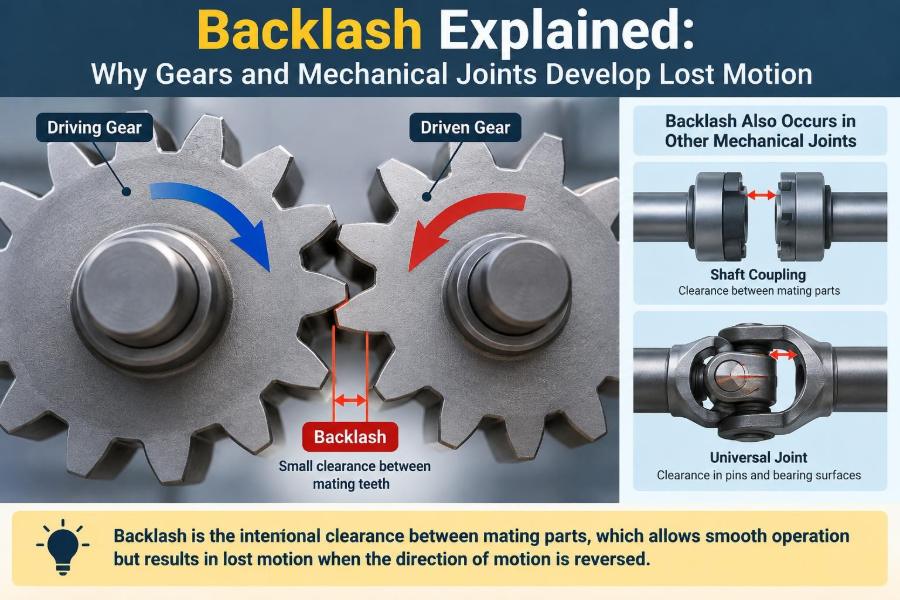
Backlash is the relative movement between mating parts when the direction of applied motion or force reverses. A gear tooth may move across a small gap before it contacts the opposite flank of the mating tooth. Until contact is re-established, the input moves but the output does not.
Imagine two books standing with a narrow gap between them. Push one book toward the other and it moves freely until the gap closes. Push it back in the opposite direction and the same thing happens on the other side. The gap represents backlash.
Backlash is commonly expressed as angular movement for rotating systems, linear displacement for slides and screws, or clearance at a specified location. Its measured value depends on where and how it is measured.
🔄 Why Direction Changes Reveal It
During steady motion in one direction, contacting surfaces are held against one side of their clearances by torque, cutting force, gravity, springs, or friction. The clearance exists, but it may not be obvious.
A reversal changes which surfaces must carry the load. Before the new load path is established, every gap in the transmission has to be taken up. This is why a positioning stage may track accurately while moving right, then miss position briefly when asked to move left.
Reversal is therefore the essential test condition. A mechanism can feel rigid under a one-direction load yet have significant backlash when cycled back and forth.
📏 Backlash, Clearance, and Play Are Not Identical
These terms are related but should not be used interchangeably. Clearance is the intentional or actual gap between parts. Backlash is the resulting lost motion in a particular force path. Play is a broader shop-floor term for unwanted free movement.
A bearing can have internal clearance without producing much measurable backlash at an output shaft if preload and external loads hold it consistently in one direction. Conversely, a small clearance at several components can combine into noticeable output play.
| Term | What it describes | Typical example |
|---|---|---|
| Clearance | Physical gap between features | Space between mating gear tooth flanks |
| Backlash | Lost movement after reversal | Motor rotation before a table reverses |
| End play | Axial movement of a shaft or part | Shaft sliding between bearing locations |
| Compliance | Elastic deflection under load | Twisting of a long drive shaft |
⚙️ Gear Tooth Clearance Creates Classic Backlash
In a pair of gears, backlash is usually associated with the space between non-contacting tooth flanks. When one gear reverses, its driving tooth must travel through that space before it bears against the opposite flank of its mate.
This clearance is not automatically a defect. Gear teeth need room for lubricant, manufacturing variation, thermal expansion, mounting error, and smooth meshing. A gear pair assembled with zero clearance under every operating condition could bind, run hot, or fail to mesh properly.
The practical question is whether the assembled backlash matches the mechanism’s speed, load, temperature range, noise target, and positioning requirement.
🦷 Tooth Geometry Sets the Starting Point
Gear geometry controls how clearance becomes motion. Tooth thickness, tooth-space width, pressure angle, pitch diameter, center distance, and the number of engaged teeth all influence the final mesh condition.
For involute gears, the common profile used in power transmission, slight changes in center distance alter tooth-flank spacing while retaining conjugate action within limits. That useful property makes involute gears tolerant of some mounting variation, but it does not make them backlash-free.
Manufacturers may specify backlash at a particular measuring diameter, often near the pitch circle. A measurement taken at the tip of a large gear produces a larger linear movement than the equivalent angular movement measured near the center.
🏭 Manufacturing Tolerances Accumulate
No real component is exactly nominal. Gear tooth thickness, bore concentricity, shaft diameter, bearing-seat location, housing dimensions, and center distance each have tolerances. Assembly combines those variations.
A gear set may be designed around a target backlash, then end up near either end of its allowable range depending on the selected parts. In high-volume products, designers account for this statistical spread through tolerancing and inspection rather than assuming every component lands at its nominal size.
Trying to remove all nominal clearance without considering variation is a common design error. Some assemblies will become tight before others become precise.
🌡️ Temperature Can Open or Close the Gap
Thermal expansion changes dimensions. If a steel gear set operates in an aluminum housing, the housing may expand more than the gears as temperature rises, increasing center distance and usually increasing gear backlash.
The reverse concern can arise in other material combinations or arrangements. A tight cold assembly may lose running clearance as parts warm, particularly where shafts, housings, and gears expand differently.
Temperature analysis does not always require a complex simulation. A preliminary calculation using expected temperature change, material expansion coefficients, and critical dimensions can identify whether backlash adjustment or a different architecture is needed.
🛢️ Lubrication Needs Space to Work
Lubricant forms a film that reduces friction and separates surfaces where operating conditions allow. Gear mesh clearance helps oil enter and leave the contact zone and provides room for thermal expansion and manufacturing variation.
Too little backlash can squeeze lubricant from the mesh, increase churning and friction, and encourage scuffing or overheating. Too much backlash can increase impact as teeth re-engage, which may disturb the lubricant film and raise noise.
Lubrication does not “fill” backlash in a dependable positioning sense. Oil viscosity may damp very small movements, but it is not a substitute for correct geometry or preload.
🔩 Splines, Keys, and Couplings Add Their Own Lost Motion
Gears are only one source. A driveline may contain a keyed hub, spline connection, flexible coupling, universal joint, clutch disc, and several shafts. Each connection can contribute clearance or wear-related movement.
A key and keyway transmit torque through contacting side faces. If their fit is loose, direction reversal shifts the key from one side of the keyway to the other. Splines behave similarly, though well-designed splined joints distribute load across multiple teeth.
In a long transmission, small angular clearances can add up. The output backlash is the combined effect of each interface, transformed through the relevant gear ratios.
🧵 Lead Screws Also Have Backlash
A lead screw converts rotation into linear motion through a nut. To reverse a conventional screw-and-nut drive, thread contact must transfer from one flank to the other. The axial gap between those load-bearing flanks appears as linear backlash.
Acme and trapezoidal screws commonly use a practical running clearance to avoid binding. Ball screws can achieve much lower backlash because recirculating balls contact the screw and nut raceways, and the ball set can often be preloaded.
Low backlash does not mean unlimited stiffness. A ball screw may still deflect under load, and its support bearings, nut mounting, and machine structure can dominate total positioning error.
🛤️ Linear Guides Can Feel Like Joint Backlash
Slides, dovetails, linear bushings, roller guides, and carriage systems can exhibit lost motion when their moving element shifts across clearance after a load reversal. A guide that is loose in one direction may let a tool or sensor move before the drive has meaningfully changed position.
Gibs in dovetail slides are adjustable wear strips that can reduce side clearance. Linear rail systems often use recirculating rolling elements and may be specified with preload to increase stiffness and reduce play.
Adjustment must be balanced. A slide tightened until all play disappears may have excessive friction, stick-slip motion, heat generation, and accelerated wear.
🪢 Bearings and End Play Affect the Load Path
A rotating shaft is not useful if its location changes unpredictably. Radial bearing clearance can allow shaft-center movement, while axial clearance or end play lets the shaft shift along its axis.
That shift can change gear alignment, move a worm relative to its wheel, or alter the position of a screw. In an angular-contact bearing arrangement, controlled preload is often used to locate a shaft more precisely and increase stiffness.
Preload increases contact force even before external load is applied. It can improve repeatability, but it also raises friction and can reduce bearing life if selected or assembled incorrectly.
🧱 Elastic Deflection Can Look Like Backlash
Not every reversal error is clearance. Shafts twist, frames bend, belts stretch, gear teeth deflect, and bearings deform under load. This is compliance, or elastic flexibility.
Consider a motor driving a load through a slender shaft. Reversing torque first untwists the shaft and then twists it in the opposite direction. The output may lag even if every joint has zero clearance.
The distinction matters because the remedy differs. Mechanical clearance may require adjustment, replacement, or preload. Elastic error may require a stiffer structure, a larger shaft, a shorter load path, lower acceleration, or compensation in the controller.
📉 Hysteresis Complicates Real Measurements
Real mechanisms often show a loop rather than a single backlash value. Friction, elastic deformation, lubricant behavior, and contact changes mean the output position for a given input can depend on whether the system approached from the positive or negative direction.
This direction-dependent behavior is called hysteresis. Backlash contributes to it, but hysteresis can remain even in preloaded mechanisms because friction and material deformation are still present.
For precision work, measure repeatability from both directions. A single move to a target does not reveal whether the same target will be reached consistently after reversals.
📐 Ways Engineers Measure Lost Motion
The measurement method should match the functional requirement. A dial indicator can reveal linear motion at a table, lever arm, or gear rim. A rotary encoder can measure angular deadband at a shaft. Laser measurement systems and high-resolution scales are used where small positioning errors matter.
A basic test holds the output under a modest, controlled condition, moves the input in one direction to establish contact, then reverses slowly while observing output movement. The input travel before output response is the observed lost motion.
- Measure at the component that matters, not only at the motor.
- Use a repeatable load or restraint, because gravity and friction can mask clearance.
- Record temperature, lubrication condition, and adjustment state.
- Test several positions through a rotation or travel range to find eccentricity-related variation.
🔍 Separate Static Checks From Running Behavior
A stationary indicator test is valuable, but a machine also behaves dynamically. At speed, inertia, vibration, lubricant drag, gear mesh stiffness, and control-loop response can make a system behave differently from its static measurement.
A gearbox might show acceptable static backlash but create objectionable rattle during repeated torque reversals. Conversely, a system with measurable clearance may perform adequately when a constant load keeps all contacts seated on one side.
Use static testing to locate mechanical gaps, then evaluate the actual duty cycle before deciding whether the result is acceptable.
🤖 Why Backlash Challenges Servo Control
A servo controller assumes that a commanded motor movement produces a predictable output response. Backlash breaks that direct relationship during reversals: the motor can move, the encoder on the motor can report motion, and the load can remain still.
Once contact is re-established, stored elastic energy and controller correction may cause overshoot. Aggressive tuning can then create hunting or audible chatter around a target position.
Load-side feedback, such as a linear scale on a machine axis, helps the controller see the true output position. It cannot remove the physical gap, but it can reduce positioning error when the mechanism and control strategy are designed for it.
🎯 Positioning Accuracy and Repeatability Differ
Accuracy describes closeness to the intended position. Repeatability describes the ability to return to the same position under the same conditions. Backlash can affect both, especially when targets are approached from different directions.
A machine can be repeatable when always approaching a point from one side because the load path stays seated. It may still be inaccurate due to scale error, screw lead variation, thermal growth, or calibration error.
This is why some manual machining practices approach a final setting consistently from one direction. The habit does not remove backlash; it avoids changing the active contact flank before the measurement or cut.
🔊 Noise and Impact Are Often Early Clues
Repeated clearance take-up can produce clicking, clunking, rattle, or a sharp change in sound during acceleration and deceleration. In a drivetrain, that sound may be called driveline lash; in a gearbox, it may be gear rattle.
Noise alone does not quantify backlash. Gear tooth form, housing resonance, torque fluctuation, lubricant, and damping all shape what a listener hears. Still, a new reversal noise is a useful reason to inspect mounts, couplings, fasteners, gears, and bearings.
High-speed or high-energy systems deserve particular care. Impact at re-engagement can increase local loads beyond those predicted from steady torque alone.
📈 Wear Usually Makes Backlash Grow
Wear removes material from contacting surfaces. Gear flanks, spline teeth, keys, bushings, bearings, and screw nuts can gradually develop more clearance, particularly when lubrication is poor, contamination is present, alignment is wrong, or loads are frequently reversed.
Growth is not always uniform. A gear may wear more heavily in the portion of its rotation that sees the most load, creating backlash that varies with angular position. A lead screw can wear most in the travel zone used every day.
Trend measurements are more informative than an isolated reading. A stable value may be acceptable; a steadily increasing value suggests that the cause of wear should be addressed before adjustment alone is attempted.
🧼 Contamination and Corrosion Change Contact Conditions
Abrasive particles in grease or oil can accelerate wear and create rough contact surfaces. Corrosion can pit teeth, raceways, and splines, producing clearance and irregular torque transmission even if the average dimensions have not changed much.
Contamination may also cause binding. The confusing result is a mechanism with both free play in some positions and high resistance in others. Tightening it to remove the apparent play can worsen the underlying damage.
Clean assembly practices, seals, breathers, correct lubricant, and timely inspection are practical backlash-control measures because they protect the surfaces that establish position.
🧰 Adjustable Meshes Need a Defined Procedure
Many mechanisms provide adjustment through shims, eccentric mounts, slotted housings, split nuts, gibs, or threaded bearing retainers. Adjustment should be based on measurement and manufacturer guidance, not on the feeling that “tighter is better.”
A sound procedure verifies backlash across the entire rotation or travel range, checks smoothness and torque, and confirms that fasteners are secured after adjustment. Eccentric gears, bent shafts, and housing distortion can create one tight spot and one loose spot.
Set the assembly for safe operation at the tightest relevant location and temperature condition, while still meeting the functional requirement at the loosest condition.
🌀 Preload Reduces Clearance by Creating Opposing Contact
Preload applies an internal force so mating elements remain in contact despite small load reversals. Examples include duplex bearings, preloaded ball nuts, split anti-backlash nuts, spring-loaded gears, and dual-pinion arrangements.
In a split anti-backlash nut, two nut sections are biased against opposite screw flanks. Reversal no longer requires a free traverse across thread clearance because both flanks are already engaged.
The trade-off is unavoidable: preload generally increases friction, heat, assembly sensitivity, and sometimes wear. It should be sufficient for the required stiffness and repeatability, not treated as a universal cure.
🪱 Worm Gears Require Special Attention
Worm gear sets are compact and can provide high reduction ratios, but their contact geometry and sliding action make setup sensitive. Backlash may be adjusted by shifting the worm, wheel, or bearing positions depending on the design.
Reducing worm-gear backlash too aggressively can create tight mesh positions, poor lubrication conditions, and high heat generation. Wear can also alter the tooth contact pattern, so a simple adjustment may not restore a damaged set.
Where precise bidirectional positioning is required, examine both backlash and torsional stiffness. A high-ratio gearbox can magnify the practical consequences of flexibility at the output.
🧲 Belts and Chains Have Deadband Too
Belts and chains are often discussed in terms of tension rather than backlash, but they can produce reversal lost motion. A timing belt can shift through tooth clearance, while insufficient tension allows additional movement before torque is transmitted. Chain drives can also exhibit clearance at pins, bushings, and sprocket engagement.
Proper tension limits slack and tooth jumping, but overtensioning increases bearing load and can shorten component life. Long belt spans also behave elastically, so their reversal response includes both clearance and stretch.
For high-precision axes, belt routing, pulley diameter, span length, tensioning method, and load-side measurement all deserve attention.
🚗 Driveline Lash Is a System-Level Problem
In a vehicle or industrial drive, a change from driving torque to braking torque can take up clearances in gears, splines, differential components, and joints. The driver may feel this as a bump when getting on or off the throttle.
Some lash is designed into durable powertrains. The concern rises when the response changes suddenly, is accompanied by vibration, or occurs with unusual noise, because worn joints, mounts, or transmission components may be involved.
Diagnosis should consider the full torque path. Replacing one visibly loose component may not remove the sensation if multiple clearances are contributing.
🧪 A Simple Diagnostic Sequence
When lost motion is suspected, begin by defining the symptom: delayed output, noisy reversal, missed position, poor surface finish, or a changing control response. Then isolate the path from actuator to load.
- Secure the system and follow applicable lockout and safety procedures.
- Establish a consistent load direction and measure output motion during a slow reversal.
- Check fasteners, couplings, keys, splines, bearing supports, and mounts before opening a gearbox.
- Measure at several positions to identify localized wear or runout.
- Compare results with the machine’s functional requirement and service information where available.
- Correct root causes such as wear, misalignment, contamination, or improper adjustment, then re-measure.
Never place hands near energized rotating machinery to feel for play. A safe static inspection with motion prevented is preferable to an improvised test.
⚠️ Common Attempts That Make Things Worse
The most frequent mistake is tightening every adjustment until movement disappears. This can turn a positioning issue into a friction, heat, or seizure issue, especially in gears, bearings, and sliding guides.
Other weak fixes include masking a worn joint with thicker grease, tuning a controller around a deteriorating transmission, or replacing only the most accessible part without confirming the whole load path. These may change the symptom temporarily while leaving the actual mechanism unresolved.
- Do not judge mesh quality only at one rotational position.
- Do not confuse elastic twist with mechanical clearance.
- Do not assume a motor encoder measures load position.
- Do not use preload without checking torque, temperature, and service limits.
🧠 Design for the Required Directionality
Not every application needs the same solution. A conveyor running continuously in one direction can tolerate more backlash than a metrology stage that reverses repeatedly over small distances. A gearbox in a rugged actuator may prioritize durability and thermal tolerance over near-zero lost motion.
Questions that guide selection include: Does the load reverse? How often? Is the final position approached from one direction? What happens when temperature changes? Is output stiffness as important as angular clearance? Can the load be measured directly?
Good design specifies the required output behavior, then allocates allowable error among gears, screws, joints, bearings, structure, sensors, and controls.
🛠️ Selecting a Backlash Strategy
Available strategies range from accepting and managing clearance to using precision components and closed-loop correction. The appropriate choice depends on duty, environment, cost, maintainability, and failure consequences.
| Need | Common approach | Key trade-off |
|---|---|---|
| One-direction motion | Maintain a consistent load direction | Not suitable for true bidirectional tasks |
| Moderate reversal accuracy | Adjustable mesh or compensation | Requires inspection and calibration |
| High repeatability | Preloaded screw, bearings, or guide | More friction and assembly sensitivity |
| High precision at the load | Load-side encoder or scale with stiff mechanics | Higher system complexity and cost |
📚 The Core Principle: Control the Entire Force Path
Backlash is not merely a gear specification. It is a system behavior created when force reverses through clearances, joints, contact surfaces, and flexible members. The observed lost motion belongs to the complete path from input to output.
Clearance can be necessary for assembly, lubrication, thermal survival, and reliable operation. Problems arise when it exceeds the application’s tolerance, changes unpredictably with wear or temperature, or combines with compliance and control behavior in ways the design did not anticipate.
The strongest solutions begin with a clear performance requirement, measure motion where it matters, distinguish gap from flexibility, and use adjustment or preload with respect for friction and durability.
Backlash becomes manageable when it is treated as a measurable property of the whole mechanism—not simply as a gap to tighten away. ⚙️🔍🛠️