
A washing machine begins to walk across the floor during a spin cycle. A glass gives a faint ring when a particular musical note is played nearby. A car steering wheel shakes at one road speed, then becomes calm again when the speed changes.
These events can seem unrelated, but each involves a system responding strongly to repeated motion. The applied force may be small, yet under the right conditions it can build into a surprisingly large vibration.
That behavior is called mechanical resonance. It is useful in many devices, from clocks and musical instruments to vibration sensors. In structures and machines, however, it can amplify stress, loosen fasteners, reduce accuracy, create noise, and in severe cases contribute to failure.
Understanding resonance does not mean treating every vibration as an emergency. It means recognizing when a repeating force is lining up with a system’s natural tendency to move—and knowing what engineering choices can break that alignment.
🔔 Mechanical Resonance in Plain Language
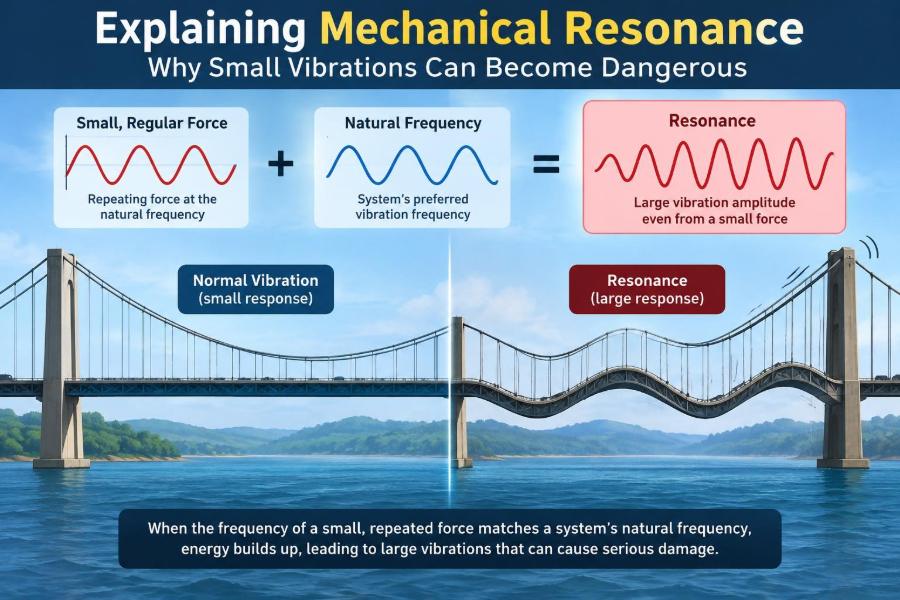
Mechanical resonance occurs when a repeated input supplies energy to a system at, or close to, one of that system’s preferred vibration frequencies. The vibration amplitude then grows until damping, nonlinear behavior, or a change in operating conditions limits it.
Think of pushing a playground swing. Randomly timed pushes do little. Push at the right point in each cycle, however, and even modest pushes produce a large arc. The same energy-timing principle applies to shafts, beams, floors, pipes, vehicle components, and rotating equipment.
Resonance is not a force by itself. It is an amplification effect created by the relationship between an exciting force and a dynamic system.
🧱 Every Physical System Has Natural Frequencies
A natural frequency is a frequency at which a system tends to vibrate after it is disturbed and released. A ruler hanging over a desk edge, for example, will oscillate at a characteristic rate after being flicked.
Most real components have more than one natural frequency. A machine frame may sway as a whole at a low frequency, while a thin guard panel, bracket, or shaft has higher-frequency bending and twisting modes.
The natural frequencies depend on the object and its boundary conditions. A beam bolted tightly at both ends behaves differently from the same beam supported loosely or clamped at one end.
⚖️ The Three Ingredients: Mass, Stiffness, and Damping
For a basic mass-spring system, the natural frequency increases when stiffness increases and decreases when mass increases. A stiff, light component generally vibrates faster than a flexible, heavy one.
Damping removes vibration energy, usually by converting some of it to heat. It can come from material hysteresis, friction in joints, air resistance, fluid motion, or purpose-built dampers.
These three properties do not fully describe every machine, but they form the most useful starting model. Changing any of them can shift a resonance problem or reduce its severity.
📈 Why Repeated Small Forces Accumulate
A single light tap on a structure produces a limited response. Repeated taps can produce much more motion if each arrives in step with the movement already present.
At resonance, the external force keeps adding energy during the part of the cycle where it helps the motion rather than opposing it. The system stores energy alternately as kinetic energy in moving mass and strain energy in bending, stretching, or twisting components.
When the forcing is out of step, some input energy cancels existing motion. That is why a machine can be quiet at many speeds but vibrate strongly in a narrow operating range.
🌊 Frequency, Period, and Amplitude
Frequency is the number of cycles per unit time, commonly measured in hertz (Hz), where one hertz means one cycle per second. The period is the time required for one complete cycle.
Amplitude describes the size of the vibration. Depending on the application, engineers may measure displacement, velocity, acceleration, strain, or force. A high acceleration reading does not automatically mean large displacement; high-frequency motion can have modest displacement but substantial acceleration.
Keeping these measures distinct helps prevent misleading conclusions when comparing vibration data from different machines or sensors.
🎵 Resonance Is a Match, Not an Exact Single Number
Textbook diagrams often show resonance as an extremely sharp peak at one frequency. Real systems are less tidy. Damping broadens the peak, while changing temperature, load, speed, support stiffness, or wear can shift the natural frequency.
A machine may therefore have a resonant region rather than one perfectly fixed dangerous speed. The closer the forcing frequency lies to the natural frequency, the stronger the response is likely to be, all else being equal.
Highly damped systems respond less dramatically, but they can still experience fatigue or accuracy problems if the vibration persists.
🌀 Forced Vibration Versus Free Vibration
In free vibration, a system is disturbed once and then allowed to move on its own. A struck tuning fork and a bumped pipe are familiar examples. Its motion gradually decays because of damping.
In forced vibration, an ongoing external source drives the motion. An electric motor, a reciprocating compressor, gear mesh, road input, or a nearby machine can all be forcing sources.
Resonance becomes especially relevant in forced vibration because the source continually replaces the energy lost to damping. Identifying that source is often the first step in troubleshooting.
🧭 Phase Explains the Energy Transfer
Phase describes timing within a cycle. Two motions can have the same frequency but reach their peaks at different times, meaning they are out of phase.
Near resonance, the relative timing between force and motion changes rapidly. This timing determines whether the applied force feeds energy into the vibration or removes it.
Phase measurements are useful in advanced diagnostics because they can help distinguish, for example, a structural resonance from a simple imbalance. They should be interpreted with knowledge of sensor location and machine geometry, not as isolated numbers.
🧮 The Simple Spring-Mass Model
A single-degree-of-freedom model represents a body of mass m attached to a spring of stiffness k, often with a damper added. Its undamped natural angular frequency is commonly written as ωₙ = √(k/m), and frequency in hertz is fₙ = ωₙ/(2π).
This equation is valuable because it shows the design direction immediately: raise stiffness to raise natural frequency, or add mass to lower it. But it is only a model. Real structures distribute mass and flexibility through space, have multiple modes, and may have nonlinear joints.
Use the equation for intuition and early estimates, then use testing or more detailed analysis when consequences justify it.
🗺️ Mode Shapes Show Where a Structure Moves
A mode shape is the characteristic deformation pattern associated with a natural frequency. In one bending mode, the middle of a beam may move most; in another, it may have several moving segments separated by nearly stationary points.
Those low-motion locations are called nodes. Placing a sensor near a node may make an important mode hard to detect. Mounting a sensitive component near an antinode may expose it to much greater motion.
Mode shapes matter because “the machine resonates” is incomplete. Engineers need to know which part moves, in what direction, and in what shape.
🏗️ Why Supports and Connections Matter So Much
Bolts, welds, rubber feet, grout, foundation anchors, pipe hangers, and bearing housings all affect stiffness and damping. A component that looks rigid in a drawing may move significantly because its support path is flexible.
Loose fasteners can lower joint stiffness and introduce impacts or rubbing. A foundation that is too flexible can allow a machine and its support to act as a coupled vibrating system.
For this reason, vibration fixes aimed only at the machine itself can fail. The practical system includes the machine, its connections, the base, and often the attached piping, ducting, or cabling.
⚙️ Rotating Machines Create Predictable Excitation
Rotating equipment commonly produces vibration at running speed, often called one-times rotational frequency. Imbalance is a classic source: if the mass center is offset from the rotation axis, the rotating force rises with the square of speed.
Other sources include misalignment, bent shafts, eccentric pulleys, bearing defects, aerodynamic blade passing, and gear mesh. Their frequencies may be related to shaft speed, tooth count, blade count, or bearing geometry.
A vibration spectrum can reveal these frequency relationships, but it does not replace inspection. A peak at a known frequency identifies a clue, not a complete diagnosis.
🚗 Critical Speed in Shafts and Rotors
A rotating shaft has bending natural frequencies. When rotational speed produces an excitation near one of them, the shaft can whirl strongly. This operating condition is often called a critical speed.
Well-designed rotating machinery may be intended to operate below its first critical speed, or it may pass through one quickly and run safely above it. The choice depends on the rotor design, supports, damping, control capability, and required speed range.
Dwelling near a critical speed is usually undesirable because vibration, bearing loads, and shaft stress can increase. Startup and shutdown procedures may therefore limit time in known critical ranges.
🔄 Reciprocating Machines Produce Harmonics
Pistons, pumps, engines, presses, and compressors create forces that repeat with their motion. Their force waveform is rarely a perfect sine wave, so it contains harmonics: frequency components at multiples of the basic cycle rate.
A structure can resonate with a harmonic even when it does not resonate at the fundamental operating frequency. For example, a bracket may respond strongly at twice or several times a machine’s running speed.
This is why “the machine speed is far from the natural frequency” can be an incomplete check. Engineers must consider meaningful excitation orders, not only the first one.
🌉 Resonance in Buildings, Bridges, and Floors
Structures respond to wind, moving people, traffic, machinery, and seismic motion. The practical concern is not only collapse; vibration can also cause occupant discomfort, disturb sensitive equipment, crack finishes, or accelerate fatigue in connections.
A footbridge or lightweight floor can feel lively when the rhythm of walking approaches a structural mode. Human movement is variable, so the response depends on crowd behavior, damping, structural layout, and the frequency range involved.
Large civil structures are analyzed using multiple vibration modes and realistic loading scenarios. Simple analogies are helpful, but they are not substitutes for structural assessment.
🎻 Musical Instruments Use Resonance Deliberately
A guitar string alone moves relatively little air and would sound quiet. Its body resonates with the string’s motion, increasing sound radiation and shaping the instrument’s tone. Wind instruments similarly rely on resonant air columns.
This is a useful reminder that resonance is not inherently harmful. Engineers and designers deliberately tune resonant systems when they want selectivity, sensitivity, sound production, energy transfer, or timing.
The difference between a musical instrument and a vibrating machine frame is usually not the physics. It is whether the amplified motion occurs in the intended place, at a controlled level, and for a useful purpose.
📱 Sensors and Timing Devices Depend on Tuned Motion
Some accelerometers use a small proof mass on a spring: acceleration changes the mass’s relative motion. Many sensors must account for their own resonances so that measurements remain accurate over the intended frequency range.
Quartz timing elements and microelectromechanical systems also use carefully controlled vibration. Their geometry, material properties, and electronic feedback are designed around repeatable resonant behavior.
These applications show why adding damping is not always the answer. Excess damping can reduce sensitivity or alter a device’s intended response, even while it improves robustness elsewhere.
🔥 How Resonance Creates Damage
Large vibration increases cyclic stress. A component may survive a single load far above its normal vibration level but develop fatigue damage when a smaller stress repeats many times. Stress concentrations at holes, weld toes, keyways, threads, and sharp corners are especially relevant.
Resonance can also cause fretting at interfaces, loosen threaded connections, overload bearings, damage seals, fatigue electrical leads, and create contact between parts that should remain separated.
The most visible motion is not always the most damaging location. A small bracket, pipe support, or cable clamp may experience a local mode and fail while the larger machine appears acceptable.
🔊 Noise Can Be a Resonance Clue
Rattling, droning, booming, or a sharp tonal sound may indicate a resonant panel, guard, duct, or enclosure. Sound alone cannot prove the mechanism, since noise can come from friction, airflow, impacts, or electrical sources.
Still, a sound that appears only over a narrow speed range is a useful clue. It suggests an interaction between a frequency-dependent source and a structural or acoustic natural mode.
Listening should lead to measurement rather than guesswork. Safe inspection, vibration data, speed information, and a check for looseness make the observation more actionable.
📊 Reading a Frequency Response
A frequency response function describes how strongly a system responds across a range of excitation frequencies. It may be measured by applying a known input—such as an instrumented impact or shaker—and recording the response with accelerometers.
Peaks often indicate natural frequencies, while the width and height of a peak provide information about damping and response strength. Multiple peaks are normal for real structures because they have multiple modes.
Test quality matters. Sensor mass, mounting method, boundary conditions, nearby components, and the excitation level can all influence results. Measurements should represent the actual operating configuration whenever possible.
🩺 Vibration Monitoring Is a Diagnostic Tool
Condition monitoring uses repeated vibration measurements to identify changes that may indicate imbalance, misalignment, looseness, bearing problems, gear damage, or structural issues. Trending often provides more value than one isolated reading.
A useful program records operating speed, load, sensor direction, mounting location, and instrument settings. Without this context, comparing measurements taken months apart can be misleading.
Vibration limits and alarm settings should be selected for the particular machine, installation, and risk. Generic thresholds can be useful screening aids, but they are not universal proof of safe or unsafe operation.
🔍 A Practical Way to Investigate a Vibration Problem
Start by defining the symptom precisely: where is it felt, at what speeds or loads does it occur, and has anything changed? Then identify likely forcing frequencies from motor speed, shaft speed, gears, fans, pumps, or reciprocating cycles.
- Inspect for looseness, rubbing, damaged mounts, cracked supports, and changes in attachment conditions.
- Measure vibration at several meaningful locations and directions while recording operating speed.
- Compare prominent frequencies with known forcing frequencies and estimated or measured natural frequencies.
- Use a controlled change—such as speed, load, temporary stiffening, or a carefully selected test mass—to test the hypothesis.
- Confirm that the final modification improves the response without creating a new problem elsewhere.
Work on energized or rotating equipment requires appropriate procedures, guards, and qualified personnel. Do not use improvised contact tests near moving parts.
🛠️ Change the Excitation When Possible
The most direct solution is often to reduce the forcing source. Balancing a rotor, aligning coupled shafts, correcting a bent component, repairing a worn bearing, or improving a gear mesh can lower the energy entering the structure.
Changing operating speed can also move the excitation away from resonance. This may be practical for variable-speed drives, but it can be a temporary workaround if the machine must regularly cross or operate in the problematic range.
Reducing excitation is generally preferable to making every surrounding component stronger. It addresses the origin of the vibration rather than only its response.
🧱 Shift the Natural Frequency with Mass or Stiffness
Adding a brace, shortening an unsupported span, increasing section stiffness, improving a joint, or strengthening a foundation can raise a natural frequency. Adding mass can lower one. Either approach may move the resonant region away from operating excitation.
The direction is easy to state but not always easy to apply. Added mass can increase static loads and may create new modes; a stiffener can redirect stress toward a weld or attachment point.
A modification should be evaluated as a system change. The aim is not merely to move a peak on a plot, but to obtain acceptable vibration and stress across the required operating envelope.
🧽 Add Damping When Frequency Separation Is Difficult
Damping reduces the amplification near resonance and helps vibrations die out more quickly. Common approaches include elastomeric mounts, constrained-layer damping treatments, friction devices, viscous dampers, and fluid-based absorbers.
Material selection matters. Rubber-like materials can change stiffness and damping with temperature, age, chemical exposure, and loading. Friction-based damping may vary with bolt preload and surface condition.
Damping is particularly helpful when a system must pass through resonance or when changing mass, stiffness, or speed is impractical. It should still be designed for the actual environment and motion range.
🎯 Tuned Mass Dampers and Dynamic Absorbers
A tuned mass damper is a secondary mass connected to the main system by a spring and damper. It is tuned so that its motion counteracts the primary structure near a target frequency.
These devices can be effective for narrow-band problems, such as a recurring vibration at a known machine speed or a dominant structural mode. They do not eliminate the original force; they redistribute and dissipate vibration energy.
Tuning is sensitive. If the main system changes substantially with load or temperature, a fixed absorber may become less effective. It also adds parts that require space, attachment strength, and maintenance consideration.
🚫 Common Fixes That Often Miss the Cause
Adding weight without knowing the mode can accidentally place the resonance closer to an operating frequency. Tightening every fastener indiscriminately may hide a clue without addressing an imbalance, misalignment, or weak support path.
Other frequent mistakes include:
- Assuming all vibration at running speed is imbalance.
- Measuring at only one location and one operating condition.
- Ignoring attached piping, ducts, guards, or cables.
- Using soft isolators without checking the resulting rigid-body natural frequency.
- Treating a quiet machine as automatically free of damaging cyclic stress.
A good corrective action follows a credible mechanism and is verified by repeat measurement or inspection.
🧰 Design Choices That Prevent Trouble Early
Early design is the least expensive time to address resonance. Engineers can map expected operating speeds, estimate forcing frequencies and harmonics, set frequency-separation targets, and model major structural modes.
Attention to load paths, joint stiffness, foundation behavior, rotor balance quality, and attachment details prevents many later surprises. Designs should also consider startup, shutdown, abnormal loads, and likely changes in installed equipment.
Prototype testing remains valuable because manufactured joints, tolerances, cable routing, fluid-filled lines, and real supports can behave differently from idealized models.
🧠 Simulation Helps, but Assumptions Matter
Finite element analysis can predict mode shapes, natural frequencies, stresses, and responses before hardware exists. It is powerful for comparing design options and locating flexible regions that may not be obvious by inspection.
However, predictions depend on assumptions about material properties, contacts, bolt preload, damping, boundary conditions, and added masses. A model with unrealistic supports can produce precise-looking but misleading frequencies.
Where vibration risk is significant, correlate the model with test data. Updating a model based on measured modes is more reliable than treating simulation output as a final answer.
⚠️ When a Resonance Issue Needs Specialist Review
Seek qualified engineering help when vibration is accompanied by cracking, repeated fastener failure, contact with rotating parts, significant pipe movement, unusual bearing heating, loss of control accuracy, or changes to safety-critical equipment.
Specialist review is also sensible when equipment operates near critical speed, when a modification affects structural capacity, or when the source may involve pressure systems, lifting equipment, vehicles, or public structures.
The right response depends on the consequences of failure, the uncertainty in the diagnosis, and the complexity of the coupled system. A quick field adjustment may be reasonable for a minor guard rattle; it is not an adequate method for a fatigued support frame.
✅ The Core Principle: Manage the Frequency Relationship
Mechanical resonance becomes troublesome when a repeated force can continuously feed a natural mode of a system. The response depends on frequency alignment, mode shape, damping, excitation strength, and the stiffness of the full support path.
Effective solutions usually do one or more of four things: reduce the exciting force, shift the natural frequency, add damping, or control the operating range. The best choice comes from identifying the actual mechanism rather than applying a generic vibration fix.
Small vibrations deserve attention when they repeat, grow over a narrow speed range, or occur near vulnerable details. Their size alone does not define the risk; their frequency, duration, location, and resulting stress do.
Resonance is the engineering lesson that timing can matter as much as force: when repeated energy arrives in step with a structure’s motion, modest inputs can produce major consequences. Recognize the pattern, measure the system, and change the relationship deliberately. ⚙️📈🔧