
A production line is running smoothly until a bearing begins to growl. The sound is easy to ignore because the machine is still making acceptable parts. But a few days later, the bearing seizes, the shaft is damaged, and a short repair becomes an unplanned shutdown.
Now consider the opposite problem: a maintenance team replaces a gearbox component during a scheduled service even though inspection shows little wear. The job avoids the possibility of failure, but it consumes labor, parts, and valuable production time.
These two situations reveal the central maintenance challenge. Equipment must be protected from failure, yet maintenance itself has a cost and can introduce mistakes if it is done unnecessarily.
Preventive, predictive, and condition-based maintenance are often treated as competing labels. In practice, they are different decision approaches. Choosing well starts with understanding what the machine does, how it fails, and what failure would mean.
🧭 Maintenance Is a Decision System, Not Just Repair Work
Maintenance is the work used to preserve or restore an asset’s required function. That function may be pumping a specified flow, holding dimensional accuracy, moving a load safely, or providing reliable electrical power.
A useful maintenance strategy decides what to do, when to do it, and what evidence justifies the action. Repairing after failure is corrective maintenance. Preventive, predictive, and condition-based approaches aim to intervene before a functional failure occurs.
The best choice is rarely a single method applied to every component. A plant may use scheduled lubrication on motors, vibration monitoring on critical pumps, and run-to-failure replacement for inexpensive indicator lamps.
🛠️ Preventive Maintenance: Work Scheduled in Advance
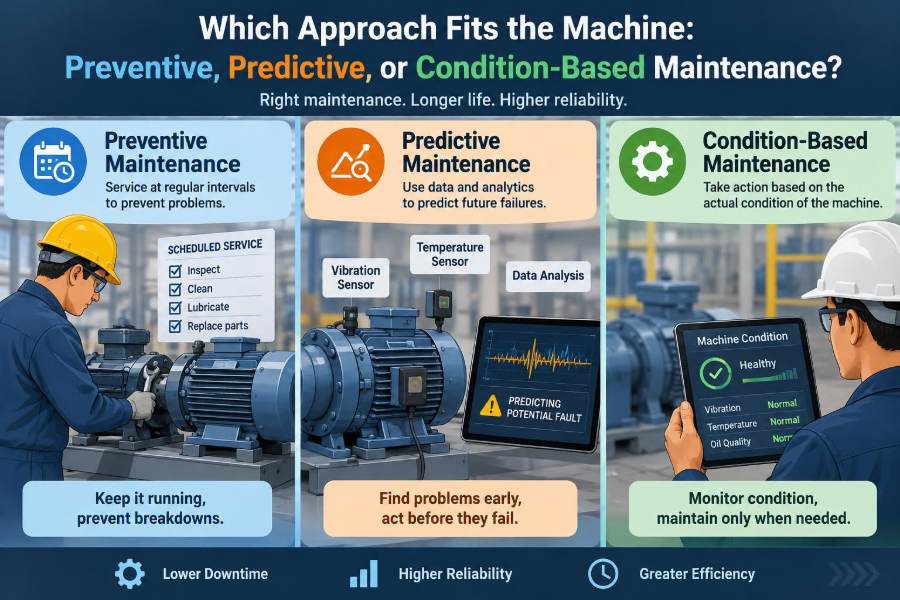
Preventive maintenance (PM) is performed at planned intervals based on time, operating hours, cycles, distance, or another usage measure. Examples include changing oil every set number of operating hours, inspecting a hoist monthly, and replacing a belt at a planned service interval.
The logic is simple: perform a known task before wear, contamination, fatigue, or degradation is expected to create an unacceptable risk. The task might be inspection, cleaning, adjustment, lubrication, testing, or replacement.
PM does not require the asset to show an active fault. Its trigger is the calendar or meter, which makes it straightforward to schedule around staffing and production windows.
📅 Why Scheduled Work Can Be Highly Effective
Time-based maintenance is especially useful where deterioration is reasonably predictable or where a task prevents a common, age-related failure. Filters can load with contaminants, grease can degrade, and certain seals can harden or lose elasticity with service and environment.
It is also valuable for safety-related checks. Emergency stops, guards, pressure-relief devices, and backup systems may require regular testing even when no condition-monitoring signal suggests a problem.
- Tasks can be planned with parts, permits, and labor ready.
- Routine inspections create opportunities to spot leaks, looseness, corrosion, and poor housekeeping.
- Compliance-driven or safety-critical activities are easier to demonstrate and document.
- Simple assets can be managed without costly monitoring hardware.
⏳ The Limits of the Calendar
A calendar does not know whether a pump ran gently in clean service or continuously near its limit. Two identical machines can accumulate very different damage because of load, alignment, contamination, operator practice, ambient temperature, and process conditions.
This creates two familiar PM failures. Under-maintenance occurs when the interval is too long and a component fails first. Over-maintenance occurs when parts are replaced too early or equipment is opened without a clear need.
Opening a healthy assembly is not risk-free. Incorrect reassembly, wrong lubricant, contamination, and adjustment errors can create defects. Planned work should therefore be technically justified, not merely frequent.
📈 Predictive Maintenance: Estimating What Will Happen Next
Predictive maintenance (PdM) uses measured condition data, operating context, and trend analysis to estimate the developing likelihood or timing of failure. Its goal is not simply to find a defect; it is to support a forecast about remaining useful service or an appropriate intervention window.
For example, repeated vibration measurements may show a bearing fault frequency increasing over several readings. Combined with load, temperature, and historical behavior, the trend can help the team decide whether the bearing can safely run until the next planned outage.
Prediction always contains uncertainty. A disciplined program expresses that uncertainty in practical terms: inspect sooner, reduce load, prepare spares, or schedule a controlled repair rather than claim to know an exact failure date.
🔎 Condition-Based Maintenance: Acting on Actual Condition
Condition-based maintenance (CBM) means maintenance is triggered by evidence of deterioration or a condition that requires action. The evidence may come from a technician’s inspection, an oil sample, a thermal scan, a sensor alarm, or a functional performance test.
CBM answers: “What is the asset’s condition now, and has it crossed an action threshold?” A portable vibration reading that exceeds an established alarm level may trigger inspection even if no long-term forecast has been made.
Condition-based maintenance can be manual or automated. A technician checking chain tension during a weekly walkdown is using CBM if the chain is adjusted because its observed condition demands it.
🔗 How CBM and PdM Overlap—and Differ
The terms are often used interchangeably because predictive maintenance depends on condition data. The distinction is useful when designing a program: CBM detects and responds to current degradation; PdM uses condition history and analysis to anticipate future degradation.
Every predictive program is condition-informed, but not every condition-based action is predictive. A high motor temperature may justify immediate troubleshooting without providing enough information to estimate remaining life.
| Approach | Main trigger | Typical question | Example |
|---|---|---|---|
| Preventive | Time, hours, or cycles | Is scheduled service due? | Replace oil after defined operating hours |
| Condition-based | Observed condition threshold | Is deterioration present now? | Inspect a bearing after elevated vibration |
| Predictive | Trend and forecast | When should intervention occur? | Plan bearing replacement during an upcoming outage |
⚙️ Start With the Required Function
A maintenance plan should begin with what the equipment must accomplish, not with a preferred technology. A cooling-water pump may need to deliver flow and pressure within a range. A machine tool spindle may need to maintain speed, runout, stiffness, and surface-finish capability.
Once the required function is stated, define functional failure: the point at which the asset can no longer meet that requirement. A pump need not be completely motionless to have failed; reduced flow can already impair the process.
This framing prevents teams from monitoring interesting data that have little connection to production, quality, safety, or cost.
💥 Understand Failure Modes Before Selecting Tasks
A failure mode is the specific way an asset can fail. A pump can lose performance through impeller erosion, seal leakage, bearing damage, cavitation, plugged suction strainers, electrical faults, or coupling misalignment. Each mechanism develops differently.
One maintenance task cannot reliably address every mode. Vibration analysis can reveal many rotating faults, but it will not directly prove that a suction strainer is blocked. A flow test may reveal reduced hydraulic performance while missing an early electrical insulation problem.
Good planning connects each important failure mode to a credible task, measurement, or operating safeguard.
🧩 Age-Related Failures Favor Preventive Tasks
Preventive replacement is most defensible when failure probability rises clearly with age or accumulated use. Some consumables and wear items fit this pattern, particularly where service conditions are stable and the consequence of failure is significant.
Manufacturer intervals are useful starting points, but they are not universal laws. A recommendation may assume a certain duty cycle, ambient condition, lubrication practice, or fluid cleanliness that differs from local reality.
Review actual findings at service: removed-part condition, recurring defects, operating history, and failure records. These observations help refine intervals without guessing.
🌦️ Random Failures Need a Different Response
Many failures are not tightly linked to age. Electrical connections may loosen due to vibration, contamination may enter after an intervention, electronic components can fail unpredictably, and bearings may be damaged early by poor installation or misalignment.
Replacing a component more often does not necessarily prevent these causes. Better responses may include installation controls, contamination exclusion, inspection, protective devices, condition monitoring, or design changes.
This is why a large PM checklist can create activity without creating reliability. The question is not “Can we schedule a task?” but “Can this task detect, prevent, or reduce this failure mode?”
🎯 Criticality Determines How Much Effort Is Rational
Asset criticality ranks the consequence of failure. A small office fan and a process compressor can both have bearings, but they do not deserve the same monitoring budget or response urgency.
Consider several consequences together:
- Safety and environment: Could failure injure people or release hazardous material?
- Production: Does it stop a bottleneck, reduce output, or cause major quality loss?
- Repair impact: Are parts difficult to obtain or is repair duration long?
- Redundancy: Is there a standby unit that can carry the load?
- Failure visibility: Will operators immediately know, or can a hidden failure disable protection?
Criticality does not automatically mean “install sensors.” It means select a proportionate, reliable way to control the risk.
📡 Choosing the Right Condition Signal
A measurement is useful only if it responds meaningfully to the failure mode early enough to act. Vibration is strong for imbalance, misalignment, looseness, and many rolling-element bearing issues. Infrared thermography can reveal abnormal heating from electrical resistance, friction, or poor connections.
Other common signals include lubricant particle counts, wear debris, ultrasound, motor current, pressure, flow, temperature, and dimensional measurements. Process data can sometimes provide the best evidence: a heat exchanger’s changing pressure drop may be more useful than a generic sensor on its shell.
Choose the signal based on failure physics, not because a technology is fashionable.
📏 Baselines Make Measurements Meaningful
A single reading can be difficult to interpret. A gearbox temperature of 75°C may be normal in one application and abnormal in another, depending on design, load, ambient conditions, and measurement location.
A baseline is a record of normal behavior under known operating conditions. It allows technicians to see change, compare similar equipment, and avoid treating every high or low number as a fault.
Measurements should be repeatable. Record the point, instrument, direction, load, speed, and process state where relevant. Inconsistent collection can look like machine deterioration.
📉 Trends Are Usually More Valuable Than Isolated Alarms
Alarm limits are necessary, especially for protection, but a trend often provides better maintenance insight. A vibration value that remains stable near a caution level may deserve observation. A lower value that doubles steadily over a few weeks may deserve urgent investigation.
Trend interpretation should account for changing operating conditions. A fan’s vibration and motor current may rise simply because airflow demand and speed have increased. Comparing unlike operating states can produce false conclusions.
Where data quality permits, relate condition readings to load, throughput, temperature, speed, and maintenance events. The aim is to distinguish a changing machine from a changing process.
🪟 The P–F Interval Creates the Maintenance Window
The P–F interval is the time between the point at which a potential failure becomes detectable and the point of functional failure. “P” is not a guaranteed date; it is the earliest practical indication that a failure mode is developing.
If a bearing defect can be identified months before it affects machine function, periodic monitoring may give ample time to plan. If a failure progresses in hours, a monthly route will not be enough, even if the measurement technology is excellent.
Inspection frequency must be shorter than the usable warning period, with enough margin for diagnosis, planning, and repair. This is one of the most practical links between failure behavior and maintenance scheduling.
🧪 A Pump Example Shows Why Strategies Mix
Imagine a critical process pump with a standby unit. The maintenance team might use a scheduled lubrication task where the bearing design requires it, inspect coupling alignment after major work, and monitor vibration and seal leakage during operation.
Oil analysis may be valuable if the pump uses a lubricated gearbox, while suction and discharge pressure trends may reveal hydraulic problems. A recurring cavitation issue may require suction-piping changes rather than more frequent bearing replacement.
In this hypothetical example, PM handles repeatable servicing, CBM detects developing faults, and PdM helps select a repair window. The strategy is a coordinated package, not a contest among labels.
🏭 Production Context Changes the Best Choice
A machine with predictable weekly downtime can tolerate more scheduled tasks than a continuously operating asset with a rare annual outage. Conversely, a highly critical machine may justify continuous monitoring if a developing fault could otherwise remain unseen between routes.
Production schedules also affect intervention timing. A condition alert does not always mean “stop immediately.” It may mean reduce load, confirm with another method, reserve a spare, and repair during the next safe opportunity.
That decision must be made with operations, engineering, and safety personnel. Maintenance data are most useful when they support an agreed operational response.
💰 Compare Total Risk, Not Just Tool Cost
A sensor, analysis software, or specialist service has an obvious price. Less visible costs include installation, calibration, cybersecurity where connected systems are used, training, data review, and response work.
Preventive work also has a total cost: spare parts, labor, downtime, and the possibility of maintenance-induced defects. The relevant comparison is not “monitoring is expensive” versus “PM is cheap.” It is the expected burden of each credible strategy relative to failure consequence.
For a low-cost, easily replaced component, run-to-failure can be reasonable. For a difficult-to-access component whose failure damages adjacent equipment, earlier detection may be worth considerably more.
🧰 Data Quality Is Part of Reliability
Condition monitoring fails when the data cannot be trusted. Loose sensors, poorly placed probes, changing measurement points, incorrect machine identification, and missing operating context all weaken analysis.
Digital systems can collect large quantities of data without producing useful decisions. A dashboard full of values is not a maintenance strategy unless someone owns the alarm logic, reviews exceptions, and initiates appropriate action.
Build simple controls: clear asset names, defined routes, documented sensor locations, calibration practices where required, and review of obviously implausible readings.
👷 Human Observation Still Matters
Operators and technicians often notice changes first: a new smell, intermittent noise, oil around a seal, a longer startup, or a change in product quality. These observations are condition data, even when they are not numerical.
Encourage precise reporting. “Pump sounds bad” is a useful warning, but “rattling begins after 20 minutes at high flow and disappears when speed is reduced” gives engineers a much stronger starting point.
Technology should extend human capability, not make teams ignore direct inspection. Safe visual checks, listening, and process awareness remain essential.
🔧 Precision Maintenance Prevents Repeat Problems
Maintenance strategy is weakened if repairs introduce the same faults they are meant to prevent. Poor shaft alignment, incorrect belt tension, inadequate fastener torque, improper bearing fit, and contaminated lubricant can dramatically shorten component life.
Precision maintenance applies controlled installation and restoration practices. It includes clean work methods, correct tools, measured alignment, proper lubrication, documented settings, and verification after startup.
If condition monitoring repeatedly finds similar defects soon after repair, investigate the work process and design assumptions rather than only changing the alarm threshold.
🧠 Avoid Treating Alarms as Diagnoses
An alarm indicates that a condition deserves attention; it does not automatically identify the root cause. High vibration can arise from imbalance, misalignment, looseness, resonance, damaged bearings, hydraulic forces, or measurement error.
Confirm important findings with appropriate follow-up. Review operating conditions, inspect the installation, compare related signals, and use targeted tests before ordering major work when time allows.
At the same time, avoid analysis paralysis. Safety-related conditions and rapidly worsening defects may require conservative action before every uncertainty is resolved.
🚨 Hidden Failures Require Functional Testing
Some assets exist mainly to operate when another event occurs: emergency generators, fire pumps, shutdown valves, protective relays, and standby equipment. Their failure may remain hidden during normal production.
Condition monitoring may help, but functional testing is often necessary because the required function itself must be demonstrated. A battery can show acceptable voltage yet perform poorly under load; a valve may appear intact but fail to move on demand.
These cases are a reminder that maintenance must protect the actual function, not merely preserve attractive sensor readings.
🗂️ Build a Practical Decision Process
A workable selection process does not need to begin with sophisticated software. Start with the assets and failure modes that matter most, then use the simplest effective task.
- Define the required function and performance standard.
- List credible failure modes and their consequences.
- Identify whether each mode is age-related, condition-detectable, hidden, or random.
- Select a task that can prevent, detect, or limit the consequence.
- Set intervals or thresholds using failure behavior, operating context, and available response time.
- Record findings and review whether the task actually changed outcomes.
This process can reveal that the right answer is a redesign, a spare unit, an operator check, or acceptance of run-to-failure—not necessarily a more elaborate maintenance plan.
🚀 Start Small and Learn From Results
Programs often struggle when every asset is instrumented before workflows are ready. A focused pilot on a few critical machines allows the team to establish baselines, test collection methods, define responsibilities, and learn which alerts lead to useful action.
Track practical outcomes: detected defects, avoided secondary damage, false alarms, missed issues, repair quality, downtime patterns, and task findings. These records support better interval adjustments than assumptions alone.
As capability grows, standardize what worked. Not every asset needs the same sensor suite or analysis depth.
⚠️ Common Strategy Mistakes
Several mistakes repeatedly undermine otherwise good intentions:
- Copying generic service intervals without considering actual duty and failure history.
- Installing sensors without assigning ownership for review and response.
- Using one measurement method for unrelated failure modes.
- Replacing components on schedule despite evidence that the task adds little value.
- Ignoring installation quality after corrective work.
- Keeping alarm limits unchanged when process conditions or machine configuration change.
- Measuring condition without planning how a detected defect will be repaired.
Each error separates maintenance activity from the failure risk it is supposed to control.
🤝 Make Maintenance a Cross-Functional Practice
Reliable decisions require input from more than the maintenance department. Operators understand process behavior, production planners understand outage constraints, engineers understand design limits, and stores personnel understand spare availability.
A useful defect report connects technical evidence with an operational decision: what was found, what might happen, how urgent it is, what restrictions apply, what parts are needed, and what repair window is recommended.
That shared language turns condition information into work that can be planned and executed safely.
🧭 Choosing the Approach That Fits
Use preventive maintenance when a scheduled task has a clear technical basis, especially for predictable wear, lubrication, statutory checks, and hidden protective functions. Use condition-based maintenance when an observable condition can reliably trigger action before functional failure.
Use predictive maintenance when trends and operating context can provide a useful forecast that improves planning. Use corrective or run-to-failure maintenance deliberately when consequences are low and replacement is quick, safe, and economical.
The core principle is to match the maintenance task to the failure mode, warning time, and consequence—not to apply a fashionable label to every machine.
A mature maintenance program blends scheduled care, informed observation, reliable data, and high-quality repair work. When those elements are connected, the question stops being which method is “best” and becomes which combination gives each machine the right level of attention. ⚙️📈🔧