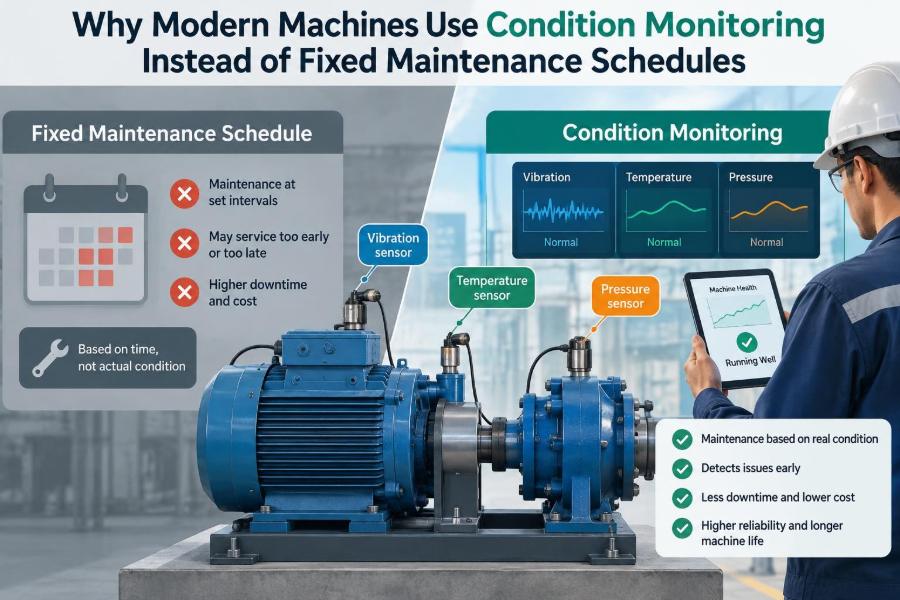

A production line is running smoothly when a technician receives an alert: one motor’s bearing vibration has changed. The motor still turns, its temperature is not yet alarming, and no one on the floor has noticed a problem. But the change is enough to schedule an inspection during the next planned stop.
Compare that with a more familiar approach: replace the bearing every six months because the maintenance calendar says so. Sometimes that replacement prevents a failure. Other times, a healthy component is discarded, the machine is opened unnecessarily, and a new installation introduces its own risks.
Modern maintenance increasingly tries to answer a better question than “What date is it?” It asks, “What is this machine telling us about its actual condition?”
This shift matters wherever machines are expensive to stop, difficult to access, safety-critical, or central to product quality. It is also changing the work of mechanical engineers: maintenance decisions now combine mechanical knowledge, sensor data, operating context, and disciplined judgment.
🧭 From Calendar-Based Work to Evidence-Based Decisions
Fixed maintenance schedules, often called time-based maintenance, prescribe work at set intervals: every month, every 2,000 operating hours, or after a specified number of cycles. The interval is usually based on manufacturer guidance, historical experience, regulation, or a cautious estimate of component life.
Condition monitoring collects indicators of machine health and uses their trends to decide whether maintenance is needed. The purpose is not to eliminate planned work. It is to target intrusive work where evidence suggests deterioration is developing.
⏱️ Why Fixed Schedules Became the Default
Scheduled maintenance grew from sensible practical needs. Early industrial assets often had limited instrumentation, maintenance records were paper-based, and failures could be costly. A calendar was visible, easy to audit, and far better than waiting for equipment to break.
Some items also genuinely age with use. Lubricants degrade, filters load with contaminants, corrosion protection may need renewal, and certain seals or belts have predictable service lives under stable conditions. Fixed intervals remain appropriate for these tasks.
📉 The Problem With Assuming Every Part Ages Alike
A fixed interval assumes that similar components experience similar deterioration. Real machinery rarely behaves so neatly. A pump in clean, steady service may be lightly loaded, while an identical pump handles abrasive fluid, frequent starts, or poor suction conditions.
Load, alignment, contamination, temperature, installation quality, and operator practices all change failure behavior. Replacing both pumps on the same date may therefore mean one is serviced too early and the other too late.
🧠 Understanding the P–F Interval
A useful reliability concept is the P–F interval. Point P is when a potential failure first becomes detectable by some method; point F is when the asset can no longer perform its required function. Between those points, a fault may be present even though the machine appears to run normally.
For example, a rolling-element bearing may first show a characteristic vibration pattern. Later it may generate heat, then noise, then damaging debris, and eventually seize or fail. Condition monitoring aims to detect the condition early enough to plan a controlled intervention.
🔍 What Condition Monitoring Actually Measures
Condition monitoring does not rely on one universal sensor. It measures physical effects associated with deterioration and compares them with a machine’s own baseline, operating state, and historical trend.
- Vibration can reveal imbalance, misalignment, looseness, resonance, and bearing or gear defects.
- Temperature can indicate excess friction, inadequate cooling, overload, or electrical problems.
- Oil analysis can identify wear particles, contamination, moisture, and lubricant degradation.
- Ultrasound can help detect compressed-air leaks, early bearing friction, and some electrical discharge phenomena.
- Electrical measurements can expose motor load changes, rotor-bar faults, insulation concerns, or driven-equipment problems.
📳 Vibration Analysis and Mechanical Fault Signatures
Vibration analysis is widely used on rotating machinery because rotating components create repeatable frequencies. Shaft speed, gear mesh frequency, blade-pass frequency, and bearing defect frequencies can provide clues about where a fault originates.
A high vibration reading alone is not a diagnosis. Technicians examine amplitude, frequency content, waveform shape, direction, and changes over time. They also need speed and load information, because a machine operating at a different point can naturally produce a different vibration response.
🌡️ Temperature Is Useful but Often Late
Temperature sensors and thermal imaging are simple, valuable tools. A hotter bearing housing may point to lubrication trouble, excess preload, misalignment, or a developing defect. A hot electrical connection may indicate resistance caused by a loose or deteriorated joint.
However, temperature often changes after a fault has progressed. Ambient conditions and process load can also mask a problem or create false concern. Temperature works best as one piece of evidence rather than a standalone verdict.
🛢️ Oil Analysis Turns Lubricant Into Evidence
Lubricating oil carries information through a gearbox, hydraulic system, or engine. Laboratory tests and on-site checks can examine viscosity, water content, oxidation, additive condition, particle count, and the type and quantity of wear debris.
Finding iron particles, for instance, does not automatically identify a failed gear. It may reflect normal wear, sampling contamination, or a developing problem. Repeated samples taken consistently are more informative than a single isolated result.
👂 Ultrasound Finds Problems Before They Become Obvious
High-frequency ultrasound is particularly effective for phenomena that may be inaudible in a noisy plant. It can detect turbulent compressed-air leaks, poor steam-trap behavior, early rolling-bearing distress, and some arcing or tracking conditions.
For a bearing, ultrasound may detect a change in friction before conventional vibration levels become prominent. Its usefulness depends on repeatable measurement locations and technicians who understand what process noise belongs to normal operation.
⚡ Motor Current Can Reveal the Driven Machine Too
A motor does not operate in isolation. Changes in current, power, torque demand, or speed can reflect problems in the motor, coupling, pump, fan, compressor, or process itself. A clogged filter, for example, may alter the load seen by a fan.
Electrical condition monitoring is especially useful when mechanical access is poor. Yet it must be interpreted carefully: variable-speed drives, supply quality, control strategies, and changing process demand all influence electrical signals.
📈 Trends Matter More Than Single Readings
One measurement is a snapshot. A trend is a story. A vibration value that is stable for months may deserve routine observation, while a lower value that doubles rapidly under comparable operating conditions can require prompt investigation.
This is why good programs record operating state alongside condition data. Speed, load, product, fluid temperature, and measurement location can explain variation that would otherwise be mistaken for deterioration.
🧱 Establishing a Healthy Baseline
Condition monitoring works best when measurements begin while equipment is known to be healthy. The baseline is not necessarily one perfect number; it is a reference range associated with normal operating conditions.
Newly commissioned machines are ideal candidates, but only if installation quality is verified first. A baseline taken from a misaligned pump or a poorly balanced fan merely documents a problem as though it were normal.
🧪 Why Operating Context Cannot Be Ignored
Machines respond to their environment. A fan’s vibration can change with airflow and damper position. A gearbox may run hotter during a heavier production recipe. A hydraulic system’s oil condition can shift after a filter change or maintenance activity.
Good analysis asks what changed in the process before concluding that the machine failed. This avoids unnecessary work and may uncover a production or design issue rather than a maintenance defect.
🧰 Detecting Bearings, Gears, and Misalignment Differently
Different faults leave different evidence. A bearing defect may produce high-frequency impacts and characteristic fault frequencies. Gear wear can affect gear-mesh patterns and sidebands. Misalignment often elevates vibration at shaft-related frequencies and can increase coupling or bearing loads.
These are diagnostic clues, not universal rules. Machine geometry, sensor position, signal processing, speed variation, and concurrent faults can complicate interpretation. Confirmation through inspection or another monitoring method is often appropriate before major action.
🏭 A Pump Example: The Value of an Early Warning
Consider a hypothetical process pump monitored with vibration, suction and discharge readings, and motor current. If vibration rises while hydraulic performance remains normal, the team might inspect alignment, lubrication, and bearing condition during the next opportunity.
If vibration and current change after a process modification, the root cause may instead be cavitation, recirculation, or operation away from the pump’s preferred range. Replacing bearings without addressing the hydraulic cause would invite the problem back.
🛠️ Planned Repair Is Different From Emergency Repair
When a developing fault is recognized early, maintenance can order parts, reserve labor, prepare procedures, and combine the work with a planned shutdown. The repair can be performed under controlled conditions rather than under pressure.
Emergency work tends to compress decisions. It may require overtime, expedited parts, hurried troubleshooting, and a longer production interruption. Condition monitoring does not remove all emergencies, but it can reduce surprises for faults that have detectable warning periods.
💰 Avoiding Wasteful Intrusive Maintenance
Opening a healthy machine is not risk-free. Every intrusive task introduces opportunities for contamination, incorrect assembly, damaged fasteners, poor alignment, incorrect lubrication, or missed commissioning checks. This is sometimes called maintenance-induced failure.
Condition-based decisions can extend the useful life of components that remain healthy. The goal is not to postpone work recklessly; it is to avoid replacing serviceable parts simply because an arbitrary interval has arrived.
🛡️ Safety and Environmental Consequences
Some failures carry consequences beyond downtime. A deteriorating seal, overheated bearing, damaged coupling guard, or leaking hydraulic system can create hazards for people and the environment. Monitoring can contribute to risk control by finding abnormal conditions before they escalate.
It is not a substitute for safeguards, inspections, or legal obligations. Safety-critical equipment needs carefully defined maintenance strategies, suitable proof testing where required, and clear escalation rules when a monitored condition changes.
📋 Condition-Based Maintenance Versus Predictive Maintenance
These terms are related but not identical. Condition-based maintenance uses observed condition to determine whether work is needed. Predictive maintenance usually goes further by estimating likely future condition or remaining time before functional failure using trends, models, or data-driven methods.
A technician noticing worsening bearing vibration and planning an inspection is practicing condition-based maintenance. A system forecasting when that trend may cross an action limit is predictive maintenance. Both still depend on sound mechanical understanding.
🤖 What Sensors and Software Can—and Cannot—Do
Connected sensors can collect data more frequently than manual routes, including from remote or hazardous locations. Software can trend signals, flag deviations, correlate data streams, and route alerts into maintenance workflows.
But more data is not automatically better maintenance. A low-quality sensor, poor installation, missing speed reference, or inappropriate alarm threshold can generate noise rather than insight. Software cannot compensate for a misunderstanding of the machine or its failure modes.
🚨 Alarm Limits Need Engineering Judgment
Alarm settings should account for machine type, measured parameter, operating state, risk, and baseline behavior. A limit borrowed from another asset may be unsuitable even if the two machines appear similar.
Many programs use staged responses: observe a mild deviation, investigate a significant change, and take urgent action when risk becomes unacceptable. The response plan matters as much as the alert itself; an alarm that no one owns is merely an expensive notification.
🧑🔧 Human Skill Remains Central
Condition monitoring changes the technician’s role; it does not eliminate it. Skilled practitioners select measurement points, verify sensor quality, recognize data artifacts, inspect physical evidence, and connect a signal to how the machine is actually operating.
Mechanical engineers contribute by understanding load paths, failure mechanisms, tolerances, lubrication regimes, dynamics, and system interactions. The strongest programs combine operator observations, maintainers’ experience, and analytical tools.
🗂️ Asset Criticality Decides Where to Start
Not every asset needs continuous monitoring. A low-cost, easily replaced fan may be better managed with basic inspections and a spare on hand. A large compressor, critical gearbox, or inaccessible conveyor drive may justify more capable sensing and analysis.
Criticality considers more than purchase price. It includes safety exposure, production effect, repair duration, spare availability, quality consequences, environmental risk, and whether redundant equipment exists.
| Asset situation | Often suitable approach | Why |
|---|---|---|
| Simple, low-consequence asset | Basic inspection and time-based tasks | Monitoring cost may exceed avoided disruption |
| Critical rotating asset with warning period | Periodic vibration and lubrication monitoring | Developing faults can often be planned |
| Remote or continuously operating critical asset | Continuous sensing plus expert review | Frequent data can reveal rapid changes |
| Safety-function equipment | Defined inspection and proof-test strategy, with monitoring where useful | Monitoring alone may not verify required function |
🧩 Choosing the Right Failure Modes
A common mistake is installing sensors because they are available rather than because they address a meaningful failure mode. Start with a simple question: how does this asset fail, and what evidence appears early enough to change the outcome?
For example, vibration may be valuable for an accessible motor-pump set, while oil cleanliness and pressure trends may be more relevant to a hydraulic system. Some failures are sudden or hidden and cannot be reliably predicted by routine condition data.
🔄 Fixed Tasks Still Have a Place
Condition monitoring is not an argument against schedules. Lubricant changes may follow time or lab results; statutory inspections may be mandatory; calibration, cleaning, functional checks, and replacement of known-life items often require planned intervals.
The best maintenance strategy is usually blended. Use fixed tasks where age or obligation governs risk, condition-based tasks where deterioration is detectable, and redesign or operational changes where repeated failure shows that maintenance is treating symptoms.
🧹 Data Quality Begins at the Measurement Point
Reliable data requires consistent mounting, location, orientation, instrument settings, and collection conditions. A handheld vibration measurement on a different spot each month may reflect measurement variation more than machine change.
For permanent sensors, cable routing, environmental protection, calibration practices, and cybersecurity also deserve attention. A sensor that fails silently can create false confidence, particularly when teams assume “no alert” means “no problem.”
⚠️ Common Mistakes When Launching a Program
- Monitoring every asset before identifying critical equipment and relevant failure modes.
- Using generic alarm limits without establishing normal behavior.
- Collecting data without assigning responsibility for review and action.
- Acting on one abnormal reading without checking operating conditions or measurement quality.
- Replacing a component but failing to investigate the cause of its deterioration.
- Measuring only technical signals while ignoring operator observations and process changes.
A focused pilot on a small group of important assets is usually more useful than a large sensor rollout with unclear decisions behind it.
🪜 A Practical Path for Building Condition Monitoring
- Identify critical assets and the consequences of their failure.
- List credible failure modes and determine whether each has a detectable warning period.
- Select the simplest useful measurement method and establish a healthy baseline.
- Define collection frequency, data ownership, alarm responses, and escalation paths.
- Review findings with maintenance, operations, and engineering together.
- Record confirmed faults and repair outcomes to improve future diagnosis.
This process creates a feedback loop. Each confirmed diagnosis teaches the team which signals matter, which thresholds need adjustment, and which recurring issues require a design or operating change.
📚 Documentation Turns Signals Into Organizational Knowledge
A good work record connects the initial symptom, condition data, inspection findings, repair action, and post-repair verification. Without that chain, teams cannot tell whether an alert was meaningful or whether the repair solved the underlying problem.
Over time, this history supports better spares planning, root-cause analysis, equipment specifications, and training. It also prevents valuable diagnostic knowledge from leaving when experienced personnel move on.
🎓 What Students and Early-Career Engineers Should Notice
Condition monitoring sits at the intersection of mechanics, materials, dynamics, tribology, instrumentation, controls, and operations. A sensor trace becomes useful only when someone understands the physical system that produced it.
When studying a machine, ask where forces enter, how they travel through shafts and housings, what surfaces wear, which variables change with load, and what failure would look like before it becomes visible. Those questions build the reasoning that dashboards cannot provide.
🌐 The Core Principle: Maintain According to Risk and Evidence
Modern machines use condition monitoring because a calendar is only a rough proxy for machine health. Evidence from vibration, temperature, lubricant, electrical behavior, and process performance can reveal how an individual asset is actually behaving.
The strongest strategy is neither “replace everything on schedule” nor “trust every sensor alert.” It combines appropriate scheduled tasks, well-chosen monitoring, competent interpretation, and repairs that address root causes. Maintenance becomes a decision process tied to condition, consequence, and the time available to act.
Condition monitoring earns its value when it turns early, trustworthy evidence into safer, better-timed maintenance decisions—not when it simply produces more data. For modern mechanical systems, that is the difference between reacting to failure and managing the path toward it. ⚙️📈🛠️