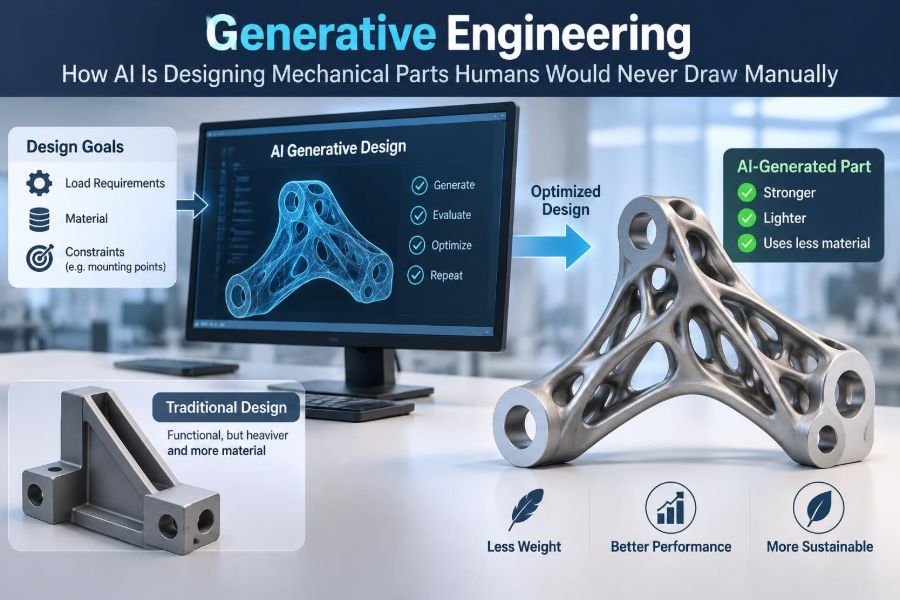

A bracket that holds a motor may look ordinary: a few mounting holes, two flat faces, perhaps a rib added where an engineer expects bending. It is the sort of component that has been designed thousands of times, often by starting from the last version and modifying it.
Then a generative-design tool produces a form that looks more like a bone, a root system, or a piece of coral. Material gathers along curving load paths, disappears from quiet regions, and leaves behind a shape that would be tedious to sketch and difficult to machine.
That unfamiliar geometry is not a gimmick. It is the visible result of asking software to search a much larger design space than a person can explore manually, while obeying engineering constraints.
For mechanical engineers, the real question is not whether an algorithm can replace judgment. It is how to use computational search, simulation, and manufacturing knowledge to create parts that are lighter, stronger in the right directions, and practical to make and inspect.
🧠 What Generative Engineering Actually Means
Generative engineering is a design approach in which software creates and evaluates many candidate solutions from goals, constraints, loads, materials, and manufacturing rules. The engineer defines the problem; the computer searches for useful geometry.
It is broader than a button that “makes a part.” The workflow can combine CAD geometry, optimization algorithms, finite element analysis, material data, and rules for a selected production process.
🧩 Generative Design, Topology Optimization, and AI
These terms overlap but are not interchangeable. Topology optimization mathematically distributes material within a defined space to improve an objective, commonly stiffness for a given mass. Its output is often an organic-looking material layout.
Generative design usually includes topology optimization but may also generate multiple layouts, consider manufacturing methods, and rank options against several criteria. AI can assist with pattern recognition, fast surrogate models, geometry generation, or design-space exploration, but not every generative workflow uses modern machine learning.
| Approach | Main question | Typical output |
|---|---|---|
| Parametric CAD | What happens when dimensions change? | Variants of a defined model |
| Topology optimization | Where should material remain? | Optimized material distribution |
| Generative engineering | Which feasible concept best meets the brief? | Several ranked design candidates |
| AI assistance | Can learned patterns speed a task? | Predictions, concepts, or faster searches |
📐 Why Conventional CAD Starts to Struggle
Human designers are excellent at interpreting requirements, recognizing manufacturing realities, and choosing sensible architecture. Yet manual CAD tends to begin with familiar primitives: plates, beams, bosses, ribs, and fillets.
That is efficient when a part must be milled, turned, molded, or assembled using established methods. It can be limiting when the design freedom is high and the loads travel through several directions at once.
🎯 The Design Brief Becomes the Geometry
A generative workflow begins with a precise brief. The software needs more than “make it lighter.” It needs a design region, preserved interfaces, load cases, supports, material assumptions, performance targets, and process constraints.
For example, an engineer might preserve four bolt-hole cylinders and a motor-mounting face, forbid material in a tool-access zone, apply a changing service load, and minimize mass while meeting a displacement limit. Those inputs shape every candidate that follows.
🗺️ Design Space, Keep-Out Space, and Preserved Geometry
The design space is the volume where material is allowed to exist. Preserved geometry contains features that must remain: bearing seats, threads, datum surfaces, fluid ports, or mounting interfaces.
Keep-out regions are equally important. They prevent an algorithm from growing material into assembly clearances, maintenance access, moving mechanisms, cable routes, or the sweep of a cutting tool.
⚙️ Loads Are More Than One Arrow
A weak setup often uses one neat static force because it is easy to define. Real parts may see acceleration, vibration, torque reversals, thermal expansion, preload, shock, and contact forces.
Each meaningful load case should be represented or bounded conservatively. A shape optimized for one load direction can be unexpectedly flexible or overstressed when the load reverses, shifts, or combines with another event.
🧱 Constraints Give the Search a Purpose
Objectives tell the solver what to improve: reduce mass, maximize stiffness, tune a natural frequency, reduce compliance, or manage heat flow. Constraints define what cannot be violated, such as displacement, stress, volume, safety clearance, or a minimum wall thickness.
Some goals compete. Less material generally lowers mass but can reduce stiffness. A good workflow makes those trade-offs visible rather than hiding them behind one attractive render.
🌊 How Material Follows Force Paths
Imagine a bridge made from countless tiny elements. The solver estimates how each element contributes to carrying the specified loads, then progressively removes or weakens material that contributes little while retaining material along efficient paths.
The result may branch around holes or blend several supports into a smooth junction. These forms can appear strange because force does not naturally travel only through straight, rectangular members.
🧮 The Role of Finite Element Analysis
Finite element analysis, or FEA, divides a model into many small elements and approximates its response to loads and boundary conditions. Generative workflows often use repeated FEA-like calculations to compare candidates.
The output is only as credible as the model. A beautiful stress plot cannot correct an unrealistic support, missing contact condition, coarse mesh in a critical feature, or unsuitable material model.
🔁 One Optimization Run Is Not a Finished Part
Optimization output is a proposal, not a released component. Engineers must interpret it, smooth or remodel geometry, add interfaces, assess fatigue and buckling, and validate performance independently.
This distinction matters because the solver has followed the mathematical problem it received. It has not inferred every requirement that remained in someone’s head or notebook.
🦴 Why the Shapes Often Look Organic
Nature-inspired appearance is a consequence of the search, not necessarily an attempt to imitate nature. Smooth branches and tapered transitions efficiently distribute force while avoiding abrupt stiffness changes.
Traditional designs may use sharp intersections because they are easy to draft and manufacture. Generative forms often replace these with flowing load paths, although practical redesign may deliberately simplify them afterward.
🖨️ Additive Manufacturing Opens New Options
Metal additive manufacturing can build internal channels, merged brackets, lattice structures, and curved load paths that would be difficult to create as one machined part. This makes it a natural partner for generative geometry.
But “printable” is not the same as “production-ready.” Build orientation, support removal, powder evacuation, surface condition, residual stress, distortion, and post-processing all influence whether a design is viable.
🛠️ Generative Design Is Not Only for 3D Printing
Manufacturing constraints can steer designs toward casting, forging, machining, sheet-metal forming, or hybrid routes. A machining-aware solution may preserve tool access and minimum internal radii; a casting-aware solution may include draft and avoid isolated heavy sections.
The resulting shapes may look less dramatic than a free-form additive result, but they can deliver more value when they fit an existing factory process.
🔩 Designing for Post-Processing
Critical fits and interfaces usually need finishing operations. Threaded holes may be drilled and tapped after printing; bearing bores may be machined; sealing faces may be milled or ground.
Include machining allowance, fixture locations, datum strategy, and tool approach early. Waiting until after optimization can turn a promising concept into an awkward, expensive production plan.
📏 Material Models Need Engineering Skepticism
Material properties entered into a solver are assumptions with limits. Additively manufactured metals can show direction-dependent behavior and properties affected by process parameters, heat treatment, geometry, and inspection quality.
For safety-critical work, use qualified data and an appropriate validation plan rather than treating a generic database value as a guarantee. The same caution applies to composites, plastics, weldments, and materials exposed to temperature or corrosion.
🧪 Fatigue Can Govern a Lightweight Part
A component can pass a static stress check and still fail under repeated service loads. Surface roughness, small geometric transitions, residual stress, pores, and local stress concentrations can strongly affect fatigue performance.
Generative geometry should therefore be checked for realistic cycles, load spectra, and finish condition. Where fatigue is critical, targeted smoothing, post-processing, and physical testing may matter more than another small reduction in mass.
📳 Vibration and Natural Frequency Matter Too
Many brackets and structures are not limited by static strength. A lighter design can shift its natural frequencies closer to excitation from motors, gears, rotating equipment, road inputs, or reciprocating motion.
Modal analysis helps identify these modes, but interpreting them requires system knowledge. A part does not vibrate alone: fasteners, joints, mounted mass, damping, and surrounding structure change the behavior.
🌡️ Thermal Problems Need Their Own Physics
Some components carry heat as well as force. A generated shape that is structurally efficient may create a poor conduction route, excessive thermal distortion, or inaccessible cooling passages.
Thermal loads, temperature-dependent properties, and expansion constraints should be included when relevant. Mechanical and thermal optimization can be combined, but only when the models represent the actual operating environment.
🧷 Interfaces Often Decide the Design
Most parts do not fail because their middle is insufficiently creative; they fail at connections. Bolted joints, inserts, welds, adhesive bonds, bearings, seals, and electrical or fluid interfaces introduce local requirements that generic optimization may not capture well.
Preserve robust interface zones and check load transfer into them. A lightweight arm attached to an overstressed bolt pattern is not a successful lightweight design.
🏭 A Hypothetical Bracket Example
Consider a robot end-effector bracket carrying a gearbox. A conventional design might be a machined plate with gussets. Its requirements include mounting faces, bolt access, a specified payload, repeated acceleration, and a stiffness limit to protect positioning accuracy.
A generative study could retain the interfaces, define the surrounding envelope, and examine several acceleration directions. It might identify two curved load paths between the gearbox face and the mounting rails, then an engineer could redesign those paths into a machinable or printable final part.
The credible comparison is not “organic versus conventional.” It is mass, stiffness, fatigue margin, manufacturability, lead time, cost, inspection method, and serviceability for the intended production volume.
📦 Part Consolidation Can Be the Bigger Win
Generative engineering can reveal that several brackets, spacers, and fasteners could become one component. Fewer parts may reduce assembly steps, tolerance stack-up, and potential joint looseness.
Consolidation also creates trade-offs. A single complex part may be harder to replace, more expensive to inspect, or too disruptive if one interface changes. The right architecture depends on maintenance and product lifecycle, not geometry alone.
💰 Cost Depends on Volume and Process
A topology-optimized, metal-printed part can be sensible in aerospace, motorsport, specialized automation, or low-volume equipment where performance and consolidation outweigh unit cost. It may be a poor choice for a high-volume component suited to stamping, casting, or simple machining.
Evaluate the whole route: design effort, machine time, material, supports, finishing, inspection, yield, tooling, assembly, and field service. A lower mass number is not automatically a lower total cost.
🔍 Verification Must Be Independent
Use an analysis workflow that is separate enough to challenge the optimization result. Remesh the remodeled part, review boundary conditions, inspect stress singularities, check deflection and buckling, and compare results with hand calculations where practical.
For physical hardware, prototype testing closes the loop. Strain measurements, modal testing, proof loads, dimensional inspection, and fatigue tests can reveal gaps between the digital model and manufactured reality.
🧑🔧 Human Judgment Remains Central
Software does not know whether an installer can reach a fastener, whether a surface must be cleaned, whether a supplier can inspect an internal passage, or whether a maintenance technician needs a familiar repair path. Those are engineering decisions grounded in context.
The engineer’s role shifts from manually drawing every candidate to framing the problem, judging assumptions, selecting trade-offs, and taking responsibility for the final design.
⚠️ Common Failure Modes in Generative Projects
- Incomplete load cases: optimizing for a nominal load while omitting transport, assembly, impact, or reverse loading.
- Unrealistic constraints: modelling a flexible bolted joint as perfectly fixed.
- Late manufacturing review: discovering inaccessible surfaces, trapped powder, or uninspectable features after the geometry is chosen.
- Chasing a mass target: accepting a thin, complex form without sufficient fatigue, vibration, or robustness checks.
- Trusting a single output: treating one solver result as proof rather than comparing alternatives and validating assumptions.
🧭 A Practical Workflow for First Projects
- Choose a part with clear loads, measurable performance, and enough design freedom to improve.
- Document interfaces, load cases, envelope, safety requirements, and manufacturing route before running software.
- Create a conventional baseline with known mass, stiffness, cost, and failure concerns.
- Run constrained concepts, then review them with manufacturing, quality, and service stakeholders.
- Remodel the selected concept, independently verify it, and test a prototype when the risk justifies it.
Starting with a non-safety-critical bracket or fixture is often more instructive than attempting a highly regulated, mission-critical component first.
📚 Skills That Make the Tools Useful
Generative engineering rewards fundamentals rather than bypassing them. Engineers need mechanics of materials, machine design, FEA literacy, CAD discipline, manufacturing-process knowledge, tolerancing, and an understanding of failure modes.
They also need the ability to ask precise questions. The quality of the solution is strongly tied to the quality of the design problem, including what has been constrained and what has been overlooked.
🔐 Data, Traceability, and Responsible Use
Engineering models may contain proprietary geometry, material information, and operating conditions. Teams should understand where design data is stored, who can access it, and how inputs, software versions, optimization settings, and approvals are recorded.
Traceability is especially valuable when a design changes later. A future engineer should be able to see why material exists in a location, what load case drove it, and what evidence supported release.
🔮 Where the Technology Is Heading
Tools are increasingly linking requirements, simulation, geometry generation, process planning, and inspection data. Faster approximations may allow broader early-stage exploration, while automation can handle repetitive setup tasks.
Still, mature use will likely look less like pressing a magic button and more like a connected engineering workflow. Better algorithms expand the search; they do not remove the need for accountable verification.
✅ The Core Principle: Search Broadly, Validate Rigorously
Generative engineering is most valuable when it expands a team’s options without weakening engineering discipline. It can expose load paths a designer would not sketch first, reduce material where it does little work, and support new manufacturing strategies.
The winning part is not necessarily the most organic one. It is the part that meets its functional requirements, survives its real environment, can be made and inspected reliably, and makes sense across its full lifecycle.
AI-driven generation can broaden mechanical design imagination, but sound requirements, manufacturable detail, and independent validation are what turn an unusual shape into dependable engineering. 🏭⚙️🔍