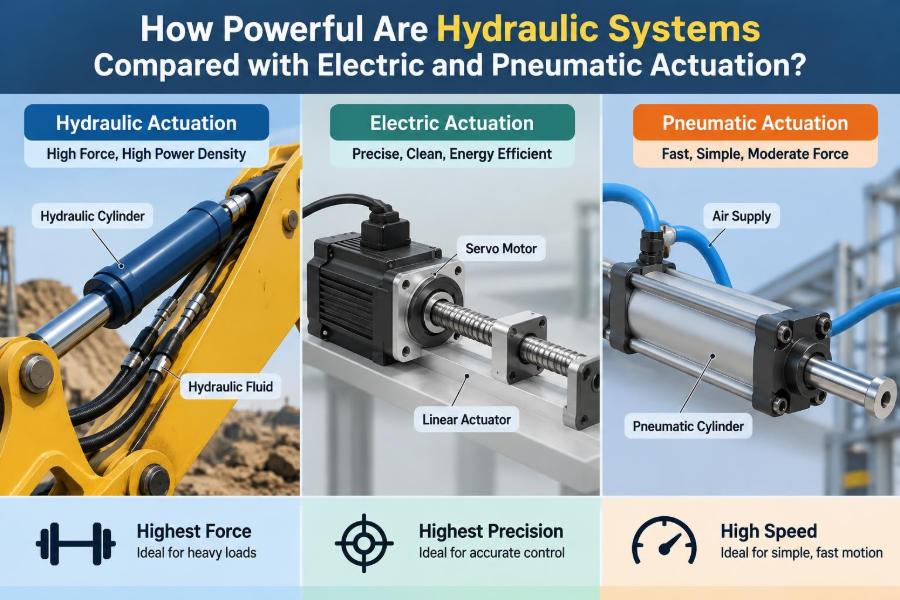

A construction excavator lifts a heavy bucket of soil, a factory robot places a delicate component, and a dental tool moves with compressed air. All three create controlled motion, yet the source and character of that motion are very different.
When engineers ask whether hydraulic systems are “more powerful” than electric or pneumatic actuation, the answer is not simply a contest of force. Force matters, but so do speed, precision, energy use, controllability, installation, maintenance, safety, and what happens when the machine stops.
The most powerful actuator on paper may be the wrong choice for a clean food-production line. A compact electric servo may outperform hydraulics in a positioning task, while a pneumatic cylinder can be the most sensible answer for a fast, simple clamp.
Understanding the trade-offs helps students select components intelligently and helps working engineers avoid designing around a single impressive specification. The useful question is: powerful enough, in what way, and for which duty?
⚙️ What an Actuator Actually Does
An actuator converts an energy source into mechanical motion. It may push in a straight line, rotate a shaft, grip a part, steer a vehicle, or hold a load in position.
Hydraulic actuators use pressurized liquid, usually oil. Pneumatic actuators use compressed gas, usually air. Electric actuation commonly uses motors, gearboxes, screws, belts, or direct-drive mechanisms.
The actuator itself is only part of the system. A pump or compressor, valves or drives, piping or cables, sensors, and a controller all influence final machine performance.
📏 Force, Torque, and Power Are Different Measures
Force is a push or pull, commonly measured in newtons. Torque is a turning effect, measured in newton-metres. Power is the rate at which work is done.
A cylinder can generate a huge force but move slowly, so its power may be moderate. Conversely, a smaller electric motor can deliver less torque but spin rapidly and produce substantial power.
For linear motion, mechanical power is approximately force multiplied by velocity. For rotation, it is torque multiplied by angular speed. This distinction prevents a common mistake: calling one technology more powerful merely because it has a high force rating.
💧 Why Hydraulic Systems Produce High Force
Hydraulics rely on pressure acting over area. In an ideal hydraulic cylinder, force is described by F = P × A, where P is fluid pressure and A is piston area.
Because liquids are nearly incompressible and hydraulic systems can operate at high pressure, a relatively compact cylinder can produce very large forces. Increasing piston area raises force; increasing pressure does too, provided every component is rated for it.
Real systems lose some force to seal friction, pressure drop in hoses and valves, and back pressure on the return side. The equation remains an excellent first sizing tool, but it is not the complete design calculation.
🔄 How Electric Actuators Make Motion
An electric motor develops torque through electromagnetic forces. The motor may drive a load directly, but many machines use a gearbox, belt, rack-and-pinion, or ball screw to trade speed for force.
A motor connected to a ball screw is a common electric linear actuator. Rotating the screw moves a nut and attached load linearly. A finer screw lead can increase available thrust, although it also changes speed and may affect back-drivability.
Electric actuation is therefore not limited to low force. Large industrial motors and screw-driven actuators can move very heavy loads. Their practical limits often come from gearbox size, screw buckling, heat, duty cycle, and structural stiffness rather than motor torque alone.
🌬️ Why Pneumatic Force Is Usually More Limited
Pneumatic cylinders use the same basic pressure-area relationship as hydraulic cylinders. The difference is that compressed-air systems generally operate at much lower pressure than hydraulic systems.
Air is also compressible. When a load changes, the air inside a cylinder can compress or expand like a spring, making motion less rigid and position control more difficult.
That does not make pneumatics weak or obsolete. Pneumatic cylinders can deliver useful force for clamping, sorting, ejecting, opening guards, and repetitive pick-and-place actions. They are simply less suited to compact, very high-force applications.
📊 A Practical Comparison at a Glance
| Characteristic | Hydraulic | Electric | Pneumatic |
|---|---|---|---|
| Force density | Very high | Moderate to high, mechanism dependent | Usually low to moderate |
| Positioning precision | High with suitable servo control | Often excellent | Limited without specialized control |
| Stiffness | High, though hose compliance matters | High with rigid mechanics | Lower because air compresses |
| Cleanliness | Leak risk must be managed | Generally clean at point of use | Clean exhaust, but air preparation matters |
| Best-known strength | Heavy-duty force | Controlled, efficient motion | Fast, simple repetitive action |
These are broad tendencies, not absolute rules. Component selection, controls, and machine architecture can shift the result significantly.
🏋️ Force Density: The Hydraulic Advantage
Force density means how much force a system can produce relative to its size or mass. This is where hydraulics are especially strong.
Mobile machinery must carry its own actuator system. A large excavator cannot rely on an oversized stationary electric drive for every joint, so compact hydraulic cylinders and motors offer a practical route to powerful working motions.
Hydraulic rotary motors also provide high torque in a compact package. This makes them useful for winches, drilling equipment, marine machinery, and attachments that encounter changing loads.
⚡ Electric Systems Can Still Be Extremely Powerful
It is misleading to treat electric actuation as suitable only for light automation. Electric drives power cranes, rolling mills, elevators, machine tools, rail traction equipment, and large industrial presses.
The key difference is often system layout. An electric motor may be physically separated from the point of force and connected through a transmission. Hydraulics can distribute power through fluid lines to cylinders or motors close to the work.
When electrical infrastructure is available and the movement benefits from programmable motion, electric systems can combine substantial power with highly repeatable control.
🧱 Pneumatics Excel at Simple, Fast Tasks
For a short stroke repeated thousands of times, a pneumatic cylinder can be difficult to beat for simplicity. Solenoid valves switch air flow quickly, cylinders are familiar to maintenance teams, and end-of-stroke sensing is straightforward.
Packaging machines often use pneumatic stops, gates, and pushers because the task is binary: extend or retract. The mechanism may not need a precise position at every point along the stroke.
The design becomes less attractive when the load is heavy, the stroke is long, energy cost is critical, or several intermediate positions must be controlled reliably.
🎯 Precision Depends on the Entire Control Loop
Precision is not automatically owned by one technology. It depends on sensors, controller resolution, mechanical backlash, friction, compliance, valve or drive response, and how disturbances are handled.
Electric servo systems are widely used for precise positioning because encoder feedback is integrated naturally with motor control. A servo drive can command position, speed, torque, or combinations of these modes.
Servo-hydraulic systems can also achieve accurate, high-force motion using proportional or servo valves and position feedback. They are common where large loads must follow controlled motion profiles, such as test rigs and heavy forming equipment.
🪀 Compressibility Changes Pneumatic Behavior
Imagine pushing a load with a spring instead of a rigid rod. Compressed air introduces some of that spring-like behavior. As pressure changes, the air volume responds, which can lead to bounce, overshoot, or variable speed.
Cushioning near cylinder end positions and flow-control valves can make pneumatic movement smoother. However, these measures do not turn a basic air cylinder into a high-stiffness servo axis.
Specialized electro-pneumatic systems can improve positioning, but designers should evaluate whether the added controls remove the original simplicity advantage.
🧭 Load Holding Is a Crucial Design Question
Can the actuator hold a load safely when power is removed? This question matters for vertical axes, suspended loads, clamps, and safety-critical mechanisms.
Hydraulic cylinders can hold loads with properly designed counterbalance valves, pilot-operated check valves, and directional controls. Internal leakage and temperature effects still need consideration.
Electric axes may need a mechanical brake or a self-locking transmission. Pneumatic systems can hold a position temporarily, but leakage and air compressibility mean they should not be assumed to provide secure long-term load holding without a dedicated locking method.
🚜 Why Heavy Mobile Equipment Uses Hydraulics
Excavators, loaders, forestry machines, and many agricultural implements face shock loads, dirty environments, and a need for large forces at multiple moving joints. Hydraulics fit these conditions well.
A central engine-driven pump can supply flow to several functions, while valves meter fluid to each cylinder or motor. Relief valves protect components by limiting pressure when a load becomes excessive.
Electrification is increasing in mobile machinery, but many designs still use electric motors to drive hydraulic pumps rather than replacing every hydraulic actuator. This hybrid architecture preserves hydraulic force density while changing the primary energy source.
🏭 Where Electric Actuation Takes the Lead
Electric actuators are especially compelling in automated assembly, electronics production, laboratory equipment, semiconductor manufacturing, and machine tools. These environments often value clean operation, accurate motion profiles, and digital integration.
A multi-axis robot illustrates the strength of electric servos. Each joint can follow a coordinated trajectory, monitor torque, and report faults through the control system.
Electric systems also avoid a continuously running hydraulic power unit in many applications. When motion is intermittent, this can reduce wasted energy and noise, although the actual result depends on drive sizing and operating pattern.
📦 Where Pneumatic Actuation Remains Sensible
Pneumatics remains a practical choice where the plant already has a compressed-air network and the required action is simple. Typical examples include part ejection, carton handling, fixture clamping, and valve operation.
Air-powered devices can tolerate some harsh conditions and are often easy to install. In certain hazardous locations, pneumatic tools also avoid placing an electric motor directly at the working point, though the complete safety assessment remains application-specific.
The best pneumatic application is usually not one demanding maximum force or perfect path control. It is one where modest force, quick cycling, and uncomplicated hardware create overall value.
🔋 Energy Efficiency Is More Than the Actuator
Comparing efficiency requires looking from energy source to useful mechanical work. A highly efficient motor cannot compensate for a poorly chosen gearbox, and a hydraulic cylinder cannot be judged only by pump efficiency.
Compressed air is often an expensive utility because generating, drying, distributing, and leaking air consumes energy. A persistent leak may seem minor at one fitting but becomes meaningful across a facility.
Hydraulic systems lose energy through throttling, fluid friction, leakage, and heat. Electric systems have motor, drive, and transmission losses. Regenerative hydraulic circuits and regenerative electric drives can recover energy in suitable decelerating or lowering motions, but they add complexity.
🌡️ Heat Reveals Hidden Losses
Heat is a visible consequence of inefficiency. In a hydraulic system, throttling fluid through a restrictive valve converts useful pressure energy into heat. In electric systems, current creates resistive heating in windings and cables, while gearboxes and screws add friction.
Actuator duty cycle matters. A component that works briefly once per minute may stay cool, while the same component repeatedly accelerating and stopping a load can overheat.
Thermal limits should be checked early. Selecting for peak force alone can produce a machine that performs during commissioning but derates, drifts, or fails during sustained production.
🛢️ Hydraulic Fluid Is Both a Benefit and a Responsibility
Hydraulic fluid transmits power, lubricates moving components, carries heat, and helps protect surfaces from wear. Its condition strongly affects pump life, valve performance, and seal reliability.
Contamination is a major concern. Solid particles can damage close-clearance components, while water, incorrect fluid, and entrained air can cause corrosion, poor lubrication, cavitation, or erratic behavior.
Effective filtration is not an optional accessory. Filter location, cleanliness targets, sampling, reservoir design, and maintenance practices should match the sensitivity of the hydraulic components.
🔧 Mechanical Transmission Shapes Electric Capability
Electric actuator performance changes dramatically with its transmission. A direct-drive torque motor offers smooth, responsive motion but may be larger than a geared alternative. A gearbox can increase output torque, but introduces backlash, friction, and sometimes reduced efficiency.
For linear axes, ball screws provide efficient, accurate force transmission, while belt drives favor long travel and high speed. Rack-and-pinion systems suit longer strokes and heavier moving structures.
Do not compare an electric motor’s catalogue torque directly with a hydraulic cylinder’s thrust. First translate both systems to the same output: force at the load, speed at the load, and required duty cycle.
📐 Cylinder Geometry Affects Hydraulic and Pneumatic Output
A double-acting cylinder has different effective areas on its two sides because the piston rod occupies area on the rod side. Extension force is therefore usually greater than retraction force at the same pressure.
Long, slender cylinders may face buckling when loaded in compression. Mounting style, side loads, rod diameter, stroke length, and end conditions all affect allowable load.
Side loading is another frequent problem. Cylinders are designed primarily to apply axial force; guide rails or external bearings should carry loads that would bend the rod or damage seals.
🧮 Sizing Requires More Than a Peak Load
A useful sizing process begins with the external load, but it must include gravity, friction, acceleration, process forces, and any shock or impact. Then define the needed stroke, speed, cycle time, and accuracy.
For electric systems, check continuous and peak torque, reflected inertia, acceleration profile, transmission limits, and thermal duty. For fluid-power systems, check pressure, flow, valve capacity, line losses, cylinder area, and available pump flow.
Reasonable design margin is necessary, but excessive oversizing can make control worse, waste energy, and raise cost. The goal is not the largest actuator; it is a reliably matched system.
🧯 Safety Devices Must Match the Failure Mode
Each actuation technology fails differently. A hydraulic hose can rupture, an electric drive can fault or unexpectedly restart if controls are poorly designed, and a pneumatic line can lose pressure suddenly.
Safety measures may include pressure relief valves, hose restraints, mechanical stops, brakes, load-holding valves, lockout procedures, guarded motion zones, and stored-energy release procedures.
Never treat an actuator as safe merely because it stops moving. Pressure, electrical charge, gravity, compressed air, and rotating inertia can all remain hazardous after commanded motion ends.
🔊 Noise, Leaks, and the Working Environment
Hydraulic power units can create noise from pumps, motors, and fluid flow. Pneumatic exhaust and air leaks can be loud, particularly in fast-cycling equipment. Electric systems are often quieter, though gearboxes, cooling fans, and rapid motion still create sound.
Oil leakage can contaminate floors, products, soil, or water depending on location. Air leaks do not leave liquid behind, but they waste energy and can affect machine performance.
Environmental conditions also influence selection. High temperatures, washdown, dust, corrosive chemicals, vacuum conditions, and clean-room requirements can change which seals, enclosures, lubricants, and actuator architecture are appropriate.
🧰 Maintenance Looks Different for Each Technology
Hydraulic maintenance focuses on fluid health, leaks, filters, seals, hoses, pressure settings, and pump condition. Preventive attention often prevents expensive damage to precision valves and pumps.
Electric maintenance may involve cable inspection, connector integrity, encoder feedback, bearings, brakes, cooling, gearbox lubrication, and alignment. Diagnostics from modern drives can help identify overloads and following errors.
Pneumatic maintenance includes air filtration, moisture control, regulator condition, lubricator requirements where applicable, leak detection, valve function, and seal wear. Clean, dry air is central to dependable pneumatic performance.
🧪 A Simple Comparison Example
Consider a hypothetical vertical fixture that must raise a heavy tooling plate through a short stroke, hold it safely, and repeat this motion slowly. A hydraulic cylinder may be attractive because it can generate large force compactly and use load-holding valves.
Now change the requirement: the plate must move to several positions with tight repeatability, record its position continuously, and coordinate with other axes. An electric servo and screw mechanism may become the clearer choice.
If the load becomes light and the action becomes a quick up-or-down stop on a packaging line, a pneumatic cylinder may be sufficient. The load did not merely change in magnitude; the entire control requirement changed.
🔀 Hybrid Systems Are Often the Practical Answer
Real machines frequently combine technologies. An electric servo may position a workpiece precisely, pneumatic clamps may hold it, and hydraulic equipment may perform the high-force forming operation.
Electro-hydraulic actuation is another important combination. Electric controls command valves or variable-speed pump drives, allowing hydraulic power to be applied more selectively and intelligently.
Choosing a hybrid arrangement is not indecision. It is often a deliberate way to use each technology where its strengths matter most.
🚫 Common Selection Mistakes
- Choosing hydraulics solely because the load is heavy, without checking whether clean, precise electric motion would be simpler.
- Choosing pneumatics because cylinders are inexpensive, while ignoring compressor capacity, leaks, and poor position control.
- Comparing catalogue ratings at different output points or under different duty conditions.
- Ignoring heat, side loads, shock, or the need to hold a suspended load after power loss.
- Assuming sensors and software can compensate for inadequate mechanical stiffness.
Most poor selections begin with a narrow requirement such as “maximum force.” A better specification states the full motion task and operating environment.
📝 Questions to Ask Before Choosing
- What force or torque is required at the load, including acceleration and worst-case resistance?
- What speed, stroke, travel range, and cycle time are needed?
- Must the system follow a precise path or simply move between end positions?
- How will it hold or stop the load during a power or pressure loss?
- What duty cycle, ambient conditions, cleanliness requirements, and maintenance skills are available?
- What is the total system cost, including utilities, controls, installation, and lifecycle maintenance?
These questions turn a technology debate into an engineering decision.
🧠 The Core Principle: Match Power to the Job
Hydraulic systems are often the leading choice when high force or torque must come from a compact actuator, especially in heavy machinery and demanding load-handling applications. Their advantage is substantial, but it comes with fluid management, plumbing, heat, and maintenance responsibilities.
Electric actuation is exceptionally versatile and frequently excels when precision, programmability, cleanliness, and efficient intermittent operation matter. Its power ceiling is far higher than the stereotype of “small motors” suggests.
Pneumatics remains valuable for fast, economical, straightforward motion, especially when exact intermediate positioning is unnecessary. Its lower pressure and compressibility define its limits as clearly as its simplicity defines its appeal.
The strongest actuation technology is the one that delivers the required force, motion quality, safety, and lifecycle performance for the real machine—not the one with the most impressive single rating. ⚙️💧⚡