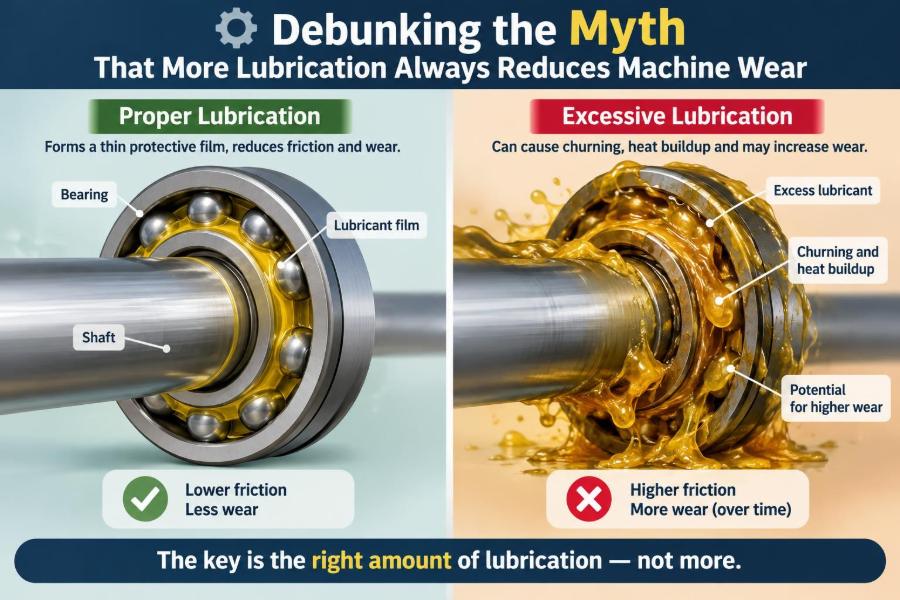

A maintenance technician notices a bearing housing running warmer than usual. The first instinct is understandable: add more grease. A machine operator sees oil near a gearbox seal and assumes the gearbox must be well protected. In both cases, the equipment may actually be receiving too much lubricant—or the wrong lubricant in the wrong place.
The idea that “more lubrication means less wear” sounds sensible because lubrication does prevent direct surface contact. Yet a lubricant is not simply a protective coating to be applied without limit. It is a carefully selected working fluid or semi-solid that must reach a contact zone in the correct amount, at the correct viscosity, and under suitable operating conditions.
Over-lubrication can raise temperature, churn lubricant into foam, force contaminants through seals, damage electric-motor bearings, and conceal developing faults. Under-lubrication is dangerous too, but avoiding one extreme does not justify creating the other.
For students learning machine design and professionals maintaining rotating equipment, the useful question is not “Have we added enough?” It is “Does this machine have the right lubricant, in the right condition, delivered in the right quantity and interval?”
🧠 Why the “More Is Better” Idea Persists
Lubrication has a visible, immediate association with smooth movement. A squeaky hinge often becomes quiet after a small amount of oil, so it is easy to extend that experience to every mechanical system.
Industrial components behave differently. Bearings, gears, compressors, hydraulic valves, and machine-tool spindles operate with specified internal clearances, speeds, temperatures, and sealing arrangements. Their lubricant requirement is governed by those conditions, not by a general desire to fill every empty space.
Another reason for the myth is that damage from excessive lubricant may not appear instantly. A greased bearing can continue operating while heat and pressure gradually build, making the real cause less obvious than a dry, noisy component.
🛢️ What Lubrication Is Actually Meant to Do
A lubricant has several jobs beyond making surfaces feel slippery. Depending on the machine, it can reduce friction, limit wear, carry away heat, protect against corrosion, seal small clearances, suspend contaminants, and transmit power.
These functions depend on lubricant properties and flow. In a circulating oil system, for example, oil must remove heat and transport particles to a filter. In a rolling-element bearing, grease must release a small amount of base oil into the contact while remaining in place as a reservoir.
Too little or too much can interfere with these functions. Lubrication is therefore a controlled engineering condition, not a one-directional adjustment.
🔬 The Lubrication Regimes Behind Wear Control
Engineers often describe lubricated contacts using three broad regimes: boundary, mixed, and full-film lubrication. The regime depends on speed, load, lubricant viscosity, geometry, and surface condition.
- Boundary lubrication: The fluid film is extremely thin, and surface asperities—microscopic high points—can interact. Additives and surface chemistry play a major role.
- Mixed lubrication: Part of the load is carried by a fluid film, while some asperity contact remains.
- Full-film lubrication: A continuous lubricant film separates the surfaces. This may be hydrodynamic or elastohydrodynamic, depending on the contact.
Adding lubricant volume does not automatically change a contact from boundary or mixed lubrication to full-film operation. The decisive factors are often viscosity at operating temperature, relative speed, applied load, and lubricant supply to the contact.
📏 Quantity Is Different From Film Thickness
One of the most useful distinctions is between the amount of lubricant in a housing and the thickness of the film at the loaded contact. A bearing cavity can be completely packed with grease while the rolling contacts still receive no better film than they would with a correctly filled cavity.
Film thickness is created by motion, fluid properties, and contact geometry. In a journal bearing, shaft rotation draws oil into a converging gap and develops a pressure-supporting wedge. Pouring in extra oil does not improve that wedge once the system already has an adequate supply.
In fact, excessive lubricant can increase resistance to motion and heat generation, which may lower viscosity and make maintaining a healthy film more difficult.
🌡️ Why Too Much Lubricant Can Increase Temperature
Lubricant itself resists being sheared. When rotating parts repeatedly push through an excessive volume of oil or grease, mechanical energy is converted into heat. This is called churning loss.
In a grease-lubricated rolling bearing, excess grease can be worked continuously by balls or rollers, cages, and races. The added drag may raise bearing temperature significantly enough to alter grease consistency, accelerate oxidation, and shorten lubricant life.
Heat is not merely a comfort issue for machinery. It changes viscosity, affects additive performance, stresses seals, and can distort clearances. A housing that runs hotter after greasing deserves investigation rather than another grease shot.
🌀 Churning and Windage in High-Speed Systems
High-speed gears and shafts are especially sensitive to oil level. If gears dip too deeply into an oil sump, they must repeatedly accelerate and throw oil aside. This creates churning, aeration, and power loss.
Rotating components can also whip air and lubricant into a turbulent mixture. This is often called windage when aerodynamic drag is a major contributor. The machine may consume more energy while the lubricant becomes hotter and less able to form a stable film.
Gearbox designers specify oil levels so gear teeth pick up enough lubricant without operating as paddles. An oil sight glass is not an invitation to fill the housing to the top; it is a means of keeping the oil within its intended range.
🫧 Aeration and Foam Are Not Harmless Bubbles
Excessive agitation can entrain air in oil. Aerated oil contains dispersed bubbles that can reduce effective film strength, impair hydraulic stiffness, and make pump operation less stable.
Foam is related but distinct: it is a layer of relatively persistent bubbles at the surface. Both conditions can interfere with lubrication and heat transfer. In hydraulic equipment, air can make actuator motion erratic and contribute to noise or cavitation-related problems at pump inlets.
Oil condition, reservoir design, return-line placement, fluid level, contamination, and additive balance all influence foam behavior. Simply adding oil to a low-looking or foamy reservoir may worsen the situation if the actual issue is air ingress or poor return flow.
🧈 Why Grease Is Not Just Thick Oil
Grease is usually made from a base oil held within a thickener structure, along with additives. The thickener helps the lubricant stay where it is needed, while the base oil gradually bleeds into moving contacts.
That structure explains why grease cannot be treated like an empty volume that should be packed full. A bearing normally needs enough grease to establish a reserve and protect against contamination, but it also needs free space for heat dissipation and displaced grease.
The correct fill depends on bearing type, speed, orientation, housing design, and relubrication method. Manufacturer guidance should take priority over generic rules of thumb.
⚙️ What Happens Inside an Overgreased Bearing
When too much grease is forced into a bearing, the rolling elements may have to plow through it. Frictional torque rises, and the bearing begins generating more heat. The grease can soften and migrate through seals or vents.
At elevated temperature, the base oil may separate or oxidize more quickly, while the thickener can be mechanically worked beyond its intended condition. The result can be a paradox: a bearing was given more grease but later has poor-quality lubricant at the contact.
Overgreasing may also push old grease and contaminants inward if the purge path is blocked. Adding grease without providing a safe route for excess material is a common maintenance mistake.
🔌 Electric-Motor Bearings Need Particular Care
Electric motors often have relatively high bearing speeds and limited grease cavity volume. Overgreasing can increase operating temperature and force grease into areas where it does not belong, including winding regions in some motor designs.
Motor bearings can also face electrical damage from shaft currents in certain variable-frequency-drive applications. More grease does not solve that separate mechanism; the remedy may involve grounding, insulation, or bearing design choices.
Where motors have grease fittings and drain plugs, maintenance instructions commonly require opening the drain during regreasing and allowing excess grease to purge safely. The exact procedure must follow the motor manufacturer’s documentation.
🧪 Viscosity Matters More Than Extra Volume
Viscosity is a fluid’s resistance to flow. For lubricating oil, it strongly affects whether an adequate separating film can form under a particular speed and load. A lubricant that is too thin at operating temperature may not provide enough film; one that is too thick may cause drag, poor flow, or excessive heat.
Adding more of an oil with unsuitable viscosity does not correct the mismatch. A heavily loaded slow gearset may require a different viscosity grade than a high-speed spindle, even if both appear to be “well lubricated.”
Viscosity also changes with temperature. Selection should therefore consider the machine’s real operating temperature, not only the ambient conditions when lubricant is stored or applied.
🧬 Additives Cannot Compensate for Every Error
Lubricants may contain antiwear, extreme-pressure, antioxidant, rust-inhibiting, detergent, dispersant, and antifoam additives. These chemicals are formulated for particular applications and should not be assumed interchangeable.
For example, an extreme-pressure gear lubricant may not be appropriate for a component with materials or friction requirements that call for a different formulation. Mixing products can dilute additive systems or create compatibility concerns.
More lubricant also means more additive exposure, but that does not equal more protection. The correct approach is to use an approved product at the required condition and quantity.
🧱 Contamination Often Causes More Wear Than Low Volume
Particles, water, process chemicals, and abrasive dust can turn lubricant into a transport medium for wear rather than protection. Hard particles caught between moving surfaces can scratch, indent, and fatigue those surfaces.
An overfilled system is not necessarily a clean system. Excess grease around seals can attract dirt, while careless greasing practices can introduce contaminants directly through fittings, open containers, or unclean tools.
Clean transfer equipment, sealed storage, filtered oil, and wiped grease fittings often matter as much as the refill itself. A small amount of clean, correct lubricant is usually preferable to a large amount of contaminated lubricant.
💧 Water Changes the Lubrication Problem
Water can promote corrosion, reduce film performance, alter additive behavior, and accelerate oil degradation. In some systems, it can form emulsions that make condition monitoring and separation more difficult.
Adding fresh oil without finding the source of water can mask the symptom while leaving the cause intact. Possible routes include damaged breathers, failed seals, washdown exposure, condensation, or faulty heat exchangers.
Water management may require improved sealing, desiccant breathers, draining, dehydration, or oil replacement, depending on the lubricant and machine. The right response depends on the source and severity of contamination.
🔒 Seals Have Limits, Not Infinite Capacity
Seals are designed to retain lubricant and exclude contamination under expected pressure, shaft movement, and temperature. Overfilling can raise internal pressure and force oil or grease past seal lips, gaskets, and labyrinth paths.
A leak after servicing is not always proof that the seal was already defective. It may indicate that the lubricant level is too high, a vent is blocked, or grease was added too quickly.
Once lubricant escapes, it can create housekeeping hazards, contaminate products, attract debris, and leave the intended contact under-lubricated later. The visible leak is often only one part of the problem.
🧯 Blocked Vents Can Turn Routine Lubrication Into a Pressure Problem
Gearboxes and bearing housings need a way to accommodate pressure changes as temperature changes. A blocked breather or vent prevents this equalization and can force lubricant out through the weakest available path.
Before attributing repeated seal leakage to “bad seals,” inspect the breather condition and verify the oil level. In dirty environments, breathers themselves require suitable protection and periodic maintenance.
Good lubrication practice considers the whole system: reservoir, vent, seal, drain, filter, and lubricant—not just the fitting where material enters.
📊 Oil Level Is a Design Setting, Not a Fullness Target
Many machines use sight glasses, dipsticks, or level plugs to establish an operating range. These markers reflect the intended relationship between lubricant level and moving parts, often when the machine is stopped and settled.
Checking level at the wrong time can create confusion. Some systems require a specific shutdown period, operating temperature, or machine position before readings are meaningful. The equipment manual should define the correct method.
| Observation | Possible interpretation | Better next step |
|---|---|---|
| Low sight-glass level | Leak, consumption, incorrect previous fill, or reading taken under unsuitable conditions | Verify the inspection procedure and inspect for the cause before topping up |
| Oil above the marked range | Overfill, thermal expansion issue, or process-fluid ingress | Confirm level condition and investigate before continued operation |
| Foamy or cloudy oil | Air entrainment, water contamination, incompatible fluid, or agitation | Identify the mechanism; do not assume more oil is the cure |
🔁 Relubrication Intervals Are Not Universal
A bearing in a clean, cool, lightly loaded application may need a very different relubrication interval from a bearing exposed to heat, moisture, vibration, or heavy loading. Speed and bearing size also change grease life and replenishment needs.
Fixed calendar schedules are easy to administer, but they can lead to overgreasing when applied without regard to actual duty. Conversely, an interval that works for one machine may be too long for another that looks similar.
Where practical, maintenance plans should be based on equipment documentation, operating conditions, lubricant type, failure history, and condition-monitoring evidence.
🧰 The Right Grease Quantity Depends on the Application
Some equipment makers provide a grease quantity per relubrication event, often based on bearing dimensions and housing arrangement. This is more reliable than pumping until resistance is felt or grease appears at a random location.
For a hypothetical example, imagine two identical bearings: one operates slowly in a dusty conveyor pulley, while the other runs at high speed in a compact motor. The conveyor bearing may need a different grease strategy because contamination exclusion is a dominant concern; the motor bearing may be more vulnerable to churning heat.
Neither situation supports a universal “more is safer” rule. The application determines the balance.
🧭 Centralized Lubrication Systems Need Calibration
Automatic lubrication systems can improve consistency and reduce exposure to hazardous access points. However, automation does not eliminate the need for engineering judgment.
A pump setting, line restriction, damaged injector, or incorrect timer can deliver too much, too little, or no lubricant at all. Long distribution lines may also behave differently at low temperatures or with high-consistency grease.
Commissioning should verify delivery at each point, and periodic checks should confirm that outputs remain appropriate. A centralized system is valuable when it is monitored, not when it is assumed to be infallible.
🔍 Condition Monitoring Gives Better Clues Than Guesswork
Lubrication decisions improve when they are informed by machine condition. Useful tools may include temperature trends, vibration analysis, ultrasound, oil analysis, particle counting, and routine visual inspection.
Each method has limits. A temperature increase can result from lubrication problems, but also from misalignment, excessive load, electrical effects, or cooling failure. Oil analysis can reveal contamination or degradation, but sampling must be representative and interpreted in context.
The goal is not to replace practical observation with a single test. It is to combine evidence before deciding whether lubrication quantity is truly the cause.
📈 Temperature Trends Are More Useful Than One Reading
A single temperature measurement can be affected by ambient conditions, load, instrument placement, and recent operating history. A trend over comparable conditions is often more meaningful.
If bearing temperature rises soon after regreasing and load has not changed, overgreasing is a plausible explanation. If temperature was already rising before lubrication, adding grease may not address the underlying fault.
Record the lubricant added, amount, product, date, and observed condition. These simple records make cause-and-effect patterns easier to identify later.
🎧 Ultrasound Can Help Identify Grease Needs
Ultrasound instruments can detect high-frequency sound generated by friction, impacts, and lubricant-film behavior in bearings. In skilled use, technicians may add small grease increments while observing the response rather than applying a large fixed amount at once.
This does not mean ultrasound can diagnose every bearing problem or replace manufacturer limits. It is a decision aid, and results can be influenced by sensor position, load, speed, and defect condition.
Its practical value lies in supporting controlled lubrication: add a measured amount, observe the response, and stop when the evidence indicates that further addition is unnecessary.
🧼 Lubricant Compatibility Deserves Attention
Mixing lubricants can be risky, especially with grease. Different thickener systems may be incompatible, causing softening, hardening, oil separation, or altered consistency. Even when thickeners are broadly compatible, base oils and additives may not suit the combined application.
Changing products should involve a compatibility review, a planned changeover method, and attention to residual lubricant in housings and lines. “It is all grease” is not a sufficient technical basis for mixing.
For oil systems, viscosity, additive chemistry, seal materials, and operating requirements should likewise be checked before a substitution.
🧑🔧 Common Habits That Create Over-Lubrication
Many excess-lubrication problems come from routine habits rather than neglect. They are preventable when procedures are specific and technicians have the right information.
- Pumping grease until it appears at a seal without confirming the intended purge path.
- Using the same number of grease-gun strokes for every bearing.
- Filling a gearbox above its specified level “for extra protection.”
- Adding oil to compensate for foam without investigating air or water ingress.
- Using an unlabelled grease gun or assuming products are compatible.
- Ignoring blocked vents, dirty fittings, and poor lubricant storage practices.
These actions can feel cautious, but they replace controlled maintenance with assumption.
📝 A Practical Lubrication Procedure
A sound procedure makes the correct action repeatable. It should identify the component, approved lubricant, quantity, interval or condition trigger, method, and any special requirements such as opening a drain plug or checking a level after shutdown.
- Confirm the machine and lubrication point.
- Clean the fitting, fill point, and nearby surfaces before opening the system.
- Verify the approved lubricant and avoid accidental product mixing.
- Check machine condition, level, venting, and signs of leakage or contamination.
- Apply the specified amount slowly, using the required operating or shutdown condition.
- Allow safe purging where the design and procedure require it.
- Record the action and watch for abnormal temperature, noise, or leakage afterward.
The details vary by asset, but the principle remains the same: lubrication should be measured, clean, and observable.
🏭 Design Choices Influence Lubrication Tolerance
Some machines are more tolerant of lubrication variation than others. Housing volume, seals, grease-relief provisions, sump geometry, oil slingers, filtration, and cooling all influence how a machine responds to excess or insufficient lubricant.
Designers can make maintenance safer by providing clear level indicators, accessible drain and fill locations, contamination control, labelled lubrication points, and documented quantities. Maintenance teams can provide valuable feedback when designs make correct servicing difficult.
Reliability is strongest when equipment design and maintenance practice support each other rather than relying on improvisation in the field.
⚖️ When Additional Lubricant Is Actually Necessary
The myth should not be replaced with an opposite myth. There are situations where lubricant must be added: a verified low oil level, a scheduled replenishment requirement, a known leak awaiting repair, or a condition-monitoring result that supports intervention.
Contaminating environments may also require more frequent grease replenishment to help purge contaminants, but this must be consistent with bearing design and a deliberate purge strategy. More frequent does not mean unlimited quantity.
The decision should be based on a defined need. Additional lubricant is beneficial when it restores the designed operating condition, not when it exceeds it.
🚦 Warning Signs That Call for Investigation
Several observations should prompt a closer look before anyone reaches for a grease gun or oil container:
- A temperature increase after lubrication.
- Fresh leakage around seals, vents, or motor end shields.
- Foam, milky appearance, darkening, or an unusual odor in oil.
- Repeatedly low oil level without an identified reason.
- Abnormal noise, vibration, or rising ultrasound readings.
- Grease hardening at a fitting or no visible path for old grease to leave.
These signs do not establish one diagnosis by themselves. They are evidence that the lubrication system and the machine’s operating condition should be checked together.
🎓 Building Better Lubrication Decisions
Good lubrication practice starts with accurate information: component identification, lubricant specification, quantity, interval, operating context, and inspection method. It becomes more reliable when technicians understand why each instruction exists.
Training should cover contamination control, grease-gun output, labeling, compatibility, safe purge practices, and the difference between a lubricant symptom and a root cause. A clear procedure is most effective when people can recognize when conditions fall outside it.
For students, this is a useful broader engineering lesson: simple maintenance actions still depend on tribology, heat transfer, fluid behavior, materials, and system design.
✅ The Core Principle: Enough, Not Excess
Lubrication reduces wear by helping surfaces operate under suitable film conditions and by supporting functions such as cooling, contamination control, and corrosion protection. Those benefits occur when lubricant selection, cleanliness, level, and delivery are matched to the machine.
Excess lubricant can create churning losses, heat, foam, pressure, leaks, and contamination risks. Too little can cause starvation and surface damage. The target is neither extreme; it is the designed operating range.
When a machine shows distress, avoid treating lubricant quantity as the only variable. Check the product, the condition, the application method, the operating environment, and the mechanical system itself.
The best lubrication strategy is not to add as much as possible; it is to deliver exactly what the machine needs, when it needs it, and keep it clean while it works. ⚙️🛢️🔍