
A high-speed machine often gives warning before it fails: a rising vibration reading, a bearing-temperature alarm, a change in sound, or an unexpected maintenance shutdown. In a compressor, turbine, machine-tool spindle, or vacuum pump, the bearing is frequently the small component setting the operating limit for a much larger and more expensive system.
Conventional rolling-element and fluid-film bearings have served industry extremely well. Yet as shaft speeds rise, the familiar problems become harder to manage: frictional heat, lubricant behavior, wear, seal losses, and the risk that a brief upset becomes contact damage.
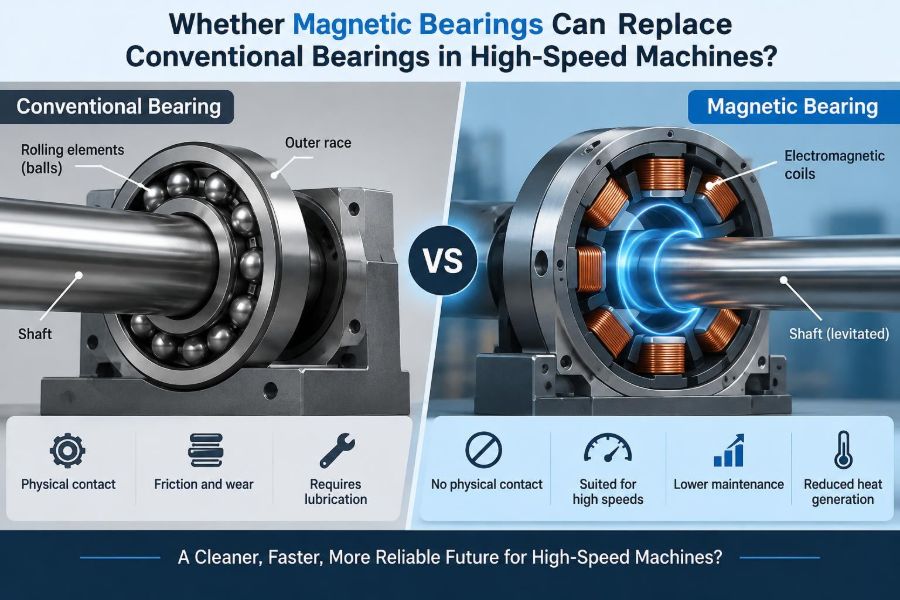
Magnetic bearings offer an appealing alternative. They hold a rotating shaft in position with controlled electromagnetic forces, allowing normal operation with no metal-to-metal contact. That sounds like an obvious upgrade—but replacing a conventional bearing is not simply a matter of swapping hardware.
The real question is not whether magnetic bearings are “better.” It is whether their capabilities, controls, costs, and failure modes fit a specific high-speed machine and its duty cycle.
🧭 The Question Behind “Replacement”
To replace a bearing means more than carrying radial and axial load. The new support system must control rotor position, survive transients, maintain stiffness, fit the machine envelope, and satisfy safety and availability requirements.
A conventional bearing is usually a largely passive mechanical component. An active magnetic bearing, or AMB, is an electromechanical system: its performance depends on sensors, power electronics, control software, actuators, and backup bearings as well as the magnetic hardware.
⚙️ What a Bearing Must Do
Every rotating shaft needs support in radial directions; many also need axial or thrust support. The bearing must resist applied loads while allowing intended rotation with acceptable heat generation and motion.
In high-speed service, it must also manage rotor dynamics. Even a well-machined rotor has some mass eccentricity, and its rotating unbalance produces a force that increases strongly with speed. The support must guide the rotor through critical speeds without excessive vibration.
🧲 The Basic Principle of Magnetic Levitation
An AMB uses electromagnets arranged around a rotor-mounted ferromagnetic target, commonly called a journal. Increasing current in one electromagnet increases attractive force and pulls the rotor toward that pole.
The rotor runs inside a small air gap. Because magnetic attraction is stronger when the gap becomes smaller, an unsupported magnetic arrangement is inherently unstable: a slight movement toward one pole tends to pull the rotor farther that way. Active feedback corrects that tendency continuously.
📡 The Closed-Loop Control System
Position sensors measure shaft displacement, often in two radial directions at each bearing location. A controller compares the measured position with a reference center position and commands currents to opposing electromagnets.
This control loop operates rapidly enough to counter normal rotor motion. The controller can be tuned to provide effective stiffness and damping, much as a suspension system uses springs and dampers, except these characteristics are created partly in software.
🔌 The Main Parts of an Active Magnetic Bearing
A practical AMB installation includes several tightly connected subsystems:
- Radial and axial magnetic actuators to generate support forces.
- Displacement sensors to locate the shaft relative to its target center.
- Power amplifiers to supply controlled coil current.
- A digital controller with protection logic and tuning parameters.
- Auxiliary or touchdown bearings for shutdowns, start-up, and fault events.
Calling this assembly “a bearing” is convenient, but its system nature explains both its strengths and its engineering burden.
🏎️ Why Speed Changes the Design Problem
At higher rotational speeds, rolling-element bearings face increasing cage speed, centrifugal loading, contact stress, and lubricant churning. Fluid-film bearings can support very high speeds, but their viscous losses, oil supply, sealing, and thermal management become significant design concerns.
Magnetic bearings avoid continuous contact in normal operation. They therefore remove rolling contact and, at the bearing itself, eliminate shear losses associated with an oil film. This can make them attractive where speed, cleanliness, or low process contamination matters.
🌀 Rolling-Element Bearings at High Speed
Ball and roller bearings remain common because they are compact, mature, relatively simple, and able to provide high stiffness. Hybrid ceramic rolling bearings can extend capability in demanding spindles and electrically sensitive applications.
However, they still require careful lubrication and preload selection. At high speed, a design that is robust at moderate speed may generate too much heat or experience reduced fatigue life. Their limits depend on bearing geometry, load, lubrication method, cooling, and the entire rotor arrangement—not speed alone.
🌊 Fluid-Film Bearings at High Speed
Hydrodynamic journal bearings use a pressurized wedge of lubricant generated by shaft motion. Tilting-pad journal bearings are particularly valued in many large turbomachines because their pads can provide stable oil-film behavior over a useful operating range.
These bearings are not obsolete alternatives waiting to be displaced. They are proven supports for substantial loads and can handle harsh duty when the oil system is properly designed. Their trade-offs are oil infrastructure, parasitic losses, leakage risk, and maintenance associated with lubricant management.
🧪 Permanent-Magnet and Passive Designs
Not every magnetic bearing is actively controlled. Permanent magnets can supply bias force, while passive magnetic elements may reduce load or stabilize selected directions. Superconducting bearing concepts also exist for specialized applications.
For general high-speed industrial machines, though, full passive levitation is constrained by fundamental stability limitations for ordinary static magnetic arrangements. Active control is usually needed when precise, stable multidirectional support is required.
📏 Stiffness Is Not a Fixed Material Property
With a mechanical bearing, stiffness comes mainly from geometry, contact mechanics, or the oil film. An AMB has magnetic stiffness, but its apparent dynamic stiffness also depends on sensor location, controller bandwidth, current capacity, and control-law design.
This flexibility can help engineers shape the machine response. It also means a poorly tuned AMB can create unacceptable vibration behavior even when its magnetic components are physically sound.
🎚️ Damping Is Often the Deciding Benefit
Damping removes energy from vibration. In a rotor system, insufficient damping near a natural frequency can allow vibration to grow to damaging levels.
Active control can introduce virtual damping: the controller commands forces opposing measured motion. This capability is especially valuable for flexible rotors operating near or above bending critical speeds, where a passive support may not provide the desired response.
📈 Critical Speeds and Rotor Dynamics
A critical speed occurs when rotational excitation aligns with a natural frequency of the rotor-support system. Passing through a critical speed is normal for many machines; the engineering goal is to keep vibration within acceptable limits during passage and at operating speed.
AMBs allow adjustments to support dynamics without machining a new bearing shell. Still, control cannot repeal physics. Rotor mode shapes, seal forces, couplings, process loads, and casing flexibility must be modeled and validated as part of the complete train.
🧼 Oil-Free Operation Changes the Whole Machine
A major attraction of magnetic bearings is oil-free operation at the bearing location. Removing a lube-oil system can eliminate pumps, reservoirs, filters, coolers, piping, and some seal arrangements.
This matters in clean vacuum equipment, process compressors where oil contamination is unacceptable, and installations where oil leakage creates environmental or operational concerns. The benefit is system-specific: machines may still need lubricants elsewhere, such as gearboxes or seals.
🌡️ Heat Does Not Disappear
Contactless support reduces bearing-contact heat, but an AMB system still creates heat in its coils and power amplifiers. Electrical losses must be removed, and high ambient temperature can affect insulation life, electronics reliability, and sensor performance.
Designers should ask where the heat goes, not merely whether the rotor touches the bearing. Cooling paths, enclosure temperature, and fault-current limits deserve early attention.
⚡ Electrical Power Is a New Dependency
A conventional bearing may continue supporting a shaft during a power interruption, at least until other machine systems coast down. An AMB needs electrical power and functioning control to levitate the rotor.
That is why critical AMB systems commonly use stored energy, such as batteries or capacitors, to support a controlled rundown after loss of normal supply. The required ride-through time depends on rotor inertia, process conditions, and the shutdown sequence.
🛟 Touchdown Bearings Are Essential
Auxiliary bearings catch the rotor when magnetic support is unavailable or before the system is energized. They are not an optional afterthought; they are a core part of fault tolerance.
A touchdown event can involve high surface speed, heat, impact, and rubbing. The bearing type, clearance, materials, dry-running behavior, allowable number of events, and coastdown profile must be assessed. A design intended for one rare emergency is different from one expected to tolerate frequent starts and stops.
🚨 Faults Must Be Designed For
Sensor faults, amplifier faults, cable damage, controller errors, cooling failures, and loss of power can each challenge levitation. Good designs use monitoring and protective logic to identify abnormal conditions and initiate an orderly response.
Redundancy can improve availability, but it is not automatically beneficial. It adds components, interfaces, testing requirements, and possible common-cause failures. The appropriate architecture follows the machine’s consequence of failure and maintenance philosophy.
🧱 Load Capacity Has Practical Limits
Magnetic force is limited by air-gap geometry, magnetic saturation, coil current, heat rejection, and available electrical power. Very high static loads can demand large actuators or make a conventional support more economical.
AMBs are often most compelling when moderate loads combine with very high speed, a need for clean operation, or a difficult rotor-dynamic problem. They are less automatically attractive when the main requirement is simply carrying heavy load at modest speed.
📐 Air Gaps Demand Manufacturing Discipline
The levitation gap is small enough that alignment, runout, thermal growth, and casing distortion matter. Sensor targets and actuator surfaces need suitable geometry and material behavior, while the rotor must have enough clearance for expected excursions.
Mechanical tolerances have not vanished; they have moved into a system where precision affects control margin. A shaft that expands thermally or a housing that deflects under piping load can consume valuable gap clearance.
🔊 Vibration Monitoring Becomes More Informative
Because AMBs already measure shaft position, they provide rich operational data. Orbit plots, displacement trends, actuator currents, and controller responses can reveal unbalance, misalignment, process changes, or developing rubs.
This does not make diagnosis automatic. Analysts still need to distinguish a control response from the underlying disturbance. But the instrumentation can support condition-based maintenance when data quality and interpretation are strong.
🏭 Machines Where AMBs Fit Well
Magnetic bearings are established in selected high-speed rotating equipment, including some turboexpanders, compressors, vacuum pumps, energy-storage flywheel systems, and specialized machine tools. These applications value one or more of the following:
- High rotational speed with low to moderate bearing loads.
- Oil-free or contamination-sensitive operation.
- Operation in vacuum, process gas, or difficult-to-lubricate environments.
- Active management of flexible-rotor vibration.
- Compact machinery with reduced auxiliary oil equipment.
Suitability still varies widely within each category. “Compressor” or “spindle” is not enough information for a bearing choice.
🏗️ Machines Where Conventional Bearings Remain Strong
Large steam turbines, heavy industrial gearboxes, pumps, fans, and many electric motors continue to use rolling-element or fluid-film bearings effectively. A well-designed conventional bearing system may be simpler, familiar to site personnel, and better matched to high loads or challenging cost limits.
Replacing it with an AMB can add complexity without solving a meaningful problem. The best technical decision is sometimes to improve lubrication, alignment, balance quality, seals, or oil-film stability rather than change bearing technology.
💰 Comparing Life-Cycle Cost Rather Than Purchase Price
An AMB system usually has higher initial engineering and equipment cost than a conventional bearing arrangement. It also requires specialized commissioning and may require staff training, controls support, and spare electronic modules.
Its economic case can improve when it removes substantial oil-system hardware, reduces contamination risk, saves downtime associated with lubrication issues, or enables a faster and more compact machine. The comparison should include installation, utilities, planned maintenance, fault recovery, and production consequences—not only the bearing invoice.
🧰 Maintenance Shifts Rather Than Vanishes
There is no routine bearing lubrication during normal levitated operation, and no rolling contact to fatigue in the usual way. Yet AMB systems need inspection and verification of sensors, cables, electrical connections, cooling, event logs, backup power, and touchdown-bearing condition.
The maintenance skill set shifts from primarily mechanical work toward a blend of mechanical, electrical, and controls competence. Organizations should plan for that shift before adopting the technology.
🧠 Control Software Is Part of the Safety Case
Controller settings determine how the rotor responds to disturbances. Version control, access permissions, backups, validation after modifications, and documented commissioning tests are therefore practical reliability measures, not administrative extras.
Changing a gain because vibration “looks high” without rotor-dynamic understanding can reduce stability margin. Treat controller tuning with the same discipline applied to changing a bearing clearance or a critical rotating component.
🔍 A Fair Side-by-Side Comparison
| Consideration | Active magnetic bearing | Rolling-element or fluid-film bearing |
|---|---|---|
| Normal contact | No contact during levitated operation | Rolling contact or lubricating film support |
| Lubrication at bearing | Not required | Usually required or integral to operation |
| Dynamic tuning | Adjustable through control strategy within limits | Primarily set by mechanical and fluid properties |
| Power dependence | Requires electrical power and controls | Does not require active levitation power |
| Fault support | Needs touchdown-bearing strategy | Support remains mechanical, subject to its own failure modes |
| Typical complexity | High electromechanical integration | Often mechanically simpler, though oil systems can be extensive |
🧮 Start With a Duty-Cycle Review
Before selecting any bearing, map the actual operating cycle: starts, stops, coastdowns, speed ramps, load changes, ambient conditions, process gas, expected upset cases, and maintenance windows.
For an AMB, frequent low-speed operation and repeated touchdown risk may be more influential than the headline maximum speed. For a conventional bearing, lubricant viscosity at start-up or thermal equilibrium at full load may dominate.
🧑💻 Model the Complete Rotor Train
A credible selection process includes rotor-dynamic analysis of shafts, impellers, couplings, seals, supports, casing flexibility, and driven or driving equipment. For AMBs, the model should include actuator limits, sensor behavior, control dynamics, and touchdown scenarios where relevant.
Models guide decisions, but commissioning measurements remain necessary. Manufacturing variation, field piping loads, and process effects can differ from assumptions, so acceptance testing should verify behavior across the intended operating range.
⚠️ Common Selection Mistakes
Several errors recur when teams compare bearing technologies:
- Assuming “frictionless” means zero energy use or zero maintenance.
- Ignoring power-loss behavior and auxiliary-bearing capability.
- Comparing component prices while omitting oil-system or controls costs.
- Treating controller tuning as separate from mechanical design.
- Choosing an AMB only for high speed, without checking load, environment, and duty cycle.
- Expecting a conventional bearing to solve a rotor-dynamic issue caused elsewhere in the train.
A requirements-led review prevents technology enthusiasm from becoming an expensive redesign cycle.
📝 Questions to Ask a Supplier or Design Team
Useful questions are specific: What loads and temperatures define the operating envelope? What happens after loss of mains power? How long can the rotor coast under stored energy? How are touchdown events detected and recorded? Which parameters may site personnel change?
Also ask how the system is commissioned, what diagnostic data are available, what spares are needed, and which fault scenarios have been tested. Clear answers reveal whether the integration plan is mature.
🌍 Efficiency and Environmental Trade-Offs
Removing oil circulation can reduce auxiliary equipment and the environmental burden associated with lubricant handling and disposal. Lower bearing losses may also help overall efficiency, particularly where every watt of heat matters.
But AMBs consume electrical power and require electronics and cooling. Their environmental value should be evaluated at system level, including the eliminated oil infrastructure, machine operating hours, and the actual energy penalty or saving in the specific design.
🔮 Where Development Is Heading
Continued progress in power electronics, sensors, computing, diagnostics, and rotor-dynamic modeling can make AMB systems more capable and easier to integrate. Better condition monitoring may also help operators recognize changes before they become forced outages.
These advances do not imply that all machines will become magnetically supported. Mechanical bearing technology also continues to improve through materials, lubrication methods, coatings, manufacturing accuracy, and predictive maintenance.
✅ The Core Decision: Match the System to the Machine
Magnetic bearings can replace conventional bearings in many high-speed machines, and in the right application they offer decisive advantages: contactless running, oil-free support, active vibration control, and valuable operating data. Their strongest case arises when those advantages solve a real machine-level constraint.
They are not universal replacements because they introduce dependencies on power, electronics, controls, precise integration, and reliable touchdown protection. Conventional rolling-element and fluid-film bearings remain highly capable choices when their load capacity, simplicity, cost, and service experience align with the machine.
The core principle is straightforward: choose the bearing system that manages the complete rotor, operating environment, failure response, and life-cycle cost—not the one with the most impressive single feature.
Magnetic bearings are a powerful tool for high-speed machinery, but successful replacement depends on whole-system engineering rather than magnetic levitation alone. ⚙️🧲📈