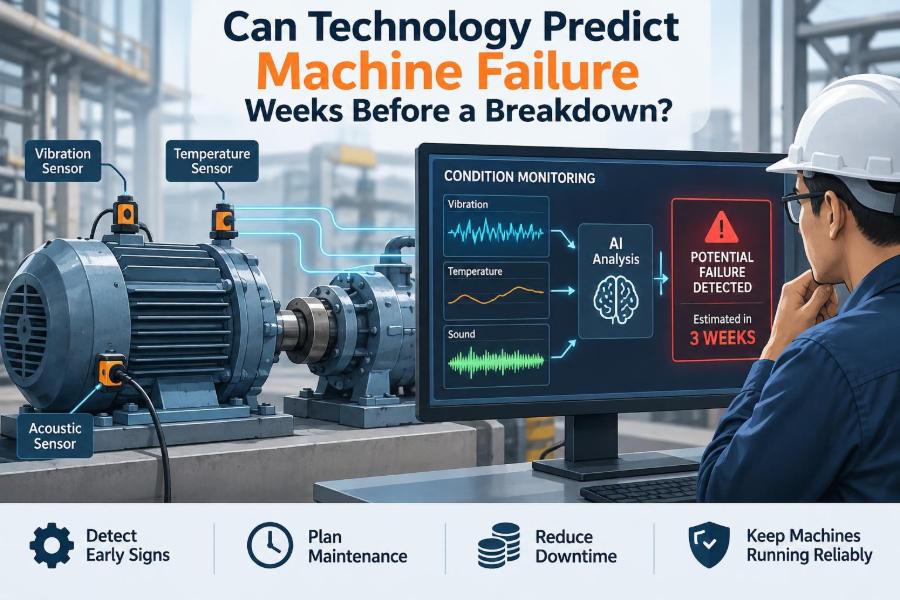

A production line is running normally when a technician notices that one motor sounds slightly different. The machine is still making parts, so stopping it feels hard to justify. Three weeks later, that small change becomes a seized bearing, a halted line, and an urgent repair.
Similar moments occur in elevators, wind turbines, pumping stations, HVAC plants, trucks, and home appliances. Most equipment does not fail without warning; it changes gradually. The challenge is recognizing a meaningful warning before it becomes an expensive interruption.
Modern sensors, data systems, and machine-learning tools can help engineers detect those changes earlier than traditional maintenance rounds. But “predicting failure weeks ahead” is not a crystal-ball capability. It is a disciplined process of measuring condition, understanding failure mechanisms, and making sound decisions under uncertainty.
For students, this topic connects mechanics, instrumentation, statistics, and reliability. For working professionals, it raises a practical question: when is a prediction trustworthy enough to plan work, order parts, or safely keep a machine in service?
🔍 What failure prediction really means
Failure prediction estimates the likelihood that equipment will lose its required function within a future period. It may forecast a developing bearing defect, declining pump efficiency, insulation deterioration, or an increasing chance of unplanned shutdown.
It does not always identify an exact date. A useful prediction often says, “This gearbox is degrading faster than its normal baseline and should be inspected during the next planned outage.”
🧰 Predictive maintenance versus preventive maintenance
Preventive maintenance schedules work by time, operating hours, or cycles. Replacing a belt every fixed interval is a familiar example. It reduces risk, but may replace healthy components too early.
Predictive maintenance, often called condition-based maintenance, uses measured evidence to decide when intervention is needed. The goal is neither “run to failure” nor “replace everything early”; it is to act when condition justifies action.
📈 Why machines often give warning signs
Many mechanical failures are progressive. Lubrication contamination can increase friction, friction can raise temperature, and wear can alter vibration long before a shaft stops rotating.
This progression creates a potential-failure interval: the time between a detectable defect and functional failure. Prediction is possible only if this interval is long enough and the chosen measurement can detect the defect.
⏳ Weeks ahead depends on the failure mode
A slowly growing rolling-element bearing defect may be detectable well before failure. A sudden electrical surge, a manufacturing defect, or an operator error may offer little or no warning.
The useful lead time therefore varies by component, duty cycle, environment, and consequence of failure. “Weeks ahead” is plausible for some degradation processes, but it is not a universal promise.
🎧 Vibration as a mechanical fingerprint
Accelerometers measure how a machine moves or shakes. Rotating equipment naturally produces vibration, but imbalance, misalignment, looseness, gear damage, and bearing defects change its pattern.
Engineers often inspect vibration amplitude and frequency content. A frequency spectrum separates a complex signal into individual components, much like separating the notes in a chord. The pattern can reveal which rotating element is likely involved.
🌡️ Temperature trends and thermal clues
Temperature sensors are simple but valuable. A bearing housing that becomes warmer than its own normal operating baseline may indicate rising friction, excessive load, lubrication trouble, or poor cooling.
Temperature alone rarely identifies the cause. Ambient conditions, product temperature, speed, and load can all change it. Its strongest value comes from comparing like-for-like operating conditions over time.
🛢️ Oil analysis looks inside the machine
Lubricant carries evidence from contacting surfaces. Oil analysis can examine viscosity, contamination, moisture, additive condition, and wear particles. These indicators can reveal processes hidden inside a gearbox or hydraulic system.
For example, an increase in ferrous debris may justify further investigation of gears or bearings. It does not automatically identify a failed part, because sampling quality and contamination control matter greatly.
⚡ Electrical signatures reveal motor condition
Motor current, voltage, power factor, and insulation-related measurements can expose electrical or mechanical changes. A driven pump problem may alter motor load; rotor or supply issues may affect current patterns.
Electrical monitoring is especially useful where physical access is difficult. Still, it requires knowledge of the motor, variable-speed drive, load profile, and supply quality to avoid misleading interpretations.
🔊 Ultrasound detects high-frequency friction
Ultrasonic instruments listen above the range of normal human hearing. They can help detect early bearing friction, compressed-air leaks, steam leaks, and some lubrication issues.
The method works best when technicians collect readings consistently from repeatable locations. A reading taken from a different angle or distance may reflect the measurement method rather than machine deterioration.
👁️ Visual inspection still has a role
Smart monitoring does not eliminate basic observation. Leaks, loose guards, belt dust, discoloration, damaged couplings, and abnormal motion often provide direct evidence that no algorithm should ignore.
Routine inspection also gives context to sensor data. A vibration increase might be caused by a recently changed baseplate bolt rather than an internal bearing defect.
📡 The condition-monitoring data chain
A prediction system is a chain, not merely a sensor. It includes measurement, signal transmission, storage, cleaning, analysis, alarm logic, human review, and maintenance execution.
A weak link can defeat the whole effort. A highly capable model cannot correct a loose sensor, an incorrect machine tag, missing operating-state data, or an alarm that nobody owns.
🧪 Baselines matter more than one reading
Machines differ. Two identical pumps may run at different temperatures because of fluid properties, suction conditions, or installation details. A single “high” value is less informative than a sustained departure from the machine’s established behavior.
A baseline should cover representative speeds, loads, and seasons where relevant. It gives engineers a reference for asking, “What changed, and is that change physically credible?”
🧹 Data quality sets the prediction limit
Missing timestamps, uncalibrated sensors, duplicate asset names, and inconsistent units can create false conclusions. Data preparation is often a larger engineering task than selecting an advanced algorithm.
- Verify sensor placement and mounting.
- Record speed, load, process conditions, and maintenance events.
- Synchronize clocks across systems.
- Flag sensor failures separately from equipment failures.
🧠 What machine learning adds
Machine learning can find patterns across many signals that are difficult to inspect manually. It may classify operating states, detect anomalies, estimate remaining useful life, or rank assets by risk.
Its value is strongest when it augments engineering judgment. A model can identify an unusual pattern; engineers must still determine whether it represents damage, a process change, or poor data.
📉 Anomaly detection versus failure forecasting
Anomaly detection asks whether present behavior differs from normal. It is useful when historical failure examples are scarce, which is common for critical assets that are repaired before catastrophic failure.
Failure forecasting attempts to estimate future condition or time to a defined failure threshold. That is harder because the model needs meaningful examples, clear failure definitions, and consistent records.
🧭 Remaining useful life is an estimate
Remaining useful life, or RUL, describes the expected time or operating exposure before a component no longer meets its requirement. It is often better communicated as a range than a single precise number.
Load changes can accelerate or slow degradation. An RUL estimate produced during steady operation may become unreliable after a change in production rate, material, lubrication, or operating environment.
🧱 Physics-informed models improve interpretation
Mechanical knowledge makes data analysis more reliable. Known bearing frequencies, pump affinity laws, fatigue relationships, thermal behavior, and lubrication mechanisms constrain what a plausible result looks like.
Combining physical understanding with data-driven methods is often called a physics-informed approach. It reduces the temptation to accept an impressive-looking pattern that has no credible mechanism behind it.
🏭 A pump example
Consider a hypothetical process pump monitored for vibration, suction and discharge pressure, flow, motor current, and bearing temperature. A rise in vibration alone may suggest bearing wear, imbalance, cavitation, or a mounting issue.
If the rise occurs only at low suction pressure and coincides with unstable flow, cavitation becomes a stronger explanation. If it persists across stable process conditions and bearing-frequency components increase, inspection of the bearing and lubrication system becomes more justified.
⚙️ A gearbox example
A gearbox may show increasing gear-mesh vibration sidebands, hotter oil, and particle debris. Together, these signals are more persuasive than any one of them alone because they describe related consequences of a mechanical problem.
The maintenance response might include confirming oil level and contamination, inspecting alignment and load, reviewing vibration trends, then planning an internal inspection. The appropriate action depends on duty, safety risk, and available shutdown windows.
🚨 False positives have real costs
A false positive is an alarm for a problem that is not actually developing. It can waste labor, interrupt production, and reduce trust in the monitoring system.
Alarm limits should therefore not be copied blindly from another machine. They need review against operating context, historical behavior, and the cost of both unnecessary action and missed detection.
⚠️ False negatives can be more serious
A false negative occurs when a real defect is missed. In critical equipment, the result can include safety hazards, environmental releases, collateral damage, or a long production outage.
Risk determines how conservatively alerts should be handled. A noncritical fan and a pump supporting a safety-related process should not necessarily use the same decision threshold.
🛡️ Prediction is not a substitute for protection
Condition monitoring should complement, not replace, guards, relief devices, shutdown interlocks, inspections, and other protective measures. A predictive system can be unavailable, misconfigured, or unable to detect a sudden event.
Safety-critical decisions need appropriate engineering review, documented procedures, and fail-safe design. A dashboard prediction alone is not a safety barrier.
🔧 Maintenance history trains the future system
Work orders often contain the most valuable labels in a reliability program: what failed, what was found, what was replaced, and whether the alarm was confirmed. Vague notes such as “fixed machine” limit later analysis.
Useful records identify the asset, component, observed condition, cause where known, corrective action, and operating context. Clear records turn repairs into learning rather than isolated events.
👷 Human expertise remains central
Experienced technicians notice sounds, smells, operating habits, and installation details that sensors may not capture. Their observations also test whether a model’s recommendation makes mechanical sense.
The best systems create a feedback loop: analytics highlights risk, people investigate, maintenance outcomes refine the rule or model, and the organization learns which warnings were actionable.
📊 Choosing the right assets first
Not every asset needs continuous monitoring. Start where failure consequences are high, downtime is costly, access is difficult, degradation is detectable, and a planned intervention could prevent significant disruption.
| Asset situation | Likely monitoring approach | Why |
|---|---|---|
| Critical rotating equipment | Continuous vibration and process monitoring | Frequent data can capture developing faults. |
| Moderate-risk pumps and fans | Route-based vibration and inspection | Periodic checks may provide adequate lead time. |
| Simple low-cost components | Run-to-failure or scheduled replacement | Monitoring may cost more than the avoided consequence. |
🗺️ A practical implementation path
- Define the asset’s required function and credible failure modes.
- Select measurements linked to those failure modes.
- Establish baseline behavior across operating states.
- Create clear alarm review and escalation responsibilities.
- Track whether alerts led to verified findings and better outcomes.
Beginning with a focused pilot is usually more useful than instrumenting everything at once. It exposes data, workflow, and training gaps before the program expands.
📚 Skills students and professionals should build
Useful capability sits at the intersection of mechanical systems and data literacy. Learn failure modes, sensors, signal interpretation, lubrication, reliability concepts, and the basics of statistics.
Also practice asking practical questions: What is being measured? What mechanism connects this signal to damage? What operating condition could explain the change? What action would this warning enable?
🌍 The wider value of earlier intervention
Earlier detection can reduce emergency work, secondary damage, wasted materials, and avoidable energy losses. A poorly aligned drive or degrading pump may consume more energy before it reaches a clear functional failure.
These gains are conditional, not automatic. They occur only when detected issues are verified, prioritized, and corrected with appropriate maintenance practices.
🎯 The core principle: predict condition, then manage risk
Technology can often identify deterioration weeks before a breakdown when the failure develops gradually, the right indicators are measured, and the data is interpreted in context. It cannot eliminate uncertainty or foresee every abrupt event.
The real achievement is not a perfectly timed forecast. It is turning early evidence into a safer, better-planned decision: inspect, adjust operation, prepare spares, schedule repair, or continue monitoring with justified confidence.
Machine-failure prediction works best when sensors, engineering knowledge, maintenance records, and human judgment operate as one system—not when any single tool is treated as an oracle. ⚙️📈🔧