
A maintenance technician notices a warm bearing on a conveyor and reaches for the grease gun. A driver sees an oil reminder light and assumes adding more oil can only help. In a workshop, a squeaky hinge receives several sprays until lubricant runs down the door.
These reactions are understandable. Lubricants reduce friction, carry heat away, protect surfaces from corrosion, and help parts move smoothly. But a machine is not better protected simply because it contains more lubricant.
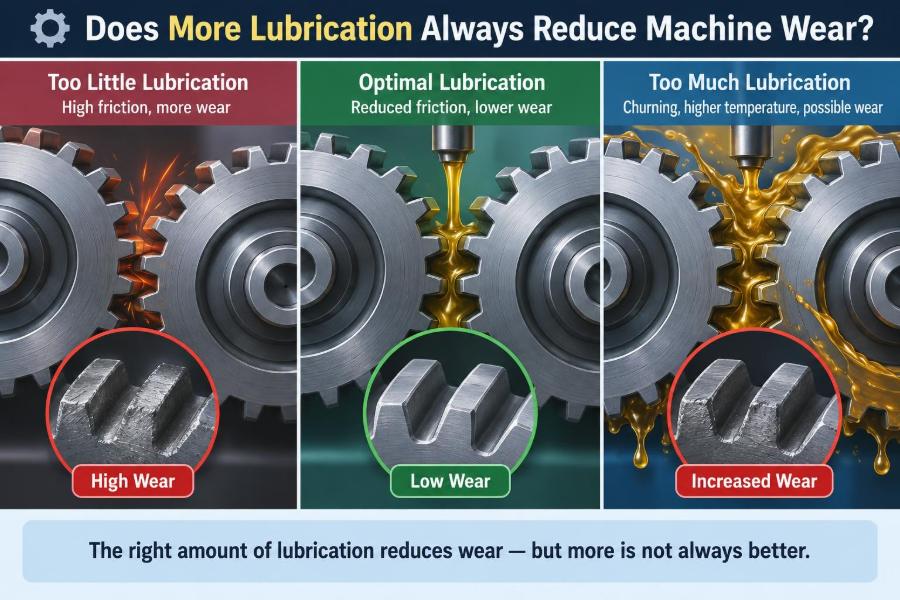
Too little lubrication can quickly damage a bearing, gear, or sliding guide. Too much can churn into heat, rupture seals, attract abrasive dirt, contaminate products, or hide a developing fault.
The useful question is not “Should we add more?” It is: does this component have the correct lubricant, in the correct amount, delivered at the correct interval and condition?
🧭 The short answer: lubrication has an optimum range
More lubrication does not always reduce wear. Most components have an operating range in which lubricant forms a protective film without creating excessive resistance, pressure, leakage, or contamination.
Below that range, surfaces may touch too often. Above it, the lubricant itself can create losses and failure risks. The optimum quantity depends on speed, load, temperature, component geometry, sealing, and the delivery method.
🔬 What lubrication is meant to do
Lubrication separates moving surfaces with a thin film. This reduces direct metal-to-metal contact, lowering friction, adhesive wear, scuffing, and heat generation.
A lubricant can also transport heat, suspend or carry contaminants toward filters, protect surfaces from moisture, and cushion loads. Grease performs many of these tasks while remaining in place; oil is more readily circulated, filtered, and cooled.
⚙️ Friction is not one single condition
Engineers often describe lubrication using the Stribeck curve, which relates friction behavior to viscosity, speed, and load. The curve helps explain why adding lubricant does not automatically improve the contact.
At different operating conditions, the same pair of surfaces may run with boundary, mixed, or full-film lubrication. A component can also move between these regimes during starting, stopping, or load changes.
🧱 Boundary lubrication: protective chemistry matters
In boundary lubrication, the oil film is extremely thin and surface asperities—the microscopic high points on a surface—still interact. This commonly occurs at low speed, high load, or during starts and stops.
Wear protection then depends heavily on the lubricant’s additives and the surface chemistry. Adding a large quantity of unsuitable oil or grease does not necessarily make the film thicker where it matters; selecting the approved lubricant is often more valuable.
🌗 Mixed lubrication: a delicate transition zone
Mixed lubrication combines fluid-film support with some asperity contact. Rolling-element bearings, gears, and piston-cylinder contacts can spend time here, especially while warming up or under variable loading.
Quantity still matters, but viscosity and replenishment matter just as much. If excess grease raises temperature, the base oil may thin, and the intended film can become less robust rather than more robust.
🌊 Full-film lubrication: separation with a cost
In hydrodynamic or elastohydrodynamic lubrication, a pressurized fluid film separates surfaces almost completely. Journal bearings develop a wedge-shaped oil film, while heavily loaded rolling contacts deform elastically and form a very thin but strong film.
Full separation greatly reduces wear, but fluid shearing still consumes energy. Filling a housing beyond its intended level can increase churning losses and heat without meaningfully improving film formation.
🧴 Oil and grease are not interchangeable
Lubricating oil is a fluid base stock combined with additives. It can be supplied continuously, splashed by moving parts, or held in a sump. Its viscosity is central to film thickness and flow.
Grease is usually oil held within a thickener structure. The thickener acts like a reservoir and releases base oil gradually at the contact. It is not simply “thicker oil,” and it should not be treated as an empty space filler.
📏 Correct quantity depends on the component
A gearbox with splash lubrication needs a controlled oil level so gears dip into the oil enough to distribute it without behaving like paddles in a full tank. A circulating oil system needs enough reservoir volume for cooling, deaeration, and stable pump supply.
A sealed-for-life bearing is designed with a chosen grease fill. A regreasable bearing needs only enough fresh grease to replenish the active zone and, where designed, purge used material. Each arrangement has a different answer to “how much?”
🌀 Why overgreased bearings run hot
Rolling-element bearings are among the most common victims of excessive grease. When their free internal space is packed, rolling elements and cages must push through grease rather than merely receive a small replenishing supply.
This causes churning and mechanical working of the grease. Temperature rises, torque increases, and the thickener can break down or release oil in an uncontrolled way. Heat may then accelerate lubricant oxidation and shorten both grease and bearing life.
🔥 Heat changes the lubricant itself
Lubricants do not keep the same properties at every temperature. Oil viscosity generally falls as temperature rises, which can reduce film thickness. Oxidation can also create acids, sludge, varnish, and deposits over time.
Grease can soften, harden, separate into oil and thickener, or bleed from seals depending on its formulation and environment. Therefore, an overfilled component can create a feedback loop: more churning, more heat, poorer lubricant condition, and higher wear risk.
💨 Churning, windage, and wasted energy
Churning occurs when moving components repeatedly displace lubricant. Windage is fluid drag caused by high-speed rotating parts moving through oil mist or excess oil. Both convert mechanical energy into heat.
At modest speed this may only waste power. At higher speed, it can materially alter operating temperature and lubrication behavior. Designers often use carefully placed oil jets, deflectors, drain paths, or controlled levels to avoid these losses.
🫧 Aeration and foaming reduce film reliability
Overfilled oil systems can entrain air as gears, shafts, or crankshafts whip through the lubricant. Tiny bubbles reduce the effective stiffness of the oil film and can interfere with pump delivery.
Foam at the reservoir surface is not merely untidy. It can lead to unstable pressure, poor heat transfer, oxidation exposure, and inconsistent lubrication at critical contacts. The appropriate remedy may involve level correction, a defoaming formulation, or fixing an air leak—not simply adding more oil.
🧯 Excess pressure can defeat seals
Grease is often added through a fitting under pressure. If the old grease has no clear escape path, or if the cavity is already full, pressure can force grease past seals.
A displaced seal may allow dirt, wash water, or process contamination into the bearing. Grease can also migrate onto brakes, belts, electrical components, food-contact areas, or product surfaces. A clean exterior does not prove that an overgreased assembly is healthy.
🌪️ More grease can collect more contamination
A visible bead of grease around a bearing housing can trap dust, fibers, grit, and moisture. During movement or later regreasing, this material may be drawn toward the seal or introduced through an unclean fitting.
Contamination is especially damaging because hard particles can create three-body abrasion: particles roll or slide between surfaces and cut both of them. Good lubrication practice includes cleaning the fitting and surrounding area before a grease gun is connected.
🧪 The lubricant must match the application
Quantity cannot compensate for the wrong viscosity, thickener, additive package, or temperature capability. A low-viscosity oil may fail to provide adequate film under a heavily loaded gear contact, while an overly viscous oil can cause poor flow and high drag during cold starts.
For grease, a formulation suited to electric-motor bearings may not suit a slow, heavily loaded, wet pivot. Manufacturer recommendations and application requirements should lead the decision, particularly for safety-critical or warrantied equipment.
🧬 Mixing lubricants can create new problems
Different oils and greases are not automatically compatible. Additive systems can interact, and grease thickeners may soften, stiffen, or lose structure when mixed. Even products with similar appearance or consistency can behave differently.
When changing lubricant type, follow the equipment maker’s conversion procedure. It may require draining, flushing, manual cleaning, shortened change intervals, or compatibility review. “Topping up” with whatever is available is a preventable risk.
📊 A practical guide to common over-lubrication effects
| Component | What excess lubricant can do | Better control |
|---|---|---|
| Rolling-element bearing | Churning, heat, seal damage, grease leakage | Measured regreasing quantity and interval |
| Gearbox | Churning loss, aeration, high temperature | Set level at the specified sight glass or mark |
| Engine crankcase | Oil aeration, windage, possible seal or catalyst issues | Check level on the stated procedure and dipstick range |
| Chain drive | Dirt accumulation and lubricant fling-off | Apply a light film to the pin-bushing contact |
| Linear guide | Contaminant buildup and excess drag | Use metered lubrication and clean wipers |
The details vary by design, but the pattern is consistent: lubrication must reach the contact without turning the surrounding space into a reservoir of unnecessary fluid or grease.
⛓️ Chain drives need penetration, not a coating
A chain’s most important lubricated contact is usually the pin-and-bushing interface, where relative motion occurs under load. A heavy coating on the outside plates may look reassuring but can attract debris while doing little for the internal joint.
Applying lubricant while the chain is warm and allowing time for penetration can be more effective than applying a large amount immediately before service. Any method must also account for guards, food safety, and contamination-sensitive environments.
🚗 Engine oil levels illustrate the same principle
Automotive engines use a specified oil sump range because the crankshaft, oil pump pickup, ventilation system, and drain-back paths are designed around it. An oil level below the safe range can starve the pump during braking, cornering, or slopes.
Overfilling can let rotating crankshaft components whip oil into foam and increase windage. The exact consequences depend on the engine design, so the correct action is to use the manufacturer’s specified checking procedure rather than estimate by appearance.
🏭 Centralized systems need calibration, not guesswork
Automatic lubrication systems improve consistency by delivering small, timed doses to many points. Yet they can still fail through blocked lines, misadjusted injectors, empty reservoirs, incorrect programming, or a lubricant that does not flow at ambient temperature.
Verification matters. Inspect indicator pins where provided, confirm lubricant reaches representative points, and investigate unexpected consumption or leakage. An automated system is a control method, not proof that every point receives the right dose.
🧹 Clean delivery is part of lubrication quality
New lubricant is not necessarily clean enough for every precision system. Oil can acquire particles from containers, funnels, breather openings, and transfer equipment; grease fittings can carry dirt directly into a bearing cavity.
Use dedicated, closed, labeled containers where practical. Keep caps on, wipe fittings, use clean tools, and avoid leaving opened containers in dusty or humid locations. The cleanest lubricant at purchase can become an abrasive mixture through poor handling.
🧰 Follow the right interval, but adjust for duty
Published lubrication intervals are starting points, not universal laws. Speed, load, vibration, temperature, moisture, mounting orientation, and contamination can all change the required interval and quantity.
A bearing in a clean, lightly loaded indoor fan may need a very different schedule from a similar bearing near washdown water or fine mineral dust. Any adjustment should be documented and based on observed conditions, inspection data, and equipment guidance—not on routine overapplication.
👀 Condition monitoring can reveal the real issue
Rising bearing temperature, abnormal vibration, ultrasonic friction signals, oil debris, and repeated grease leakage are clues, not automatic instructions to add lubricant. Each symptom can have several causes.
For example, a hot bearing may be underlubricated, overgreased, misaligned, overloaded, electrically damaged, or near the end of its life. Good troubleshooting tests plausible causes before an action makes the evidence harder to interpret.
🧫 Oil analysis answers questions appearance cannot
For suitable oil-lubricated assets, laboratory analysis can examine viscosity change, oxidation indicators, water, particle content, and wear debris. Trend information is usually more useful than a single isolated sample.
Sampling must be representative. Drawing oil from a stagnant drain point may not describe the oil reaching a loaded contact. Follow a consistent sampling location and method so changes reflect the machine rather than sampling variation.
📝 Build a lubrication route that technicians can use
A practical route identifies every point, lubricant type, quantity, interval, access method, and special instruction. Color coding and clear labels can reduce accidental mixing, but labels should supplement—not replace—written specifications.
- State the exact lubricant or approved equivalent.
- Specify a measured quantity, such as grams, milliliters, or pump strokes verified for that gun.
- Describe the condition for application, including shutdown or running requirements.
- Record leakage, temperature concerns, unusual noise, and the amount actually applied.
Documentation turns lubrication from a vague routine into a repeatable maintenance control.
🔧 Measure grease-gun output before relying on strokes
“One pump” is not a universal unit of grease. Grease guns differ in output, and output can change with grease consistency, gun condition, and user technique. A component designed for a small dose can be overfilled surprisingly quickly.
A simple controlled check can establish approximate mass per stroke for a particular gun and lubricant. For critical equipment, use the manufacturer’s procedure or a metering device rather than treating pump count as exact.
🚧 Purging is useful only when the design permits it
Some bearing housings are designed to allow old grease to purge through a relief point. In such cases, controlled purging can remove degraded material and moisture, provided the expelled grease is safely captured and cleaned away.
Other bearings have shields, seals, or arrangements that do not tolerate forced purging. Applying pressure until grease appears somewhere is not a universal rule. The escape path, seal type, and allowable pressure must be understood first.
⚠️ Common habits that cause preventable damage
- Adding lubricant because a component “looks dry” without checking its design.
- Filling a gearbox above its marked operating level.
- Using grease to silence a noise caused by misalignment or damage.
- Mixing leftovers from unmarked cartridges or containers.
- Greasing through dirty fittings or with damaged couplers.
- Ignoring leaks because the machine still runs.
These habits are appealing because they are quick. Their cost often appears later as overheating, contamination, downtime, or a confusing failure investigation.
🛠️ What to do when over-lubrication is suspected
Start by making the situation safe and consulting the equipment documentation. Check level indicators, drain or relief arrangements, temperature, leakage paths, and the correct lubricant specification.
Do not automatically drain, purge, or dismantle a component while it is hot, rotating, pressurized, or supporting a load. For critical machinery, unusual temperatures, persistent leakage, or suspected seal damage should be assessed by qualified maintenance personnel using the site’s procedures.
🎯 Design intent should guide every decision
Lubrication systems are designed around a target film, flow path, heat balance, and contamination-control strategy. The target may be a controlled oil level, a measured grease charge, a timed micro-dose, or an oil jet aimed at a contact.
Maintenance works best when it preserves that design intent. More is sometimes necessary after a leak, during severe service, or under a specifically approved procedure—but it is never a substitute for understanding why the component needs lubrication.
✅ The core principle: right lubricant, right amount, right time
Machine wear falls when a lubricant maintains an appropriate protective film and remains clean, stable, and available at the contact. Quantity is only one part of that system.
Use the approved product, control the dose, respect level marks and relief paths, keep delivery equipment clean, and investigate abnormal heat or noise instead of masking it. This approach protects components while also reducing energy loss, leakage, cleanup, and wasted lubricant.
More lubrication is not automatically better; precise lubrication is what reduces wear reliably. Treat each machine’s specified quantity as an engineering requirement, not a suggestion, and let observed condition guide any adjustment. ⚙️🛢️🔧