
A packaging line is running smoothly until a bearing begins to wear. The motor still turns, the product still moves, and the dashboard may show no obvious alarm. Yet vibration has shifted slightly, temperature is creeping upward, and energy use is no longer quite normal.
If that machine fails during a production run, the visible repair may take an hour while the operational consequences last much longer. Operators stop the line, maintenance teams diagnose under pressure, work-in-progress accumulates, and delivery plans may need to change.
Traditional preventive maintenance reduces this risk by servicing equipment on a calendar or runtime schedule. But a component does not always fail on schedule; some are replaced early, while others deteriorate between inspections.
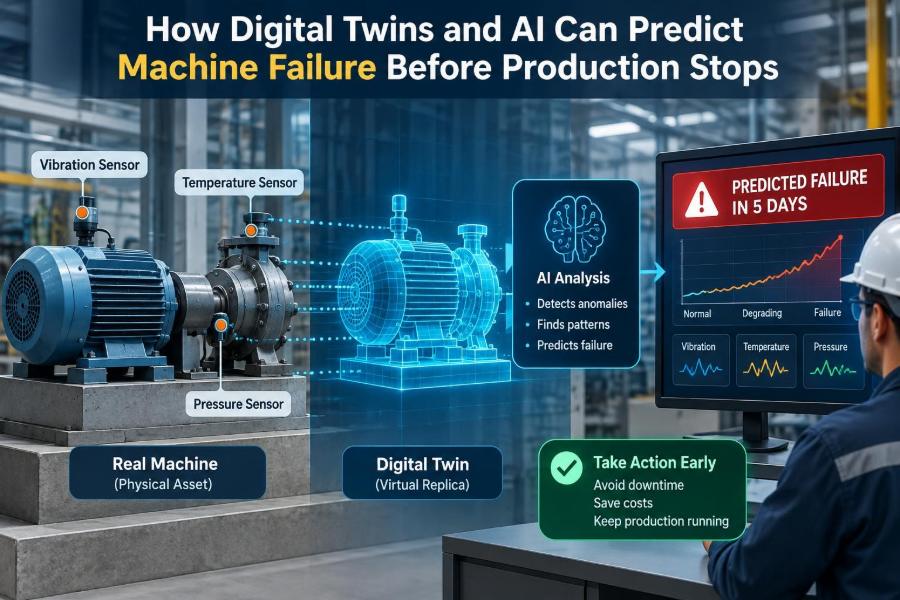
Digital twins and artificial intelligence offer a more condition-aware approach. Together, they can turn scattered machine signals into an evolving picture of equipment health—helping teams investigate likely failures before they become unplanned production stops.
⚙️ The Production Problem Behind Unplanned Failure
Unplanned downtime is rarely just a mechanical event. It interrupts material flow, consumes labor at inconvenient times, can create quality concerns during restart, and forces decisions with incomplete information.
The central maintenance question is simple: is the machine behaving as expected for its current operating condition? Answering it is difficult when engineers must compare many variables across different shifts, products, loads, and ambient conditions.
Predictive maintenance aims to identify developing faults early enough to plan a response. That might mean scheduling a bearing change, checking alignment during a planned stop, ordering a spare, or reducing load while engineers investigate.
🧠 What a Digital Twin Actually Is
A digital twin is a digital representation of a physical asset, process, or system that is connected—directly or periodically—to real operating data. It is more than a static 3D model or an equipment record in a database.
For a machine, the twin may combine design information, operating limits, sensor data, maintenance history, control states, and mathematical models. Its purpose is to represent what the equipment is doing now and what its behavior may imply.
The level of detail should match the decision. A twin used to monitor pump health may model flow, pressure, power, and vibration. A twin used to optimize an entire plant may represent material routing, utilities, buffers, and production schedules instead.
🗂️ The Difference Between a Model, a Dashboard, and a Twin
These terms are often used loosely, but the distinction matters. A dashboard displays values. A model describes relationships. A useful digital twin connects those relationships to the specific physical asset and updates them using operational evidence.
| Tool | Main purpose | Typical limitation |
|---|---|---|
| Dashboard | Shows current and historical measurements | May not explain why a value changed |
| Engineering model | Estimates behavior from physical principles | Can drift from real conditions if not updated |
| Digital twin | Combines asset context, data, and models | Requires disciplined data and maintenance |
A twin does not need to be visually elaborate. In many reliability applications, its most valuable output is a clear health indicator with the evidence behind it.
📡 The Signals That Reveal Machine Condition
Machines communicate their condition through measurable effects. Common signals include vibration, temperature, acoustic emissions, current, voltage, pressure, flow, speed, position, lubricant condition, and control-system alarms.
No single sensor is universally sufficient. A rising motor temperature, for example, may result from overload, poor cooling, electrical imbalance, friction, or a warmer environment. Combining signals gives the system better diagnostic context.
- Vibration can reveal imbalance, misalignment, looseness, and rolling-element bearing damage.
- Electrical measurements can expose overload, supply problems, rotor-related effects, or changes in driven load.
- Process variables show whether a machine is achieving its intended duty.
- Maintenance records provide the history needed to interpret patterns.
🌡️ Why Context Matters More Than a Single Threshold
A fixed alarm threshold is useful for immediate protection, but it is often too blunt for early prediction. A pump drawing more power at high flow may be normal; the same power draw at low flow may deserve investigation.
Context can include product type, machine speed, recipe, ambient temperature, operating mode, recent maintenance, and upstream or downstream conditions. A digital twin uses this context to compare like with like.
Instead of asking whether vibration exceeds one universal limit, engineers can ask whether vibration is unusual for this asset at this speed and load. That change in question is fundamental to condition-based reasoning.
🔄 From Raw Data to a Usable Machine History
Sensor data arrives as time-stamped observations, often at very different rates. A vibration sensor may generate high-frequency waveforms, while an operator inspection may occur once per shift and a maintenance work order only after an intervention.
Creating a useful history requires data engineering: consistent timestamps, equipment identifiers, units, operating states, and quality checks. If one tag reports degrees Celsius and another is assumed to report Fahrenheit, a sophisticated algorithm will not rescue the result.
A practical architecture usually retains raw data for specialist analysis while producing summarized features for routine monitoring. Examples include vibration root-mean-square level, spectral peaks, temperature trend, pressure differential, and power per unit output.
🧹 Data Quality Is a Reliability Issue
Missing samples, failed sensors, incorrect tag mappings, and implausible readings can create false alarms or conceal genuine deterioration. Data quality should therefore be monitored as part of the reliability system, not treated as an IT afterthought.
Useful checks include sensor range validation, stale-data detection, timestamp synchronization, calibration records, and comparison against related signals. A pressure transmitter that remains perfectly unchanged during changing production may be disconnected, stuck, or simply observing a stable process; context determines which explanation is plausible.
Bad data can produce confident-looking but unreliable predictions. An alert should show signal quality and data coverage so users know how much trust to place in it.
📐 Physics-Based Twins and What They Add
Physics-based models use engineering relationships such as mass balance, energy balance, heat transfer, fluid dynamics, motor behavior, or rotor dynamics. They estimate what the machine should do under defined conditions.
For a heat exchanger, a twin might compare measured temperature changes with expected heat-transfer performance. For a centrifugal pump, it might relate flow, head, speed, and power to expected operating behavior.
These models are especially useful when failure examples are scarce. Rather than waiting for many failures to train an algorithm, engineers can flag a growing difference between measured and expected behavior.
🤖 What AI Contributes to Failure Prediction
AI is a broad term. In machinery applications, it commonly refers to machine-learning methods that find patterns in historical data, classify known conditions, detect anomalies, or estimate a condition trend.
AI can handle interactions that are difficult to express with one simple equation. It may learn that a particular combination of vibration features, temperature rise, speed, and duty cycle is unusual, even when each value alone appears acceptable.
It does not replace engineering judgment. AI is strongest when it supports a clear maintenance decision: inspect, lubricate, align, test, monitor more closely, plan replacement, or rule out a suspected problem.
🔍 Three Main AI Tasks in Maintenance
Anomaly detection
Anomaly detection learns normal behavior and flags departures from it. This is valuable when the site has few confirmed examples of each failure mode, which is common for well-maintained critical assets.
Fault classification
Classification attempts to identify a known fault category, such as bearing damage, cavitation, belt slip, or cooling failure. It requires reliable labeled examples and can be vulnerable when the machine, sensor location, or operating regime changes.
Remaining useful life estimation
Remaining useful life estimates how long an item may continue to meet its function. This is inherently uncertain because operating duty, intervention quality, and failure mechanisms vary. It should be treated as a planning range, not a countdown clock.
🧩 Hybrid Twins Combine Physics and Data
A hybrid twin blends physical understanding with data-driven learning. The physical model establishes expected relationships; the data-driven layer accounts for real-world effects that are hard to model perfectly, such as gradual fouling, material variability, or installation differences.
For example, a model may estimate expected compressor power from pressure ratio, inlet condition, and flow. Machine learning can then characterize the residual—the gap between expected and measured power—and identify patterns linked to degradation.
This approach is often more interpretable than a purely opaque model. Engineers can see both the performance deviation and the operating conditions that produced it.
🏭 A Hypothetical Pump Example
Consider a process pump whose flow begins falling slightly at the same valve position and speed. At the same time, power and vibration characteristics change from their normal pattern.
A twin can account for operating point, liquid properties if available, suction conditions, and speed. It may show that the performance gap is consistent with possible impeller wear, blockage, recirculation, cavitation-related damage, or an instrument problem.
AI can rank the unusual pattern against historical behavior, but it should not automatically declare a failed impeller. A technician may first verify instruments, inspect suction strainers, review process conditions, and then plan a targeted inspection.
🧷 Failure Modes Must Lead the Design
Starting with available data rather than credible failure modes is a common mistake. A team may collect thousands of tags yet lack the signal or context needed to detect the problems that actually cause downtime.
Failure modes and effects analysis can provide a better starting point. Identify how the asset can fail, what causes each failure, what physical effect appears first, which measurements can observe it, and what action is possible.
- Misalignment may affect vibration, bearing temperature, and coupling condition.
- Heat-exchanger fouling may affect pressure drop, approach temperature, and energy demand.
- Lubrication problems may affect temperature, vibration, particle counts, and inspection findings.
This structure keeps the twin tied to maintainable realities rather than abstract data patterns.
🧭 Choosing the Right Assets First
Not every machine needs an advanced digital twin. The best early candidates are assets where unplanned failure has meaningful consequences and where a warning would lead to a practical intervention.
Consider production criticality, safety implications, repair lead time, spare-part availability, failure history, condition-monitoring feasibility, and the cost of false alarms. A low-cost, easily replaced fan may need simple monitoring, while a difficult-to-access compressor may justify deeper analysis.
A focused pilot also helps teams learn data, workflow, and governance lessons before expanding across a plant.
🔧 Sensor Placement Shapes the Answer
Sensor selection is not merely a purchasing decision. The location, mounting method, sampling rate, orientation, and environmental protection determine what phenomena can be observed reliably.
A vibration sensor mounted close to a bearing housing usually captures bearing-related behavior better than one placed on a flexible guard. A temperature sensor on a motor frame may react slowly to an internal electrical issue but still provide useful long-term trend information.
Engineers should document why each sensor exists, what failure modes it supports, and what normal operating range is expected. That documentation is part of the twin’s engineering foundation.
⏱️ Detecting a Trend Before It Becomes an Alarm
Protection systems are designed to prevent immediate damage, often with high or low limits that trigger trips or alarms. Predictive systems work earlier by detecting gradual drift, repeated deviations, or an abnormal combination of variables.
Trend detection can compare a short-term average with a longer baseline, measure rate of change, or calculate deviation from a context-aware prediction. The aim is not to generate more notifications; it is to create an earlier, actionable signal.
A small increase that persists through comparable operating periods may matter more than one large but explainable transient during startup.
🚦 Alert Design Determines Whether People Use It
An alert without context creates work but not necessarily insight. Maintenance teams need to know what changed, how unusual it is, when it began, which signals support the finding, and what operating conditions were present.
Good alerts distinguish urgency from confidence. A high-confidence anomaly may still be low urgency if failure consequences are limited, while a modest concern on a safety-critical asset could warrant rapid review.
- Include the asset, subsystem, and relevant operating state.
- Show the recent trend and comparison baseline.
- State the likely failure mechanism only when evidence supports it.
- Suggest a verification step, not an unsupported repair command.
🧑🔧 Human Expertise Remains in the Loop
Operators hear, smell, see, and feel changes that sensors may miss. Technicians understand installation history, access constraints, and recurring local issues. Reliability engineers recognize whether a predicted mechanism makes physical sense.
The most useful systems capture this feedback. If a technician finds a loose mounting bolt rather than bearing damage, that outcome should be recorded. Over time, such feedback improves both the asset history and the quality of future alerts.
A prediction becomes valuable only when it is connected to a reliable human decision process.
🛠️ Connecting Predictions to Maintenance Workflow
Prediction should lead into existing work management, not sit in a separate analytics portal that no one checks during a busy shift. The workflow may include alert review, condition verification, priority assessment, work request creation, planning, scheduling, execution, and closeout feedback.
Teams should define who owns each step. If responsibility is unclear, a warning can remain visible while the condition progresses. Conversely, automatic work-order creation without review can overload planners with weak signals.
Integration with a computerized maintenance management system can help preserve traceability, but the process must be designed before it is automated.
📊 Measuring Value Without Misleading Metrics
Counting alerts is not a measure of success. A system that creates many alerts may simply be noisy. Likewise, claiming that every avoided event was averted by analytics is usually impossible to prove with certainty.
More meaningful measures include detection lead time, percentage of alerts that received timely review, confirmed useful findings, repeat fault reduction, planned-versus-unplanned maintenance work, data availability, and user adoption.
Qualitative evidence also matters. Did the system help a team obtain a spare before a planned shutdown? Did it direct inspection toward a real mechanism? Did it prevent unnecessary intrusive maintenance? Record both outcomes and limitations honestly.
⚠️ False Positives and Missed Faults
Every predictive system makes trade-offs. A sensitive model may detect weak signals early but generate more false positives. A conservative model may be quieter but miss early deterioration.
The acceptable balance depends on the asset and response cost. Investigating a false alarm on a remote, hazardous, or production-critical asset may be expensive; missing a warning there may be worse. Thresholds and model behavior must be reviewed against real operating consequences.
No system eliminates uncertainty. Defense in depth still includes protective controls, inspections, preventive tasks, operating procedures, and competent maintenance practice.
🔐 Cybersecurity and Data Access
Connecting operational technology to analytics platforms introduces cybersecurity and governance considerations. Sensors, gateways, control networks, historians, and cloud services should be designed with appropriate segmentation, access control, patching practices, and monitoring.
Availability also matters. A predictive tool should not interfere with machine control, and loss of connectivity should not compromise essential protection functions. The twin is an advisory layer unless it has been deliberately engineered, validated, and authorized for more direct control.
Clear ownership of data, models, and access permissions prevents avoidable confusion as systems evolve.
🧪 Validation Is Not a One-Time Test
A model can perform well during development and become unreliable after a process change, sensor replacement, overhaul, product mix shift, or control-system update. This is often called model drift: the relationship learned from past data no longer matches current reality.
Validation should therefore continue in service. Compare alerts with inspections, track missed detections that become known later, review model inputs after equipment changes, and periodically reassess thresholds and assumptions.
Version control is valuable here. Teams should know which model, data configuration, and asset configuration produced a particular recommendation.
🏗️ Digital Twins at Equipment, Line, and Plant Scale
An equipment twin focuses on one machine and its components. A line-level twin can add interactions: conveyor accumulation, synchronization, changeovers, bottlenecks, and the effect of one machine’s degradation on downstream quality or throughput.
At plant scale, the twin may include utilities such as compressed air, steam, cooling water, and electrical demand. This broader view can reveal that a recurring “machine problem” is actually caused by unstable supply conditions or process constraints elsewhere.
Higher scale is not automatically better. Complexity should grow only when it improves a decision that people can act on.
📚 Building the Skills Around the Technology
Successful programs need mechanical and process knowledge, instrumentation expertise, controls understanding, data engineering, cybersecurity awareness, and maintenance planning. Few individuals possess all of these skills, so collaboration is essential.
For students, useful foundations include vibration basics, thermodynamics, fluid mechanics, control systems, reliability engineering, statistics, and programming for data handling. For working professionals, a practical next step is learning to translate a failure mode into observable signals and a maintenance action.
The key skill is not simply using a machine-learning tool. It is asking whether the input, model output, and proposed response make engineering sense.
🪜 A Practical Implementation Path
- Choose one asset with a clear failure consequence and feasible response.
- Define priority failure modes and the decisions a warning should support.
- Audit available signals, maintenance records, operating states, and data quality.
- Establish a normal baseline across meaningful operating conditions.
- Deploy understandable monitoring, then add more advanced models where justified.
- Connect findings to named review and work-management steps.
- Capture inspection outcomes and improve the system continuously.
This progression is usually more dependable than beginning with a broad promise to “apply AI” across every asset.
🚫 Common Implementation Mistakes
One mistake is treating the project as a software installation rather than a reliability improvement effort. Another is expecting historical work orders to provide clean fault labels; many records are incomplete, inconsistent, or describe symptoms rather than root causes.
Teams also struggle when they ignore process changes, fail to involve operators and technicians, or use a generic model with no asset-specific baseline. A visually impressive interface cannot compensate for unclear ownership and weak engineering logic.
A better approach is to start small, explain outputs transparently, review outcomes regularly, and expand only after the system demonstrates practical usefulness.
🔮 What These Tools Can and Cannot Predict
Digital twins and AI can identify abnormal behavior, quantify performance deviation, prioritize inspection, and sometimes estimate degradation trends. They are particularly valuable where a fault develops gradually and produces observable changes.
They cannot reliably foresee every sudden event. A random external impact, an abrupt utility interruption, incorrect operation, or a defect that produces no measurable precursor may occur without warning.
Prediction quality depends on the failure mechanism, sensor coverage, data quality, operating variability, model design, and the time available to act. Honest communication about those boundaries builds trust.
🎯 The Core Principle: Better Decisions Before the Stop
The goal is not to create a perfect virtual copy of every machine or to replace experienced people with algorithms. The goal is to recognize meaningful deviation early enough to make maintenance safer, calmer, and more planned.
A strong program connects failure modes to measurements, measurements to operating context, context to interpretable models, and model outputs to a defined maintenance response. Physics, data, and human expertise each contribute something the others cannot provide alone.
When that chain is in place, a digital twin becomes more than a visualization. It becomes a practical decision-support system for protecting production capability.
Digital twins and AI create value not by predicting every failure with certainty, but by giving engineering teams earlier, better-grounded opportunities to prevent avoidable disruption. 🏭📈🔧