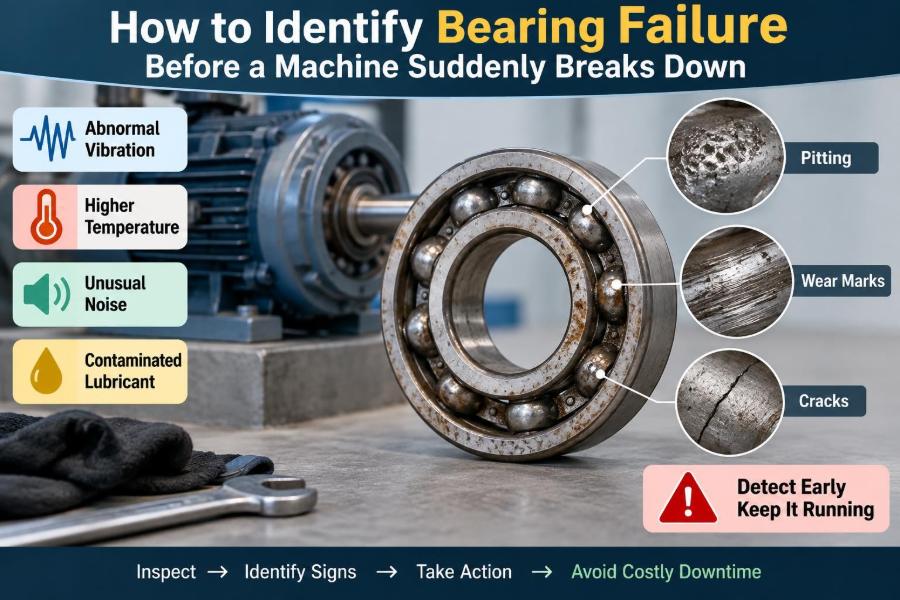

A production line is running normally, then one motor begins to sound slightly rougher than the others. The temperature at its housing feels a little higher. Nothing has stopped, and the machine still meets its output target, so the warning is easy to postpone.
Days or weeks later, that small change can become a seized shaft, a damaged gearbox, a thrown belt, or an unplanned shutdown. The bearing may be a modest component, but it often sits at the point where rotating motion becomes either smooth and controlled or expensive and destructive.
For students, bearing failure is a useful lesson in how load, lubrication, alignment, materials, and maintenance interact. For working professionals, recognizing early symptoms is a practical way to plan repairs before a failure dictates the schedule.
The goal is not to diagnose every fault from one clue. It is to combine observations, measurements, operating history, and inspection findings until the condition of a bearing becomes clear enough to act safely.
🔩 What a Bearing Actually Does
A bearing supports and guides a moving part while reducing friction. In rotating equipment, it usually supports a shaft and transfers radial load, axial load, or both into the machine frame.
Rolling-element bearings use balls or rollers between an inner ring and an outer ring. Plain bearings, also called journal or sleeve bearings, support motion on a lubricating film rather than rolling elements. Their failure signs overlap in some ways, but their mechanisms differ.
When a bearing is healthy, its internal surfaces move with controlled contact and adequate lubrication. When that control is lost, friction, heat, vibration, and surface damage tend to reinforce one another.
🧭 Why Early Detection Changes the Outcome
An early-stage defect may only require a planned bearing replacement, a lubrication correction, or an alignment adjustment. A late-stage failure can damage a shaft seat, housing bore, coupling, seal, gear mesh, or nearby wiring.
Planned work also allows time to isolate energy, obtain the correct part, inspect the cause, and install the replacement correctly. Emergency work is more likely to happen under pressure, when contamination and assembly errors are harder to control.
Early warning does not mean every noisy bearing needs immediate replacement. It means the machine can be assessed according to its duty, safety risk, spare-part availability, and rate of deterioration.
👂 Listen for a Change, Not Just a Loud Noise
Operators often notice bearing problems first because the sound of a machine changes. A healthy bearing commonly produces a steady, low mechanical sound. Damage may introduce rumbling, growling, clicking, whirring, or a repeating metallic tick.
A useful question is: does the sound change with speed or load? If it rises as the shaft speed rises, the rotating assembly deserves attention. A repeating click can suggest a localized defect, while a broad rough rumble may indicate general wear, contamination, or poor lubrication.
Sound alone is not proof. Gear teeth, loose guards, cavitation in pumps, belt defects, and electrical issues can also create noise. Still, an unfamiliar sound is a valuable trigger for closer inspection.
📳 Understand Vibration as a Bearing Clue
Vibration is motion around a machine’s intended position. Every rotating machine vibrates to some extent, but excessive or changing vibration can show that forces inside the machine are no longer balanced or smooth.
A damaged rolling element striking a pit in a raceway creates short impacts. At first, these impacts may be too subtle to feel by hand, but a vibration sensor can often detect their high-frequency energy. As damage grows, the vibration becomes easier to measure and sometimes audible.
Trend data matters more than a single isolated reading. The same vibration level can be acceptable on one machine and concerning on another, depending on the design, speed, mounting stiffness, and normal baseline.
📈 Know the Basic Bearing Defect Frequencies
In vibration analysis, rolling-element defects often produce characteristic frequencies related to shaft speed and bearing geometry. These include frequencies associated with the outer race, inner race, rolling elements, and cage.
Analysts use the bearing part number, rotational speed, and instrument data to compare measured peaks with calculated expected frequencies. Sidebands around a defect frequency can provide additional clues about modulation by shaft rotation.
These patterns are powerful, but they are not automatic verdicts. Variable speed, slipping belts, electrical noise, poor sensor mounting, and structural resonances can complicate interpretation. Confirm important decisions with other evidence.
🌡️ Treat Rising Temperature as a Symptom
Friction produces heat, so a bearing that is deteriorating can run hotter. Temperature checks are especially useful when comparing equivalent bearings on similar machines or comparing a machine against its own normal operating condition.
A hot housing does not automatically mean the bearing itself is failing. Excess grease, incorrect lubricant viscosity, a tight seal, high process load, misalignment, or restricted cooling can all raise temperature.
Infrared tools are convenient, but surface readings are influenced by emissivity, reflections, airflow, and measurement location. Take readings consistently and watch the trend rather than relying on a single scan.
🛢️ Read the Lubricant for Evidence
Lubricant carries information about what is happening inside a bearing. Darkening, burnt odor, unusual thickening, water contamination, or visible particles should lead to investigation rather than being dismissed as cosmetic change.
For oil-lubricated systems, oil analysis can help identify wear debris, contamination, viscosity change, and lubricant degradation. The result is most useful when samples are collected from a representative live zone using a clean, repeatable method.
Grease is harder to sample meaningfully, but purge material, seal condition, and grease appearance can still reveal water entry, incompatible mixing, or contamination. A shiny metallic appearance is a warning sign, not a diagnosis by itself.
💧 Recognize Lubrication Starvation
Lubrication starvation occurs when too little suitable lubricant reaches the rolling contacts or sliding surfaces. The protective film becomes too thin, allowing more metal-to-metal interaction and elevated temperature.
Common causes include missed lubrication intervals, blocked grease paths, an empty reservoir, leaking seals, excessive grease purging, and lubricant that is too viscous to flow at startup temperature. A bearing may survive briefly under these conditions, but surface distress can begin long before complete seizure.
Do not solve every hot bearing by adding more grease. First verify the specified lubricant, delivery path, quantity, and interval.
🫧 Avoid the Equally Common Problem of Overgreasing
Too much grease can churn inside a bearing cavity. Churning raises temperature, may force grease through seals, and can cause the grease structure to break down.
In electric motors, excess grease may migrate toward windings or create seal-related problems. In high-speed applications, the acceptable quantity can be particularly limited.
Use the machine manufacturer’s guidance where available. If a relubrication point includes a drain or relief path, make sure old grease can escape safely during the procedure.
🧂 Keep Contamination Out
Hard particles entering a bearing act like abrasive grit. They dent raceways and rolling elements, disrupt the lubricant film, and create sites where fatigue damage can later grow.
Water is also harmful. It can reduce lubricating performance, promote corrosion, and change grease consistency. Steam, washdown, humid storage, damaged seals, and poorly protected lubricant containers are common entry routes.
Cleanliness is not merely an appearance standard. It is a direct control on bearing life. Clean fittings before greasing, keep containers sealed, and protect open housings during maintenance.
⚙️ Watch for Misalignment
Misalignment occurs when coupled shafts do not share the intended centerline or angular relationship. It can impose extra forces on bearings, couplings, seals, and shafts.
Possible clues include repeated bearing failures at one end of a machine, hot couplings, unusual axial vibration, worn coupling elements, and a machine that changes condition after thermal growth. Soft foot, where a machine foot does not sit flat on its base, can distort alignment after bolts are tightened.
Laser alignment tools can be highly useful, but good results also depend on a stable base, correct pipe supports, allowance for thermal movement, and proper torque on mounting bolts.
🪨 Do Not Ignore Rotor Imbalance
An imbalanced rotor has mass distributed unevenly around its centerline. As it spins, centrifugal force creates vibration at rotational speed and loads the bearings repeatedly.
Dirt buildup on a fan, a missing balance weight, blade damage, product accumulation, or a repaired impeller can create imbalance. The bearing may be the component that fails, but the root cause can be elsewhere in the rotating assembly.
Balancing reduces force, not just noise. Before balancing, however, check for looseness, bent shafts, misalignment, and structural problems that can imitate or complicate imbalance.
🧱 Look for Mechanical Looseness
Loose bearing housings, worn fits, loose foundation bolts, cracked supports, or excessive internal clearance allow components to move in ways the design did not intend. That movement can amplify vibration and accelerate fretting wear.
Fretting is surface damage caused by tiny repeated motions under load. It may leave reddish-brown or dark debris on shaft seats, housings, or fits. Once a fit is damaged, simply replacing the bearing may not restore correct support.
During inspection, check fasteners, housing bores, shaft journals, adapter sleeves, and mounting surfaces. The bearing is only one part of the support system.
🔌 Consider Electrical Bearing Damage
Electrical current can sometimes pass through motor bearings, particularly in systems with variable-frequency drives. Repeated electrical discharge can mark raceways with fine fluting or washboard-like patterns.
The resulting noise may resemble other bearing faults, and the damage may not be obvious until the bearing is dismantled. Grounding arrangements, shaft grounding devices, insulated bearings, and drive-system design can be relevant controls depending on the application.
This issue needs application-specific assessment. Do not assume every motor bearing failure is electrical, but do consider the possibility when failures recur on drive-fed motors.
🏭 Match the Symptom to the Machine Type
A pump bearing may be affected by hydraulic forces, pipe strain, cavitation, or seal leakage. A fan bearing may be influenced by imbalance from dust accumulation. A conveyor bearing may suffer contamination and shock loading. A gearbox bearing may reveal its condition through oil debris and gear-mesh vibration.
The same symptom therefore has different likely causes in different equipment. A hot bearing beside a washdown conveyor calls for questions about water ingress and sealing. A hot bearing in a high-speed motor calls for questions about grease quantity, preload, electrical effects, and cooling.
🧠 Use Your Senses Safely During Routine Checks
Basic route-based inspection remains valuable. Operators can observe leaks, listen for changes, note odors, inspect seals, and compare vibration or temperature readings over time.
Never touch exposed rotating parts, reach through guards, or use improvised methods near moving machinery. A listening probe, vibration meter, or infrared tool should be used according to site procedures and with appropriate guarding and personal protective equipment.
Human observation is strongest when it is structured. Record what changed, where it was observed, and whether operating conditions were normal at the time.
🧾 Build a Useful Condition Baseline
A baseline is a record of normal machine condition after correct installation and stable operation. It may include vibration values, temperature, sound observations, lubrication condition, speed, load, and photographs of mounting arrangements.
Without a baseline, teams often compare one machine to another even though the two machines may have different foundations, duties, or histories. A trend from the same point on the same machine is usually more informative.
Collect data at consistent locations and operating conditions. Label measurement points clearly so that future readings are comparable.
📊 Compare Common Warning Signs Carefully
| Observation | What it can suggest | What else to check |
|---|---|---|
| Rising bearing-housing temperature | Lubrication issue, load, friction, misalignment | Grease quantity, cooling, operating load, measurement method |
| Rough or repeating sound | Raceway damage, contamination, looseness | Gears, belts, guards, pump condition, speed relationship |
| Increasing high-frequency vibration | Early rolling-element distress | Sensor mounting, lubrication, defect-frequency evidence |
| Metallic debris in oil | Wear or damage inside the system | Sample quality, gears, seals, and other lubricated components |
| Repeated failure at one location | Uncorrected installation or system cause | Alignment, fits, load path, contamination, electrical effects |
The table is a triage aid, not a replacement for inspection. Several weak signals that agree with one another are generally more persuasive than one dramatic but unexplained reading.
🔍 Inspect the Bearing After Removal
A removed bearing can reveal the failure mechanism if it is handled carefully. Mark its orientation, preserve related parts, and avoid washing away evidence before observations are recorded.
Look for discoloration, scoring, pitting, flaking, corrosion, cracked cages, damaged seals, and abnormal wear patterns. Record whether damage is concentrated on the loaded zone, around the full circumference, or at a particular location.
Some damage modes look similar. For example, surface staining may be corrosion, lubricant degradation, or heat-related discoloration. When the cause matters to reliability decisions, use qualified analysis rather than relying solely on visual impressions.
🧰 Install Bearings Without Creating New Damage
A surprising number of premature failures begin during installation. Applying force through the rolling elements while pressing a bearing onto a shaft can dent raceways. Hammering, poor cleanliness, wrong heating practice, or incorrect fits can also cause hidden damage.
Apply mounting force to the ring with the interference fit: to the inner ring when fitting to a shaft, and to the outer ring when fitting into a housing. Induction heating may be appropriate for some bearings, but temperature limits and manufacturer instructions must be followed.
Use the specified internal clearance, preload, locking method, and lubricant. These details are design requirements, not assembly preferences.
📐 Respect Fits, Clearance, and Preload
Internal clearance is the small amount of movement available between bearing components before installation. Interference fits, temperature, and mounting method can reduce that clearance in service.
Too little operating clearance can generate heat and excessive stress. Too much can allow poor shaft guidance, vibration, and uneven load distribution. Some bearings are deliberately preloaded to improve stiffness and accuracy, especially in precision applications.
Correct selection depends on load, speed, temperature, housing material, shaft fit, and arrangement. A replacement with the same dimensions is not necessarily the correct replacement.
⏱️ Decide Whether to Monitor, Plan, or Stop
Not every bearing warning has the same urgency. The decision should consider the severity and trend of the symptom, machine criticality, possibility of secondary damage, safety exposure, and whether a standby unit exists.
- Monitor: a small, stable deviation with no safety concern and a clear plan for follow-up measurements.
- Plan repair: a confirmed degrading trend, visible lubricant concern, or repeatable defect indication while the machine remains controllable.
- Stop and assess: rapid temperature rise, severe noise or vibration, smoke, seized motion, damaged guards, or any condition that threatens people or major equipment.
Site procedures and the equipment manufacturer’s limits should govern final decisions. When uncertain, escalation to a competent maintenance or reliability professional is the safer path.
🗂️ Record Failures So Patterns Become Visible
A work order that says only “bearing replaced” loses valuable knowledge. Record the bearing identification, location, machine speed, operating load, observed symptoms, lubricant used, contamination evidence, fit condition, and suspected cause.
Over time, these records can reveal patterns: failures after washdown, repeated damage on the drive end, problems following a lubricant change, or defects associated with a particular operating condition.
Root-cause thinking asks more than what failed. It asks why this bearing experienced conditions it was not meant to tolerate.
🚫 Avoid Common Diagnostic Shortcuts
One shortcut is replacing a bearing repeatedly without checking alignment, shaft condition, housing fit, seals, and lubrication practice. This treats the visible casualty while leaving the damaging condition in place.
Another is treating every vibration increase as a bearing defect. Vibration analysis becomes reliable through correct measurement locations, repeatable routes, knowledge of machine dynamics, and corroborating evidence.
A third is mixing greases casually. Different thickener systems and base oils may not behave well together. If compatibility is uncertain, clean-out and a controlled relubrication plan may be needed.
🧪 Choose the Right Monitoring Method
Different tools detect different stages of deterioration. A basic inspection route can find leaks, heat, and obvious noise. Ultrasound can be sensitive to friction and lubrication-related changes. Vibration analysis can identify recurring impact patterns. Oil analysis can reveal internal debris and contamination in suitable lubricated systems.
More advanced tools are not automatically better for every asset. A low-cost, noncritical fan may need routine observation and a spare bearing. A critical compressor may justify detailed vibration trends, oil sampling, and defined alarm-response procedures.
The right program matches the consequence of failure with the cost and capability of monitoring.
🤝 Coordinate Operations and Maintenance
Operators see machines under real production conditions. Maintenance teams bring inspection methods, repair skills, and failure history. Reliability improves when a change noticed by one group is communicated clearly to the other.
Helpful reports are specific: “A rough sound appeared near the non-drive-end motor bearing after an hour at full load” is far more actionable than “motor sounds bad.” Include when it began and what operating change occurred nearby.
This shared awareness prevents subtle warning signs from being normalized simply because the machine has not yet stopped.
🎓 A Simple Example of Evidence-Based Diagnosis
Imagine a hypothetical belt-driven exhaust fan whose drive-end bearing temperature has gradually risen. An inspection finds a slightly damaged seal and dust around the housing. Vibration also shows increasing high-frequency activity, while the fan speed and load are unchanged.
The reasonable conclusion is not merely “the bearing is hot.” The combined evidence suggests contamination or lubricant loss may be contributing to rolling-contact damage. A planned shutdown can then include bearing replacement, seal inspection, housing cleaning, belt and pulley checks, and verification of alignment.
If the bearing alone were replaced without fixing the ingress path, the same failure mechanism could return.
🧩 The Core Principle: Follow the Evidence Chain
Bearings rarely fail without leaving clues. The clues may be a temperature trend, a new sound, lubricant contamination, vibration changes, repeated failures, or visible damage after removal. Each clue is incomplete on its own.
The strongest diagnosis connects the symptom to a physical mechanism and then to a correctable cause. For example: rising vibration leads to inspection; inspection finds contamination; contamination is traced to a failed seal; the repair restores both the bearing and the barrier that protects it.
Reliable bearing maintenance is not about reacting to a single alarm; it is about recognizing change early, verifying the cause, and correcting the conditions that created it.
A bearing is small, but the habits that protect it are broad: clean lubrication, correct installation, sound alignment, useful condition data, and disciplined follow-up. Catch the change while the machine can still be repaired on your terms. 🛠️⚙️📈