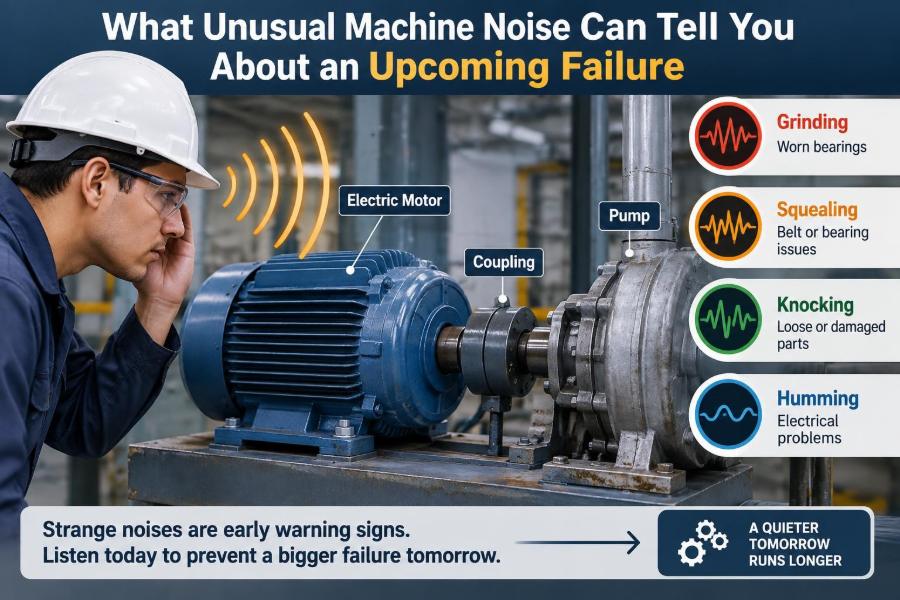

A pump that has run quietly for years begins to make a faint gravel-like rattle. A belt-driven fan develops a regular chirp on each revolution. A gearbox produces a new whine only when the production line is heavily loaded.
It is tempting to turn up the radio, tighten an obvious bolt, or wait until the next planned shutdown. But machine noise is often an early, accessible signal that friction, looseness, impact, flow disturbance, or structural resonance has changed somewhere in the system.
Sound alone rarely identifies a failure with certainty. A noisy machine may have a minor alignment issue, while a quiet one can still contain serious damage. Yet when operators combine what they hear with operating conditions, inspection, vibration data, and process history, unusual noise becomes useful condition-monitoring information.
The goal is not to diagnose every machine by ear. It is to recognize meaningful change, respond safely, and turn an unfamiliar sound into a focused investigation before a small defect becomes lost production, damaged equipment, or injury.
👂 Why a New Sound Deserves Attention
Machines generate sound whenever mechanical energy creates pressure waves in air. Gears mesh, rolling elements pass over surfaces, fluid pulses move through piping, and motors create electromagnetic forces. Some of this noise is normal and predictable.
The warning sign is usually not simply “loud.” It is a change from the machine’s established acoustic pattern: a new tone, a different rhythm, a sound that appears under load, or a noise that grows between inspections. This change can precede a functional failure because many defects alter contact forces before they stop the machine.
🔍 Sound Is a Symptom, Not a Verdict
A squeal may indicate belt slip, but it can also arise from a dry seal, a rubbing guard, or a bearing running with inadequate lubrication. Treating every sound as a one-to-one diagnosis is a common and costly mistake.
Use sound to form hypotheses. Then test those hypotheses with evidence such as temperature, vibration spectrum, lubricant condition, motor current, speed, process flow, and visual inspection. The best question is not “What does this noise mean?” but “What physical mechanism could produce this noise under these operating conditions?”
📈 Establishing the Normal Acoustic Baseline
Meaningful comparison requires a baseline. During healthy operation, document the machine’s normal sound at representative speeds, loads, temperatures, and process states. A centrifugal pump, for example, may sound different at minimum flow than it does near its preferred operating region.
Baseline records do not need to begin with expensive instrumentation. Operator notes, short controlled audio recordings where permitted, and routine walk-around observations can be valuable. Record the date, asset, operating state, location, and anything unusual nearby, such as a running compressor or open enclosure.
🎵 Frequency, Pitch, and Repetition
Pitch broadly reflects frequency: higher-frequency sounds are perceived as sharper, while lower-frequency sounds feel like hums or rumbles. Repetition adds another clue. A once-per-revolution knock suggests a rotating component with a localized problem, whereas a smooth high-pitched tone may relate to mesh frequency, air flow, or electrical excitation.
Human hearing is good at recognizing pattern changes but poor at assigning exact frequencies. A simple sound description is still useful: “metallic click once per turn,” “broad rushing noise at high flow,” or “steady whine increasing with speed.” Avoid vague reports such as “sounds bad.”
⚙️ Rotational Speed Connects Noise to Components
Every rotating shaft has a rotational frequency, often expressed in revolutions per minute or hertz. If a sound occurs once per shaft revolution, its repetition rate follows shaft speed. A defect on a pulley, coupling, fan blade, or eccentric shaft can therefore create a speed-related pattern.
Knowing the speed narrows the search. A knock that remains fixed in time while shaft speed changes may instead come from a valve cycle, external impact, or structural movement. In variable-speed equipment, observing whether the sound tracks speed is especially informative.
🧱 Rumbles Often Point to Looseness or Rough Contact
A low, irregular rumble can come from a worn rolling-element bearing, loose foundation hardware, damaged gear teeth, or components rubbing intermittently. It may be more noticeable through the machine frame than through the air.
Do not assume every rumble is a bearing failure. Check for soft foot, loose baseplates, degraded isolation mounts, pipe strain, and contact between guards and rotating parts. These conditions can amplify a modest source into an alarming sound and may themselves create fatigue risk.
🪨 Grinding Signals Abrasive or Damaged Contact
Grinding usually suggests surfaces sliding or rolling across rough material, debris, or damage. Examples include a bearing with severe surface distress, a brake dragging, a worn impeller contacting a casing, or foreign material in a conveyor drive.
A grinding noise that appears suddenly merits prompt assessment, particularly if it is accompanied by increasing temperature, vibration, reduced speed, metallic debris, or a burning odor. Continued operation can rapidly turn a repairable contact issue into shaft, housing, or rotor damage.
🐦 Squeals Commonly Involve Slip or Insufficient Lubrication
A sharp squeal often occurs when surfaces move relative to one another in stick-slip motion: they briefly adhere, release, and reattach. Belts slipping on pulleys, dry bushings, glazed friction surfaces, and seals can all produce it.
For a belt drive, inspect tension, pulley alignment, belt condition, contamination, and load. Simply increasing tension may silence the noise temporarily but overload bearings if misalignment or a seized driven component is the true cause. Diagnose the source before adjusting it.
🔔 Knocks and Clunks Reveal Impact
A knock is an impact event. It may result from excessive bearing clearance, a loose coupling element, a cracked mount, gear backlash under reversing load, a reciprocating mechanism, or a rotating part striking a stationary guard.
The timing matters. A clunk only during starts and stops can indicate torque reversal or coupling clearance. A rhythmic knock during steady running may track rotation. Isolate the area without approaching unguarded motion, then inspect mounting hardware, couplings, guards, and driven attachments during a safe shutdown.
📣 Whines Can Come From Gears, Bearings, or Electrical Effects
A whine is usually tonal and sustained. Gear mesh naturally creates tones, especially in high-speed reducers, but a changing whine can indicate altered tooth contact from wear, misalignment, incorrect backlash, inadequate lubrication, or increased load.
Electric motors and variable-frequency drives can also produce audible electromagnetic tones. A new electrical whine should be assessed alongside current balance, speed, cooling, and drive settings. Do not open energized electrical equipment unless qualified and authorized to do so.
💨 Hissing and Roaring Often Involve Fluid Energy
Pressurized air, steam, gas, and liquid can create hissing or roaring when passing through restrictions, leaking seals, damaged valves, or partially closed fittings. The sound may be the most obvious clue to energy loss or an unsafe release.
Fluid noise is not always a leak. High velocity through a correctly operating control valve can be noisy, and turbulent flow may be expected in certain services. The key distinction is whether the sound is new, localized, or associated with abnormal pressure, flow, temperature, or process performance.
🫧 Cavitation Has a Distinctive Gravel-Like Character
Cavitation occurs when local pressure in a liquid falls enough for vapor bubbles to form and then collapse as pressure recovers. In pumps, the collapse can create a crackling or gravel-like noise, fluctuating discharge conditions, vibration, and eventual erosion of impellers or casings.
Possible causes include insufficient suction head, a blocked suction strainer, excessive liquid temperature, a valve restriction, operating too far from the pump’s preferred range, or air ingress. The practical response is to investigate the suction system and operating point, not merely to reduce the audible noise.
🌊 Flow Turbulence Can Sound Like a Mechanical Defect
Rapidly changing flow direction, separation around obstructions, and pulsation from pumps or compressors can create broadband rushing, whooshing, or buffeting sounds. Piping, ducts, and thin panels may transmit or amplify these fluctuations.
This is why process context matters. If a noise begins after a valve adjustment, filter change, or production-rate increase, examine the flow path first. Mechanical repairs will not solve a hydraulic or pneumatic instability, and a process correction may prevent fatigue damage in piping supports.
🦷 Gear Noise Reflects Contact Quality
Healthy gears are not silent, especially at high speed, but their sound is generally stable for a given load and speed. A rising whine, cyclic growl, or periodic click can reflect tooth wear, chipped teeth, eccentricity, shaft misalignment, housing distortion, or lubrication trouble.
Oil inspection can strengthen the diagnosis. Changes in viscosity, contamination, water ingress, or metallic particles may support a gear-related concern. However, oil findings should be interpreted within the machine’s maintenance history; a sample taken after recent repair work may contain residual debris.
🛞 Bearing Noise Changes as Damage Progresses
Rolling-element bearings often begin with defects too small to hear directly. Vibration monitoring may detect characteristic impact frequencies earlier than an operator can. As damage grows, roughness and impacts can become audible as a hiss, growl, rumble, or periodic tick.
Noise alone cannot identify the exact bearing element at fault. Still, a worsening sound combined with elevated vibration or temperature supports timely planning. Bearing failures can also originate outside the bearing itself, including poor fits, contamination, misalignment, overload, electrical discharge, or incorrect lubrication.
🧲 Electrical Noise Has Mechanical Consequences Too
Motors can hum because alternating magnetic forces act within the stator and rotor. A noticeable change in hum may be associated with loose laminations, unbalanced voltage, air-gap irregularity, mounting looseness, or driven-load effects.
Electrical faults and mechanical faults can interact. For example, a damaged bearing can alter rotor position, while poor power quality can increase heat and torque pulsation. When a motor sounds different, evaluate both the electrical supply and the mechanical system it drives.
🏗️ Resonance Can Make a Small Problem Sound Severe
Resonance occurs when an excitation frequency aligns with a natural frequency of a structure. The machine, base, guard, pipe, or panel can then vibrate much more strongly than the original forcing would suggest.
A resonance-related noise often appears only over a narrow speed range. A fan may become loud while accelerating through one speed and quiet again above it. That pattern points toward structural dynamics, although the original excitation—imbalance, misalignment, or blade pass forces—still needs investigation.
🔩 Loose Parts Create Secondary Noise Sources
Not every alarming sound originates inside the machine. Loose guards, cable trays, inspection covers, brackets, pipe supports, and foundation bolts can buzz, rattle, or strike in response to otherwise ordinary vibration.
These secondary sources should not be dismissed. A loose guard can become a safety hazard, and a loose pipe support can accelerate fatigue. But avoid declaring victory after tightening the visibly rattling item; confirm whether it was the root cause or merely a component responding to deeper vibration.
🌡️ Use Temperature as a Corroborating Signal
Friction, poor lubrication, electrical losses, and restricted cooling often generate heat. A new noise plus a localized temperature rise is more concerning than either symptom alone. Infrared tools can be useful for comparative checks when used correctly.
Surface temperature has limits. Emissivity, reflections, airflow, load changes, and measurement location affect readings. Compare like with like: the same point on similar equipment under similar conditions. Never rely on an unverified temperature image as a complete diagnosis.
📊 Vibration Analysis Adds Precision
Vibration instruments measure motion rather than airborne sound, allowing technicians to identify frequencies and amplitudes with greater repeatability. A spectrum can reveal running speed, harmonics, gear mesh frequencies, and characteristic bearing-related activity.
For many critical assets, vibration trending is more dependable than informal listening. Even so, sound remains valuable because operators notice it quickly and because it can reveal air leaks, flow noise, and external contact that may not appear clearly in a vibration measurement.
🛢️ Lubrication Problems Are Often Heard Late
Too little lubricant, the wrong lubricant, contamination, degraded oil, and excessive grease can all change machine sound. A dry contact may squeal or grind, while overgreasing a rolling bearing can raise temperature and churn lubricant.
Adding lubricant solely because a bearing is noisy is risky. If the bearing has severe damage, contamination, or an incorrect fit, grease may mask symptoms briefly without correcting the cause. Follow the equipment’s lubrication procedure, including type, quantity, interval, and cleanliness controls.
🧭 The Operating Condition Is Part of the Diagnosis
Ask when the sound occurs: at startup, after warm-up, at one speed, under high torque, during valve movement, or only with a particular product. This operating envelope often separates likely causes faster than the sound label itself.
Consider a hypothetical conveyor gearbox that whines only when boxes accumulate. The load-dependent behavior could indicate gear contact problems, bearing load sensitivity, or structural deflection. A noise present with the belt empty would point the investigation in a different direction.
🗺️ Locate the Sound Without Putting Yourself at Risk
Use normal observation points and follow site safety procedures. Listening from several safe positions can help distinguish a motor-end sound from a pump-end sound or determine whether piping is transmitting noise from another source.
Never remove guards, reach through barriers, or use improvised listening tools near exposed rotating equipment. Some facilities use purpose-designed mechanical or ultrasonic listening devices under controlled procedures. Their usefulness depends on training, access control, and the hazards of the specific asset.
📝 Describe Noise So the Next Person Can Act
A useful report contains more than “strange noise.” Include the asset identification, exact location, sound character, onset, duration, severity trend, operating state, and accompanying symptoms. A short description such as “high-frequency whine at reducer output, only above normal line speed” gives maintenance a testable starting point.
Where site policy allows, an audio clip can preserve a transient symptom that disappears before inspection. Label it carefully with operating conditions. Recordings made in noisy plant areas should support, not replace, direct inspection and instrument data.
🚦 Triage: Monitor, Plan, or Stop
The right response depends on consequence, rate of change, redundancy, and evidence of active damage. A stable, minor noise on a noncritical asset may justify monitoring. A growing noise with rising vibration may require planned intervention. Harsh grinding, smoke, rapid heating, exposed damage, or signs of containment loss can warrant immediate shutdown under established procedures.
When uncertain, escalate to the responsible supervisor, maintenance engineer, or reliability team. Production pressure should not force an operator to accept a condition that violates safety limits or could cause a major secondary failure.
⚠️ Do Not Silence the Symptom and Call It Fixed
Noise reduction can be useful for worker comfort and hearing conservation, but it is not necessarily equipment repair. Adding insulation, tightening a panel, or changing a speed may make the sound less noticeable while the original defect continues.
Similarly, changing a machine’s operating condition can hide a developing fault. If lowering flow stops pump cavitation, that may be an appropriate temporary control, but the suction conditions and process requirement still need review before the system returns to normal duty.
🧰 A Practical First-Response Sequence
When an unfamiliar noise is reported, a disciplined sequence prevents both panic and neglect:
- Confirm the asset and operating condition from a safe location.
- Compare the sound with known normal behavior and recent history.
- Check for obvious associated signs: vibration, heat, leakage, odor, speed change, or abnormal process readings.
- Assess immediate safety and process risk using site procedures.
- Document the observation and notify the appropriate person.
- Use targeted inspection or condition-monitoring tests to confirm the cause.
This sequence turns an impression into information while keeping troubleshooting proportionate to the risk.
🧠 Common Interpretation Mistakes
Several habits weaken noise-based troubleshooting. One is anchoring on the first familiar explanation, such as blaming every rumble on bearings. Another is comparing different machine states, such as a fully loaded pump today with an unloaded pump yesterday.
- Ignoring nearby equipment that can transmit sound through structures or piping.
- Failing to record when the noise began or what changed beforehand.
- Using a single reading instead of looking for a trend.
- Confusing a loud normal machine with a changing abnormal one.
- Performing adjustments without recording the original condition.
Good diagnosis remains evidence-based, even when an experienced operator has an excellent ear.
🎧 Hearing Protection Does Not Replace Observation
In many workplaces, hearing protection is necessary because exposure to high noise levels can harm hearing. It should be selected and worn according to the site’s safety program. Protection can make subtle sounds harder to notice, but that does not mean workers should remove it in hazardous areas.
Instead, build deliberate inspection practices: use safe observation points, scheduled checks, approved tools, and instrumented monitoring for critical equipment. The objective is to protect people while preserving the ability to detect meaningful machine changes.
🔄 Build Noise Into Predictive Maintenance
Predictive maintenance uses condition indicators to plan work before functional failure. Acoustic observations fit best when they are part of a wider program including vibration analysis, thermography, oil analysis, ultrasonic inspection, motor testing, and process trend review where appropriate.
Not every asset needs every technology. Select methods based on failure modes and consequences. An air-leak survey may benefit from ultrasonic detection, while a critical gearbox may justify regular vibration and oil analysis. Choose the measurement that can detect the failure mechanism early enough to act.
🤝 Operators and Maintainers Need a Shared Language
Operators hear machines throughout the shift and may notice changes long before scheduled maintenance rounds. Maintainers bring diagnostic methods, repair history, and technical context. Reliability improves when neither group treats the other’s information as anecdotal or secondary.
Create simple shared categories for sound, location, load condition, and urgency. Feedback matters too: when maintenance finds the cause, explain it. Over time, this helps operators recognize which changes are normal and which observations deserve immediate escalation.
🏁 The Core Principle: Listen for Change, Then Verify
Unusual machine noise is best understood as an early warning language, not a self-contained diagnosis. Rumbles, squeals, knocks, whines, hisses, and crackles each point toward physical mechanisms, but context determines whether the source is a belt, bearing, gear, pump, valve, structure, or electrical system.
The most reliable response combines safe observation with trend data and targeted testing. Listen for what has changed, connect it to speed and operating conditions, look for supporting symptoms, and act according to the risk. This approach prevents both unnecessary intervention and dangerous delay.
A machine’s new sound is valuable not because it predicts one specific failure, but because it tells you the machine deserves a better question before the defect gets worse. 🔊⚙️🛠️