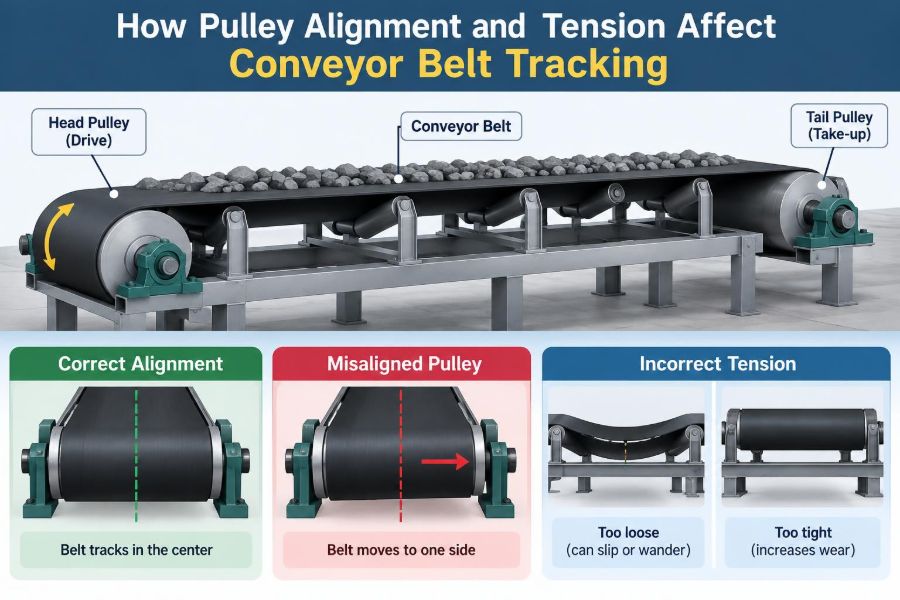

A conveyor that runs smoothly during a quiet inspection can begin drifting toward one side as soon as it carries a real load. The edge may rub a guard, material may spill, and operators may be tempted to turn an adjustment screw until the belt appears to behave.
That quick fix sometimes works briefly. But belt tracking is rarely just a “belt problem.” It is the visible result of forces created by pulleys, idlers, loading, structure, belt condition, and tension.
Two factors deserve particular attention: pulley alignment and belt tension. Together, they establish the geometry and friction conditions that guide a belt through every revolution.
Understanding their interaction helps technicians correct root causes rather than repeatedly compensate for them. It also reduces belt-edge damage, unplanned downtime, cleanup work, and avoidable component wear.
🧭 What Belt Tracking Actually Means
Belt tracking is the belt’s ability to run consistently in its intended path, usually centered on pulleys and idlers. A correctly tracking belt may move slightly as conditions change, but it does not continually migrate toward one edge.
Tracking should not be confused with a perfectly motionless belt. Small side-to-side movement can occur because of splice variations, material distribution, belt construction, or changing operating conditions. The concern begins when the belt contacts stationary parts, develops a persistent side bias, or needs frequent adjustment.
🔄 The Basic Conveyor Belt Force System
A conveyor belt is pulled by a drive pulley and supported or guided by other pulleys and idlers. Its movement depends on longitudinal tension—the pulling force along its length—and on friction between the belt and the drive pulley.
At the same time, the belt responds to lateral forces. A pulley that is not square to the belt path, a tilted idler, or uneven loading can introduce a sideways component of force. Since a flexible belt follows the path of least resistance created by contact geometry, it gradually walks sideways.
🎯 Why Pulleys Have Such Strong Influence
Pulleys define major changes in the belt’s direction. The head pulley, tail pulley, bend pulleys, take-up pulleys, and snub pulleys all establish reference points for the belt path.
Because the belt wraps around a pulley, the pulley can affect the belt for a substantial contact arc rather than at one small point. A small angular error at a pulley can therefore create a persistent tracking tendency over many belt cycles.
📐 Pulley Alignment Defined
In conveyor practice, pulley alignment means more than making a shaft look level. A pulley should be positioned so its shaft is square to the intended belt centerline, its face is level where required by the conveyor design, and its two bearings are located at the correct elevation and distance.
A pulley may be level relative to the building floor yet still be misaligned relative to a conveyor frame that has shifted or was installed out of square. The useful reference is the belt’s intended travel path, not a convenient nearby surface.
↗️ How a Misaligned Pulley Steers a Belt
A belt tends to move toward the side of a pulley that it contacts first. Put another way, it tends to seek the side where the pulley is effectively leading it.
Imagine rolling a strip of paper over a cylinder whose axis is slightly skewed. The paper does not leave the cylinder in a straight, centered path; it migrates toward one side. A conveyor belt behaves similarly, although its stiffness, tension, loading, and pulley lagging make the real response more complex.
🧱 Head Pulley Errors and Their Consequences
The head pulley is especially influential because it is commonly the drive pulley and the discharge point. If it is not square to the belt centerline, the belt may approach the pulley off-center and continue to drift through the return run.
Misalignment here can also affect discharge. Material may leave unevenly, scrape a chute wall, or build up on one side of the pulley. Build-up then changes the pulley’s effective diameter locally, creating another tracking force on top of the original alignment error.
🏁 Tail Pulley Alignment at the Start of the Carrying Run
The tail pulley establishes the belt’s entry into the loaded, carrying side. If it is skewed, the belt can begin its loaded run already moving toward one side, making downstream idler adjustments seem necessary even though they are only compensating for the tail-pulley condition.
For that reason, persistent tracking problems should usually be investigated from the belt’s entry and exit points around major pulleys before adjusting numerous idlers.
🌀 Snub, Bend, and Take-Up Pulley Effects
Smaller auxiliary pulleys are sometimes overlooked because they do not discharge material or provide the main drive. Yet a snub pulley changes wrap angle, a bend pulley redirects the belt, and a take-up pulley maintains tension; each can steer the belt if misaligned.
A moving take-up adds a further complication. Its carriage must travel freely and remain square. A take-up that binds, moves unevenly, or has unequal adjustment on its two sides can introduce both tension imbalance and pulley skew.
⚖️ Tension Is Not the Same as Tightness
Conveyor tension is an engineered operating condition, not simply the feeling that a belt is “tight.” A belt needs enough tension to transmit drive force, maintain required sag between idlers, and remain stable through curves, transitions, and loading zones.
Too little tension can permit slip at the drive pulley and excessive sag. Too much tension increases forces on the belt, splice, bearings, pulleys, and structure. The target is the tension specified for the conveyor and belt design, not the maximum tension the system can tolerate.
🧲 How Adequate Tension Supports Tracking
With adequate and reasonably uniform tension, the belt seats predictably on pulleys and idlers. Its response to a deliberate tracking correction is clearer because slack is not masking the belt path.
Low tension can make the belt flutter, sag, or shift in response to changing loads. It may appear to track acceptably empty but wander once material is added, especially where the load changes the belt shape or increases resistance on one side.
📉 Low Tension and Drive-Pulley Slip
When friction is insufficient to transmit the required driving force, the belt can slip on the drive pulley. Slipping may generate heat, wear lagging, polish the pulley surface, and damage the belt cover.
Slip does not always cause lateral mistracking directly. However, it often occurs alongside unstable belt behavior, contaminated lagging, poor wrap, or uneven loading—all conditions that can make tracking more difficult to diagnose and control.
📈 Why Excessive Tension Is Also a Problem
Increasing tension may make a belt look more stable for a short time, but it is not a universal tracking cure. Excessive tension raises bearing load and can accelerate fatigue in mechanical joints, splices, and the belt carcass—the internal reinforcement that carries tension.
It can also hide a geometric error. The belt may resist visible wandering until loading, temperature, or belt wear changes, after which the unresolved alignment problem returns.
↔️ Unequal Tension Across the Belt Width
A belt should generally be tensioned uniformly across its width. If one side carries more longitudinal tension than the other, the belt can steer, cup, wrinkle, or show uneven edge behavior.
Unequal tension may result from an out-of-square take-up, an uneven splice, belt damage, a distorted pulley, or a loading condition that consistently drags more heavily on one side. This is a different issue from the correct overall tension value: a system can have enough total tension while still being uneven across the belt.
🧵 The Splice as a Tracking Variable
A splice is a local change in belt stiffness, thickness, and flexibility. If a mechanical splice is installed crooked, or a vulcanized splice is not square, it can create a repeating tracking disturbance every time it passes a pulley.
Watch whether the belt shifts at the same point in every revolution. A repeating event points toward the splice, a localized damaged area, or a pulley condition rather than a general frame alignment problem.
🛞 Crowned Pulleys: Helpful but Limited
A crowned pulley has a slightly larger diameter at its center than near its edges. The geometry can encourage a belt to seek the pulley center, which is why crowned pulleys are used in some conveyor arrangements.
They are not a substitute for correct alignment. A severely skewed pulley, poor loading, or damaged belt can overpower the centering effect. Crown suitability also depends on belt type, width, construction, pulley location, and manufacturer guidance; some modern conveyor belts and pulley arrangements are not intended to rely on crown for tracking.
🧰 Lagging Changes Grip, Not Alignment Geometry
Pulley lagging is a covering, often rubber or ceramic, applied to improve traction, protect the shell, and sometimes shed water or debris. It can be critical at a drive pulley, particularly in wet or demanding service.
But lagging cannot make a skewed pulley square. Unevenly worn, damaged, or material-coated lagging may actually worsen tracking by changing the effective pulley diameter or friction from one side to the other.
🏗️ The Conveyor Structure Must Provide a True Reference
Technicians often align a pulley to nearby steelwork. That approach fails if the stringers, supports, or pulley supports are bent, twisted, or incorrectly installed.
Check the conveyor centerline over a meaningful distance. The structure should support idlers and pulleys in a consistent plane, without local twists that force the belt to alternate between competing paths. A systematic survey is more reliable than correcting only the visibly troublesome location.
🪜 Idlers Can Correct or Create Tracking Errors
Idlers support the belt between pulleys. A training idler may pivot or shift intentionally to react to belt movement, while ordinary carrying and return idlers should be installed square to the belt path.
An idler that is skewed can steer the belt, which is useful only when it is a deliberate, controlled correction. Randomly skewing several ordinary idlers is a common practice with poor long-term results: it creates a sequence of opposing steering forces and complicates later troubleshooting.
📦 Centered Loading Protects Belt Path
Material should be loaded near the belt centerline and at a velocity and direction compatible with belt travel. If material lands heavily on one side, that side experiences greater drag and weight, encouraging the belt to move laterally.
Chutes, skirts, impact beds, and sealing systems all affect this condition. A belt that runs centered when empty but tracks poorly under load often needs a loading-zone inspection, not merely a pulley adjustment.
🧹 Material Build-Up Creates a Moving Misalignment
Sticky material, carryback, and fines can accumulate on pulley faces, return idlers, and chute components. Build-up on one side of a pulley effectively changes its diameter, causing the belt to climb or steer as if the pulley had changed shape.
Effective belt cleaners, correctly adjusted scrapers, and access for routine cleaning are therefore tracking controls as well as housekeeping measures. Never attempt to remove build-up from a moving conveyor unless the equipment is isolated and the site’s safe-work procedure permits the task.
🔍 Inspect the Direction and Timing of the Drift
A useful diagnosis begins with observation. Note where the belt first begins moving sideways, whether it moves toward the same side on both carrying and return runs, and whether the motion changes with load.
- Drift beginning near one pulley can indicate that pulley or its approach alignment.
- Drift only under load can point to loading asymmetry, sag, or tension instability.
- A periodic shift can indicate a splice, damaged belt section, or eccentric pulley.
- Erratic movement can indicate contamination, loose components, fluctuating loading, or multiple interacting causes.
These patterns are clues, not proof. Measurements should confirm the suspected cause.
📏 Practical Ways to Check Pulley Alignment
Methods range from a string line and tape measure to laser alignment instruments and optical surveying equipment. The appropriate method depends on conveyor length, access, required accuracy, and site procedures.
At a basic level, compare pulley center positions and shaft orientation against an established conveyor centerline. Check bearing elevations, measure diagonals where geometry permits, and inspect whether the pulley is parallel to other correctly referenced pulleys. Laser tools can improve repeatability, but only if the chosen reference path is itself valid.
🧪 A Controlled Adjustment Sequence
Adjustments should be deliberate, small, and recorded. Before changing anything, verify that guards, interlocks, isolation practices, and authorized work procedures are followed.
- Remove obvious build-up and repair loose or damaged components.
- Confirm the belt, splice, loading zone, and structure are not creating the primary error.
- Measure and correct major pulley alignment issues first.
- Set the take-up according to the conveyor’s design requirements.
- Run the belt under representative conditions and observe several complete cycles.
- Use tracking devices or minor idler corrections only after the fundamental geometry is sound.
Changing several variables at once makes it impossible to know which change helped or caused a new problem.
🚫 Common Adjustment Mistakes
One frequent mistake is adjusting the tail pulley repeatedly to compensate for a crooked head pulley or an off-center loading chute. Another is tightening the take-up whenever the belt wanders, even though overall tension is already correct.
- Using belt-edge contact as a normal guide rather than treating it as a symptom.
- Aligning to floors, guards, or damaged structure instead of the true belt path.
- Ignoring worn lagging, seized idlers, or carryback.
- Making large changes and testing only with an empty belt.
- Assuming automatic tracking devices can overcome major installation errors.
These actions may reduce the visible symptom while increasing wear or hiding the root cause.
🛡️ Safety Boundaries During Troubleshooting
Conveyors contain nip points where belts enter pulleys and idlers, as well as moving loads and stored energy in take-up systems. Belt tracking work can place people close to these hazards.
Inspection while running should be limited to safe observation from approved locations. Alignment, cleaning, component replacement, and hands-on adjustment require isolation, lockout/tagout or the site’s equivalent energy-control process, and trained personnel. The exact procedure depends on the equipment and workplace rules.
🧱 Belt Condition Can Override Good Settings
A belt with damaged edges, a permanently curved carcass, uneven wear, delamination, or a distorted splice may not track consistently even on a well-aligned conveyor. Aging can also alter flexibility and response to crown or training idlers.
This does not mean every tracking issue requires a new belt. It means inspection must distinguish between an external steering force and a belt that has developed an internal or geometric defect. Replacing components without making that distinction can waste maintenance effort.
🌡️ Environmental and Operating Changes Matter
Temperature, moisture, dust, washdown, and seasonal changes in material properties can all alter friction and build-up. A conveyor in cold conditions may behave differently from the same conveyor in warm, dry operation.
Similarly, a belt may track differently at startup, at full throughput, and during intermittent operation. A sound diagnosis considers the actual operating envelope rather than relying on one short no-load observation.
📋 A Practical Symptom-to-Cause Guide
| Observed behavior | Likely areas to inspect | Why it matters |
|---|---|---|
| Belt tracks off-center in the same area every cycle | Splice, damaged belt section, pulley runout | A repeating feature is influencing each revolution. |
| Belt is centered empty but wanders loaded | Loading chute, skirt drag, belt tension, structure deflection | Load introduces uneven resistance or changes belt shape. |
| Belt moves toward one pulley edge after entering it | Pulley squareness, bearing positions, build-up | The pulley may be steering the belt directly. |
| Tracking changes after rain or washdown | Lagging, contamination, cleaners, slip, drainage | Moisture changes friction and may carry debris onto pulleys. |
| Frequent corrections do not hold | Reference alignment, take-up condition, belt health, multiple causes | A local adjustment is likely compensating for a larger fault. |
🔧 Maintenance Practices That Preserve Alignment
Tracking reliability improves when alignment is treated as a condition to maintain rather than a crisis to solve. Record baseline pulley positions after installation or major overhaul, then inspect for movement during planned maintenance.
Useful routine checks include loose bearing housings, cracked supports, uneven lagging wear, seized idlers, take-up travel, cleaner condition, belt-edge wear, and accumulation near pulleys. Trend observations from operators as well: a slight, repeatable change often appears before serious edge damage.
🤝 When Tracking Devices Are Appropriate
Self-aligning idlers, guide rolls, edge sensors, and powered tracking systems can be valuable where loading varies or where the conveyor has unavoidable operating disturbances. They should be selected for the belt type, speed, loading, and environment.
These devices work best on a conveyor with sound foundations. A tracking device is a control measure, not permission to accept skewed pulleys, a twisted frame, or chronic material build-up. It also needs inspection; a seized or incorrectly positioned tracker can become another steering source.
🧠 The Core Principle: Geometry First, Tension in Balance
Reliable belt tracking begins with a conveyor whose pulleys and structure define a true path. Correct pulley alignment removes persistent lateral steering forces before technicians try to manage their symptoms elsewhere.
Tension then supports that geometry by keeping the belt engaged, stable, and capable of transmitting drive force without excessive sag or slip. The goal is neither a loose belt nor the tightest possible belt, but uniform, design-appropriate tension combined with accurate mechanical alignment.
When a belt wanders, investigate in order: establish the path, inspect the pulleys and belt, evaluate tension and loading, remove contamination, and make measured corrections. That sequence turns tracking from trial-and-error adjustment into a practical engineering problem.
A conveyor belt tracks best when its pulleys establish a straight, square route and its tension is correct and even across the belt width. Treat every persistent drift as useful evidence of a force or geometric error waiting to be found. 🔧🧭🛠️