
A factory conveyor slows unexpectedly during a busy shift. Its motor is still energized, the shaft is still turning, but a hot, rough sound is coming from the drive end. A small component between the shaft and the machine frame may be deciding whether production continues or stops.
The same principle appears in a bicycle wheel, a ceiling fan, an electric vehicle motor, a wind turbine, and a household washing machine. Wherever one part rotates relative to another, engineers must control friction while carrying forces safely.
That is the job of a bearing. Although bearings are often hidden inside housings, their selection, installation, lubrication, and maintenance strongly influence efficiency, precision, noise, reliability, and safety.
Understanding how bearings work helps engineers see rotating machinery as a complete system rather than a collection of separate parts. ⚙️
🧭 1. The Basic Job of a Bearing
A bearing is a machine element that supports and guides a moving component while allowing a desired type of motion. In rotating machinery, it usually supports a shaft and permits rotation relative to a stationary housing.
Its purpose is not simply to “make things spin.” A bearing must transmit loads from the shaft into the structure, maintain the shaft’s intended position, and do so with manageable friction and heat.
🔄 2. Why Rotating Shafts Need Support
A shaft carrying a pulley, gear, rotor, impeller, or wheel experiences forces as it operates. Without support near suitable locations, it can deflect, vibrate, rub against stationary parts, or fail from excessive stress.
Bearings provide reaction forces that restrain the shaft. Their locations create the support span, which affects shaft deflection, critical speed, gear contact, belt tracking, and seal performance.
🧱 3. The Problem With Sliding Surfaces
Imagine a shaft rotating directly in a hole in a machine frame. The shaft and frame surfaces would slide over one another, producing resistance, wear, and heat.
This arrangement can work in a properly designed plain bearing, but it needs appropriate materials, geometry, lubrication, and clearance. An unplanned metal-on-metal sliding contact is usually destructive.
🛞 4. Rolling Friction Versus Sliding Friction
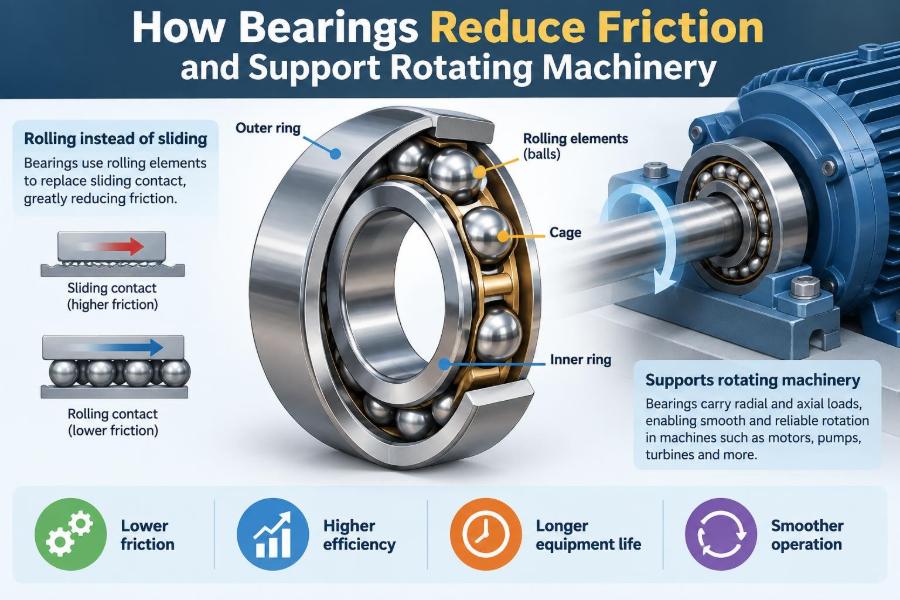
Rolling-element bearings reduce resistance by placing balls or rollers between two rings. Instead of broad sliding contact between shaft and housing, rolling elements move along carefully formed raceways.
Rolling does not eliminate all friction. Real bearings still lose energy through elastic deformation at contacts, lubricant shear, cage motion, seals, churning, and small amounts of sliding. Yet their friction can be low and predictable under suitable conditions.
💧 5. How Fluid Films Reduce Friction
Plain bearings commonly rely on a thin lubricant film separating the shaft journal from the bearing surface. When the film is established, the opposing solids do not continuously touch across their full apparent contact area.
In hydrodynamic lubrication, shaft rotation drags oil into a converging clearance, creating pressure that supports the load. The shaft rides on the oil film, much like a surface supported by a shaped wedge of fluid.
🧩 6. The Main Parts of a Rolling-Element Bearing
A typical rolling bearing contains several coordinated components:
- Inner ring: commonly mounted on the rotating shaft.
- Outer ring: commonly held in the stationary housing.
- Rolling elements: balls, cylindrical rollers, tapered rollers, needle rollers, or spherical rollers.
- Cage: spaces and guides the rolling elements.
- Lubricant and seals: reduce friction and protect the internal surfaces.
Depending on the application, either ring may rotate. What matters is the relative motion and the load path through the assembly.
⚪ 7. Why Balls Are Useful
Ball bearings use spherical rolling elements. Their point-like contact regions generally produce low rolling resistance and make them well suited to moderate loads, higher rotational speeds, and applications needing smooth motion.
Common examples include small electric motors, fans, pumps, machine-tool spindles, and bicycle hubs. The exact capability depends on bearing size, internal design, preload, lubrication, and operating conditions.
🧱 8. Why Rollers Carry Larger Loads
Roller bearings use rolling elements with line-like contact regions rather than ball-like point contacts. This spreads load over a larger area and can provide higher radial load capacity for a given bearing envelope.
Rollers are not interchangeable with balls in every case. Their geometry, speed limits, alignment tolerance, thrust capability, and friction characteristics differ.
📐 9. Radial Loads and Axial Loads
A radial load acts perpendicular to the shaft centerline. Belt tension, gear mesh force, and the weight of a rotor can all create radial loading.
An axial load, also called thrust load, acts parallel to the shaft centerline. Helical gears, propellers, pumps, and thermal expansion arrangements may introduce axial force.
Many bearing failures begin with a mismatch between the actual load direction and the bearing’s intended function.
↔️ 10. Locating and Floating Arrangements
Long shafts and housings change length as temperature changes. If both bearing positions rigidly restrain axial movement, thermal growth can create damaging internal forces.
Engineers often use one locating bearing to position the shaft axially and one floating bearing to permit controlled axial displacement. The floating function may occur within the bearing or between a bearing ring and its seat.
🧾 11. Common Bearing Types Compared
| Type | Typical strengths | Typical considerations |
|---|---|---|
| Deep-groove ball | Simple, versatile, low friction; carries radial and moderate axial loads | Limited tolerance for severe misalignment or very high load |
| Angular-contact ball | Supports combined radial and axial loading; useful for precision arrangements | Often requires a defined orientation or paired arrangement |
| Cylindrical roller | High radial capacity and stiffness | Axial capability depends on flange design |
| Tapered roller | Handles combined loads; axial clearance or preload can be adjusted | Usually used in opposing pairs |
| Spherical roller | High load capacity and accommodation of misalignment | Often has more friction than some ball-bearing options |
| Plain journal bearing | Can support heavy loads and damp vibration at high speed | Requires careful lubricant-film design and oil control |
🎯 12. Contact Angle and Combined Loading
In an angular-contact ball bearing, the line through the contact points is inclined relative to the radial direction. This contact angle allows the bearing to support substantial axial load in one direction while also carrying radial load.
Two angular-contact bearings are frequently arranged together so the shaft can resist axial loads in both directions. Their arrangement also affects stiffness and response to moments.
🪜 13. Tapered Roller Bearings and Opposing Forces
Tapered roller bearings contain conical rollers running between conical raceways. Their geometry naturally supports both radial and axial components of load.
Because one bearing primarily accepts thrust in one direction, a second bearing is often installed facing the opposite direction. Wheel hubs, gearboxes, and machine spindles commonly use this principle.
🌐 14. Misalignment and Self-Aligning Designs
Misalignment occurs when the shaft axis and housing axis are not perfectly collinear. It may result from manufacturing error, mounting distortion, shaft deflection, foundation movement, or thermal effects.
Self-aligning ball bearings and spherical roller bearings can accommodate a degree of angular misalignment. They are valuable where alignment cannot be held tightly, but they do not excuse poor shaft and housing design.
📏 15. Clearance: Small Space, Major Effect
Internal clearance is the small amount by which bearing rings can move relative to one another before mounting and operation. It changes after interference fits, temperature differences, and applied loads.
Too much operating clearance can reduce stiffness and allow vibration. Too little can create preload, raise friction and temperature, and shorten fatigue life.
🔒 16. Preload for Stiffness and Precision
Preload is an intentional internal load applied to a bearing arrangement even before the machine experiences its service load. It removes free play and increases stiffness.
Precision spindles, instrument mechanisms, and certain gear supports may benefit from preload. However, excessive preload increases heat, contact stress, and lubricant demand, so it must be specified and controlled carefully.
🛢️ 17. Lubrication Does More Than Make Parts Slippery
Lubricant forms films at contacts, reduces wear, carries away heat, protects against corrosion, and can transport contaminants toward filters in circulating systems. In some machines, lubricant selection is as important as bearing selection.
Grease is convenient because it remains near the bearing, while oil can better support high-speed operation, heat removal, and circulation. Neither is universally superior.
🧪 18. Grease, Oil, and Lubricant Selection
Grease consists of a base oil held in a thickener, plus additives where appropriate. Its consistency, base-oil viscosity, temperature behavior, and compatibility with seals and existing lubricants all matter.
Oil systems may use bath, splash, ring, wick, jet, mist, or forced circulation methods. The chosen method must deliver an adequate film without excessive churning or leakage.
- High speed often increases the need to manage heat and lubricant flow.
- Heavy loads generally require a lubricant film with suitable viscosity.
- Water, dust, chemicals, and food-processing requirements can change the preferred lubricant and sealing approach.
🧼 19. Contamination: A Small Particle, a Large Consequence
Hard particles entering a bearing can dent raceways and rolling elements. These dents disturb smooth motion and may become sites of stress concentration, noise, vibration, and surface fatigue.
Clean assembly practices, clean lubricant, effective filters, and appropriate seals are practical reliability tools. A high-quality bearing cannot compensate for a contaminated environment.
🛡️ 20. Seals and Shields Protect the Bearing
Shields primarily provide non-contact protection against larger contaminants while retaining lubricant. Contact seals provide stronger exclusion and retention but add friction and can limit speed.
The right choice depends on the environment and duty cycle. A clean, enclosed electric motor and a muddy agricultural machine demand very different protection strategies.
🔥 21. Temperature Is a System Signal
A bearing’s temperature reflects friction, load, speed, lubricant condition, ambient conditions, and heat flow through its shaft and housing. Rising temperature is therefore a useful symptom, not a diagnosis by itself.
Possible causes include excessive preload, inadequate lubrication, overfilling with grease, misalignment, contamination, overload, or a nearby heat source. Trend changes are often more informative than one isolated reading.
📳 22. Vibration Reveals Bearing Condition
Rolling bearings naturally generate some vibration, but developing defects can create repeated impacts and characteristic frequency patterns. Vibration monitoring can help identify a problem before it becomes a seizure or major breakdown.
Interpretation requires care. Imbalance, looseness, gear defects, electrical effects, resonance, and poor alignment can all appear in the same machine and influence the measured signal.
⚡ 23. Electrical Damage in Motor Bearings
Stray electrical currents can pass through bearing contacts in some motor and drive systems. Repeated electrical discharge may damage raceway surfaces and degrade lubricant.
Mitigation can include proper grounding, shaft grounding devices, insulated bearing arrangements, and system-level attention to variable-frequency drive effects. The solution depends on the machine’s electrical design, not on the bearing alone.
🧰 24. Fits, Mounting, and Installation Discipline
A bearing ring must be supported adequately around its circumference. The appropriate shaft and housing fits depend on which ring rotates relative to the load, load magnitude, temperature, and service requirements.
During installation, force should be applied only to the ring being fitted. Pressing a bearing onto a shaft by transmitting force through the rolling elements can damage the raceways before operation begins.
- Keep components and tools clean.
- Confirm shaft shoulders, fillets, seats, and housing bores match the design.
- Use controlled heating or approved mounting tools when interference fits require them.
- Set clearance, preload, locking devices, and lubrication according to the machine design.
🔨 25. Why “Hammer It In” Is Bad Practice
Impact installation can introduce dents, brinelling-like marks, skewed seating, and damage to cages or seals. Even when the machine initially runs, the hidden damage can shorten service life.
Correct tools distribute force uniformly and allow the installer to verify position. Good installation is a precision operation, not merely an assembly step.
💥 26. Common Failure Modes
Bearing failure is rarely explained by one word. Surface fatigue, abrasive wear, adhesive damage, corrosion, false brinelling during vibration at rest, smearing, overheating, and cage damage can look different and have different root causes.
A useful investigation asks what changed in load, lubrication, contamination, fit, alignment, temperature, electrical environment, or operating procedure. Replacing the bearing without addressing that cause often repeats the failure.
🔍 Patterns worth investigating
- Early noise after installation: incorrect fit, damage, inadequate lubrication, or setup error.
- Repeated failures at one location: alignment, shaft/housing geometry, load path, or contamination source.
- Discolored rings or lubricant: possible overheating, though the entire operating context must be checked.
- Rust or etching: moisture ingress, improper storage, or chemical exposure.
📊 27. Bearing Life Is a Design Calculation, Not a Guarantee
Rolling-bearing selection commonly considers a calculated fatigue-life relationship based on load, speed, and bearing capacity. It is a valuable design tool for comparing options and establishing a suitable rating.
Actual service life can be shorter or longer because real machines experience contamination, mounting errors, transient loads, lubrication changes, vibration, and varying temperatures. Rating calculations must be paired with sound engineering judgment.
🏭 28. Bearings in Real Machinery Systems
A bearing cannot be selected in isolation. A gearbox bearing interacts with gear forces, shaft stiffness, housing rigidity, lubricant supply, seals, assembly tolerances, and maintenance access.
For example, a pump bearing arrangement must account for impeller forces and seal requirements. A conveyor pulley bearing must tolerate belt loads, contamination, structural deflection, and practical relubrication intervals.
✅ 29. A Practical Selection Sequence
A disciplined selection process begins with the function of the shaft, not with a familiar catalog number. Define the operating conditions before choosing the bearing family.
- Identify radial, axial, moment, and transient loads.
- Determine speed range, required life, stiffness, precision, and acceptable noise.
- Assess alignment error, shaft deflection, housing stiffness, and thermal expansion.
- Select a bearing type and arrangement that manages loads and location.
- Specify fits, clearance or preload, lubrication, sealing, and mounting method.
- Plan inspection, condition monitoring, and safe replacement access.
This systems approach prevents a bearing from becoming the weak link in an otherwise capable machine. 🔧
🧠 30. The Core Principle: Control Motion, Load, and Contact
Bearings reduce friction by replacing uncontrolled rubbing with controlled rolling contact or a designed lubricating film. At the same time, they support loads, guide shafts, preserve alignment, and protect the machine’s intended geometry.
The best bearing solution is not simply the one with the lowest friction; it is the arrangement that safely manages load, motion, heat, lubrication, contamination, and installation throughout the machine’s working life. ⚙️🛠️📈