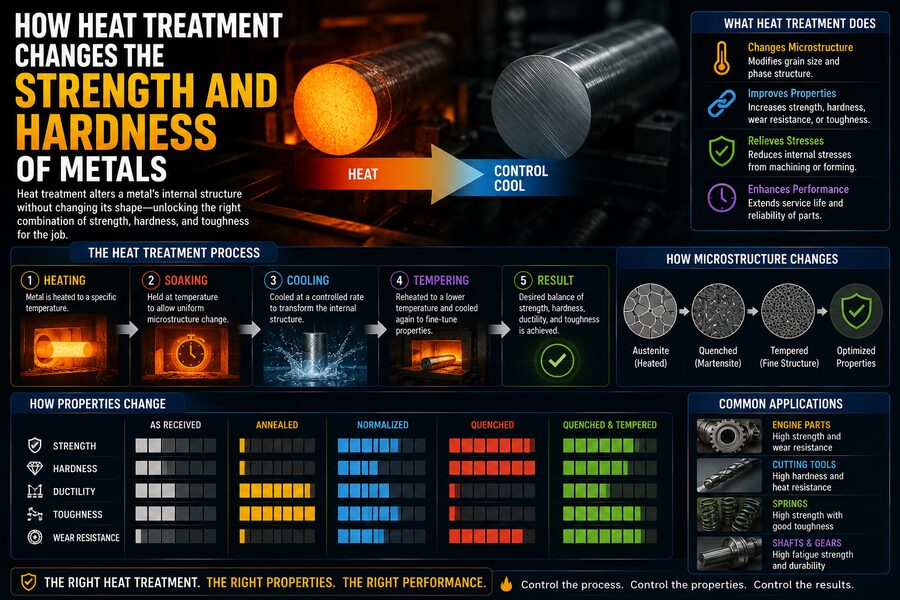

Metals may look solid and unchanging, but their internal structure can be dramatically altered by carefully controlling temperature, heating time, and cooling rate. Engineers use this principle in a group of industrial processes known as heat treatment.
Heat treatment can make a metal harder, stronger, tougher, softer, more ductile, easier to machine, or more resistant to wear—often without changing its overall shape or chemical composition. ⚙️🔩
This is possible because metals are made of microscopic crystals called grains, and the arrangement of atoms inside those grains can change when the material is heated and cooled.
For steels in particular, heat treatment can transform the internal microstructure into very different forms, each with its own mechanical properties.
A gear may be hardened so its teeth resist wear. A spring may be heat treated to combine strength with elasticity. A cutting tool may be hardened so its edge remains sharp. A welded component may be heated afterward to reduce harmful residual stresses.
Heat treatment is therefore one of the most important techniques in materials and manufacturing engineering.
🧠 What Is Heat Treatment?
Heat treatment is the controlled heating and cooling of a metal to change its microstructure and mechanical properties.
A typical process may involve three stages:
- Heating the metal to a selected temperature
- Holding, or soaking, it at that temperature for a specified time
- Cooling it at a controlled rate
Changing any of these variables can produce a different result.
For example, a steel component cooled very slowly from high temperature may become relatively soft and ductile.
The same steel cooled extremely rapidly may become much harder but also more brittle.
This relationship between temperature and microstructure is the foundation of heat treatment.
🔬 What Is Metal Microstructure?
A piece of metal is not one perfectly continuous crystal.
Most engineering metals are polycrystalline, meaning they are made of many small crystals or grains.
Each grain contains atoms arranged in an ordered structure.
Important microstructural features include:
- Grain size
- Grain boundaries
- Different phases
- Precipitates
- Dislocations
- Carbides
- Internal stresses
These microscopic features strongly influence how the material behaves under load.
Heat treatment modifies these features and therefore changes properties such as:
- Hardness
- Tensile strength
- Yield strength
- Toughness
- Ductility
- Wear resistance
⚙️ Why Atomic Structure Matters
When metals deform, much of that deformation occurs through the movement of defects called dislocations.
If dislocations move easily, the metal can deform relatively easily.
If their movement is obstructed, the material becomes stronger and harder.
Heat treatment can strengthen metals by creating microstructures that make dislocation movement more difficult.
It can also do the opposite.
Some treatments reduce internal obstacles and make the metal softer and easier to shape.
This is why heat treatment can be used both to harden and to soften a metal.
🧱 Steel Is Especially Responsive to Heat Treatment
Steel is one of the most important heat-treatable engineering materials.
Steel consists primarily of iron with carbon and often other alloying elements.
Its behavior changes dramatically with temperature because iron can exist in different crystal structures.
At certain temperatures, steel can form a phase called austenite.
When austenite is cooled in different ways, it can transform into microstructures such as:
- Ferrite
- Pearlite
- Bainite
- Martensite
Each has different mechanical properties.
Controlling which structures form allows engineers to tailor steel for specific applications.
🔥 Austenitizing
Many steel-hardening processes begin with austenitizing.
The steel is heated above a critical temperature so that much of its structure becomes austenite.
The exact temperature depends on:
- Carbon content
- Alloy composition
- Desired treatment
The metal is then held long enough for the transformation to occur uniformly.
What happens next depends heavily on how quickly the steel is cooled.
❄️ Quenching: Rapid Cooling for High Hardness
Quenching is the rapid cooling of heated metal.
Steel may be quenched using:
- Water
- Oil
- Polymer solutions
- Air
- Gas
The purpose is often to cool the steel fast enough to prevent slower equilibrium structures from forming.
Instead, the austenite can transform into martensite.
Martensite is extremely hard and strong.
This makes quenching useful for:
- Gears
- Shafts
- Tools
- Bearings
- Wear components
However, martensite is also relatively brittle.
A freshly quenched steel part may therefore be too brittle for practical service.
That is why quenching is commonly followed by tempering.
🧊 Why Martensite Is So Hard
Martensite forms when carbon atoms become trapped inside a distorted iron crystal structure during rapid cooling.
Because cooling happens so quickly, the carbon does not have enough time to diffuse into more stable arrangements.
The resulting crystal lattice is highly strained.
This distortion makes it difficult for dislocations to move.
The result is:
Very high hardness + high strength + reduced ductility
This is an excellent example of how microscopic atomic arrangements influence macroscopic engineering behavior.
🔥 Tempering: Reducing Brittleness
After quenching, steel is often tempered.
Tempering involves reheating hardened steel to a temperature below the critical transformation range and holding it there for a controlled period.
This allows some of the internal stresses and lattice distortion to relax.
As tempering temperature increases, steel generally becomes:
- Less hard
- Less brittle
- More ductile
- Tougher
The engineer selects a tempering condition that provides the desired compromise between hardness and toughness.
For example, a cutting tool may require very high hardness.
A heavily loaded shaft may need somewhat lower hardness but significantly greater toughness.
⚖️ Strength, Hardness, and Toughness Are Not the Same
These terms are often confused.
Strength describes how much stress a material can resist before yielding or failing.
Hardness describes resistance to localized indentation, scratching, or wear.
Toughness describes the ability to absorb energy before fracturing.
A material can be extremely hard but not particularly tough.
Freshly quenched martensitic steel is a good example.
It may resist wear very well but fracture more easily under impact.
Heat treatment therefore involves balancing several properties rather than simply maximizing hardness.
🧯 Annealing: Making Metal Softer
Not every heat treatment is intended to increase hardness.
Annealing generally heats a metal and then allows it to cool relatively slowly.
The process can:
- Reduce hardness
- Increase ductility
- Relieve internal stresses
- Improve machinability
- Refine or modify microstructure
Annealing is useful when a metal has become too hard or brittle after cold working.
For example, sheet metal may be rolled or formed repeatedly.
This introduces large numbers of dislocations and makes the material stronger but less ductile.
Annealing can restore workability.
🔄 Recovery, Recrystallization, and Grain Growth
When cold-worked metal is annealed, several microstructural processes can occur.
🔹 Recovery
Some internal stresses decrease and dislocations rearrange.
🌱 Recrystallization
New, relatively strain-free grains form.
This can dramatically restore ductility.
🌾 Grain Growth
If heating continues too long or at too high a temperature, grains can become larger.
Excessive grain growth can reduce strength and toughness.
Heat-treatment temperature and time must therefore be carefully controlled.
🌡️ Normalizing
Normalizing is another common heat treatment for steel.
The steel is heated above a critical temperature and then cooled in still air.
Because air cooling is faster than typical furnace cooling used during full annealing, normalized steel often develops a finer microstructure.
Normalizing can:
- Refine grain structure
- Improve uniformity
- Increase strength compared with annealed steel
- Prepare steel for later heat treatment
It is frequently used for forgings, castings, and structural components.
🌱 Why Grain Size Influences Strength
Grain boundaries hinder the movement of dislocations.
A metal with many small grains has more grain-boundary area than a metal with a few large grains.
Therefore, finer grains often increase strength.
This relationship is described by the Hall-Petch effect.
In simplified terms:
Smaller grain size → More barriers to dislocation motion → Higher strength
Fine grains can also improve toughness in many steels.
This is why controlling grain growth during heat treatment is so important.
🌀 Bainite
If austenitized steel is cooled at an intermediate rate or held at certain temperatures, it may form bainite.
Bainite has properties between those of pearlite and martensite.
Depending on composition and processing, bainitic steels can offer:
- High strength
- Good toughness
- Useful wear resistance
Some modern high-performance steels are designed around bainitic microstructures.
🧵 Pearlite
Pearlite consists of alternating layers of ferrite and cementite.
It forms when austenite transforms under suitable slower cooling conditions.
Fine pearlite is generally stronger and harder than coarse pearlite because the spacing between layers is smaller.
Cooling rate therefore affects not only which phase forms but also how fine the final structure becomes.
📊 Time-Temperature-Transformation Diagrams
Engineers use Time-Temperature-Transformation, or TTT, diagrams to understand how steel transforms.
These diagrams show which microstructures form when austenite is held at different temperatures for different times.
They help predict whether the steel will form:
- Pearlite
- Bainite
- Martensite
A related tool is the Continuous Cooling Transformation, or CCT, diagram.
CCT diagrams are particularly useful for industrial processes where components cool continuously rather than being held at one constant transformation temperature.
💦 Quenching Media Affect Cooling Speed
Different quenching media cool steel at different rates.
Water is generally a more aggressive quenchant than oil.
Fast cooling can create high hardness, but it also increases the risk of:
- Cracking
- Distortion
- Residual stresses
Oil cools more slowly and may reduce these risks.
Air hardening is slower still, but certain alloy steels are specifically designed to harden during air cooling.
The quenching medium must therefore match the steel composition, component size, and desired properties.
⚠️ Why Quenching Can Distort Parts
A component does not cool uniformly during quenching.
The surface cools first.
The center cools later.
This creates temperature gradients and uneven dimensional changes.
Phase transformations can also cause volume changes.
These effects produce internal stress.
For complex components, excessive stress can cause:
- Warping
- Cracking
- Dimensional changes
Engineers control distortion through component geometry, quenching method, steel selection, fixtures, and carefully designed heat-treatment cycles.
🔥 Stress-Relief Heat Treatment
Manufacturing processes such as:
- Welding
- Machining
- Casting
- Forming
can leave residual stresses inside a component.
These stresses may cause distortion later or contribute to cracking.
Stress relieving heats the component to a moderate temperature and holds it there.
This allows residual stresses to decrease without completely changing the basic microstructure.
Large welded structures often undergo stress-relief treatments where dimensional stability is important.
🛠️ Case Hardening
Sometimes engineers want a component to have:
A very hard surface + A tough interior
This combination is valuable for gears, shafts, bearings, and wear surfaces.
A hard exterior resists abrasion and contact stress.
A tougher core helps absorb shock.
This is achieved using case-hardening processes.
Common methods include:
- Carburizing
- Nitriding
- Carbonitriding
- Induction hardening
- Flame hardening
🧪 Carburizing
Carburizing adds carbon to the surface of low-carbon steel.
The component is heated in a carbon-rich environment.
Carbon diffuses into the surface.
The part is then hardened, usually through quenching.
The high-carbon surface becomes very hard, while the lower-carbon core remains tougher.
Carburizing is widely used for:
- Transmission gears
- Automotive components
- Shafts
- Industrial gearing
🌌 Nitriding
Nitriding introduces nitrogen into the surface of certain alloy steels.
Nitrogen reacts with alloying elements to create extremely hard nitride compounds.
Advantages can include:
- High surface hardness
- Excellent wear resistance
- Good fatigue resistance
- Lower distortion than some quench-hardening processes
Because nitriding can often be performed at lower temperatures without a severe quench, dimensional stability can be excellent.
⚡ Induction Hardening
Induction hardening uses electromagnetic induction to heat only the surface of a steel component.
An alternating magnetic field generates heat near the surface.
The heated region is then quenched.
The result is a hardened outer layer while the core remains relatively unchanged.
This method is common for:
- Gear teeth
- Crankshafts
- Axles
- Bearing surfaces
It is fast, localized, and highly automatable.
🔥 Flame Hardening
Flame hardening works on a similar principle but uses a high-temperature flame to heat the surface.
The surface is rapidly heated and then quenched.
Only the outer region becomes hardened.
Large components can sometimes be treated this way without placing the entire part in a furnace.
🧲 Heat Treatment of Aluminum Alloys
Heat treatment is not limited to steel.
Many aluminum alloys can also be strengthened through thermal processing.
One important mechanism is precipitation hardening, also called age hardening.
The process commonly involves:
- Solution heat treatment
- Quenching
- Aging
Tiny particles form inside the aluminum matrix during aging.
These particles obstruct dislocation movement and increase strength.
⏳ Natural and Artificial Aging
After solution treatment and quenching, some aluminum alloys strengthen gradually at room temperature.
This is called natural aging.
Others are heated to a moderately elevated temperature to accelerate precipitation.
This is called artificial aging.
Aerospace aluminum alloys frequently use carefully controlled aging processes to achieve specific combinations of:
- Strength
- Toughness
- Corrosion resistance
✈️ Heat Treatment in Aerospace Engineering
Aircraft components must deliver high strength while minimizing weight.
Heat treatment is therefore critical for materials such as:
- Aluminum alloys
- Titanium alloys
- High-strength steels
- Nickel-based alloys
Components including landing gear, turbine parts, fasteners, and structural members may undergo highly controlled heat-treatment cycles.
A small error in temperature or processing time can significantly affect performance.
🚗 Automotive Applications
Automobiles contain numerous heat-treated parts.
Examples include:
- Gears
- Crankshafts
- Camshafts
- Springs
- Bearings
- Axles
- Transmission components
A transmission gear needs a wear-resistant surface but also enough toughness to survive repeated shock loads.
Case hardening is therefore particularly useful.
Springs need high strength and fatigue resistance, which also depend heavily on heat treatment.
🏭 Tool Steels
Cutting tools, dies, and molds require exceptionally high hardness.
Tool steels are specifically designed to respond to heat treatment.
Typical processing may include:
Austenitize → Quench → Temper
Certain tool steels are tempered multiple times to stabilize their microstructure.
The final treatment influences:
- Edge retention
- Wear resistance
- Toughness
- Dimensional stability
🔪 Why Kitchen Knives Are Heat Treated
Even everyday knives demonstrate heat-treatment principles.
A blade must be hard enough to hold a sharp edge.
If it is too soft, it dulls rapidly.
But if it is too hard and brittle, it may chip.
Manufacturers therefore harden and temper knife steel to achieve a suitable balance.
Different knife applications use different hardness levels depending on desired edge retention and toughness.
🔨 Heat Treatment After Forging
Forging shapes metal using large compressive forces.
The process can create strong grain flow, but the resulting microstructure may not yet provide the desired properties.
Heat treatment after forging can:
- Refine grains
- Homogenize structure
- Reduce residual stresses
- Adjust hardness
Many critical forged components therefore undergo heat treatment before entering service.
🧱 Heat Treatment of Castings
Cast metals can contain coarse or nonuniform microstructures because they solidify from a liquid.
Heat treatment may improve uniformity and mechanical properties.
For certain alloys, homogenization treatments allow alloying elements to diffuse more evenly throughout the material.
Subsequent treatments can then optimize strength and toughness.
🌡️ Furnace Atmosphere Matters
High-temperature metals can react with the surrounding atmosphere.
For steel, exposure to oxygen can produce:
- Oxidation
- Scale
- Surface decarburization
Industrial heat-treatment furnaces may therefore use controlled atmospheres.
These can include:
- Inert gases
- Nitrogen-based atmospheres
- Vacuum environments
- Specialized carburizing or nitriding gases
Protecting the surface is especially important for precision components.
🌌 Vacuum Heat Treatment
Vacuum furnaces remove much of the surrounding gas before heating.
This reduces oxidation and contamination.
Vacuum heat treatment can produce extremely clean surfaces.
It is commonly used for:
- Aerospace components
- Tool steels
- Medical parts
- Precision components
Some vacuum furnaces use high-pressure inert gas for quenching.
🧪 Hardness Testing After Heat Treatment
Manufacturers must verify that the treatment achieved the required properties.
Common hardness tests include:
- Rockwell
- Brinell
- Vickers
Each method presses an indenter into the material and measures the resulting indentation in a standardized way.
Hardness testing is fast and useful for production quality control.
🔬 Metallographic Examination
For critical components, engineers may examine the microstructure directly.
A sample is:
- Cut
- Mounted
- Ground
- Polished
- Etched
- Viewed under a microscope
Metallography can reveal:
- Grain size
- Martensite
- Pearlite
- Carbides
- Case depth
- Unwanted phases
This helps engineers verify that heat treatment produced the intended internal structure.
📏 Measuring Case Depth
For case-hardened parts, surface hardness alone is not enough.
Engineers also need to know how deeply the hardened layer extends.
Case depth can be measured using hardness profiles or metallographic techniques.
If the hardened case is too shallow, the component may wear prematurely.
If it is excessively deep, the part may become unnecessarily brittle or expensive to manufacture.
🧠 Hardenability vs. Hardness
Hardness and hardenability are different concepts.
Hardness describes resistance to indentation.
Hardenability describes how deeply a steel can form a hardened microstructure during quenching.
Two steels can achieve similar surface hardness while having very different hardening depths.
Alloying elements such as chromium, molybdenum, and manganese can increase hardenability.
This allows thicker components to harden more uniformly.
🧪 The Jominy End-Quench Test
The Jominy end-quench test is used to evaluate steel hardenability.
A standardized steel specimen is heated and then quenched with water at one end.
The quenched end cools rapidly.
Locations farther away cool more slowly.
Hardness is measured along the specimen.
The resulting profile shows how effectively the steel hardens at different cooling rates.
This information helps engineers select materials for large components.
⚠️ Overheating and Over-Tempering
Heat treatment must be carefully controlled.
Excessive temperature can cause:
- Grain growth
- Oxidation
- Decarburization
- Loss of toughness
Excessive tempering may reduce hardness more than desired.
Insufficient tempering may leave the material too brittle.
Heat-treatment recipes therefore specify narrow ranges for:
- Temperature
- Time
- Cooling rate
- Atmosphere
🔁 Repeated Heat Treatments
Some alloys require multiple heating cycles.
Tool steels may be tempered more than once.
Certain precipitation-hardening alloys use several aging stages.
Special steels may undergo complex sequences designed to control retained austenite or carbide formation.
Heat treatment is therefore often a carefully engineered thermal history rather than one simple heating-and-cooling step.
💻 Computer-Controlled Heat Treatment
Modern industrial furnaces use computerized control systems.
Sensors continuously monitor:
- Furnace temperature
- Component temperature
- Atmosphere
- Pressure
- Cooling conditions
Programmable controllers can follow precise heating ramps and soaking times.
Data logging creates a record of each batch.
For industries such as aerospace and medical manufacturing, this traceability can be essential.
🤖 Simulation of Heat Treatment
Engineers can also use computer simulation to predict:
- Temperature gradients
- Cooling rates
- Phase transformations
- Residual stresses
- Distortion
This is particularly useful for large or complex components.
Simulation allows engineers to adjust the heat-treatment process before committing to expensive production trials.
💰 Why Heat Treatment Can Be Economically Valuable
Heat treatment allows relatively ordinary materials to achieve much higher performance.
Instead of manufacturing an entire gear from an extremely expensive alloy, engineers may use a more economical steel and then case harden the surface.
This can provide the necessary performance at lower cost.
Heat treatment can therefore improve:
- Component life
- Wear resistance
- Reliability
- Manufacturing efficiency
The additional processing cost may be small compared with the value of longer service life.
♻️ Heat Treatment and Component Life
A correctly heat-treated component can last much longer than an untreated one.
For example, a hardened bearing surface resists wear.
A tempered shaft resists fracture.
A stress-relieved welded structure maintains dimensional stability.
Longer-lasting components reduce the need for replacement and can decrease material consumption over time. ♻️
✨ Conclusion
Heat treatment changes the strength and hardness of metals by altering their internal microstructure through controlled heating and cooling.
In steel, heating can create austenite. Rapid quenching can transform this into extremely hard martensite, while subsequent tempering reduces brittleness and improves toughness.
Slower cooling can produce softer structures such as ferrite and pearlite.
Processes such as annealing and normalizing can improve ductility, machinability, grain size, and structural uniformity.
Other methods selectively harden the surface.
Carburizing, nitriding, induction hardening, and flame hardening can create a wear-resistant exterior while preserving a tougher interior. 🔩🔥
Nonferrous alloys also benefit from thermal processing. Aluminum alloys, for example, can become much stronger through precipitation hardening and aging.
The key principle is that mechanical behavior depends not only on what elements a metal contains, but also on how its atoms, grains, phases, and defects are arranged.
Heat treatment gives engineers a way to control that internal arrangement.
By selecting the right temperature, holding time, cooling rate, and atmosphere, manufacturers can tailor metals for applications ranging from gears and cutting tools to aircraft structures, engines, bearings, springs, and industrial machinery.
Ultimately, heat treatment demonstrates one of the most powerful ideas in materials engineering: a metal’s properties are not fixed when it leaves the foundry.
By carefully controlling its thermal history, engineers can transform the same material from soft and easily machined into hard and wear-resistant—or from brittle into tough and durable—without fundamentally changing the shape of the component. 🔥⚙️