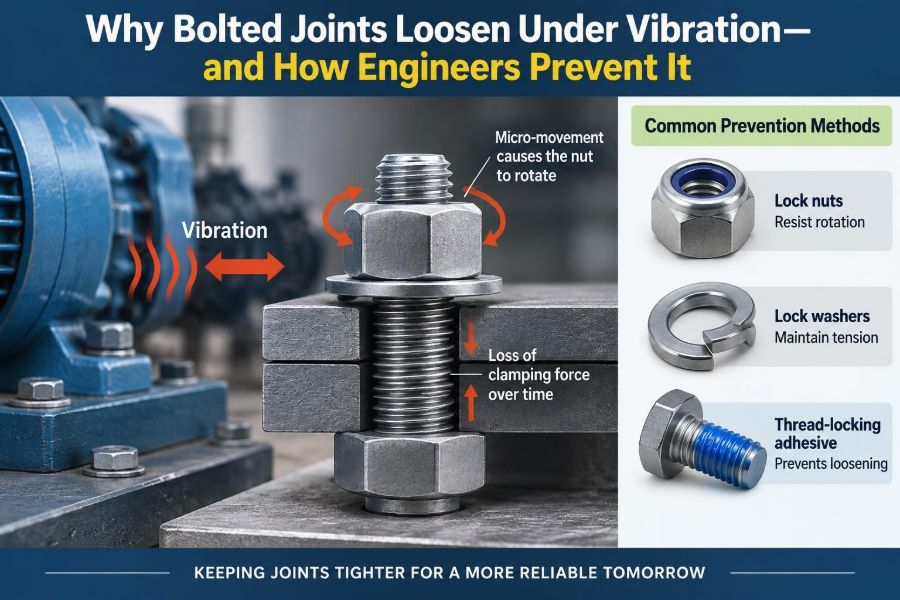

A bolt that looks perfectly secure during assembly can become a maintenance problem after thousands of vibration cycles. Think of a bicycle stem, a machine guard, an engine bracket, or a pump mounted to a steel frame: all may experience repeated movement even when no single load seems severe.
The usual assumption is that vibration somehow “unscrews” the nut. That can happen, but it is not the whole story. Most bolted-joint failures begin earlier, when the joint loses enough clamping force that the connected parts can move against one another.
That loss of clamp load can create noise, leakage, fatigue cracks, damaged holes, and eventually separation of the joint. In safety-critical equipment, the consequence can be much more serious than an inconvenient loose fastener.
Understanding why joints loosen means looking beyond the bolt itself. The answer lies in preload, friction, stiffness, load paths, assembly control, and the small but powerful motions created by vibration.
🔩 A bolted joint is a spring system
A conventional bolted joint is not simply a threaded rod holding two parts together. When tightened, the bolt stretches slightly and the clamped parts compress slightly. Both behave like springs.
The stretched bolt pulls the components together with a force called preload, also called clamp force. That force is what allows the joint to resist many external loads without the components separating or sliding.
A useful mental model is a tightly squeezed stack held by an elastic rubber band. The rubber band is the bolt; the squeezed stack is the joint. The joint stays secure because of the squeeze, not because threads alone block motion.
🧲 Preload is the first line of defense
Proper preload creates friction between the mating surfaces. If a sideways force acts on the assembly, this friction can carry the force while the parts remain stationary relative to each other.
For a simple slip-resistant joint, the available friction depends broadly on clamp force and the friction coefficient of the interface. Higher preload generally provides more resistance to transverse, or sideways, loading—provided the bolt, threads, and parts are not overloaded.
Preload also helps keep fluctuating external loads from becoming large fluctuations in bolt tension. This matters because fatigue damage is driven by repeated stress variation, not merely by a high static load.
📉 Loosening is usually a loss of clamp force
“Loose” can describe several different conditions. A bolt may have rotated, the nut may have backed off, the bolt may have yielded, or the joint may simply have lost preload without obvious thread rotation.
These distinctions matter during failure analysis. A nut found several turns from its original position suggests rotational self-loosening. A nut still in position with little clamp force may point instead to embedding, creep, thermal effects, or settlement.
In practice, more than one mechanism can act in the same assembly. Initial settlement may reduce preload, for example, and the resulting joint slip can then make rotational loosening easier.
↔️ Transverse vibration drives rotational self-loosening
The most influential form of vibration for ordinary threaded fasteners is often transverse vibration: repeated motion perpendicular to the bolt axis. This motion tends to make the joint members slide across one another.
When transverse displacement is large enough to overcome interface friction, the bolt can bend slightly and the threads can experience microscopic relative movement. That movement reduces the frictional restraint that normally prevents nut rotation.
With repeated cycles, the nut or bolt head can rotate in the loosening direction. This is commonly called self-loosening or vibration-induced loosening. It does not require a dramatic visible shake; small cyclic displacement repeated many times is enough.
🌀 Why axial vibration behaves differently
Axial vibration acts along the bolt’s length. It repeatedly changes bolt tension and can be severe for fatigue, especially if the joint separates or the bolt is poorly sized.
However, axial loading alone is generally less effective than transverse movement at causing thread rotation. The components are being pulled apart and pressed together rather than slid sideways across the clamped interface.
That does not make axial vibration harmless. It can reduce contact pressure momentarily, accelerate wear at interfaces, and expose defects in preload or joint geometry.
🧪 The Junker effect explains the critical motion
Engineers often discuss vibration loosening in connection with transverse-vibration testing, frequently called Junker testing after the test method associated with Gerhard Junker. The essential lesson is straightforward: lateral displacement can rapidly reduce clamp force once joint slip begins.
In such testing, preload is monitored while a joint is subjected to controlled transverse motion. The goal is not to reproduce every machine exactly, but to compare how fastener systems behave under a demanding loosening mechanism.
A practical takeaway is that a fastener should not be selected only by its torque value or tensile strength. Its ability to maintain preload under the actual direction and amplitude of service motion also matters.
🧱 Joint slip changes everything
As long as the clamped parts do not slip, the friction interface carries a transverse load. Once they slide, the load path changes: the bolt shank, threads, holes, and bearing faces can begin to experience repeated contact and bending.
This is why a joint may seem stable for a long period and then loosen quickly. A modest loss of preload can lower friction capacity enough to cross the threshold into slip.
Slip is also damaging because it can fret the surfaces. Fretting is small-amplitude rubbing that wears material and produces debris, often making the interface less predictable during later operation or retightening.
📐 Bolt stiffness and member stiffness share the load
External separating load does not transfer entirely into the bolt at once. Some of it first unloads the compressed joint members. The relative stiffness of the bolt and clamped material determines how the load is shared.
A longer, more elastic bolt can sometimes be beneficial because its tension changes less for a given joint movement. Very short bolts clamping stiff members may experience larger tension changes under the same external displacement.
This is not a rule to make every bolt long. Available geometry, buckling, thread engagement, fatigue, and assembly access all matter. The point is that joint stiffness is a design variable, not background detail.
📏 Grip length affects preload retention
Grip length is the total thickness of material clamped between the bearing surfaces under the head and nut. A short grip with only a few threads engaged can be especially sensitive to surface irregularities and settlement.
Increasing effective grip length, where the design permits it, often makes the bolt system more forgiving of small embedment losses. The additional elastic length can also reduce stress variation in the bolt.
Washers, spacers, and sleeves are not automatically improvements. They must be stiff enough, flat enough, and suitable for the load; otherwise they can introduce their own settlement or bending problems.
🪨 Embedment relaxation steals preload after assembly
No engineering surface is perfectly smooth. Thread flanks, under-head faces, washers, coatings, and mating parts contain small peaks called asperities. Under preload, some asperities flatten or seat.
This process is known as embedment relaxation or settlement. A very small reduction in clamped-stack thickness can cause a meaningful drop in bolt tension, particularly in a short, stiff joint.
Paint, soft coatings, burrs, thick surface treatments, and uneven washers can worsen the effect. Properly prepared bearing faces and realistic tightening procedures are often more valuable than simply choosing a more elaborate locknut.
🌡️ Temperature changes can alter bolt tension
Bolts and clamped parts expand when heated, but not always by the same amount. Different materials, changing temperature gradients, and local heat sources can raise or lower preload during a duty cycle.
For example, a steel bolt clamping an aluminum housing may see preload shift as the assembly heats. The exact direction and magnitude depend on geometry, temperatures, material expansion coefficients, and stiffness—not just the material names.
High temperature also raises concerns about creep and stress relaxation. Materials may deform slowly under sustained stress, especially in elevated-temperature service, reducing clamp force even without vibration.
🧴 Soft materials and gaskets need special treatment
Gaskets, polymer components, painted surfaces, and laminated stacks do not behave like rigid steel plates. They can compress, flow, relax, or change thickness over time.
A gasketed joint must maintain enough load for sealing while avoiding gasket crushing. Its tightening pattern, bolt spacing, flange stiffness, and operating temperature are part of the design, not merely installation details.
Using a generic locking washer cannot correct a fundamentally unsuitable gasket or flexible flange. In these joints, preload retention depends heavily on the whole system’s compression behavior.
🧵 Threads create friction, but not a lock by themselves
Threads convert rotation into axial movement, and friction in the thread flanks resists unintended rotation. Friction under the bolt head or nut bearing face also contributes substantial resistance.
But ordinary thread friction is not an absolute lock. When transverse motion causes localized unloading and relative movement, the resistance to rotation can be overcome cycle after cycle.
Thread pitch matters because a finer pitch generally produces less axial movement per turn and can offer different resistance characteristics. Yet pitch selection must also consider strength, assembly speed, damage tolerance, and available engagement length.
🧼 Friction makes torque an imperfect preload measure
Torque tightening is common because it is fast and practical. The difficulty is that much of applied torque is consumed overcoming friction in threads and under the turning face, while only part produces useful bolt stretch.
Lubrication, plating, coatings, surface finish, reused hardware, and contamination can all change that friction. The same torque setting can therefore produce different preloads in apparently identical joints.
This is why blindly applying a torque value from an unrelated manual is risky. Torque specifications should correspond to the fastener size, grade, lubrication condition, joint design, and assembly method being used.
🎯 Better preload-control methods improve consistency
Where clamp force is critical, engineers may use methods more consistent than torque alone. Torque-angle tightening adds a controlled rotation after a seating stage, helping reduce sensitivity to friction variation.
Other options include direct-tension indicators, ultrasonic bolt elongation measurement, hydraulic tensioning, and fasteners designed to show elongation. Each method has cost, access, training, and calibration requirements.
For large or critical joints, measuring bolt stretch directly is often closer to the real objective than measuring turning resistance. Still, no method eliminates the need for clean interfaces and a sound joint design.
🔧 Correct tightening sequence protects the joint
In multi-bolt flanges, covers, and structural connections, tightening one bolt changes load in nearby bolts. A random sequence can create uneven compression, distortion, or local gaps.
A staged cross-pattern sequence helps bring parts together gradually and distribute load more uniformly. Final passes may be needed because tightening later fasteners can reduce tension in earlier ones.
Sequence requirements should be treated as part of the engineering instruction. They are especially relevant for sealing flanges, thin covers, large bolt circles, and components that can warp under localized load.
🧷 Locking methods solve different problems
There is no universal “anti-vibration fastener.” Some devices increase resistance to rotation; others improve preload retention, provide a positive mechanical stop, or prevent total loss after loosening has started.
| Method | Main action | Key limitation |
|---|---|---|
| Prevailing-torque nut | Adds friction to rotation | Performance can change with reuse and temperature |
| Threadlocker adhesive | Bonds threads and fills gaps | Requires clean, compatible surfaces and curing conditions |
| Wedge-lock washer pair | Uses cam action to resist loosening rotation | Needs correct orientation and suitable bearing surfaces |
| Tab washer or safety wire | Provides positive rotational restraint | Requires features, access, and disciplined installation |
The best choice depends on vibration direction, temperature, service access, reusability, inspection needs, and the consequences of preload loss.
🧲 Prevailing-torque nuts add rotational resistance
Prevailing-torque nuts use a distorted metal section, polymer insert, or similar feature that creates interference with the mating thread. The extra torque resists rotation even before the nut contacts the joint.
They can be useful in many general applications, but they do not replace required preload. A prevailing-torque nut installed with inadequate clamp load may still permit joint slip and component damage.
Polymer-insert types have service-temperature and chemical-compatibility limits. All-metal versions suit hotter environments but may have different reuse guidance from the manufacturer.
🧪 Threadlockers need disciplined application
Anaerobic threadlockers cure in the confined, oxygen-limited space between compatible metal threads. They can improve resistance to loosening and help seal threads against leakage.
Successful use depends on surface cleanliness, correct product grade, gap size, cure time, temperature, and material compatibility. Oil or old adhesive can reduce performance; passive materials may require a suitable activator.
Threadlocker is not a substitute for damaged threads, missing preload, or a joint that is sliding in service. It works best as a supplement to a properly designed and assembled clamped joint.
🧩 Wedge-lock washers resist the loosening direction
Wedge-lock washer systems are typically used in matched pairs with cam faces facing each other. Their cam rise is designed so that any attempted loosening rotation creates more separation between the pair than the thread pitch allows.
That geometry makes loosening rotation tend to increase bolt elongation rather than reduce it, preserving resistance while the assembly remains engaged. The outer faces grip the bearing surfaces.
They are effective only when installed as the intended pair and against suitable surfaces. Mixing parts, reversing orientation, or placing them over unsuitable soft layers can defeat the mechanism.
🛡️ Positive locking is valuable when consequences are high
Safety wire, cotter pins, tab washers, lock plates, and castellated nuts physically limit rotation. These methods are common where inspection discipline and loss prevention are more important than quick assembly.
Positive locking should not be misunderstood as proof that preload is correct. A safety-wired nut can remain on a joint whose clamp force has been lost, leaving the parts free to fret, leak, or fatigue.
Use positive retention when a fastener must not depart or rotate beyond a safe limit, while separately ensuring the joint has proper preload and load-path design.
🏗️ Design the joint so friction carries shear
For many vibration-prone joints, the strongest strategy is to prevent relative movement in the first place. Select sufficient preload and interface conditions so operational transverse loads remain below the available slip resistance.
This requires attention to realistic loads, including startup, braking, shock, imbalance, and misalignment. A machine’s normal running force may be modest while occasional transients govern the joint.
Where slip cannot be reliably avoided, design a positive shear load path. This may involve fitted bolts, dowel pins, keys, shoulders, or bearing features sized to carry shear without repeatedly bending the threads.
🕳️ Keep threads out of the shear plane when possible
Threads have reduced cross-sectional area and stress concentrations compared with a smooth shank. If the joint geometry permits, placing the unthreaded bolt shank through the principal shear plane is generally preferable.
That arrangement can reduce wear and improve fatigue performance when some bearing or shear transfer occurs. It does not remove the need for proper clamp force, but it gives the joint a more robust response if minor movement occurs.
Hole clearance, alignment, and manufacturing tolerances must be considered. An oversized clearance hole may allow impact-like movement before the bolt bears against the side of the hole.
⚠️ Fatigue can follow a loose-joint problem
Once a joint separates or slips, the bolt may see bending and larger cyclic tensile stresses. Repeated loading can then initiate fatigue cracks, often near thread runout, the first engaged thread, or a geometry transition.
A bolt that breaks after loosening did not necessarily fail because it was weak. It may have been loaded in a way the preloaded joint was meant to prevent.
Inspection should look beyond replacing the broken fastener. Check the mating surfaces, hole condition, alignment, load history, clamp length, and whether the specified assembly method was actually used.
🔍 Signs a joint may be losing preload
Visible nut rotation is one clue, but it is not the only one. Rust-colored or dark fretting debris around a joint, polished contact marks, recurring leakage, unusual rattling, and enlarged holes can all signal relative movement.
Paint witness marks can show gross rotation during inspections, although they do not measure clamp load. Torque checks are also limited: breakaway torque after service is not a direct measurement of original preload.
For critical assemblies, monitoring plans may include visual checks, defined retorque procedures where appropriate, ultrasonic measurement, or condition monitoring based on the equipment’s failure modes.
🧰 Common assembly mistakes that invite loosening
Many loosening problems begin on the assembly floor rather than in the design office. The following mistakes reduce preload or make it inconsistent:
- Tightening over paint, scale, burrs, or debris that later crushes or flakes away.
- Using a dry torque specification on lubricated threads, or the reverse.
- Mixing washer types, bolt grades, coatings, or reused locking hardware without approval.
- Applying torque with an uncalibrated tool or an incorrect extension arrangement.
- Bottoming a bolt in a blind hole before the joint is clamped.
- Using too little thread engagement or engaging damaged threads.
These are controllable process issues. Clear work instructions and verification can prevent many field failures.
📝 A practical engineering selection workflow
Start by defining what the joint must do: maintain a seal, resist sliding, preserve alignment, carry tension, retain a cover, or prevent component loss. The answer determines what “failure” means.
- Estimate service loads, directions, vibration characteristics, temperature, and environment.
- Choose joint geometry, materials, grip length, and fastener size or grade for strength and stiffness.
- Set a preload target that supports slip resistance and fatigue performance without yielding parts or crushing interfaces.
- Select an assembly method capable of achieving that target consistently.
- Add an appropriate locking or retention feature when the risk and service conditions justify it.
- Validate the design with representative testing when consequences or uncertainty are significant.
Validation is particularly valuable when real vibration contains shocks, thermal cycles, flexible structures, or variable friction that simplified calculations cannot capture fully.
🏭 Application examples show why context matters
In a small electric motor mounted to a bracket, repeated lateral vibration may be the dominant concern. Adequate preload, clean mating faces, and a joint designed not to slip may be more effective than adding a lock washer to an under-tightened bolt.
In an exhaust or high-temperature process assembly, thermal cycling and relaxation may matter as much as vibration. Material selection, expansion compatibility, and high-temperature locking methods deserve attention.
In a removable machine guard, the priority may include service convenience and prevention of lost hardware. A captive fastener or positive-retention feature can be sensible, even if the structural load is low.
📚 Standards and supplier data are starting points
Fastener standards, design codes, equipment manuals, and manufacturer instructions provide useful limits and procedures. They should be followed where applicable, particularly for regulated, pressure-containing, lifting, transportation, or safety-critical equipment.
But a generic chart cannot know the exact stiffness, coatings, vibration, access constraints, or consequence of failure in a particular assembly. Engineering judgment is needed to connect published data to the real joint.
When modifying an existing critical joint, seek review from a qualified engineer or the equipment manufacturer. Changing bolt grade, lubrication, washer stack, or tightening method can change preload substantially.
✅ The core principle: preserve clamp force and prevent motion
Bolted joints loosen under vibration mainly when the system permits relative movement and loses the preload needed to resist it. Thread rotation is often the visible result, not the original cause.
The most reliable approach combines suitable joint geometry, controlled preload, clean and stable interfaces, a realistic load path, and a locking strategy matched to the environment. No single product can compensate for every weakness in those foundations.
When diagnosing a loose fastener, ask two questions before selecting a locknut: Where did the clamp force go, and what moved relative to what? Those questions lead to solutions that address the mechanism rather than merely hiding the symptom.
A vibration-resistant bolted joint is built by maintaining preload and preventing slip, then using locking features as a deliberate layer of protection. That is the mindset that turns a fastener from a simple piece of hardware into a dependable engineered connection. ⚙️🔩✅