
A car waits at a red light with its engine running. The wheels are stopped, the transmission is ready, and the driver can select a gear without stalling the engine. That simple everyday action depends on a component that can connect rotating parts gradually rather than all at once.
The same need appears in machine tools, conveyors, motorcycles, pumps, and industrial drives. A prime mover may need to run continuously while the driven equipment starts later, changes speed, or stops for adjustment.
A rigid shaft connection cannot provide that freedom. Once two shafts are locked together, they must rotate at the same speed. A clutch creates a controllable connection that can transmit torque when needed and separate the engine or motor from its load when needed.
Its apparent simplicity hides careful engineering. A useful clutch must carry torque without slipping in normal operation, engage smoothly enough to avoid shock, release reliably, reject heat, and survive repeated cycles.
🔩 The fundamental job of a clutch
A clutch is a mechanical device that selectively couples a driving member to a driven member. The driver receives power from an engine, electric motor, turbine, or another rotating source; the driven member sends that power to a gearbox, wheel, machine, or process load.
When engaged, the clutch transmits torque. When released, it interrupts the torque path while allowing the driving side to continue rotating. It is therefore not simply an on-off switch: many clutches also provide a controlled transition between those states.
🧭 Torque is the quantity being transferred
Torque is the twisting action that causes a shaft to rotate. An engine crankshaft produces torque, and the drivetrain uses it to overcome rolling resistance, acceleration demand, gradients, and mechanical losses.
Power depends on both torque and rotational speed. In simplified form, P = Tω, where P is power, T is torque, and ω is angular speed. During clutch engagement, torque can be transmitted even while the two sides are rotating at different speeds.
🚗 Why a permanent connection causes problems
Imagine a manual-transmission car with the engine crankshaft permanently bolted to the gearbox input shaft. At idle, the engine would force the wheels to turn unless the vehicle were in neutral. If a gear were selected while stationary, the engine would likely stall because it could not instantly accelerate the vehicle.
Industrial equipment has similar issues. A motor may need to reach a stable speed before a high-inertia fan or conveyor is connected. A permanent connection can create severe starting current, torque shock, or an impractical operating sequence.
🔄 The two rotating sides of a clutch
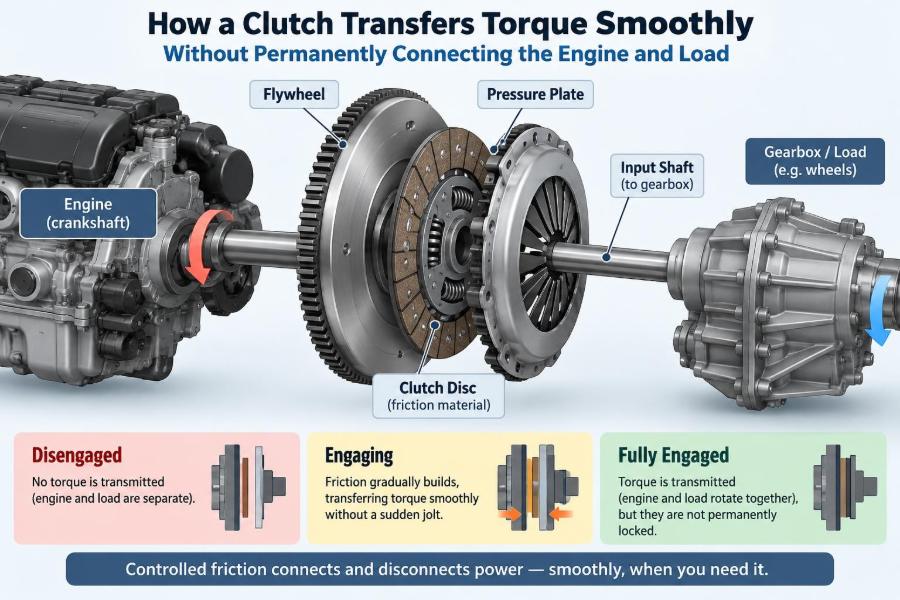
Most friction clutches have a driving side and a driven side. In a typical automotive dry clutch, the flywheel is attached to the engine and acts as a driving friction surface. The clutch disc is splined to the transmission input shaft and is the driven member.
A pressure plate presses the disc against the flywheel. Once the contact force is sufficiently high, friction makes the disc rotate with the flywheel, carrying torque into the transmission.
🧲 Friction creates the torque path
Friction clutches work because rough, carefully chosen surfaces resist relative sliding when squeezed together. The tangential friction force acts at a radius from the shaft center, creating torque.
A simplified capacity relationship is T ≈ μFr, where μ is the friction coefficient, F is the clamping force, and r is an effective friction radius. Real clutch calculations account for pressure distribution, surface wear, number of friction faces, and material behavior, but the principle remains the same.
📏 Why diameter and clamp force matter
A larger friction diameter gives the friction force a longer lever arm, raising torque capacity. Increasing clamp force also raises capacity, provided the materials and structure can tolerate it.
Neither choice is free. Larger clutches add mass and packaging difficulty. Higher clamp force can make a pedal harder to operate, increase bearing loads, and worsen wear if release travel is inadequate. Design is a compromise among torque, space, pedal effort, cost, heat capacity, and durability.
🧱 The main parts of a single-plate dry clutch
The familiar manual-transmission clutch contains several parts with distinct jobs:
- Flywheel: provides a machined driving surface and also smooths engine speed fluctuations through its inertia.
- Clutch disc: carries friction linings and connects to the gearbox input shaft through a splined hub.
- Pressure plate: applies axial force to clamp the disc against the flywheel.
- Diaphragm spring: supplies clamp load in many modern designs.
- Release bearing and fork or actuator: temporarily relieve spring force so the clutch can disengage.
The cover assembly bolts to the flywheel, while the disc must remain free to slide a small distance axially on its splines.
🌱 Engagement begins with controlled slip
When a driver releases the clutch pedal, the disc initially rotates more slowly than the flywheel. The surfaces touch and slide against one another. Friction transfers some torque, which accelerates the driven side and may slow the engine slightly.
This temporary speed difference is called clutch slip. It is desirable during a carefully controlled engagement, because it allows the speed mismatch to disappear progressively rather than through a sudden impact.
🔥 Where the energy goes during engagement
Speed matching requires energy to be dissipated. During slip, friction converts the difference in rotational energy into heat at the contact surfaces. The greater the speed difference, inertia, torque demand, or engagement time, the more heat the clutch must absorb.
For example, starting a heavily loaded vehicle uphill requires more slipping than a gentle start on level ground. A clutch can handle occasional heat pulses, but repeated prolonged slipping can overheat its lining, pressure plate, and flywheel.
🎯 What smooth engagement actually means
Smooth engagement does not mean zero slip. It means torque rises at a rate the engine, drivetrain, and load can accept without harsh acceleration, driveline lash, vibration, or stalling.
For a driver, smoothness feels like a vehicle moving away without a jolt. For a machine, it may mean a conveyor begins moving without throwing product, a pump accelerates without excessive pipe stress, or a gearbox avoids a damaging torque spike.
🌀 Matching rotational speeds
Full engagement occurs when the driving and driven members rotate at effectively the same speed and the clutch no longer needs to slide. At that point, the friction surfaces behave like a locked connection within the clutch’s torque limit.
A clutch cannot erase inertia; it manages it. The engine may need to contribute extra torque, and the load must be accelerated. The engagement process controls how rapidly that exchange happens.
🦾 Torsional dampers soften drivetrain vibrations
Many clutch discs include springs between the friction carrier and the splined hub. These are torsional damper springs, and they permit a small angular movement under changing torque.
They help filter engine firing pulses and reduce rattle in gears and shafts. Without damping, small cyclic speed variations can excite backlash in the transmission, producing noise and a less refined response. The springs do not replace the friction clutch; they improve the quality of torque delivery through it.
🪜 The diaphragm spring and release action
A diaphragm spring is a conical disc with radial fingers near its center. Its outer region applies clamp load to the pressure plate. When the release bearing pushes on the inner fingers, the spring pivots and reduces the force holding the disc against the flywheel.
This mechanism provides high clamp load with a compact arrangement. Its geometry can also help keep pedal force manageable as the friction lining wears, though the exact behavior depends on the design.
🛑 Disengagement creates useful separation
Pressing the clutch pedal should create enough clearance that the disc no longer receives meaningful friction torque. The engine can then rotate independently of the transmission input shaft.
That separation allows gear selection, stopping with a gear engaged, and controlled changes in the torque path. A clutch that drags when released makes shifting difficult because the transmission input shaft keeps turning when it should slow down.
⚙️ Why gear changes need a clutch
Many manual gearboxes require their internal components to be brought close to compatible speeds before engagement. Synchronizers perform much of this speed-matching work, but they are not intended to fight a strongly driven input shaft.
Disengaging the clutch reduces torque through the gearbox and lets the synchronizer do its job. Re-engaging afterward reconnects engine torque through the newly selected gear ratio.
🚦 Launching a vehicle from rest
At a standstill, the driven side of the clutch is nearly stationary while an idling engine may be rotating hundreds of times each minute. The driver adds enough engine torque to prevent a stall while releasing the clutch progressively.
This is the most demanding routine task for a vehicle clutch because it combines a large speed difference with the need to accelerate vehicle mass. Releasing the pedal abruptly can cause a stall or a jerk; holding the clutch at its engagement point too long wastes energy as heat.
🏭 Starting machines with high inertia
A large rotating load, such as a fan, flywheel, or drum, resists changes in speed. A clutch can let the motor reach a suitable operating speed before progressively applying torque to that inertia.
However, a friction clutch is not automatically the best choice. If starts are frequent or inertia is very high, thermal capacity can become the limiting factor. Engineers may instead use soft starters, variable-frequency drives, fluid couplings, or other controlled-start systems.
💧 Wet clutches use oil strategically
A wet clutch operates with its friction plates immersed in oil. The oil removes heat, lubricates moving parts, and can support compact multi-plate arrangements. Motorcycles, automatic transmissions, and many powershift systems use wet clutch designs.
Oil also changes friction behavior and introduces drag losses when the clutch is released. The friction material, oil formulation, groove pattern, and hydraulic control must therefore be designed as a system.
🌬️ Dry clutches favor direct, efficient contact
A dry clutch operates without an oil bath at the main friction interface. Its surfaces can provide a direct friction response and avoid fluid churning losses, which is why dry single-plate clutches are common in manual cars and many light-duty applications.
The trade-off is lower cooling capability than an oil-cooled pack. Dust from lining wear, contamination from leaks, and repeated severe slipping can degrade performance more quickly.
📚 Single-plate and multi-plate arrangements
A single-plate clutch has two active friction faces, one on each side of the disc. It is simple and well suited to applications with enough diameter available.
A multi-plate clutch stacks alternating driving and driven plates, creating many friction interfaces in a smaller diameter. This raises torque capacity for a given package size, but it adds parts, drag considerations, and manufacturing complexity.
| Arrangement | Typical advantage | Typical limitation |
|---|---|---|
| Single-plate dry clutch | Simple, accessible, low drag when released | Needs more diameter for high torque |
| Multi-plate wet clutch | High torque in a compact, cooled package | Oil drag and greater control complexity |
| Dual-clutch system | Can preselect the next gear for rapid shifts | More complex hardware and control strategy |
🤖 Automated clutches still follow the same physics
An automated manual transmission may use electric or hydraulic actuators instead of a driver’s foot. A dual-clutch transmission uses two independently controlled clutches, commonly assigning one to odd-numbered gears and one to even-numbered gears.
The control system can prepare the next ratio while the current one carries torque, then transfer torque from one clutch to the other. The hardware may be sophisticated, but smoothness still depends on managing clamp force, speed difference, engine torque, and heat.
🌊 Fluid couplings offer a different kind of connection
A fluid coupling transfers torque through moving fluid rather than direct friction contact. An impeller driven by the engine accelerates fluid, which acts on a turbine connected to the load. There is no solid friction disc clamped to a flywheel.
A torque converter, used in many automatic transmissions, is a related device that can multiply torque under some conditions. These systems provide smooth launch behavior, but they can have more inherent slip until a lock-up clutch engages.
🔌 Electromagnetic clutches enable remote control
An electromagnetic clutch uses a magnetic field to pull an armature into contact with a rotor. Applying electrical power engages the clutch; removing it releases the clutch, often with the help of springs.
These clutches are useful where remote or automated actuation matters, such as auxiliary drives and equipment mechanisms. They still face familiar limits: torque capacity, heat during engagement, response time, and wear at the friction surfaces.
🧮 Torque capacity must exceed operating demand
A clutch should have adequate capacity not only for steady torque but also for expected peaks, engagement transients, temperature effects, and lining wear. An undersized clutch may hold during gentle operation yet slip under acceleration, towing, shock loads, or elevated temperature.
Excessive capacity is not always ideal either. It can increase pedal force, rotating inertia, cost, and packaging size. Good selection begins with the duty cycle: how much torque, how often it engages, how quickly it must engage, and how much heat each cycle produces.
🌡️ Heat is usually the life-limiting factor
Every friction engagement has a thermal budget. Heat must be stored temporarily in the plates, flywheel, and cover, then rejected to surrounding air or oil before the next demanding cycle.
Overheating can change the friction coefficient, glaze the lining, distort metal parts, damage lubricant, or leave hot spots on mating surfaces. A clutch that smells burnt after a difficult maneuver has likely experienced substantial friction heating, even if it continues to function.
🧪 Friction materials are engineered, not incidental
Clutch linings must provide a predictable friction response over their intended temperature range, resist wear, tolerate compressive load, and survive repeated thermal cycling. Organic composite materials are common in ordinary vehicle clutches, while more demanding applications may use specialized metallic, ceramic, or sintered materials.
A material with very high friction is not automatically superior. It may engage too abruptly, wear mating surfaces, create noise, or behave poorly when cold or hot. Engineers select the material for the full application rather than one attractive property.
⚠️ Common signs of clutch trouble
Symptoms often reveal whether the clutch is slipping, dragging, or releasing unevenly. Diagnosis should consider the complete system, because a hydraulic actuator, cable, bearing, mount, or oil leak can mimic a worn disc.
- Engine speed rises without matching vehicle acceleration: possible slip.
- Difficulty selecting gears at rest: possible drag or incomplete release.
- Shudder during takeoff: possible uneven friction, contamination, distorted surfaces, or driveline issues.
- Noise when pressing the pedal: possible release-bearing or release-system fault.
- Burning odor after repeated starts: excessive friction heating.
🛠️ Operating habits that reduce wear
Drivers can greatly influence dry-clutch life. Resting a foot on the pedal may partially load the release system. Holding a vehicle on a hill with the clutch at the bite point creates continuous slip and heat; using the brake is the better method.
For industrial operators, the equivalent discipline is avoiding unnecessary partial engagement and following the intended start sequence. A clutch should transfer through its slip region efficiently, not be used as a speed-control device unless it was specifically designed for that duty.
🔍 Maintenance and inspection priorities
Most enclosed clutches are not inspected at every service interval, but related systems deserve attention. Correct hydraulic fluid, cable adjustment where applicable, clean release mechanisms, and prompt repair of engine or transmission oil leaks all protect clutch operation.
When a clutch assembly is removed, technicians typically inspect the flywheel surface, pressure plate condition, release bearing, pilot bearing where fitted, splines, and signs of overheating. Replacing only the visibly worn disc can leave the original cause of failure unresolved.
🧯 Common misconceptions about clutch operation
One misconception is that a clutch is either fully connected or completely disconnected at every instant. In reality, its controlled friction phase is essential to smooth launch and many automated shift events.
Another is that slipping always indicates failure. Brief, intentional slip during engagement is normal; persistent slip under full clamp load is not. The distinction is whether the clutch reaches stable speed synchronization and carries the required torque without continued relative motion.
🧠 The central engineering trade-off
A clutch solves a timing problem between a power source and a load. It permits independent rotation when operating conditions demand it, then uses friction, fluid motion, magnetic force, or another coupling method to restore a torque path.
For the common friction clutch, the core sequence is straightforward: apply contact force, allow controlled slip while speeds converge, lock into near-synchronous rotation, and release contact when separation is required. Smooth operation comes from controlling that sequence without exceeding thermal or mechanical limits.
A clutch transfers torque smoothly by managing the difference in speed between engine and load, then becoming a firm connection only after those speeds are compatible. That controlled transition is why engines can keep running while vehicles stop, machines can start gently, and drivetrains can change operating states without permanent connection. ⚙️🚗🔥