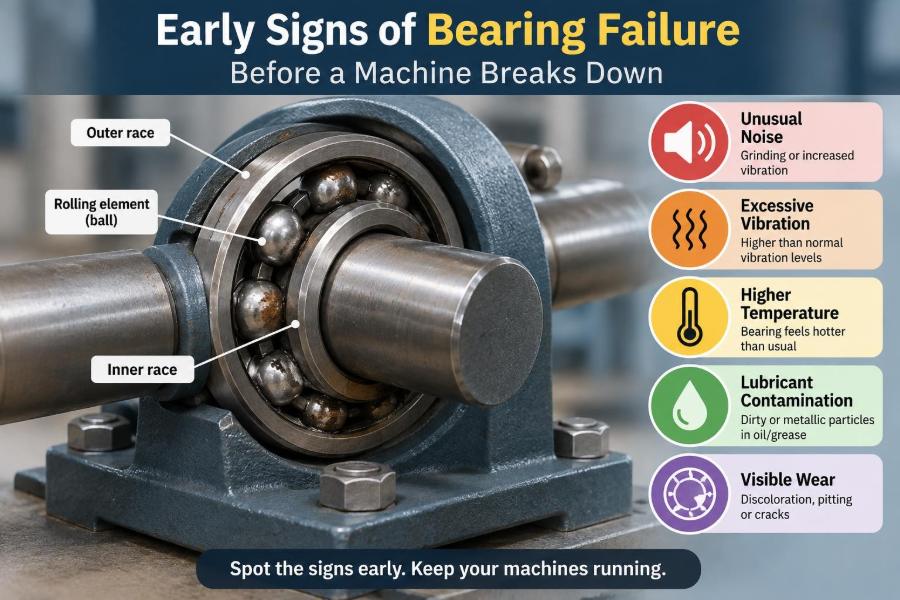

A conveyor begins making a faint rough sound near the end of a shift. A pump housing feels warmer than usual. A small electric motor develops a vibration that is noticeable only when someone rests a hand on the guard.
These observations are easy to postpone because the machine is still doing its job. Yet many bearing failures announce themselves gradually, sometimes for weeks, before the bearing seizes, damages a shaft, or forces an unplanned shutdown.
Bearings sit inside machines where they are often out of sight, but they guide rotating components, carry loads, and reduce friction. When they deteriorate, the effects spread well beyond one replaceable part: product quality, energy use, safety, seals, couplings, and production schedules can all be affected.
Recognizing an early warning does not mean guessing that every unusual noise is a failed bearing. It means combining observations, measurements, operating history, and inspection so maintenance decisions are based on evidence rather than urgency.
🔩 What a Bearing Actually Does
A rolling-element bearing supports relative motion between a stationary housing and a rotating shaft. In a common ball bearing, balls roll between an inner ring attached to the shaft and an outer ring held in the housing. Roller bearings use cylindrical, tapered, spherical, or needle-shaped rollers instead.
The bearing carries radial load, which acts perpendicular to the shaft, axial or thrust load, which acts along it, or a combination of both. It also maintains shaft position. A bearing can look small compared with the machine around it, but its condition strongly influences alignment, smoothness, and reliability.
⚙️ Why Failures Rarely Arrive Without Clues
Most bearing damage progresses through stages. A dent, contamination particle, inadequate lubricant film, or slight misalignment first creates localized stress. Repeated rolling contact then enlarges that defect into roughness, surface fatigue, cracking, or spalling, where flakes detach from a raceway.
Early-stage faults may be detectable only with sensitive monitoring. Later, vibration, heat, noise, and visible damage become obvious. The time between stages is not fixed: load, speed, lubrication, contamination, bearing type, and operating duty can make deterioration slow or surprisingly rapid.
👂 An Unusual Sound Is Often the First Human Clue
A healthy bearing usually contributes a steady, unobtrusive rolling sound. A developing fault can introduce rumbling, grinding, clicking, squealing, or a repeating tick. The sound may change with speed or load, which is useful information for troubleshooting.
Listening alone cannot diagnose a bearing. Belt slip, a loose guard, gear tooth damage, cavitation in a pump, and electrical noise can all be misleading. Still, a sound that is new, localized near a bearing housing, and repeatable under similar conditions deserves investigation.
🎧 Use Listening Tools With Care
A mechanic’s stethoscope, contact probe, or ultrasonic listening instrument can help compare similar locations without placing hands near rotating equipment. Ultrasonic tools detect high-frequency friction and impact activity that may appear before an audible change develops.
Comparison is more valuable than a single reading. Listen to the drive-end and non-drive-end bearings, then compare the machine with an equivalent healthy unit if one exists. Record operating speed, load, temperature, and the exact measurement point; otherwise, later comparisons lose much of their meaning.
📳 Growing Vibration Is a Strong Warning Sign
Rolling bearings generate small vibrations even when new. Damage to a ball, roller, cage, inner race, or outer race produces impacts as rolling elements pass over the defect. These impacts can raise overall vibration, but the increase may initially be too subtle to feel.
A vibration trend that rises under otherwise comparable operation is usually more informative than one isolated measurement. Vibration also changes when a machine runs faster, carries more load, or uses a different process setting, so those conditions must be considered before calling a bearing defective.
📈 Why Vibration Trends Beat One-Off Readings
A single vibration value answers only, “What did the machine do at this moment?” A trend answers, “Is its behavior changing?” That distinction prevents both missed problems and unnecessary bearing replacements.
For example, a fan may vibrate more during a high-flow operating condition than during a low-flow condition without having a bearing fault. But if measurements at the same speed and location climb over successive checks, maintenance personnel have evidence that something is evolving.
🧭 Vibration Direction Helps Narrow the Cause
Measurements are commonly taken in horizontal, vertical, and axial directions near each bearing. The direction with the strongest change can point toward a likely mechanism, although it is not a final diagnosis by itself.
- High radial vibration can be associated with imbalance, looseness, misalignment, or bearing-related problems.
- Elevated axial vibration may occur with angular misalignment, thrust loading, or certain coupling problems.
- Broad changes in several directions can indicate a developing fault, structural looseness, or a process-related change.
Interpretation requires knowledge of the machine’s construction. A flexible support structure, for instance, can amplify a response that originates elsewhere.
🌊 High-Frequency Impacts Can Reveal Early Surface Damage
Very small defects may create sharp impacts before they produce a large overall vibration increase. Techniques such as high-frequency acceleration measurements, enveloping, or demodulation are designed to expose repetitive impact patterns from rolling contact.
These methods need correct sensor mounting, sufficient signal quality, and an experienced interpretation. A damaged raceway is not the only possible source of high-frequency energy; poor lubrication, rubbing, electrical discharge damage, and external impacts may also contribute.
🌡️ A Hot Bearing Housing Needs Context
Temperature is one of the easiest conditions to observe. Increased friction from poor lubrication, excessive preload, contamination, misalignment, or a progressing defect can raise bearing temperature. A sudden rise during steady operation is more concerning than a stable temperature that has long been normal for that machine.
Housing temperature is not the same as the temperature at the rolling contact. It is influenced by ambient air, cooling flow, load, speed, sensor location, and heat from adjacent parts. Treat temperature as a useful trend indicator, not a standalone verdict.
🔥 Watch for Temperature Changes, Not Just a Number
An infrared thermometer or fixed sensor can quickly reveal an abnormal comparison between similar points. Measure the same spot, at a similar load and speed, after roughly the same warm-up period. A reading from the outer housing near the bearing is generally more repeatable than a random point on the machine frame.
Investigate if temperature rises unexpectedly, climbs continuously after startup, or differs meaningfully from a comparable bearing. Before shutting down a critical asset, verify the reading and look for corroborating signs such as changed vibration, lubricant leakage, or a new noise.
🛢️ Lubricant Condition Tells Part of the Story
Grease or oil creates a separating film between rolling surfaces, carries heat away in many systems, and helps protect against corrosion. When that film is too thin, contaminated, chemically degraded, or unsuitable for the speed and load, metal surfaces experience damaging contact.
Darkened oil, burnt odor, hardened grease, free water, or visible particles are warning signs, but appearance has limits. Some lubricants naturally darken in service, and small particles may not be visible. Oil analysis and grease inspection are most useful when combined with machine condition data.
💧 Contamination Leaves a Lasting Mark
Dirt, process dust, moisture, metal debris, and fibers can enter through damaged seals, poor handling, contaminated lubricant, or unsuitable breathers. A particle trapped in a loaded contact can dent a raceway. Each rolling element later passes over that dent, creating stress concentrations and vibration.
Water can displace lubricant, encourage corrosion, and alter grease consistency. Even after the original contaminant is gone, the surface damage it caused can continue to grow. Clean lubrication practices are therefore preventive maintenance, not merely housekeeping.
🧴 Overgreasing Can Be as Harmful as Undergreasing
A common reaction to a noisy bearing is to add more grease. If the bearing is starved, the correct lubricant and quantity may help. But excessive grease can churn, raise temperature, force material past seals, and increase drag, especially at higher speed.
Follow the equipment manufacturer’s lubrication guidance where available. If grease is added while a machine runs, use a controlled procedure and observe whether temperature stabilizes or rises. Never assume more lubricant automatically provides more protection.
🧪 The Wrong Lubricant Can Accelerate Wear
Lubricant selection depends on base-oil viscosity, thickener type for grease, additives, operating temperature, speed, load, and environmental exposure. Two greases that look similar may be incompatible; mixing them can alter consistency or reduce effective lubrication.
Use clearly labeled containers, dedicated dispensing equipment, and a documented lubricant route. When changing lubricant type, confirm compatibility and flushing requirements with technical information from the machine and lubricant suppliers. A bearing problem caused by lubricant error may not become obvious until long after the maintenance task.
📐 Misalignment Loads the Bearing Unevenly
When coupled shafts are not aligned, the coupling transmits extra forces into the bearings. Angular misalignment means shaft centerlines meet at an angle; parallel or offset misalignment means they are parallel but not collinear. Thermal growth can change alignment after a machine reaches operating temperature.
The result is uneven loading, added heat, vibration, and shortened fatigue life. Alignment should be evaluated after correcting obvious soft foot, pipe strain, loose mounting, and base problems. Otherwise, an accurate shaft adjustment may not remain accurate in operation.
🧱 Soft Foot and Loose Mounting Mimic Bearing Trouble
Soft foot occurs when one or more machine feet do not sit flat on the base. Tightening the hold-down bolts bends the machine frame and can distort alignment. Loose bolts, cracked grout, weak supports, or a distorted base can create vibration patterns that resemble internal bearing damage.
Before replacing an expensive bearing, inspect the machine’s foundation and mounting condition. A new bearing installed in a machine with the same structural problem may soon develop the same symptoms.
⚖️ Excessive Load Shortens the Margin for Error
Bearings are selected for a defined combination of load, speed, life expectation, and environmental conditions. Changes such as a tighter belt, a larger impeller, higher process pressure, or a jammed conveyor can increase bearing load beyond the original duty.
Overload does not always cause instant failure. It often reduces the machine’s tolerance for contamination, lubrication variation, and small alignment errors. When a bearing repeatedly fails in the same position, ask whether the actual operating load has changed.
🔌 Electrical Damage Has a Distinctive Mechanism
In some motor-driven systems, shaft voltages can discharge through bearings. Repeated electrical discharge can create tiny craters, fluting patterns on raceways, and a characteristic rough running condition. Variable-frequency drives are one potential source, though they are not the only possible cause.
Electrical bearing damage calls for an electrical and mechanical review. Possible controls may include correct grounding, shaft-grounding devices, insulated bearings, or system-specific measures. Replacing the bearing without addressing the current path can leave the underlying mechanism unchanged.
🧩 Cage Damage Changes the Character of the Fault
The cage separates and guides rolling elements. If it wears, cracks, deforms, or becomes damaged by poor lubrication and shock loading, the rolling elements may no longer remain evenly spaced. Noise and vibration can become irregular rather than neatly repetitive.
Cage failure can progress quickly once clearances change or fragments circulate inside the bearing. A suspected cage issue, especially on a critical high-speed machine, warrants prompt professional assessment rather than extended operation while waiting for a clearer signal.
🪓 Shock Loads Can Start Hidden Damage
Dropping a motor, striking a shaft with a hammer, forcing a coupling into place, or allowing a machine to experience a sudden jam can dent bearing raceways. The initial damage may be microscopic and may not create an immediate operational complaint.
Use proper fitting tools and apply installation force only to the ring being fitted. Pressing a bearing onto a shaft by pushing through the outer ring transfers force through the rolling elements; the reverse is true when fitting into a housing. This avoidable mistake can create a failure seed at installation.
🧰 Installation Quality Matters From Day One
Cleanliness, correct fits, proper heating methods, careful handling, and accurate preload or internal clearance are essential. A bearing installed with a damaged seal, a burred shaft shoulder, or an incorrect locknut adjustment may operate poorly despite being new.
Record the bearing designation, fit method, lubricant, date, and relevant measurements when practical. These details make later root-cause analysis far more effective than a work order that simply says “bearing replaced.”
🔍 Visual Inspection Can Confirm, Not Replace, Monitoring
Once a bearing is safely removed, inspect raceways, rolling elements, seals, cage condition, lubricant residue, and the shaft and housing fits. Spalling, corrosion, scoring, discoloration, false brinelling marks, and electrical fluting can each suggest different mechanisms.
Photograph the damage before cleaning parts or discarding them. The failed bearing is evidence. Replacing it immediately may restore production, but preserving the evidence helps prevent a repeat failure.
🧠 Know Common Damage Patterns
| Observed pattern | Possible contributing mechanism | Useful next check |
|---|---|---|
| Flaking or pits on raceway | Rolling-contact fatigue, contamination, overload | Review load, lubrication, and particle ingress |
| Brown-red staining or etched surfaces | Moisture exposure or corrosion | Inspect seals, storage, and water entry paths |
| Evenly spaced dents | Shock, vibration while stationary, contamination | Review handling and standby vibration conditions |
| Washboard-like fluting | Electrical discharge through bearing | Check grounding and shaft-voltage controls |
| Blue or dark heat discoloration | Overheating, lubrication failure, excessive preload | Verify lubricant, fit, clearance, and operating load |
These patterns are clues rather than proof. More than one mechanism can act at the same time, and surface damage may reflect both the initiating cause and the later consequences.
🕒 Intermittent Symptoms Are Still Symptoms
Some faults appear only at a particular speed, temperature, or load. A bearing may sound normal when cold but become noisy after the grease softens. A pump bearing may vibrate more only at a certain flow condition because hydraulic forces change.
Document when the symptom occurs rather than dismissing it because it cannot be reproduced immediately. Operating logs, operator observations, and time-stamped condition data can reveal patterns that a short inspection misses.
🏭 Process Changes Can Be the Real Trigger
A maintenance team may focus on the bearing while the actual trigger lies in the process. Higher viscosity fluid, a partially blocked filter, changed belt tension, frequent starts, a hotter ambient environment, or a new production recipe can alter machine loading.
When symptoms start after a process change, include operations personnel in the investigation. The best correction may be restoring the intended duty, modifying the machine for the new duty, or changing the maintenance strategy—not simply installing another bearing.
📝 Build a Useful Inspection Route
A basic route gives operators and technicians a consistent way to spot deterioration. It should be practical enough to use regularly and specific enough that two people can collect comparable observations.
- Observe noise, odor, leakage, and visible seal condition.
- Measure temperature at defined points under noted operating conditions.
- Collect vibration or ultrasound data where the program supports it.
- Check lubrication tasks, lubricant identity, and contamination controls.
- Record changes from normal, not only obvious failures.
The aim is not to turn every operator into a vibration analyst. It is to ensure early clues reach someone who can evaluate them.
📊 Set Baselines While Equipment Is Healthy
Baseline readings collected after correct installation and stable operation provide a reference for future decisions. They are especially useful for machines with unique designs, variable speeds, or locations where absolute “normal” values are difficult to generalize.
Baselines should include measurement locations, instrument settings, speed, load, and temperature conditions. A number without context can falsely suggest change when the measurement method, not the machine, has changed.
🚦 Decide Whether to Monitor, Plan, or Stop
Not every warning requires an immediate shutdown. The response should reflect the severity and rate of change, machine criticality, consequences of failure, availability of a spare, and evidence of collateral risk.
A mild, stable indication on a noncritical standby fan might justify closer monitoring and planned replacement. Rapidly rising temperature, severe noise, smoke, loss of lubrication, shaft movement, or a risk of seizure may require controlled shutdown. Site safety procedures and manufacturer guidance take priority.
🗣️ Communicate Evidence, Not Just a Conclusion
“The bearing is bad” is less useful than a concise evidence statement: “Drive-end horizontal vibration has risen across three comparable readings, ultrasound increased, and housing temperature is higher than the matching bearing.” This gives planners and operators a basis for action.
Include uncertainty where it exists. A good report can say that the data indicates a likely bearing-related issue while noting other possibilities, such as misalignment or looseness, that should be checked during the outage.
🚫 Common Mistakes That Create Repeat Failures
Repeat failures are often maintenance-system problems rather than bad luck. Common errors include replacing only the bearing, lubricating by habit instead of need, mixing greases, reusing damaged seals, ignoring shaft and housing wear, and failing to correct alignment or mounting defects.
Another costly mistake is treating all vibration as a bearing fault. A disciplined diagnosis considers the entire machine train: driver, coupling, driven equipment, base, process, and controls.
🛠️ A Practical First Response to a Suspected Fault
When an early sign appears, begin with safe, orderly checks rather than an impulsive adjustment. Keep guards in place and follow lockout, access, and plant procedures before any close inspection.
- Confirm the symptom under known operating conditions.
- Compare with historical data or a similar healthy machine.
- Check for obvious lubrication, seal, mounting, and alignment concerns.
- Assess trend rate and operational consequence.
- Plan inspection or replacement with the likely root causes in mind.
- Inspect removed components and document findings before closing the job.
🧭 When Specialist Support Is Worthwhile
Complex, high-speed, heavily loaded, safety-critical, or production-critical machines often justify support from a vibration analyst, reliability engineer, bearing specialist, or equipment manufacturer. Specialist review is also valuable when failures repeat despite apparently correct maintenance.
Advanced analysis does not eliminate engineering judgment. It improves the quality of the evidence and can help distinguish bearing damage from resonance, gear faults, electrical effects, hydraulic instability, and other look-alike conditions.
✅ The Core Principle: Detect Change, Then Find the Cause
Early bearing failure detection is not about reacting to every warm housing or replacing parts at the first hint of noise. It is about noticing change from a known normal condition, verifying it with complementary evidence, and tracing the physical mechanism behind it.
The most reliable programs connect daily observation with condition monitoring, good lubrication, correct installation, sound alignment, and disciplined root-cause analysis. A bearing is rarely an isolated component; it reflects the health of the system that loads, lubricates, powers, and supports it.
When a machine begins to sound, feel, vibrate, or run differently, treat that change as useful information early enough to act before a small defect becomes a disruptive breakdown. ⚙️🔍🛠️