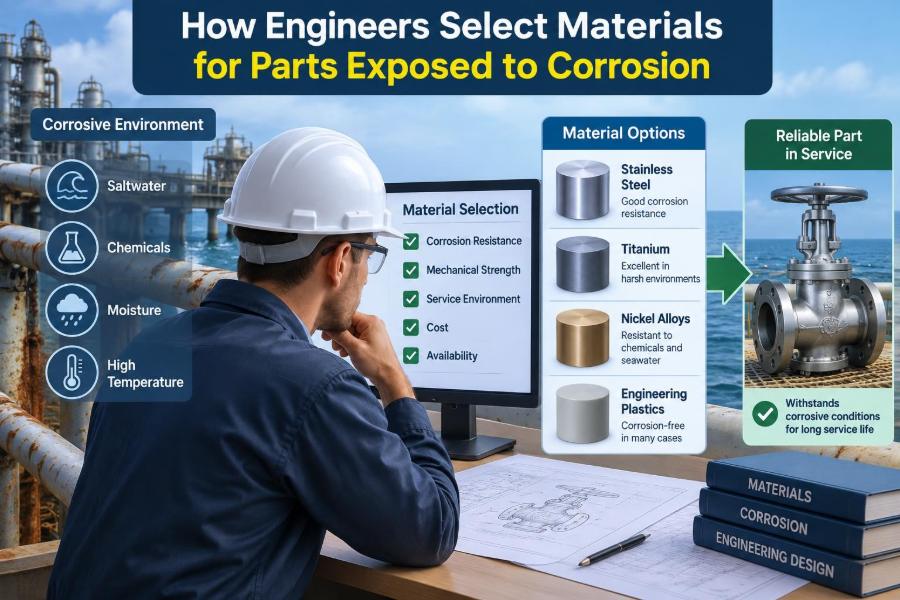

A pump casing in a chemical plant begins to leak at a flange. A stainless-steel fastener on an offshore platform cracks unexpectedly. A beautifully machined aluminum housing develops white deposits after a season outdoors.
None of these failures is explained by a material name alone. “Stainless,” “aluminum,” and “coated steel” describe broad families, not guaranteed outcomes in every liquid, gas, temperature range, or joint design.
For engineers, material selection under corrosion is therefore an investigation. The part, the environment, the manufacturing route, the neighboring materials, and the consequences of failure all matter at the same time.
A good choice is not always the material that corrodes least in a laboratory. It is the material system that performs safely for the required service life, can be made and inspected reliably, and fits the project’s cost and maintenance strategy. 🧪
🔍 1. Start with the actual service question
Corrosion selection starts by defining what the part must do. A thin decorative cover, a pressure boundary, a rotating shaft, and a safety-critical bolted joint can face the same atmosphere while requiring very different levels of resistance.
Write the service question in practical terms: what is the part, what contacts it, how long will it operate, and what happens if it degrades? This prevents an early jump to a familiar alloy.
- Function: contain fluid, transmit load, seal, conduct heat, or provide appearance.
- Failure limit: leak, loss of strength, seizure, contamination, or unacceptable appearance.
- Design life: temporary equipment, routinely replaced item, or long-lived infrastructure.
🌦️ 2. Identify the environment, not just the fluid
Listing “water” or “air” is rarely enough. Water may be fresh, saline, stagnant, aerated, chlorinated, acidic, alkaline, or contaminated by process chemicals. Air may be dry indoors, humid industrial air, marine spray, or a condensing enclosure.
Engineers ask where deposits form, whether surfaces dry between exposures, and whether oxygen can reach the metal. Small environmental differences can change the dominant corrosion mechanism.
🧾 3. Gather the chemistry that controls attack
Useful data include pH, dissolved salts, oxidizing or reducing character, conductivity, oxygen content, contaminants, and cleaning chemicals. Chloride deserves particular attention because it can promote localized attack in materials that otherwise appear highly resistant.
Concentration is only one variable. A dilute solution at elevated temperature or under a deposit can be more aggressive than expected, while a concentrated medium may allow some materials to form a stable protective film.
If the process composition changes during startup, cleaning, upset conditions, or shutdown, those periods belong in the design envelope too.
🌡️ 4. Map temperature and pressure across the life cycle
Temperature often accelerates chemical reactions and can destabilize passive films. It also affects fluid evaporation, salt concentration, polymer permeability, mechanical strength, and the performance of coatings and sealants.
Use maximum, minimum, normal, and transient temperatures rather than a single nominal value. A steam-cleaning cycle, heat-traced pipe, or hot spot near a weld may govern material selection even if most operation is mild.
Pressure does not directly cause all corrosion, but it can control gas solubility, boiling, leakage consequences, and the severity of a pressure-boundary failure.
💧 5. Determine whether an electrolyte is present
Most common electrochemical corrosion needs an electrically conductive path through an electrolyte. Liquid water, damp dirt, seawater spray, condensate, and wet insulation can all provide that path.
A component in a dry gas may perform well until shutdown creates condensation. Likewise, a nominally dry outdoor assembly can retain moisture in crevices for far longer than its exposed surfaces.
The important question is not simply “Does it get wet?” but “How often, for how long, and where does the moisture remain?”
⚡ 6. Understand the basic electrochemical cell
Corrosion is commonly an electrochemical process. One location acts as an anode, where metal dissolves, while another supports a cathodic reaction. Electrons move through the metal, and ions move through the electrolyte.
Removing any required part of this circuit can reduce corrosion. Designers may isolate dissimilar metals, exclude water with sealing, choose a resistant alloy, apply a coating, or use cathodic protection.
This model also explains why attack can be highly local. A tiny anode coupled to a large cathode may dissolve rapidly when conditions allow it.
🛡️ 7. Separate uniform corrosion from localized corrosion
Uniform corrosion spreads relatively evenly over a surface. It can sometimes be managed by choosing corrosion allowance: extra wall thickness intended to be consumed gradually during service.
Localized corrosion, including pitting and crevice corrosion, is more dangerous for many parts because deep penetration can occur with little overall metal loss. A vessel may look acceptable externally while a small pit threatens containment.
Engineers must identify which mode is plausible before using a general corrosion rate as a design basis.
🕳️ 8. Design against pitting corrosion
Pitting is localized breakdown of a protective surface film, often associated with aggressive ions such as chlorides. Once initiated, the pit geometry and local chemistry can sustain attack even when the surrounding surface remains passive.
Alloy composition matters, but so do temperature, deposits, solution chemistry, surface condition, and stagnant zones. A polished, freely drained surface may behave very differently from the same alloy beneath a deposit.
- Avoid water traps and debris-retaining ledges.
- Specify cleaning and drainage where chloride-bearing contamination is possible.
- Consider alloys with suitable localized-corrosion resistance for the full service condition.
🧩 9. Treat crevices as their own environment
Gaskets, lap joints, threads, washers, deposits, and tight gaps can restrict oxygen exchange and trap electrolyte. The fluid inside a crevice may become chemically different from the bulk fluid, creating conditions that favor intense local attack.
Material selection alone cannot fix poor crevice geometry. Whenever possible, use continuous welds instead of overlapping plates, provide drainage, minimize stagnant gaps, and select gasket arrangements that do not create uncontrolled wet pockets.
A corrosion-resistant alloy can still fail if its protective film cannot recover inside a persistent crevice.
🔗 10. Check every dissimilar-metal connection
When unlike metals are electrically connected in an electrolyte, galvanic corrosion may occur. The less noble material in that particular environment tends to become anodic and may corrode faster.
The area ratio is crucial. A small active fastener coupled to a large noble panel is generally a poor arrangement because the fastener’s limited area must support the galvanic current.
Galvanic series charts are useful screening tools, but they are not universal rankings. Environment, passivation, temperature, oxygen access, and geometry all influence the outcome.
🧷 11. Use isolation and area ratio intelligently
Electrical isolation can interrupt a galvanic circuit. Nonconductive sleeves, washers, gaskets, coatings, and carefully designed joints may separate metals, provided moisture cannot bridge the isolation path.
Coating only the more noble member can be risky if coating damage leaves a small exposed cathodic area. Coating the less noble member is often more forgiving, although the complete assembly and expected damage pattern must be evaluated.
Do not assume a painted interface is permanently isolated. Fastener holes, scratches, compression, aging, and conductive deposits can defeat the original intention.
🌊 12. Account for flow, erosion, and impingement
Moving fluid can remove protective films or coatings, especially at elbows, pump inlets, valves, restrictions, and areas where entrained solids strike the surface. This combined action is often called erosion-corrosion.
Increasing alloy resistance may help, but flow geometry is frequently the first design lever. Reduce unnecessary turbulence, avoid sharp changes in direction, control velocities where practical, and keep solids from concentrating at vulnerable locations.
A static immersion coupon may not reveal a problem that develops in a high-velocity pump circuit.
🌀 13. Consider cavitation separately from corrosion
Cavitation occurs when vapor bubbles form and collapse in a liquid, producing repeated local impacts. Pump impellers, propellers, and valve trims can suffer surface damage that exposes fresh metal and accelerates corrosive attack.
The remedy may combine hydraulic design, operating control, resistant material, improved surface finish, and repairable protective systems. Calling every damaged impeller “corrosion” can hide the root cause.
🧱 14. Evaluate stress corrosion cracking risks
Stress corrosion cracking requires a susceptible material, a specific corrosive environment, and tensile stress. The stress may come from service load, forming, welding, bolting, or residual stresses left by manufacturing.
Cracks can grow with little visible general corrosion, making this mechanism especially concerning for pressurized and highly loaded parts. Selection should examine both the alloy condition and the likely stress state.
Reducing tensile stress, changing material condition, controlling environment, improving geometry, or applying appropriate heat treatment may be part of the solution.
🔥 15. Do not overlook high-temperature corrosion
At elevated temperatures, corrosion may occur without liquid water. Oxidation, sulfidation, carburization, nitridation, and attack by hot salts or combustion deposits can control life in furnaces, turbines, exhaust systems, and process heaters.
Here, alloying elements that form stable scales become important, but thermal cycling can crack or spall those scales. The material must tolerate both the chemical environment and repeated expansion and contraction.
Room-temperature immersion data should not be used to predict high-temperature gas service.
🧪 16. Compare material families by behavior
No family is universally best. Carbon steel is economical and strong but may require allowance, coating, inhibitors, or protection in wet service. Stainless steels rely on passive films and vary greatly in localized-corrosion resistance.
Aluminum alloys are light and form oxide films, yet can be vulnerable in some alkaline, chloride-rich, or galvanically coupled conditions. Copper alloys may suit selected waters but are not appropriate for every chemistry or velocity.
Nickel alloys, titanium alloys, polymers, ceramics, and composites each solve particular problems while introducing limits in cost, fabrication, temperature, brittleness, permeability, or mechanical design.
| Material approach | Potential advantage | Selection caution |
|---|---|---|
| Carbon steel with allowance | Simple, strong, widely fabricated | Only suitable when attack is predictable and manageable |
| Stainless steel | Passive film can provide strong resistance | Localized attack and crevices can still govern |
| Coated metal | Base material can retain structural benefits | Edges, defects, adhesion, and repair need planning |
| Polymer or composite | Can resist many aqueous chemicals | Temperature, pressure, permeation, and joining matter |
| High-alloy metal | May tolerate severe environments | Cost, availability, welding, and unnecessary overdesign matter |
🧬 17. Select the grade, condition, and product form
Choosing “stainless steel” is not a complete specification. Grade, heat treatment, strength level, microstructure, thickness, cast versus wrought form, and supplier processing can affect corrosion and cracking behavior.
Cast components may have different surface quality and local composition from wrought products. High-strength conditions can improve load capacity while increasing sensitivity to some environmentally assisted cracking mechanisms.
Specify the material condition that supports both mechanical requirements and environmental resistance.
🏭 18. Include manufacturing in the selection
A theoretically suitable material can become unsuitable if it cannot be formed, machined, cast, welded, bonded, or heat treated consistently for the part. Manufacturing also creates surface roughness, crevices, residual stress, and contamination.
For example, machining practices can embed foreign particles, while aggressive grinding may damage a surface. A material system should include process controls, not merely a purchase description.
Ask early whether the chosen material can be made at the required size, tolerance, and production volume.
⚙️ 19. Treat welds and heat-affected zones as critical locations
Welding changes local microstructure, residual stress, surface condition, and geometry. Weld toes, undercut, incomplete penetration, spatter, and unremoved heat tint can create sites where corrosion initiates more readily.
Selection and fabrication planning should define compatible filler material, welding procedure, post-weld cleaning, and any needed heat treatment. The weld region must be considered part of the corrosion design, not an afterthought.
Where access permits, smooth transitions and continuous welds can be easier to inspect and clean than intermittent attachments.
🧼 20. Specify surface condition and cleanliness
Surface finish affects how deposits adhere, how readily liquids drain, and whether protective films form uniformly. A smoother surface is not automatically best in every application, but uncontrolled roughness and contamination create avoidable risk.
For passive alloys, fabrication residues and heat discoloration may need removal through an appropriate controlled process. For coated parts, surface preparation strongly influences adhesion and long-term performance.
Cleaning agents themselves matter. A material that tolerates the process fluid may not tolerate an overlooked disinfectant, descaler, or chloride-containing cleaner.
🎨 21. Choose coatings as engineered systems
Paints, metallic coatings, conversion layers, linings, and thermal-spray systems can extend the use of economical structural materials. Their success depends on substrate preparation, application quality, film thickness, edge coverage, curing, inspection, and repair access.
A coating is not a vague instruction to “protect the part.” It needs a defined service environment, compatible primer or lining, acceptable defect criteria, and a maintenance plan.
Consider what happens after inevitable damage. Will the exposed substrate corrode slowly, undercut the coating, or trigger galvanic effects with a metallic coating?
🔋 22. Know when cathodic protection is appropriate
Cathodic protection shifts the electrochemical behavior of a protected structure so that it becomes cathodic rather than anodic. It can use sacrificial anodes or an externally supplied current.
This approach is commonly considered for immersed or buried conductive structures where electrolyte continuity exists. It requires design, monitoring, and coordination with coatings; it is not a substitute for understanding the environment.
Overprotection can also create problems for certain materials or coating systems, so the full system needs specialist evaluation.
🧫 23. Remember microbiologically influenced corrosion
Microorganisms can contribute to corrosion by changing local chemistry, forming biofilms, creating differential oxygen conditions, or producing corrosive metabolites. This is called microbiologically influenced corrosion, or MIC.
MIC is not solved by assuming that a material is “biologically resistant.” Water quality, stagnation, nutrient availability, cleaning, biocide strategy, deposits, and inspection all influence risk.
Systems with intermittent operation, dead legs, and untreated water deserve particular attention.
📐 24. Design geometry to help the material
The best alloy can be defeated by geometry that traps liquid and debris. Corrosion-conscious design aims for drainage, ventilation, access for cleaning, smooth transitions, and avoidance of blind cavities and sharp re-entrant corners.
Place dissimilar-metal joints where they can stay dry if possible. Keep critical surfaces inspectable, and avoid designs that require a coating to bridge impossible gaps or coat inaccessible internal corners.
Good geometry often reduces corrosion risk at little material cost. 🔧
🧮 25. Balance corrosion allowance with localized-risk control
Corrosion allowance is useful when uniform thinning is reasonably predictable and extra thickness does not compromise weight, heat transfer, fatigue, or fit. It is common in some structural and pressure-containing applications.
It is not a reliable answer to pitting, crevice corrosion, cracking, or coating disbondment. Adding thickness does not prevent a crack or a small deep pit from causing leakage.
Use allowance as one design tool within a justified damage model, not as a universal safety margin.
🧪 26. Test under representative conditions
Published compatibility information and field experience provide valuable starting points, but unusual service may require testing. A meaningful test reproduces important variables: chemistry, temperature, flow, oxygen level, crevices, stress, surface condition, and exposure duration.
Simple immersion tests may screen candidate materials, while more specialized methods can investigate localized attack, cracking, coating performance, or galvanic behavior. The method should match the suspected failure mechanism.
Test results need interpretation. A short, clean laboratory exposure cannot automatically represent years of deposits, cycling, fabrication variation, and maintenance practice.
📚 27. Use codes, data, and experience with judgment
Design codes, owner specifications, industry guidance, material datasheets, and prior service records can narrow choices efficiently. They should be applied to the actual duty, not copied from a superficially similar project.
Field history is especially valuable when it includes chemistry, temperature, design details, inspection findings, and failure mode. “This alloy worked before” is weak evidence if those details are unknown.
When a component is safety-critical or the environment is uncertain, involving corrosion and materials specialists early is usually less costly than redesign after installation.
💰 28. Compare life-cycle cost, not purchase price
A low-cost material may need frequent coating renewal, inspection, shutdowns, or replacement. A higher-alloy material may reduce maintenance but impose higher fabrication cost or longer procurement time.
Life-cycle thinking includes installation, inspection access, repair complexity, lost production, environmental consequences, and the cost of failure. It also recognizes that some failure consequences are unacceptable regardless of replacement cost.
The economic choice is the option that manages total risk and ownership burden over the required life.
📝 29. Turn the choice into a complete specification
Material selection is incomplete until it can be purchased, manufactured, inspected, and maintained. A clear specification identifies the material grade and condition, permitted substitutions, fabrication requirements, surface preparation, coating or treatment, inspection needs, and acceptance criteria.
It should also state service limits and maintenance assumptions. If a design depends on periodic washing, an inhibitor, dry storage, or cathodic-protection monitoring, those requirements must be visible to the people who operate the equipment.
Ambiguity often reappears later as mismatched fasteners, unsuitable cleaners, skipped surface treatment, or undocumented substitutions.
✅ 30. Apply the core principle: select the whole system
The central principle is simple: engineers do not select a material in isolation; they select a material, environment, geometry, fabrication route, protection method, and maintenance plan as one system.
Start by defining the real exposure, identify credible corrosion mechanisms, evaluate candidate materials in their actual forms and joints, then verify the design through evidence, testing, and inspection planning. This approach avoids both underdesign and expensive, unnecessary overdesign.
The right corrosion-resistant part is the one whose complete system remains reliable in its real service environment for its intended life. 🛡️🔩🌊