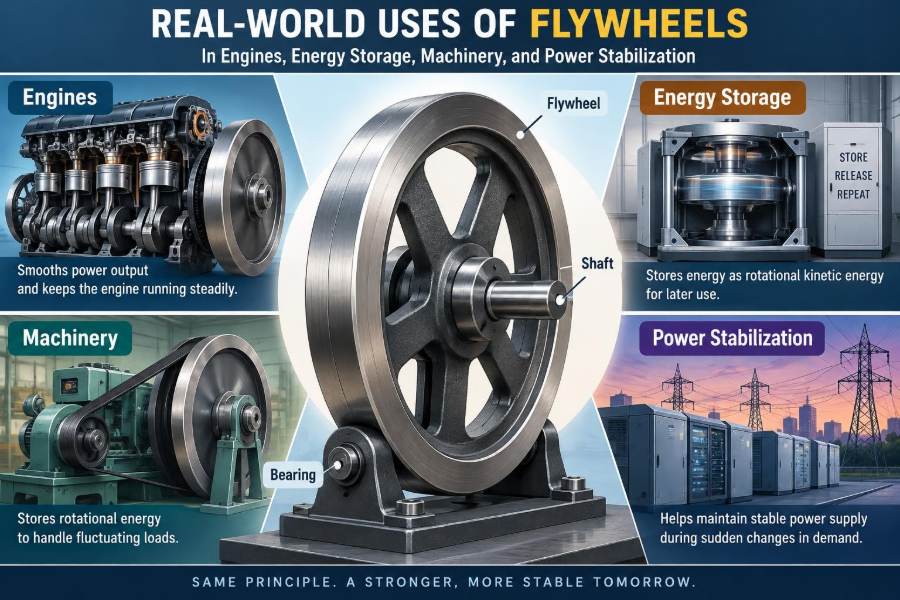

A car pulling away from a traffic light, a workshop press shaping sheet metal, and a data center riding through a brief power disturbance may appear unrelated. Yet each can depend on the same mechanical idea: storing rotational energy so it is available at the moment it is needed.
That stored energy often sits in a flywheel—a rotating mass designed to resist sudden changes in speed. Sometimes its role is almost invisible, smoothing the uneven pulses from an engine. In other cases, it is a deliberately engineered energy-storage device operating at very high speed inside a protective enclosure.
Flywheels matter because real machines rarely receive or deliver power in a perfectly steady flow. Engines fire in pulses, electrical grids experience disturbances, and industrial equipment can demand a large burst of energy in a fraction of a second.
Understanding where flywheels fit helps engineers choose between mechanical, electrical, and chemical storage systems—and helps operators recognize why a heavy rotating part can be essential to reliable performance.
🔄 What a Flywheel Actually Does
A flywheel is a rotor with enough rotational inertia to store kinetic energy. Once spinning, it tends to keep spinning; when a load temporarily needs extra energy, the flywheel slows slightly and supplies part of that demand.
Conversely, when an input delivers energy too quickly, the flywheel speeds up and absorbs part of the surplus. This makes it an energy buffer, not a source of energy. It must first be accelerated by an engine, motor, turbine, or another prime mover.
🧮 The Physics Behind Stored Rotation
The energy in a flywheel is commonly expressed as E = ½Iω², where I is moment of inertia and ω is angular speed. Moment of inertia depends not only on mass, but also on how far that mass lies from the rotational axis.
This equation explains two core design choices: increase rotational speed, or increase moment of inertia. Because speed is squared, a modest rise in speed can substantially increase energy storage—but it also increases mechanical stress and safety demands.
⚖️ Why Mass Distribution Matters
A solid disk and a rim-heavy wheel with the same mass do not behave identically. Material positioned farther from the center contributes more strongly to moment of inertia, which is why many traditional flywheels place substantial material near the rim.
Modern high-speed units may use shapes and materials optimized for strength rather than simply making the rim thicker. The design must balance energy capacity, rotational stress, manufacturing practicality, bearing loads, and safe containment.
🚗 Smoothing Torque in Piston Engines
A piston engine produces torque unevenly. Each cylinder delivers a strong impulse during its power stroke, while intake, compression, and exhaust strokes consume energy or contribute little driving torque.
The engine flywheel absorbs energy during the stronger parts of the cycle and returns it between combustion events. The result is smoother crankshaft rotation, less speed fluctuation, and more stable operation at low engine speed.
Without sufficient flywheel inertia, an engine can feel rough, stall more easily, and transmit larger torsional fluctuations into connected equipment.
🚙 Why Vehicle Engines Use Different Flywheel Designs
Flywheel requirements vary with engine layout and vehicle purpose. A multi-cylinder engine with frequent, overlapping power strokes generally needs less smoothing from a flywheel than a small single-cylinder engine.
A heavy commercial vehicle may favor smooth launch behavior and low-speed drivability, while a performance-oriented vehicle may use lower rotational inertia for quicker speed changes. Neither approach is universally superior; the correct choice follows the duty cycle and drivetrain design.
🧷 Connecting the Engine to a Manual Transmission
In many manual-transmission vehicles, the flywheel provides the friction surface for the clutch. The clutch disc is pressed against it to transmit engine torque into the gearbox.
This creates several requirements at once: the surface must remain flat, tolerate heat, resist wear, and have enough thermal mass for repeated engagements. A flywheel therefore acts as both an energy-storage component and a functional part of the clutch system.
🛞 Dual-Mass Flywheels and Driveline Comfort
A dual-mass flywheel divides the rotating assembly into two masses connected through springs and damping elements. Its purpose is to reduce torsional vibration before it reaches the transmission and vehicle structure.
These units can improve refinement, especially in engines with strong low-speed torque pulses. However, their internal damping components can wear, and replacement decisions should consider the complete drivetrain rather than treating the flywheel as a simple solid disk.
🏍️ Small Engines Need Careful Inertia Choices
In lawn equipment, motorcycles, portable generators, and small pumps, a flywheel often has several jobs. It smooths speed variation, may carry cooling-fan features, and can include magnets used for ignition or charging.
Too little inertia can make governed speed unstable under changing load. Too much can make the machine slow to respond and increase starting effort. Small-engine flywheel design is therefore closely linked to combustion characteristics, governor behavior, and operator expectations.
🏭 Delivering Short Bursts in Industrial Machinery
Some factory machines demand high power only briefly. A punching press, shear, or forging machine may need a large energy pulse during the actual forming operation, followed by a longer interval with much lower demand.
A flywheel lets the driving motor replenish energy gradually between cycles. This can reduce the peak power that the motor and electrical supply must deliver, provided the operating cycle gives enough time for the flywheel to recover speed.
🔨 The Mechanical Press as a Classic Example
In a mechanical press, the motor accelerates the flywheel to operating speed. When the press performs work on the material, energy flows from the flywheel through the clutch, gears, and crank mechanism to the ram.
The flywheel slows during the demanding part of the stroke. If production rate, material thickness, or forming load rises beyond the machine’s intended capacity, the flywheel may not recover its speed between strokes—an operational warning that should not be ignored.
🧵 Textile, Weaving, and Reciprocating Machines
Machinery with back-and-forth motion often creates cyclic torque demand. Looms, pumps, compressors, and some legacy manufacturing equipment use flywheels to reduce the speed variations caused by these repeating loads.
By smoothing the torque seen by the motor, the flywheel can reduce belt slip, limit shock loading, and improve motion consistency. It does not eliminate imbalance or poor alignment; those faults must still be corrected at their source.
💨 Reciprocating Pumps and Compressors
A reciprocating pump or compressor alternately accelerates components, compresses fluid or gas, and reverses motion. The resisting torque changes substantially over each revolution.
Flywheel inertia moderates crankshaft speed variation, helping the machine pass through less favorable portions of the cycle. It can also reduce the cyclic torque transmitted to the driver, although pressure pulsation in piping requires separate controls such as accumulators, dampers, or suitable pipe design.
⚡ Flywheel Energy Storage Systems
A dedicated flywheel energy-storage system uses an electric motor-generator to spin a rotor up when energy is available. Later, the same electromechanical system converts the rotor’s kinetic energy back into electricity.
These systems are fundamentally different from a conventional engine flywheel in scale and control. They commonly use sophisticated power electronics, sensors, containment structures, and low-loss bearings to operate safely and efficiently at high rotational speeds.
🧲 High-Speed Rotors, Bearings, and Vacuum Enclosures
Air drag becomes a significant loss as rotational speed rises, so high-speed flywheel systems may operate in a low-pressure enclosure. Advanced designs can use magnetic bearings, which support the rotor without conventional rolling contact during normal operation.
These features reduce ongoing losses and bearing wear, but they add cost and control complexity. A practical system also needs auxiliary bearings or a safe support strategy for shutdowns, faults, and maintenance conditions.
🔋 How Flywheels Compare With Batteries
Flywheels and batteries both store energy, but their strengths differ. A flywheel is often well suited to rapid charge and discharge cycles, high power output, and frequent cycling. Batteries often provide more energy for a given installation volume or duration, depending on chemistry and system design.
| Characteristic | Flywheel storage | Battery storage |
|---|---|---|
| Stored form | Rotational kinetic energy | Electrochemical energy |
| Typical strength | Fast power response and repeated cycling | Longer-duration energy delivery |
| Key loss mechanism | Mechanical and aerodynamic standby losses | Electrical and chemical losses |
| Design concern | Rotor containment and bearing system | Thermal management and cell aging |
The right choice depends on required duration, power level, cycling pattern, site constraints, safety strategy, and total system economics—not on a single headline specification.
🖥️ Bridging Power for Critical Loads
Brief voltage sags and short outages can interrupt sensitive equipment even when a longer-term backup generator is available. Flywheel-based systems can bridge this gap by responding nearly immediately while a generator starts or a transfer sequence completes.
Applications may include facilities where interruption is costly or disruptive, such as certain industrial processes, communications equipment, and data infrastructure. The system must be sized for the actual transition time and load profile, not merely the nominal rating of connected equipment.
🌐 Supporting Grid Frequency and Power Quality
An electrical grid must continuously balance generation and demand. When a disturbance occurs, fast-acting storage can inject or absorb power to help limit the rate of frequency change while other resources respond.
Flywheels can also assist with short-duration power-quality events. Their value is greatest when the required service is fast and repetitive; they are generally not a substitute for long-duration storage during extended shortages.
🚆 Capturing Braking Energy in Transport
When a vehicle brakes, its kinetic energy is normally converted into heat at the brakes. Regenerative systems attempt to capture some of that energy for later acceleration, and a flywheel can serve as the storage medium in certain transport concepts.
The attraction is rapid charge acceptance and rapid power release. The engineering challenge is packaging a spinning rotor safely in a moving vehicle while managing gyroscopic effects, containment, cost, and maintenance.
🏁 Kinetic Recovery in Performance Applications
In motorsport and other high-performance applications, flywheel-based kinetic energy recovery has been explored where repeated braking and acceleration create short, intense energy cycles. A transmission couples the storage unit so that recovered energy can later assist acceleration.
This is a specialized application, not a universal automotive solution. It illustrates the flywheel’s strongest characteristic: moving substantial power quickly over a relatively short interval.
🌬️ Helping Variable Renewable Generation
Wind and solar output can change with weather and operating conditions, while local electrical demand also varies. Flywheels can smooth rapid fluctuations and support short control actions at the point where energy is generated or consumed.
They do not make a renewable source dispatchable for days at a time. Rather, they can complement batteries, flexible generation, network controls, and demand management in systems that need a fast response layer.
🎛️ Mechanical Versus Electronic Smoothing
Modern variable-frequency drives and power electronics can regulate motor speed and torque with impressive precision. In some systems, they reduce the need for a large mechanical flywheel by actively controlling the energy flow.
But electronics do not automatically replace inertia. A flywheel may still be valuable when a load produces very sharp energy peaks, when grid connection limits matter, or when stored rotational energy provides a useful ride-through function.
📏 Sizing a Flywheel for Real Duty Cycles
Flywheel sizing starts with the energy exchanged during the event, not simply the average machine power. Engineers define the allowable speed drop, estimate losses, consider the cycle time, and verify whether the driver can restore energy before the next event.
A useful conceptual relationship is:
Required energy change ≈ ½ I (ω₁² − ω₂²)The allowable speed range is crucial. If speed is allowed to fall only slightly, much more inertia is needed for the same energy delivery. Actual design also includes shaft strength, torsional dynamics, bearing rating, thermal effects, controls, and safety margins.
📉 Speed Droop Is Often a Design Constraint
When a flywheel supplies energy, it slows down. This is called speed droop, and it can be acceptable or unacceptable depending on the machine.
A press may tolerate a controlled speed reduction during a forming stroke. A precision process, generator, or synchronized drive may require a much tighter speed band. Designers must define what the connected system can tolerate before selecting inertia.
🌀 Gyroscopic Effects in Moving Equipment
A spinning flywheel resists changes in the direction of its axis. This gyroscopic behavior can create reaction torques when a vehicle turns, pitches, or rolls.
In stationary machinery, the effect is usually unimportant because the axis remains fixed. In vehicles, ships, and mobile equipment, orientation and mounting become important design decisions. Counter-rotating flywheels can be used in some concepts to reduce net gyroscopic effects.
🛡️ Containment Is a Primary Safety Requirement
A high-speed rotor contains considerable energy. If it fails because of overspeed, material defects, fatigue, impact, or poor assembly, fragments can be hazardous. Safe flywheel systems therefore require engineered containment, overspeed protection, inspection procedures, and controlled operating limits.
Never treat a protective enclosure as an optional cover. Its design is part of the energy-storage system, particularly for high-speed composite rotors that may fail differently from traditional metal wheels.
🔧 Balance, Alignment, and Bearing Health
Even a small mass imbalance creates a rotating force that rises sharply with speed. Poor balance can produce vibration, accelerate bearing wear, loosen fasteners, and contribute to fatigue damage.
Good practice includes dynamic balancing where appropriate, accurate shaft alignment, sound foundations, and condition monitoring for critical assets. A flywheel that begins vibrating unusually should be investigated rather than operated until failure becomes obvious.
🌡️ Heat, Losses, and Standby Energy
Real flywheels lose energy through bearing friction, windage, seals, electrical conversion losses, and auxiliary systems. A conventional exposed wheel slows gradually; a high-speed storage unit may use a vacuum enclosure specifically to reduce aerodynamic loss.
These losses mean flywheels are generally best for short-to-medium storage intervals and frequent cycling. For long standby periods, the energy needed to maintain speed can become a significant system consideration.
🧰 Maintenance Priorities for Conventional Flywheels
A basic engine or industrial flywheel is durable, but it is not maintenance-free. Inspection should focus on the parts that connect, support, or load it: clutch surfaces, mounting bolts, keyways, couplings, bearings, and guards.
- Check for cracks, heat checking, scoring, and damaged ring gears where applicable.
- Use specified tightening methods for mounting hardware; incorrect clamp load can be dangerous.
- Investigate new noise, vibration, or clutch engagement problems promptly.
- Follow manufacturer procedures for resurfacing or replacing flywheels and clutch components.
Critical rotating equipment should be serviced by personnel qualified for the machine and its safety procedures.
🚫 Common Misunderstandings About Flywheels
One misconception is that a flywheel “creates” extra power. It does not. It changes when energy is delivered, allowing a smaller continuous input to meet a brief high-power demand.
Another mistake is assuming a heavier flywheel is always better. Extra inertia can slow acceleration, increase loads during starting and stopping, and make control less responsive. The right amount of inertia is application-specific.
🧭 Choosing the Right Technology
A flywheel is a strong candidate when the requirement involves frequent cycling, very fast response, short energy duration, or smoothing of cyclic torque. A battery, capacitor, hydraulic accumulator, larger motor, or electronic control system may be more appropriate in other cases.
Ask practical questions before choosing: How much energy is needed? For how long? How quickly must it be delivered? How often will the cycle repeat? What speed variation is acceptable? What happens if containment or control fails?
📚 The Core Engineering Takeaway
Flywheels solve a timing problem in energy systems. They absorb energy when supply exceeds immediate demand and release it when demand briefly exceeds supply, using rotational inertia as the buffer.
From engine crankshafts and clutch assemblies to press machines, grid-support equipment, and advanced storage systems, the same principle appears in different forms. The details change—mass, speed, material, controls, and safety measures—but the underlying physics remains consistent.
A well-designed flywheel does not add energy to a machine; it makes available energy arrive at the right time, at a useful rate, and with manageable fluctuations. That simple role is why it remains relevant across mechanical engineering, even as motors, electronics, and energy-storage technologies continue to evolve. ⚙️🔋🌀