
A manufacturing manager has a drawing that does not match the part on the shop floor. A startup has a promising sketch but no prototype it can test. A building owner keeps replacing the same pump seal and wants to know why it fails.
Each problem sits squarely within mechanical engineering—and each can become paid work for an engineer who can define the problem, produce a defensible solution, and communicate it clearly.
Salary is one path for mechanical engineers, but it is not the only way to earn. CAD services, prototype support, and maintenance consulting can become freelance work, a side practice, or a specialized business when they are built on real technical competence rather than software access alone.
The practical question is not simply “What can I design?” It is “Which costly decision, delay, or recurring failure can I help a client avoid?”
🧭 Start with Problems That Have a Budget
People rarely buy engineering because they want a model, drawing, or report. They buy it because a part must fit, a machine must run, a project must pass a review, or an operational problem is consuming time and money.
A useful service begins with a concrete outcome: manufacturing-ready drawings, a testable enclosure, a replacement component specification, or a maintenance plan for critical equipment. The clearer the outcome, the easier it is for a client to approve the work.
Focus on problems where delay has a visible cost. A production stoppage, repeated scrap, missed installation date, or unreliable asset creates urgency that vague “design support” does not.
🧱 Choose a Commercial Niche Before Offering Everything
Mechanical engineering is broad. Trying to serve every industry can make a capable engineer look interchangeable. A niche gives your portfolio, language, and process a recognizable shape.
Possible starting niches include:
- Jigs, fixtures, and workholding for small manufacturers
- Sheet-metal enclosures and brackets for equipment builders
- Replacement and reverse-engineered machine components
- Product housings and mechanisms for early-stage hardware teams
- Pump, fan, conveyor, or compressed-air maintenance support
- Design-for-manufacture reviews for local fabricators
A niche is not a permanent restriction. It is a practical answer to the client’s question: “Why should I hire you for this particular problem?”
💼 Understand the Three Revenue Paths
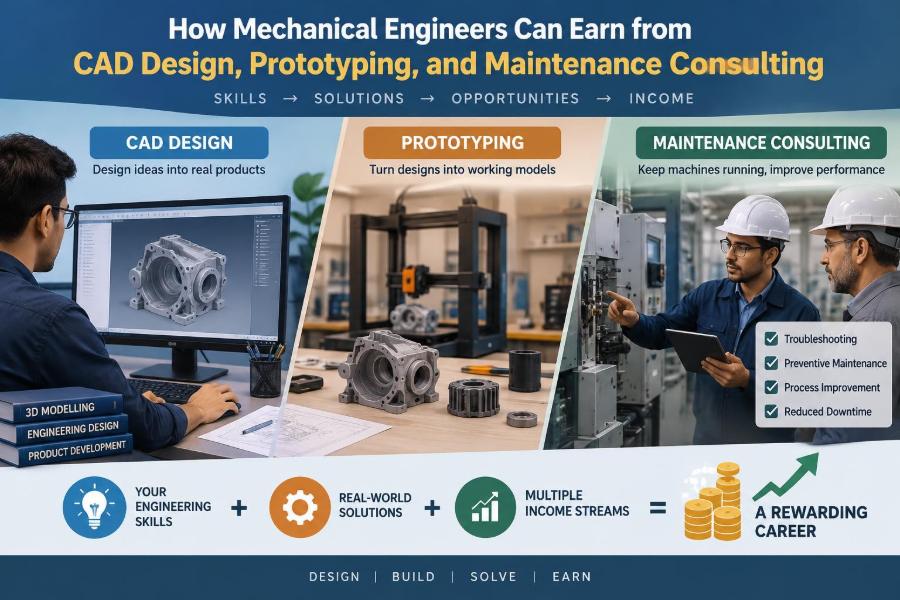
CAD design, prototyping, and maintenance consulting overlap, but they produce value differently. CAD work is usually a defined deliverable. Prototyping is an iterative learning process. Maintenance consulting often combines diagnosis, risk judgment, and implementation support.
| Service | What the client receives | Main commercial challenge |
|---|---|---|
| CAD design | Models, drawings, assemblies, and specifications | Avoiding unclear scope and revision loops |
| Prototyping | A testable physical concept and documented findings | Managing uncertainty, suppliers, and changing requirements |
| Maintenance consulting | Diagnosis, priorities, procedures, and recommendations | Working safely with incomplete operational data |
Many engineers start with CAD because it has lower equipment needs, then add prototype coordination and reliability-focused consulting as their experience and network grow.
🖥️ Sell CAD as Decision Support, Not Just Drafting
A 3D model is useful because it lets people check fit, motion, interfaces, manufacturing constraints, and assembly sequence before metal is cut. A drawing is useful because it tells a supplier what must be controlled.
When presenting CAD services, describe the decisions your work enables. For example, a fixture model can verify clamp access and tool clearance; an assembly drawing can reduce ambiguity between a designer and fabricator.
Software skill opens the door, but engineering judgment creates the value. A client may know how to sketch an idea. They hire an engineer to turn it into a component that can be made, assembled, and used safely.
📐 Build Models That Survive Change
Client requirements change. A supplier may substitute a bearing, a motor frame may change, or an enclosure may need an additional connector. Fragile CAD models turn small edits into expensive rebuilding.
Use clear datum strategy, meaningful feature names, sensible parameters, and organized assemblies. Keep purchased components separate from custom parts, and document critical interface dimensions.
Good model hygiene is commercially valuable because it makes revision work faster and reduces the chance that an old dimension quietly remains in a new drawing.
📏 Produce Drawings a Fabricator Can Actually Use
A visually impressive model is not automatically production-ready. Fabricators need material information, dimensions, tolerances where function requires them, finishes, thread callouts, weld information where applicable, and revision identification.
Do not add tight tolerances by habit. Unnecessarily restrictive tolerances can raise cost and slow sourcing. Instead, identify which dimensions control fit, motion, sealing, alignment, or safety, then specify those deliberately.
If a dimension does not establish function, inspection, or manufacturing intent, ask whether it belongs on the drawing at all.
🏭 Design for the Process That Will Make the Part
Design for manufacturability means shaping a part around a realistic process, not merely creating a valid solid model. A CNC-machined component, laser-cut bracket, molded housing, and welded frame each have different economical features.
Before finalizing work, speak with the intended manufacturer when possible. Ask about preferred stock sizes, bend radii, available tooling, minimum features, lead times, and inspection capability.
A hypothetical example: changing a deep internal pocket into two bolted plates may slightly increase part count but make machining faster and inspection easier. There is no universal answer; the better choice depends on volume, loading, assembly, and supplier capability.
🧾 Define CAD Deliverables in Writing
“Design a bracket” is not a complete scope. It leaves open whether the client expects one concept or three, models only or drawings too, supplier communication, revisions after fabrication, and responsibility for final fit.
A concise scope should identify:
- The problem and functional requirements supplied by the client
- Files to be delivered, including native and neutral formats if needed
- Number of design concepts and revision rounds
- Manufacturing assumptions and excluded services
- Acceptance criteria and expected client review points
This is not bureaucracy. It is how both sides understand what “finished” means.
🔍 Price the Uncertainty, Not Only the Drawing Time
Hourly billing can suit exploratory work, troubleshooting, and meetings where the effort cannot be predicted. Fixed fees can suit a well-defined package, such as a drawing set for a known assembly.
Whichever approach you use, account for requirement review, concept development, communication, checking, revisions, file preparation, and administration. A model that takes six hours to create may require several additional hours to make usable and reliable.
For uncertain work, use staged authorization: discovery first, then concept selection, then detailed design. This protects clients from committing to a large undefined project and protects engineers from unpaid scope growth.
🧪 Treat Prototyping as a Learning Service
A prototype is not necessarily a miniature final product. Its purpose may be to test grip comfort, mechanism travel, airflow, thermal behavior, assembly sequence, or user interaction.
The first question should be: What must this prototype teach us? That answer determines fidelity, material, manufacturing method, instrumentation, and budget.
A rough printed mechanism can test interference and movement. It cannot automatically validate fatigue life, production tolerances, or long-term environmental resistance. Clear limits prevent clients from treating an early prototype as final proof.
🧠 Select Prototype Fidelity Deliberately
Low-fidelity prototypes are quick representations used to explore geometry or workflow. Functional prototypes test selected performance characteristics. Engineering prototypes may use production-intent materials and interfaces to reduce technical risk before a larger build.
Higher fidelity is not always better. It costs more and can slow learning if the core question is still basic. Build only enough realism to answer the next decision.
For instance, if a team needs to verify whether a latch can be operated while wearing gloves, a simplified physical mock-up may provide better feedback than a detailed rendering.
🛠️ Match the Prototype Method to the Question
3D printing is excellent for rapid form, fit, and selected functional checks. Machining may be needed for tighter interfaces, stronger materials, or realistic surface conditions. Sheet-metal fabrication can reveal bend and assembly problems that a plastic mock-up hides.
Mechanical engineers can earn by helping clients avoid a common error: choosing a process for visual convenience rather than test relevance. Explain what each method can and cannot establish.
When outside suppliers are involved, compare quotations on more than price. Material certification, tolerance capability, finishing, inspection, lead time, and willingness to discuss design details can all affect prototype usefulness.
📋 Write a Test Plan Before Building
Without a test plan, teams often build something interesting and then debate what its result means. A simple plan creates discipline.
- State the question or requirement being examined.
- Identify the test condition and expected loads or environment.
- Decide what will be measured or observed.
- Define what result would support the next design decision.
- Record limitations and unexpected behavior.
This does not require laboratory complexity for every job. Even a basic fit-up test benefits from photographs, dimensions, observations, and a record of what changed.
🔄 Charge for Iteration Without Hiding It
Prototype work naturally involves iteration. The mistake is promising a finished solution when the project is fundamentally exploratory.
Separate the work into cycles: design, build, test, review, and decide whether another cycle is justified. Each cycle should have a budget boundary and a specific learning objective.
Clients tend to accept iteration when they can see why it is occurring. They resist it when revisions appear to be evidence that nobody defined the problem.
🧰 Build a Reliable Supplier Network
Few independent engineers need to own every machine. A dependable network of printers, machine shops, sheet-metal firms, welders, electronics specialists, and test providers expands what you can deliver.
Be transparent about your role. You may design and coordinate fabrication while the supplier manufactures under its own quotation and terms. Avoid presenting another company’s capabilities as your own.
Keep notes on each supplier’s strengths: fast low-volume work, precision machining, large weldments, finishing, or responsiveness to engineering questions. This turns procurement knowledge into a practical competitive advantage.
🔧 Enter Maintenance Consulting Through Familiar Equipment
Maintenance consulting is strongest when it is grounded in equipment you understand. Pumps, fans, gearboxes, conveyors, heat exchangers, rotating machinery, and utility systems each have distinct failure modes and operating context.
Begin with assets connected to your prior industry experience. A mechanical engineer who has worked around process pumps can offer more credible support there than generic advice across every plant system.
Maintenance work rewards observation. The original design intent matters, but so do operator practices, contamination, alignment, spare-part quality, process changes, and installation history.
🩺 Diagnose Before Prescribing a Fix
Repeated failure rarely has only one possible cause. A leaking seal may involve alignment, vibration, pressure excursions, dry running, contamination, incorrect installation, or an unsuitable seal arrangement.
Start with evidence: maintenance history, operating conditions, photographs, operator observations, inspection findings, and available vibration, temperature, or process data. Distinguish facts from assumptions in your notes.
A useful consultant does not simply recommend replacing the failed component with a more expensive version. They develop and test plausible causes until the client can choose a corrective action with reasonable confidence.
📊 Use Failure Analysis Without Overclaiming
Root cause analysis is a structured attempt to identify why an event occurred and what conditions allowed it. It is not a guarantee that every future failure can be eliminated.
Tools such as the “five whys,” fault trees, and cause-and-effect diagrams can organize thinking, but they do not replace physical evidence. A good report identifies the confidence level of each conclusion and names data that would reduce uncertainty.
This honesty matters in commercial work. Maintenance decisions often involve production risk, safety, and cost; clients need recommendations that are clear about both evidence and limitations.
⏱️ Prioritize Assets by Consequence
Not every machine deserves the same maintenance effort. A low-cost standby fan and a single-point-of-failure process pump should not automatically receive identical attention.
Asset criticality considers consequences such as personnel safety, environmental exposure, production interruption, repair lead time, product quality, and availability of redundancy. It helps a client focus resources where failure has the greatest impact.
Consulting value often comes from this prioritization. A long maintenance list is less useful than a ranked plan explaining what needs action now, what needs monitoring, and what can wait.
📅 Convert Reactive Work into Practical Plans
Reactive maintenance means repairs are triggered after failure. Preventive maintenance uses scheduled tasks. Predictive or condition-based maintenance uses evidence—such as trend data or inspections—to decide when intervention is needed.
No approach is automatically right. Calendar-based replacement can waste usable life, while sophisticated monitoring can be unjustified for simple, low-consequence equipment.
Build plans around failure modes. A bearing may need lubrication control, alignment checks, vibration trending, or contamination protection depending on how and why it tends to degrade in that service.
📈 Make Condition Monitoring Actionable
Vibration readings, temperature trends, oil analysis, ultrasound, and visual inspections can be useful only when they lead to a decision. Collecting data without alarm logic, baseline context, or response ownership creates false confidence.
For a small client, a disciplined inspection route and good records may be more valuable than a complex monitoring platform. For a critical rotating asset, specialist vibration analysis may be justified.
State what your data can support. A single elevated reading may warrant follow-up, but it does not necessarily prove a specific failure mechanism.
🦺 Respect Safety, Legal, and Professional Boundaries
Mechanical consulting can affect people, equipment, and facilities. Work within your demonstrated competence, follow site safety requirements, and escalate work requiring specialist review.
Depending on location and project type, certain designs, inspections, or reports may require review, approval, or stamping by an appropriately licensed professional engineer. Requirements vary, so do not assume that a general engineering background authorizes every service.
Be especially careful around pressure systems, lifting equipment, guarding, hazardous areas, structural modifications, and safety-critical controls. A freelance assignment is not a reason to bypass formal responsibility.
🗂️ Turn Field Observations into Useful Reports
A maintenance report should help someone act. Begin with the observed condition, then explain the likely implications, evidence, recommended action, priority, and any uncertainty.
Use photographs, annotated sketches, asset tags, and plain language. A maintenance supervisor may need technical detail, while a manager may first need a concise explanation of risk, downtime exposure, and next steps.
Separate immediate containment actions from long-term corrective work. This prevents urgent repairs from being mistaken for a permanent solution.
🤝 Find Clients Through Trust and Specificity
Early clients often come from professional contacts, local manufacturers, fabricators, maintenance contractors, product teams, and former colleagues who already understand your reliability.
Do not send a generic message saying you are available for “all mechanical engineering services.” Instead, describe a specific outcome: improving fabrication-ready drawings, organizing prototype builds, or investigating recurring equipment failures.
Case studies can help even when confidential. With permission and without revealing sensitive information, explain the initial constraint, your process, the deliverable, and what changed as a result.
🧑💼 Build a Portfolio That Shows Engineering Thinking
A portfolio should show more than polished renderings. Include problem statements, constraints, design choices, manufacturability considerations, test plans, drawing excerpts, and lessons learned.
If client work cannot be shown, create honest self-directed projects. For example, redesign a common workshop fixture, document material selection and load assumptions, then produce a manufacturing drawing and prototype review.
Clearly label conceptual work as conceptual. Misrepresenting an exercise as a deployed product damages trust before a conversation has even begun.
🗣️ Ask Better Questions During Discovery
The first client conversation determines whether you are solving the right problem. Technical questions should uncover function, interfaces, loads, environment, manufacturing volume, schedule, budget limits, and what “success” looks like.
For maintenance assignments, ask what changed before the issue appeared: operating conditions, product, personnel, supplier, installation, control settings, or maintenance practice. Changes often provide the best starting clues.
Listen for unstated constraints. A client who says “make it stronger” may actually need less deflection, longer fatigue life, easier assembly, or fewer field adjustments.
🚫 Avoid the Most Expensive Early Mistakes
New engineering service providers commonly under-scope work, accept vague requirements, deliver files without revision control, or begin fabrication before interfaces are verified. These mistakes create rework and weaken client confidence.
- Do not promise performance you have not analyzed or tested.
- Do not treat supplier capability as an afterthought.
- Do not bury assumptions inside CAD files or personal notes.
- Do not allow unlimited “small changes” after approval.
- Do not issue safety-sensitive advice beyond your authority or competence.
A careful boundary is not a barrier to service. It is part of professional service.
💳 Protect Cash Flow and Intellectual Property
Independent work involves commercial discipline as well as technical skill. Use written proposals, payment terms, change procedures, and a clear statement of ownership and permitted use of deliverables.
For longer projects, milestone billing can align payment with completed stages such as concept approval, detailed design release, or prototype delivery. Keep records of approvals and decisions; they are useful when memories differ later.
Confidential drawings, customer data, and supplier quotations should be handled carefully. Store files securely and clarify whether the client expects a confidentiality agreement before detailed discussions begin.
📚 Keep Expanding Technical Credibility
Clients notice whether an engineer understands current manufacturing methods, materials, tolerancing practice, maintenance systems, and relevant standards. Learning should be connected to the work you want to win.
That may mean improving geometric dimensioning and tolerancing, studying reliability-centered maintenance concepts, learning a simulation tool’s limitations, or spending time in fabrication shops to understand real process constraints.
Credentials can support credibility, but they do not replace a record of clear thinking, careful documentation, and dependable delivery.
🌱 Create Offers That Can Grow with You
A sustainable practice often develops in layers. A small CAD review can lead to detailed drawings. Drawings can lead to prototype coordination. Prototype work can reveal installation and maintenance needs.
Package recurring needs where appropriate: monthly drawing support for a fabricator, periodic reliability reviews for a facility, or a defined prototype-development sprint for product teams. Repeatable offers reduce the effort required to explain every engagement from scratch.
Growth should not mean accepting work outside your capacity. Standard templates, checklists, trusted subcontractors, and disciplined project selection are safer ways to scale.
🎯 Measure Value Beyond the Invoice
Revenue matters, but long-term demand comes from work that clients can recognize as useful. Did the drawing reduce supplier questions? Did the prototype answer a decision? Did the maintenance plan prevent repeated emergency work?
After each project, review what consumed time, what caused revisions, what assumptions failed, and what the client valued most. This feedback improves both your engineering process and your pricing.
The strongest referrals usually follow work that was technically sound, easy to use, and delivered with fewer surprises than the client expected.
🏁 Build an Engineering Practice Around Useful Outcomes
CAD design, prototyping, and maintenance consulting are not separate worlds. They are connected by the same engineering habit: translate a real need into evidence, decisions, and practical action.
CAD earns when it makes a product or component manufacturable. Prototyping earns when it reduces uncertainty before a costly commitment. Maintenance consulting earns when it helps a team understand, prioritize, and reduce operational problems.
Start narrow, document carefully, communicate assumptions, and let each successful assignment demonstrate the next service you can credibly offer.
The most durable opportunity for a mechanical engineer is not selling software time—it is becoming the person who turns physical problems into workable, well-documented decisions. ⚙️🛠️📈