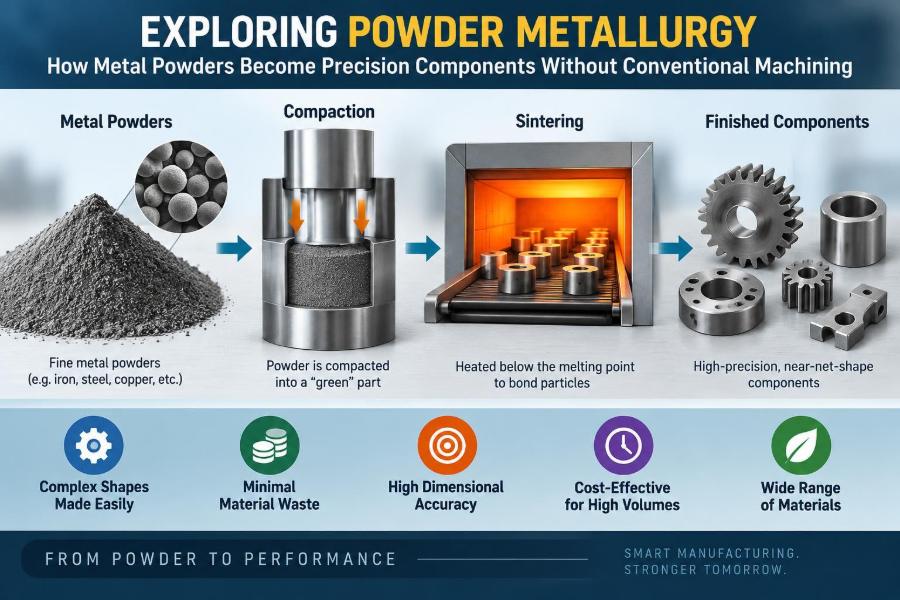

A vehicle transmission shifts smoothly, a cordless drill delivers torque, and a compact medical device performs repeatedly—all with parts that may have begun as loose metal powder. The finished components can look ordinary: a gear, a bushing, a cam, or a structural bracket.
What is less obvious is that many of these parts were not carved from a solid bar by cutting tools. Instead, their material was measured, blended, pressed into shape, and heated until its particles bonded together.
This route, called powder metallurgy, can turn near-net-shape manufacturing into a practical production method. It reduces some machining, uses material efficiently, and enables controlled porosity that conventional machining cannot simply create.
It is not a universal replacement for casting, forging, or machining. Its real value appears when component geometry, production volume, material behavior, and performance requirements all fit the process.
🔩 What Powder Metallurgy Means
Powder metallurgy, often shortened to PM, is a family of manufacturing processes in which metal powders are formed and consolidated into useful parts. The classic route is powder production, blending, compaction in a die, and sintering in a controlled furnace.
Sintering heats a compact to a temperature below the main metal’s melting point. Atoms diffuse across contacting particles, creating bonded necks and progressively stronger connections.
The phrase “without conventional machining” needs a careful qualification. PM often creates a part close to its final dimensions, but secondary operations such as sizing, drilling, grinding, heat treatment, or surface finishing may still be necessary.
🧭 Why Engineers Choose the Powder Route
The central attraction is near-net-shape production: the press tool establishes much of the external geometry before sintering. This can avoid turning a large fraction of expensive stock into chips.
PM is particularly compelling for repeat production of relatively small components with features compatible with pressing. A gear blank, latch part, or automotive hub may need only limited finishing after its initial forming.
It also offers an unusual design variable: density. Engineers can deliberately preserve interconnected pores for an oil-retaining bearing, or apply additional densification when greater strength is required.
🌾 Metal Powder Is an Engineered Raw Material
A metal powder is not merely metal broken into small pieces. Particle size, shape, surface condition, chemistry, internal porosity, and size distribution all influence how it flows, packs, presses, and sinters.
For example, roughly spherical particles often flow readily into a die, while irregular particles can interlock more effectively and may provide greater green strength. Neither form is automatically better; the required filling behavior and final properties decide.
Powder suppliers characterize these attributes carefully because variation in feedstock can become variation in part mass, density, dimensions, and mechanical response.
🏭 Common Ways Metal Powders Are Made
Different powder-making methods produce different particle forms and cost structures. Selection begins with the alloy, purity requirement, production scale, and downstream process.
- Atomization breaks a molten metal stream into droplets using gas or water; the droplets solidify into powder.
- Reduction removes oxygen from metal oxides, commonly producing porous or irregular particles.
- Electrolytic deposition grows metal that can be removed and milled into powder.
- Mechanical milling fractures or blends solids and can create specialized alloyed powder mixtures.
- Carbonyl processing forms and decomposes a volatile metal compound, producing very fine powder for suitable metals.
Water-atomized powder is often irregular, whereas gas atomization commonly produces more spherical particles. Those tendencies affect handling but do not alone determine a powder’s suitability.
📏 Particle Size Distribution Controls Packing
A powder batch contains a range of particle sizes rather than perfectly identical grains. This distribution affects how smaller particles occupy spaces between larger ones and therefore affects apparent density and compaction behavior.
Fine powder can improve detail and increase contact area for sintering, but it may flow poorly, oxidize more readily, and create dust-management concerns. Coarser powder generally flows more easily but may limit fine features.
Engineers balance these effects rather than pursuing the smallest possible particle. Consistent behavior from lot to lot is often as valuable as an ideal laboratory result.
🧪 Blending Builds the Required Chemistry
Before pressing, manufacturers blend base powder with alloying additions, lubricants, and sometimes graphite or other constituents. The aim is a homogeneous feedstock so each compact receives comparable composition and pressing behavior.
In iron-based PM steels, graphite is often mixed with iron powder to supply carbon during sintering. Elements may be pre-alloyed into particles, added as separate powders, or introduced by diffusion-bonded approaches.
Blending must avoid segregation. If powders of dissimilar size, shape, or density separate during transport or filling, one region of a part can receive a different composition or density from another.
🧴 Why Lubricants Are Added
Lubricant in the powder mix reduces friction between particles and against the die wall during compaction and ejection. Lower ejection force helps protect the compact, tooling, and press.
The lubricant is useful during pressing but undesirable in the final metal. Early in sintering, it must be removed in a controlled manner so gases escape without cracking, blistering, or leaving harmful residue.
Too little lubricant can cause high tool wear and ejection damage. Too much can lower green strength and leave more volume that must be removed during heating.
⬇️ Die Filling Sets Up Dimensional Consistency
In conventional press-and-sinter PM, a feed shoe delivers a measured charge into a die cavity. The powder must fill corners and narrow regions consistently before punches apply pressure.
Poor flow can create local mass differences, especially in shapes with thin walls, deep steps, or abrupt changes in section. Those differences become density differences after compaction and can later produce uneven shrinkage or strength.
This is why a seemingly simple question—“Will the powder fill the tool?”—is fundamental to practical part design. Geometry must suit both the finished component and the path taken by loose powder.
🧱 Compaction Turns Loose Powder into a Green Part
Upper and lower punches compress the filled die. Particles rearrange, deform at contact points, and mechanically interlock, producing a fragile but handleable component called a green compact.
Its shape resembles the final part, but it is not yet metallurgically bonded. Green strength must be sufficient for ejection, handling, and furnace loading without chipped edges or cracks.
Pressing pressure is substantial, but it cannot be treated as a simple “more is better” setting. Excessive pressure can increase tool loading, complicate ejection, and still fail to eliminate density gradients in a complex part.
📐 Density Gradients Are a Central Design Challenge
Pressure is transmitted through powder imperfectly because particles and die walls create friction. Regions closer to punches may compact differently from distant regions, particularly in tall or complex shapes.
Density influences strength, permeability, dimensional change, and fatigue behavior. A local low-density zone can become the governing weakness even when the average part density appears acceptable.
Using multiple punches, double-action pressing, optimized fill, and geometry changes can improve uniformity. Engineers also use simulation and trial measurements to identify difficult areas before committing to high-volume tooling.
🚪 Ejection Can Damage an Otherwise Good Compact
After pressing, the green compact must slide out of the die without cracking or scuffing. Radial forces against the die wall and friction during movement make ejection a critical step.
Sharp corners, long straight walls, insufficient draft where appropriate, and abrupt section changes can raise the risk. A compact may survive visual inspection yet contain small defects that open further in sintering.
Tool surface condition, lubrication, press alignment, and ejection speed all matter. Successful PM manufacture depends as much on controlled movement as on the peak compaction load.
🔥 Sintering Creates Metallurgical Bonds
Green compacts travel through a furnace with carefully managed temperature zones and atmosphere. After lubricant removal, the main sintering stage allows atoms to diffuse across particle boundaries.
At first, tiny necks grow where particles touch. With time and temperature, those connections enlarge, pores change shape, and the compact gains strength and integrity without fully melting like a casting.
The furnace cycle must fit the alloy and part. Temperature, time, heating rate, cooling rate, and atmosphere interact; changing one can alter carbon content, microstructure, dimensions, or oxide condition.
🌬️ Furnace Atmosphere Protects the Material
Hot metal surfaces react readily with oxygen and other reactive species. Sintering atmospheres are selected to limit harmful oxidation and, where needed, control chemical reactions at the part surface.
Hydrogen-containing, nitrogen-based, endothermic, vacuum, and inert-gas environments may be used depending on material and process. Each route has operational and safety implications, especially where flammable gases or oxygen-deficient environments are possible.
Atmosphere control is not a cosmetic detail. Oxides at particle contacts can obstruct diffusion and weaken bonding, while unintended carbon transfer can shift the properties of steel components.
🕳️ Porosity Is Often Designed, Not Accidental
Conventional PM parts usually retain some porosity after sintering. This distinguishes them from fully dense wrought metal and explains both their capabilities and their limitations.
In a self-lubricating bronze or iron bearing, interconnected pores are impregnated with oil. During operation, heat and motion help bring lubricant to the bearing surface; at rest, oil can be drawn back into the pore network.
For a load-bearing gear, however, pores can reduce fatigue resistance and provide pathways for corrosion or leakage. The desired pore structure depends entirely on function.
🛢️ Self-Lubricating Bearings Show PM at Its Best
A porous bearing is a clear example of process and product working together. Rather than treating pores as defects, the design uses them as a reservoir for lubricant.
These bearings can be useful where routine relubrication is impractical, where a compact assembly is preferred, or where quiet sliding motion matters. Load, speed, temperature, shaft finish, and lubricant compatibility still determine whether they are appropriate.
They are not substitutes for every rolling-element bearing or heavily loaded hydrodynamic bearing. Their advantage comes from the combination of controlled porosity and a suitable duty cycle.
⚖️ Density, Strength, and Ductility Move Together
As density rises, load-bearing metal area generally increases and pores become fewer or smaller. Strength and stiffness often improve, while permeability falls.
But a high-density target can increase processing cost and may require special pressing, warm compaction, repressing, sinter-forging, or infiltration. It can also narrow the process window for a difficult geometry.
Designers should compare required properties with properties demonstrated for the actual PM grade and route. Assuming that a generic powder-metal part performs like wrought bar stock is a common and potentially costly error.
🧩 Secondary Operations Refine the Near-Net Shape
PM reduces machining; it does not prohibit it. The most effective production plans reserve secondary operations for features that truly need them.
- Sizing represses a sintered part to improve dimensions and roundness.
- Coining applies higher localized deformation to sharpen features or increase density.
- Machining creates cross-holes, threads, undercuts, or tight-tolerance surfaces.
- Impregnation fills pores with oil, resin, or another material for a functional purpose.
- Heat treatment and finishing tailor hardness, wear resistance, corrosion behavior, or surface appearance.
The economic question is not whether any machining remains. It is whether the total route uses less time, material, and handling than an alternative route.
🔧 Which Shapes Are Press-Friendly
Classic die compaction works best when punches can move in and out along a consistent pressing axis. Through-holes parallel to that axis, steps, flats, hubs, and many gear forms can be practical.
Features such as transverse holes, re-entrant geometry, severe undercuts, and side projections may require complex tooling or a secondary process. A designer accustomed to CNC machining may need to rethink feature orientation.
A useful early question is: Can each tool element withdraw without trapping the part? If not, redesign, assembly, machining, or an alternative PM process may be needed.
🧮 Tolerances Depend on the Entire Process Chain
Dimensional variation begins with fill mass and compaction density, then continues through sintering shrinkage or growth, cooling, heat treatment, and any finishing. A tool dimension is not automatically the final part dimension.
Manufacturers establish process-specific capability through development and production evidence. It is risky to specify very tight tolerances broadly across a PM component when only a few functional surfaces truly require them.
Good drawings distinguish critical fits from noncritical dimensions. That lets the supplier apply sizing, grinding, or inspection effort where it has engineering value.
🧱 Material Families Used in PM
Iron and steel powders dominate many structural PM applications, including gears, sprockets, lock components, and automotive mechanisms. Copper-based powders are familiar in bearings and electrical applications.
Stainless steels, nickel alloys, titanium, aluminum, refractory metals, and magnetic materials also appear in powder-based manufacturing. Their processing windows differ significantly because oxide behavior, reactivity, melting range, and sintering mechanisms differ.
Not every alloy that can be made as powder can be economically pressed and sintered by the conventional route. Material selection must include manufacturability, not merely target chemistry.
🌡️ Heat Treatment Still Matters
A sintered steel component may be heat treated to develop a harder or stronger microstructure. Carburizing, quenching and tempering, steam treatment, nitriding, and other routes can be considered when compatible with the alloy and pore structure.
Porosity changes thermal response and may allow treatment media to penetrate differently than in dense steel. Distortion, dimensional change, and surface chemistry must therefore be evaluated for the actual component.
Heat treatment cannot fully compensate for an unsuitable density level or a poorly designed load path. It should be part of a coordinated material-and-process decision.
🆚 Powder Metallurgy Compared with Machining and Casting
| Route | Strong fit | Typical trade-off |
|---|---|---|
| Press-and-sinter PM | High-volume, compact near-net shapes; controlled porosity; low scrap | Geometry and density constraints; dedicated tooling |
| Machining from bar or plate | Flexible geometry, prototypes, tight localized features | More material removal and cycle time for many shapes |
| Casting | Complex larger shapes and internal cavities | Solidification defects, finishing needs, and different tolerance behavior |
| Forging | High-integrity shapes with favorable grain flow | Tooling, flash or machining, and shape limitations |
No row is “best” in isolation. Annual volume, part size, alloy cost, strength demand, geometry, and the cost of downstream work determine the sensible choice.
➕ Additive Manufacturing Is a Different Powder Process
Metal additive manufacturing also begins with powder, but it builds shapes layer by layer rather than filling and pressing a rigid die. This enables internal channels and geometries that conventional compaction cannot form.
Its powder requirements, equipment, build rate, post-processing needs, and defect risks are different. Confusing additive manufacturing with press-and-sinter PM can lead to unrealistic assumptions about cost or design freedom.
Both technologies illustrate why powder is valuable, but they solve different manufacturing problems. Conventional PM commonly favors repeatable volume; additive methods often justify themselves through geometric complexity or low-volume flexibility.
💰 Tooling Cost Changes the Volume Equation
Compaction dies, punches, and supporting tooling require precision and investment. A simple part may justify that investment quickly in repeat production, while a low-volume or frequently changing part may not.
Part consolidation can improve the equation. If a PM design replaces several machined pieces and assembly steps with one pressed component, the value may extend beyond reduced material waste.
Early collaboration matters because a modest geometry change can simplify a tool dramatically. Waiting until a drawing is frozen can turn a manageable PM proposal into an expensive one.
🧯 Powder Handling Requires Real Safety Discipline
Fine metal powders can create inhalation, skin-contact, ignition, dust-explosion, or reactivity hazards depending on their composition and particle size. Some materials demand particularly stringent controls.
Safe facilities use appropriate containment, housekeeping, grounding, ventilation, ignition control, personal protection, and documented procedures. The correct approach depends on the material’s safety data and the specific process equipment.
Never treat metal powder like harmless workshop dust. Process engineers and operators must follow site rules and applicable safety requirements rather than relying on generic advice.
🔍 Inspection Looks Beyond Overall Dimensions
A PM quality plan may check part mass, density, dimensions, hardness, chemistry, microstructure, pore distribution, and mechanical properties. The right set of checks follows the component’s function and failure risks.
For example, a bearing may need confirmation of pore volume and oil impregnation behavior, while a transmission part may prioritize density consistency, tooth geometry, hardness profile, and fatigue-related validation.
Non-destructive methods can help detect cracks or density anomalies, but their sensitivity depends on material, geometry, and defect type. Destructive sectioning remains valuable during development and troubleshooting.
⚠️ Common Design Mistakes to Avoid
Many PM difficulties originate in requirements rather than in the press. The following mistakes are especially common when a component is converted from another manufacturing route.
- Specifying wrought-material properties without accounting for residual porosity.
- Adding cross-holes or undercuts that require costly side actions or machining.
- Demanding tight tolerances everywhere instead of identifying functional surfaces.
- Ignoring density variation caused by tall sections or unequal punch travel.
- Choosing PM for a volume too low to support dedicated tooling.
- Assuming that sintering will repair cracks, segregation, or poor die fill.
The remedy is not simply more process control. It is design-for-manufacture discussion early enough to change the part intelligently.
🛠️ A Practical PM Design Checklist
Before selecting powder metallurgy, define the load case, environment, service life, allowable porosity, critical dimensions, annual quantity, and acceptable secondary operations. These inputs reveal whether the process is a genuine fit.
Then review geometry with a PM specialist: pressing direction, tool withdrawal, wall changes, holes, chamfers, density-sensitive regions, and inspection access all deserve attention.
Prototype evidence should represent the intended route as closely as possible. A machined prototype can validate function, but it may not reveal density gradients, pore-related behavior, or sintering distortion in the future PM part.
🌱 Material Efficiency and Sustainability Context
PM can be materially efficient because much of the powder enters the part rather than becoming machining chips. That benefit is most meaningful when powder yield, rejected parts, energy use, alloy recycling, and secondary processing are considered together.
Powder production and high-temperature furnaces consume energy, while some powders require careful recovery and handling. A sustainability comparison should examine the full manufacturing route rather than assuming that low scrap alone settles the question.
Where it fits well, near-net-shape PM can reduce downstream machining and transport of excess material. Where it does not, forcing the process may create waste through rejects or extensive finishing.
🚀 Advanced Routes Expand What Powder Can Do
Conventional press-and-sinter remains widely used, but advanced approaches extend the range of density, shape, and material performance. Warm compaction improves powder compressibility through controlled heating; isostatic pressing applies pressure more uniformly from multiple directions.
Metal injection molding blends fine powder with a binder, injects it into complex molds, then removes binder and sinters the part. Hot isostatic pressing and sinter-forging can drive density higher for demanding applications.
These methods bring their own equipment, cycle-time, shrinkage-control, and cost considerations. “Powder metallurgy” describes a broad toolbox, not one fixed process.
🎯 The Core Principle: Design the Process into the Part
Powder metallurgy succeeds when engineers treat powder behavior, pressing direction, density, sintering, and finishing as part of the product design. The component is not simply a conventional machined shape made by a cheaper route.
Its strongest opportunities are repeatable near-net shapes, efficient material use, purposeful porosity, and production-scale consistency. Its constraints are equally real: specialized tooling, geometry limits, residual pores, and process-dependent properties.
The most useful decision is therefore not “Can this be made with PM?” but “Does PM produce the required performance and total cost with fewer compromises than the alternatives?”
Powder metallurgy turns metal particles into precision components by controlling every stage—from powder characteristics and compaction to sintering and finishing—so the process becomes a deliberate part of engineering design. ⚙️🔥