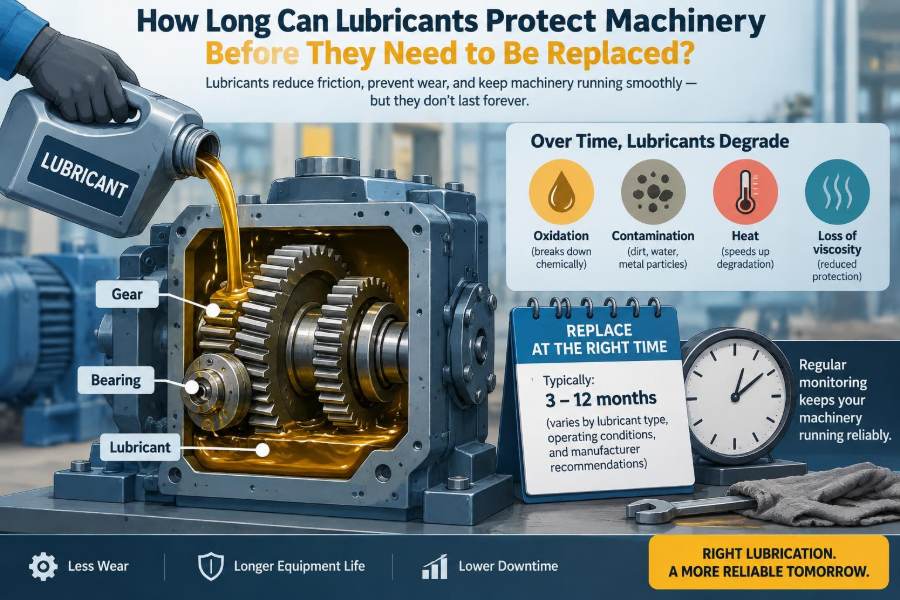

A gearbox runs smoothly for months, then begins to whine. A bearing that once stayed cool now feels warmer during routine checks. Nothing may look obviously wrong, yet friction is quietly increasing inside the machine.
In many cases, the lubricant is still present. That does not necessarily mean it is still protecting the surfaces it was selected to protect.
Lubricants do not have one universal expiry date. Their useful life depends on the machine, load, temperature, contamination, lubricant chemistry, and maintenance practices. A calendar-only oil change can waste good lubricant, while an overdue change can turn a manageable maintenance task into damaged gears, bearings, or hydraulic components.
The practical question is not simply, “How old is the oil?” It is: can this lubricant still form the right protective film, carry heat, resist contamination, and perform its assigned functions?
🛢️ What “Lubricant Life” Actually Means
Lubricant life is the period during which an oil or grease remains fit for its intended service. In that period, it must retain enough of its viscosity, additive performance, cleanliness, and physical stability to protect components.
For circulating oil, this may mean separating moving metal surfaces, removing heat, and transporting contaminants to a filter. For grease, it also means holding oil in the contact zone while remaining mechanically stable and resistant to washout.
A lubricant can reach the end of its useful life long before it disappears, leaks out, or changes color dramatically.
⚙️ The Basic Job of a Lubricant Film
At the most basic level, lubricant reduces direct contact between surfaces that move relative to one another. A shaft journal, rolling-element bearing, gear tooth, or hydraulic pump component ideally rides on a thin fluid film.
When speed, viscosity, and geometry support a full film, this is often called hydrodynamic or elastohydrodynamic lubrication. In heavily loaded contacts, the film can be extremely thin but still separate the surfaces.
At low speed, high load, or during starts and stops, some surface contact may occur. Additives then become especially important because they form protective boundary layers on the metal.
⏳ Why There Is No Universal Replacement Interval
Two identical drums of oil can have very different service lives after filling. One may operate in a clean, temperature-controlled compressor room; the other may serve a dusty outdoor gearbox exposed to heat, moisture, and frequent load shocks.
Manufacturer guidance is a sensible starting point, but it is not a universal prediction. It usually assumes particular operating conditions, lubricant types, filtration arrangements, and maintenance procedures.
Use fixed intervals where the risk is low and operating conditions are stable. Use condition data where equipment is critical, lubricant volume is large, or the operating environment changes substantially.
🌡️ Temperature: The Main Accelerator of Aging
Heat accelerates oxidation, a chemical reaction between lubricant and oxygen. Oxidation can increase viscosity, create acidic by-products, form varnish or sludge, and consume additives.
Localized temperatures matter as much as bulk sump temperature. A bearing contact, gear mesh, or hydraulic valve may experience brief hot spots that are much hotter than the temperature shown on an external gauge.
Consistently high temperature is therefore both a lubricant-life issue and a machine-health clue. It may point to overload, poor cooling, incorrect viscosity, excessive friction, or restricted flow.
🔥 What Oxidation Does Inside Oil
Oxidation gradually changes base oil molecules into heavier and more reactive compounds. Early changes may be invisible, but over time the oil may darken, thicken, and develop deposits.
In turbines and hydraulic systems, oxidation by-products can contribute to sticky varnish on close-tolerance components. In gearboxes, thicker oxidized oil can impair flow and increase churning losses.
Antioxidant additives delay this process, but they are sacrificial. Once they are significantly depleted, the remaining oil can deteriorate faster than it did early in service.
💧 Water Is More Than a Rust Problem
Water can enter through damaged breathers, condensation, faulty seals, washdown, cooling leaks, or poorly stored containers. Even small quantities can reduce lubricating performance in sensitive contacts and promote corrosion.
Free water can make oil appear cloudy or milky. Dissolved water may not be visible, yet it can still contribute to oxidation and additive depletion.
In rolling bearings, water is especially unwelcome because corrosion pits can become stress raisers. Under repeated loading, those small defects can develop into fatigue damage.
🌪️ Particles Turn Lubricant into an Abrasive
Dirt, wear debris, fibers, and process dust can circulate through a lubricated system. Hard particles may scratch surfaces, interfere with close clearances, and create new wear particles in a self-reinforcing cycle.
The size of contamination matters. Particles near the thickness of the lubricating film can be particularly damaging because they are more likely to enter loaded contacts.
A fresh oil change does not solve a contamination problem if the breather, seals, transfer equipment, or filter system remains ineffective. Clean oil must stay clean after it enters the machine.
🧪 Additives Have a Finite Working Reserve
Modern lubricants are formulated packages, not merely refined base oil. Additives may provide antiwear protection, extreme-pressure performance, corrosion resistance, foam control, demulsibility, oxidation resistance, or detergency.
Some additives are consumed while doing their job. Others can settle, react with contaminants, or become less effective as the lubricant ages.
This is why two oils with similar viscosity can have different remaining serviceability. Viscosity alone cannot reveal whether the lubricant still has enough functional additive reserve.
📏 Viscosity Must Stay in the Right Range
Viscosity is a fluid’s resistance to flow. It strongly influences film thickness, pumping behavior, heat generation, and leakage. It is one of the first properties engineers consider when selecting an oil grade.
Oil that becomes too thin may not maintain an adequate film under load. Oil that becomes too thick may circulate poorly, increase drag, and starve remote or cold components.
Viscosity can change because of oxidation, thermal cracking, fuel dilution, mixing with another lubricant, shear of viscosity modifiers, or contamination. The direction of change helps guide diagnosis.
🧯 Grease Ages Differently from Oil
Grease consists of base oil held within a thickener structure, usually with additives. It does not simply “wear out” in the same way as circulating oil because its ability to stay in place is part of its function.
Mechanical working can soften some greases or cause oil separation. High temperatures can harden grease, while water exposure may wash it away or alter thickener behavior.
For grease-lubricated bearings, the replacement question is often about relubrication quantity and frequency rather than a complete drain interval. Too little grease risks starvation; too much can cause churning and heat.
🔄 Base Oil Chemistry Changes Expected Life
Mineral oils, synthetic hydrocarbons, esters, polyglycols, and other base stocks differ in oxidation stability, low-temperature flow, compatibility, and water-handling behavior. “Synthetic” does not mean indefinite life, but an appropriate synthetic may tolerate demanding conditions better than a conventional alternative.
Selection must match the application. Some synthetic lubricants have compatibility limitations with seals, paints, or other lubricants, and certain chemistries should not be mixed.
The correct comparison is not simply mineral versus synthetic. It is whether a specific approved formulation meets the machine’s operating demands and maintenance strategy.
🏭 Operating Load Changes the Demand on Lubricant
High load raises contact stress and makes boundary or mixed-film conditions more likely. Shock loads in crushers, presses, conveyors, and heavily loaded gear drives can also place greater demand on extreme-pressure and antiwear additives.
Repeated starts, reversals, and slow-speed operation may be harder on a lubricant film than steady operation at a moderate load. A machine that runs fewer hours is not automatically easier on its lubricant.
Maintenance plans should account for how the machine is used, not just its total running time.
🏁 Starts, Stops, and Long Idle Periods Matter
During startup, lubricant may not yet have reached every contact at its normal operating flow or pressure. This is when boundary additives and correct viscosity are particularly valuable.
Long idle periods create different risks. Temperature cycling can draw moist air into a reservoir, allowing condensation to form. Sediment may settle, and protective films can be disturbed by corrosion.
Standby equipment needs preservation practices, periodic checks, and sometimes circulation or rotation programs. It should not be assumed ready merely because it has not accumulated operating hours.
🌬️ Breathers and Seals Control the First Line of Defense
Every reservoir that “breathes” can exchange air with its surroundings as temperature and fluid level change. A basic vent may allow dust and humid air to enter, especially in harsh environments.
Appropriate desiccant breathers, well-maintained seals, and clean filling points reduce the contamination burden before filters must deal with it. These small components can influence lubricant life significantly.
Inspect them as functional reliability parts, not as accessories. A clogged breather can also create pressure problems that encourage leaks or seal damage.
🧹 Filtration Extends Life Only When It Fits the System
Filters remove particles, but their effectiveness depends on location, flow, media rating, pressure-drop limits, and maintenance. A filter that is bypassing, overloaded, or installed only on a partial flow path may provide less protection than expected.
Offline “kidney-loop” filtration can continuously clean reservoir oil independently of machine operation. It can be useful for systems with large reservoirs or difficult duty cycles.
Filtration cannot restore oxidized oil or replace depleted additives. It is a contamination-control tool, not a cure for every lubricant failure mode.
🧫 Oil Analysis Makes Replacement Decisions More Defensible
Used-oil analysis examines a sample for properties that indicate lubricant condition, contamination, and machine wear. It changes the question from “Has the calendar date arrived?” to “What is occurring inside this system?”
Typical tests may assess viscosity, water, particle levels, oxidation indicators, acid or base trends where applicable, elemental metals, and additive-related elements. The most useful interpretation compares results over time.
One sample is a snapshot. A sequence of properly collected samples is a trend, and trends usually provide better maintenance evidence.
🧷 Sampling Quality Determines Data Quality
A sample taken from the bottom drain may mostly represent settled debris and water rather than circulating oil. A sample drawn immediately after topping up can be diluted and unrepresentative.
Whenever feasible, collect from a live, turbulent zone downstream of components and upstream of filtration, following the site’s approved sampling arrangement. Use clean bottles and label the sample accurately.
- Sample at a consistent operating condition and location.
- Record lubricant product, service hours, top-up volume, and recent maintenance.
- Investigate unusual results before assuming the laboratory result alone identifies the cause.
📈 Trends Are More Useful Than Isolated Limits
Alarm limits are helpful screening tools, but a value within a broad limit can still be concerning if it has shifted sharply from the machine’s normal baseline. Conversely, a slightly unusual value may be stable and explainable for that design.
For example, rising iron may indicate wear, but the source could be gears, bearings, corrosion, or recently disturbed deposits. Context from vibration, temperature, inspections, and operating history matters.
Condition monitoring works best when multiple observations agree. It is a decision process, not a single laboratory number.
🧭 Three Practical Replacement Strategies
Organizations generally use time-based, condition-based, or reliability-centered approaches. Each can be appropriate depending on equipment criticality and available resources.
| Strategy | Best fit | Main limitation |
|---|---|---|
| Fixed interval | Simple, low-risk equipment with stable service | May discard usable lubricant or miss severe conditions |
| Condition-based | Critical equipment or expensive lubricant volumes | Requires sound sampling and interpretation |
| Reliability-centered | Plants integrating risk, failure consequences, and monitoring | Needs stronger asset data and maintenance discipline |
A practical program often combines them: a maximum time limit, routine inspections, and earlier intervention when condition data indicates deterioration.
🚜 Application Differences Are Significant
Engine oils face combustion by-products, fuel dilution risks, and soot handling demands. Hydraulic oils prioritize clean, stable fluid for close-tolerance valves and pumps. Gear oils require strong protection in loaded tooth contacts.
Turbine oils may operate for long periods when kept cool and clean, but oxidation and varnish control can be central concerns. Food-grade lubricants introduce additional approval and contamination-control requirements.
Never transfer an interval from one machine type to another simply because both use “oil.” Function and failure modes determine the maintenance plan.
🧰 A Hypothetical Gearbox Comparison
Consider two similar conveyor gearboxes. Gearbox A runs indoors at steady load, has effective seals, and receives filtered top-up oil. Gearbox B operates near washdown, sees frequent starts, and has a damaged breather.
Even if both were filled on the same day, Gearbox B is more likely to accumulate water and contamination and experience additive stress. Its lubricant may require corrective action much earlier.
The lesson is not to guess a shorter interval. It is to repair the entry path, verify oil condition, and then establish an interval supported by actual operating evidence.
🔍 Signs That Call for Investigation
Color alone is unreliable because some oils darken normally in service. However, several observations together can justify prompt examination.
- Persistent temperature increase or unusual noise
- Cloudiness, visible sediment, foam, or strong burnt odor
- Frequent filter blockage or rising filter differential pressure
- Leaks, emulsified oil, or evidence of water ingress
- Abnormal vibration, wear debris, or changed operating behavior
These are not automatic instructions to change oil. They are signals to identify the mechanism causing the change.
🚫 Common Mistake: Changing Oil Without Fixing the Cause
Replacing degraded oil can temporarily improve conditions, but it does not correct overheating, a coolant leak, poor filtration, worn seals, or incorrect lubricant selection. The replacement charge may deteriorate quickly for the same reason.
Before draining, ask what changed and whether the machine needs repair. Retain a sample of the old oil when practical; it may provide useful diagnostic evidence.
A drain-and-fill should be a maintenance action with a purpose, not a substitute for diagnosis.
⚠️ Common Mistake: Mixing Products Casually
Mixing oils can alter viscosity, additive balance, air-release behavior, and water separation. Mixing greases is particularly risky because incompatible thickeners can soften, harden, or separate unpredictably.
Compatibility charts and supplier guidance can inform a decision, but they do not replace machine-builder approval where required. When changing lubricant families, flushing and transition procedures may be necessary.
Clearly labeled storage, dedicated transfer containers, and color-coded equipment help prevent accidental cross-contamination.
🧪 Common Mistake: Treating Additives as a Universal Rescue
Aftermarket additives are sometimes promoted as solutions for wear, heat, or extended drain intervals. Their effects depend on the original formulation and application, and they can disrupt a balanced lubricant package.
Use only additives explicitly approved by the equipment manufacturer or lubricant supplier for that service. A suspected lubricant deficiency should first prompt a review of the specified product, condition data, and operating problem.
More chemistry is not automatically more protection.
🛠️ Building a Better Lubrication Program
An effective program begins by identifying critical assets, approved lubricants, fill quantities, operating conditions, and failure consequences. It then sets clear tasks for storage, transfer, inspection, sampling, filtration, relubrication, and response to abnormal results.
Useful practices include:
- Store containers sealed, dry, and clearly identified.
- Filter bulk oil during transfer where the application warrants it.
- Use dedicated tools for each lubricant family.
- Train operators to report leaks, heat, noise, and changed appearance.
- Review intervals after changes in load, environment, or lubricant type.
Good lubrication management is often less about adding complexity and more about consistently preventing contamination and recording what happened.
👷 Human Factors Often Decide the Outcome
A technically correct lubricant specification has limited value if a technician cannot identify the right fill point, has no clean transfer container, or receives unclear relubrication instructions. Small process gaps can defeat sophisticated monitoring programs.
Job plans should state the product, quantity, method, cleanliness requirements, safety precautions, and expected observations. Labels should be readable where work is performed, not only in a database.
Feedback from maintainers is valuable because they see recurring leaks, access problems, and operating changes that may not appear in spreadsheets.
📋 When to Follow the Manual—and When to Escalate
Equipment manuals provide the baseline for lubricant grade, approved products, capacities, and initial service guidance. Follow them unless an authorized engineering review supports a change.
Escalate rather than improvise when results show rapid viscosity change, repeated water contamination, unusual wear metals, major overheating, or uncertainty about chemical compatibility. Critical equipment may require advice from the machine builder, lubricant supplier, or qualified reliability specialist.
Condition-based extension should be deliberate and documented, especially where failure consequences involve safety, production loss, or environmental exposure.
✅ The Core Principle: Replace on Evidence, Not Habit Alone
Lubricants protect machinery until their physical and chemical condition, contamination level, or additive reserve can no longer support the application. Time is relevant because aging continues, but time is only one part of the picture.
The most reliable approach combines the correct product, clean handling, control of heat and contamination, sensible inspection, and condition monitoring proportionate to the asset’s importance.
When lubricant replacement is connected to the cause of deterioration, it becomes more than an oil change. It becomes a practical way to reduce wear and improve machine reliability.
A lubricant lasts as long as the machine’s real operating conditions allow it to keep doing its job—not simply as long as the calendar says it should. Keep it clean, keep it cool, and let evidence guide the decision. ⚙️🛢️🔍